


Bore & Stoke Breakout: Dynamic Aero & Winglets: Innovation or Gimmick?

Go to any motorcycle show or dealership today, and if they’re selling sporty bikes, you’re likely to find them adorned with aerodynamic winglets derived directly from MotoGP racing. To the casual observer, these protrusions look like pure styling gimmicks — visual marketing cues designed to make a street bike look fast while sitting on a showroom floor.
But according to Piaggio Design Chief Miguel Galluzzi, aerodynamic development is the most legitimate performance revolution to hit the motorcycle industry in decades, and it is completely reshaping how bikes are designed.
The field splits down two paths of aerodynamic focus for the Piaggio group. Aprilia leans toward a racing focus with fixed winglets and spoilers that drive the front tire down, mitigating high-speed air pockets. Moto Guzzi targets a comfort focus, utilizing active, deploying wings that redirect wind blast around the body to eliminate helmet buffeting.
The Purpose of the Wing

Galluzzi dismisses the idea that wings are a passing design trend. On performance-focused Aprilia machinery, like the RS 660 and RSV4, the fairings incorporate advanced multi-layered side panels with integrated winglets.
These aren't aesthetic choices; they are functional air management tools. By creating low-pressure zones along the flanks of the motorcycle, the bodywork actively draws engine heat away from the rider’s legs and shapes a clean pocket of air that flows effortlessly over the rider's helmet, drastically reducing physical fatigue at high speeds.
Moto Guzzi and Active Aerodynamics
While Aprilia uses aerodynamics to slice through the air and create downforce for racing, Galluzzi’s team applied those exact same principles to create comfort on the Moto Guzzi V100 Mandello. The sport-touring machine features an industry-first active aerodynamics system consisting of motorized, deflecting wings mounted to the sides of the fuel tank.

The operational layout functions smoothly: as speed increases, the side wings automatically deploy outward, widening the wind blast around the rider's body and eliminating helmet buffeting.
"Nobody even notices that they are there until you hit highway speeds," Galluzzi explains. "As your velocity rises, the wings automatically deploy outward. It widens the wind blast around your torso, completely eliminating the aggressive helmet buffeting that usually sneaks in under your chin bar. It is technology used purely to make a long-distance ride enjoyable."
The Modern Packaging Problem: Radars
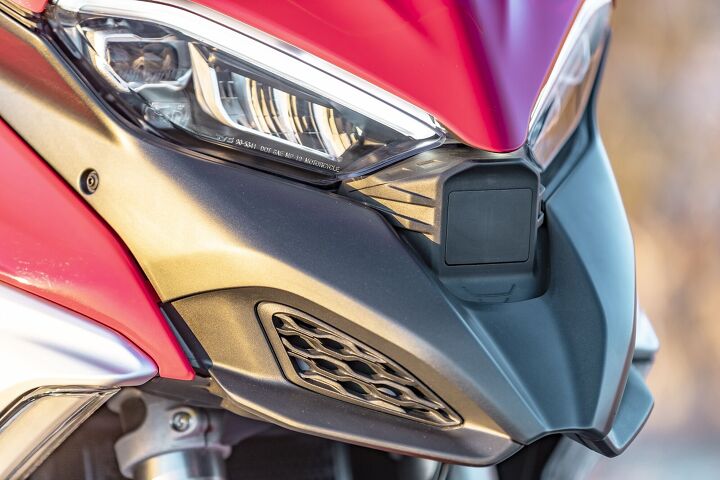
While aerodynamics have opened up exciting design avenues, other modern technologies are proving to be an aesthetic nightmare for design studios. Galluzzi points directly to the emergence of front and rear adaptive cruise control radar units.
- The Size Barrier: Current automotive-derived radar sensors are bulky, requiring flat, square structural real estate at the absolute front and rear of the motorcycle.
- The Aesthetic Limitation: To function properly, radars must remain completely uncovered by bodywork or metallic paint, forcing design teams to disrupt the flowing lines of a motorcycle's face with a prominent plastic block.
Until tech suppliers can scale radar sensors down to the size of a small camera lens, incorporating these safety features will remain one of the most frustrating packaging challenges facing modern motorcycle studios.
Check out the Bore & Stoke episode with Miguel Galluzzi here to listen to the full interview.
Become a Motorcycle.com insider. Get the latest motorcycle news first by subscribing to our newsletter here.

Motorcycle.com presents an unrivaled combination of bike reviews and news written by industry experts
More by Motorcycle.com Staff


Comments
Join the conversation
It is a series of holes drilled in a shotgun barrel that supposedly reduces recoil but in reality doesn't do much of anything--just like the winglets--mostly a cosmetic feature that no one needs or wanted but can be touted as a feature in the sales brochure--you should get out more and try some other sports! Shoot a round of clays sometime--great fun -competitive like golf but noisy like motorcycles,
Moto needs more attention paid to aero. For the naysayers here who've never tried any of this stuff, do this simple test: while riding use your own hand to place in various spots on the bike and see just how something that small can redirect airflow. Bikes are not as easy as cars to work with - obviously - and a multitude of airflow effects need to be taken into account. On my own ST 1200 I installed the typical side wings just under the screen and it made an appreciable difference in turbulence reduction. I also did the hand thing with airflow in and around the cockpit area and was able to readjust the handguards to move the airflow not only around my hands, but to create less overall turbulence. Comfy now. To write these efforts off as gimmickry is naive. Add-on lower fairings have made long distance travel more comfortable for years already, and I would welcome a bit more downforce from winglets on the front end at highway speeds, especially in some of the environments I ride in, including deserts and mountains. Yeah, bring it on.