


2025 Indian Challenger and Chieftain PowerPlus Review – First Ride

Loading the baggers with power and tech

The MOrons are becoming Bonafide-bagger brothers. That’s probably a good thing since the two American V-Twin stalwarts, Harley-Davidson and Indian Motorcycle, are squaring up once more. Ah, it’s a tiff for the ages, played out on racetracks or dealership floors since Teddy Roosevelt threatened people with sticks. Why can’t we all just get along and ride into the sunset listening to “Free Bird,” one bellyful of cheeseburger at a time? Well, it seems the Midwesterners are trading blows again, but instead of going eye-for-an-eye, they’re going bagger-for-bagger with Indian Motorcycle rolling out its 2025 PowerPlus bagger and touring range.
2025 Indian PowerPlus Family
Indian launches the PowerPlus range of touring baggers, bringing additional engine performance and technological sophistication to the mix. It’s a big step forward for Indian Motorcycle, which we’ll be keeping our eyes on.
Highs
- Versatile engine
- Excellent handling
- Great seating comfort
Sighs
- Lackluster braking performance
- Major buffeting aboard Chieftain
- Dated instrumentation doesn’t jibe with new tech
The folks in St. Paul, Minnesota, are elevating the performance, style, and technology bar within its complete range of touring motorcycles – though some a little more than others. That narrative begins with a new liquid-cooled PowerPlus 112 V-Twin offered alongside the established PowerPlus 108. Quick recap: The 108 was first introduced and exclusive to the frame-mounted-fairing Challenger and Pursuit models, but all that is changing. This year, the entire bagger range will offer optional PowerPlus powerplants in its two displacements, as we witness the 108ci and 112ci engine options extend to the arguably more traditionally styled Chieftain and Roadmaster lines for the first time.
Purists will be pleased to hear that the air-cooled Thunderstroke will live on in the Chieftain, Springfield and Roadmaster lines, at least for the U.S. market. In Europe, the Chieftain and Roadmaster will only be offered with the PowerPlus 112, though the Thunderstroke does live on in the Chief lineup, Springfield Special Edition and Roadmaster Elite.

Regarding the nerdy stuff, things are getting more advanced with all PowerPlus 112-equipped models or trims. That begins with a 6-axis IMU (SmartLean says Indian), accommodating traction control (on/off), combined with a new linked-braking system and cornering ABS. A hill-start assist function also joins the party. In line with European and Japanese competitors, Indian also deploys rear-facing radar with a rear-collision warning and blind-spot detection on select trims.
Those are significant advancements for these V-Twin tourers. While the Challenger and Pursuit receive the larger engine option and whizbang gadgets, the lion’s share of meaningful updates goes to the 2025 Chieftain and Roadmaster machines. The fork-mounted machines now utilize the same modern chassis that debuted on the Challenger, which is a boon for the Chieftain and Roadmaster lines, as they gain the proven frame, as well as its sturdier inverted fork. That’s also backed up by styling updates to the “batwing” fairing and LED headlight.

Arguably, the 2025 PowerPlus update is a sizable one. That’s why Indian brought us to Henderson, Nevada — a hop, skip, and maybe a missing kidney outside Sin City to sample its two brightest stars: the 2025 Indian Chieftain PowerPlus Limited and Challenger PowerPlus Limited. We soaked up some sun in Valley of Fire State Park, explored scenic highways near New Deal relics and dagnabbit, we even did some riding that looked like touring.
PowerPlus: Reimagining Americana

American V-Twin culture can trace its roots to the 1930s hotrod zeitgeist, where the engine seizes the spotlight above all else. And rightfully so, because a hearty V-Twin is one of the most immediately recognizable exhaust notes in motoring. Yet, Indian differentiates itself with the PowerPlus family by offering a V-Twin that puts a unique spin on this American tradition. Yes, there’s boatloads of torque, but there’s more than that. And maybe, not quite what you’d expect. If you’re curious about pricing, the Limited trim Chieftain and Challenger are identical at $27,499 w/ PP 108 and $30,499 w/ PP 112.
Take a long, hard look at the PowerPlus mills, ladies and gentlemen. Just drink it in, darnit. You’ll notice a distinct departure from the Thunderstroke with their classic 45-degree V-angles and pushrod actuated valvetrains. The PowerPlus jugs are boxier, and the faux cooling fins are purely decorative, as we’re talking about a liquid-cooled 112ci (1834cc), 4-valve per cylinder engine with overhead cams. It also steps out from the American Twin-cylinder herd with a 60-degree V. All of this tracks since the PowerPlus’ development is linked directly to MotoAmerica’s King Of The Baggers championship, where Indian Motorcycle holds three titles to its name.

Diving into the numbers, the new PowerPlus 112ci’s claimed 126 horsepower and a whopping 133 lb-ft. of torque both peak at an easily accessible 3,600 rpm. Compared to the 108ci variant, that’s a minor 3% bump in ponies, while the bottom end receives an extra 3.9% oomph. That uptick in performance is thanks to a light internal massaging of the 108, that sees the bore grow to 110mm (+2mm) while retaining the 96.5mm stroke, which nets a touch higher compression ratio at 11.4:1 (11.0:1 on the 108). The truth is, we’d need to run them back-to-back to have any opinions on what’s going on between, and no 108-powered models were available, but what we can say is that it’s darn stout and pulls like the dickens even when loaded into bikes that are nearly 850 pounds wet in their slimmest configurations.
Despite being a heritage brand, Indian isn’t afraid to embrace the contemporary concerning the silky-smooth rigid-mounted PowerPlus 112. There's a palpable bottom-end on tap when shoving off the line, though you’ll want to twist the throttle more than you normally would with orthodox 45-degree American iron. Instead of the standard potato-potato lope, this mill seems to look across the Atlantic at some Austrian and Italian influences — two nations that also enjoy a good Twin-cylinder — mixing some of those free-revving traits to help it bump against the idea of modernity.

A hearty burble acts as your backing track and short-shifting whilst settling into a torque-powered groove is still somewhat of an effective strategy. Somewhat. A good whip crack is the way to go, leading us to where all that torquey low-to-midrange punch calls home. The thing’s got stamina, too, which isn’t always the case with big-inch V-Twins, and wringing it out to the redline is worth a giggle or two. Sure, it peters out at the bitter end, but at least the fun doesn’t end prematurely.
Chunky, clunky, and slow — that’s what most might say about grabbing gears on baggers from bygone eras. Not so here, says Indian. While extending my 32-inch inseam to the shift lever is something of a reach, there’s no issue with rowing through the cogs on the 112ci and we can’t fault the smooth gearbox. Tapping the shifter does warrant a firmer action than your average Japanese or European equivalent, though what we got is inherently more polished than baggers hailing from Brew City.
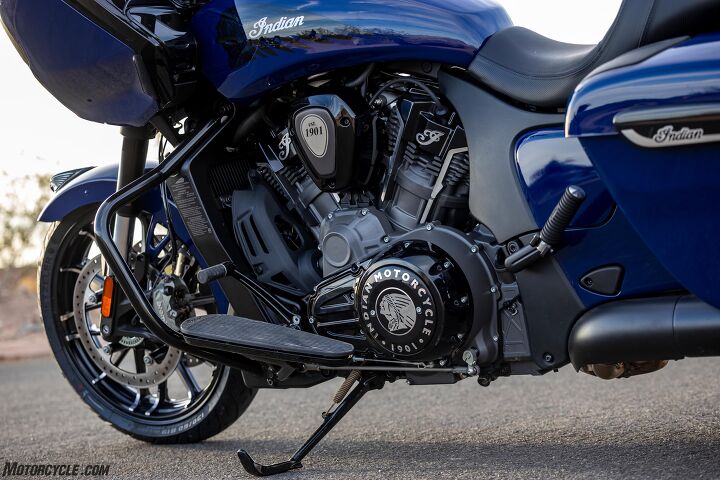
Different? Absolutely. Then again, that seems to be the point and PowerPlus can help develop its own identity instead of living in the unwavering shadow of the Badge-and-Shield. The real question is whether American V-Twin buyers are ready to buck tradition in a class so painfully beholden to it.
Chassis: Handling Hand-Me-Downs

When the Challenger launched in 2020, it set a new high bar within the V-Twin segment in terms of comfort, cornering ability, and, above all else, ride quality. Well, all the brand’s baggers will ride upon that same cast-aluminum frame, propped up by a non-adjustable 43mm inverted fork with 5.1 inches of travel and preload-adjustable monoshock featuring 4.5 inches of travel. A 19-inch front and 16-inch cast-aluminum wheel combo also applies to all models, but again, styling will vary slightly according to trim.
Those rear travel figures are a significant talking point because until H-D released the 2022 Harley-Davidson Road Glide ST and Street Glide ST, it spent literal decades performing Olympic-level mental gymnastics trying to justify meager shock travel. Depending on the model, that was usually a little over 2 inches of travel in the rear and sometimes less.

That’s a big woof in my book, folks, because short travel numbers and heavy loads often equate to stiff spring rates with harsh damping. That’s a tried-and-true recipe for some good ol’ coccyx-smashing over bumps if we’ve ever seen one. Credit where credit is due, since the three inches of stroke many of H-D’s dual-shock touring setups now boast are a notable improvement. Though, it’s barely above what we’d consider adequate. Hence, this is why the Indians score a win in the bump absorption and ride quality department. Sure, a few g-outs at pace found the bump stops with an eyebrow-raising clunk, but little of that is transmitted to the rider.
Whether you find yourself behind the bars of the Chieftain platform with its classic, though restyled fork-mounted fairing or the Challenger platform with the far more futuristic frame-mounted fairing that comes with the assurance that these two big gals can cut a rug, either machine is quick to flip on the side of its Metzeler Cruisetec rubber and use up all its 31-degrees of lean angle in a jiff.

Those who are a little more ambitious can shave off some material from the floorboards post haste for a whiff of extra lean. And, for the most part, all that heft creates a dead-steady ride without any shimmying while carving through sweeping turns in Nevada’s desert. If you attempt your best Factory Indian KOTB impression, you’ll tease out a little wiggle, but nothing to get worked up about.
The chassis across all 2025 touring bikes doesn’t miss its mark. However, we wonder if Indian isn’t taking suspension far enough. An optional auto preload adjusting shock is available, but replacing the suspenders with semi-active units that further refine the ride and auto preload adjusting shock would be a whole lot cooler.

Since stopping is equally essential as going, now would be a good time to discuss the braking performance, bolstered by dual Brembo M4.32 calipers and 320mm rotors in the front. A new linked braking system is deployed on PowerPlus 112-powered baggers, which applies the front and rear brakes simultaneously, regardless of which brake is applied first by the input rider.
The system does relent when riding below 13.4 mph, and the brakes can be used independently for low-speed maneuvering or gymkhana if that’s your thing. Linked braking systems have their place in heavyweight touring applications, as using all three brakes will help haul these big beasties to a halt far more effectively than using the front or rear alone. All good in terms of stopping power, and they’d stop on a poker chip if you yank hard enough.
But that’s the problem. It makes for a disappointing experience when grabbing the front binders, which need a manly pull to get them working. Bolting on master cylinders with conservative ratios is commonplace in the American V-Twin world, and weight is certainly a factor here, too, so there is some context to consider. However, when we look at European or Japanese touring competitors, they don’t have the same lackluster braking. We can do better Stateside.
Fairing Faffery: Comfort and More

The fairing is a crucial choice, says Indian Product Design Director Ola Stenegärd, who explained that there are two distinct camps: those who want a fork-mounted fairing and those who wish for a frame-mounted fairing.
Functionally, there isn’t much between them, and it’s somewhat analogous to our experiences with the H-D Street Glide (Chieftain) and Road Glide (Challenger) variants. The fork-mounted Chieftain offers slightly better turn-in rates and front-end feel than the frame-mounted Challenger. However, the Chieftain’s “batwing” fairing is influenced by side winds, and arguably, its edge in cornering eagerness also detracts a touch of stability.

Regarding wind protection, there is a clear line in the sand between them. When cruising at freeway speeds, the electronically adjustable windscreen aboard the Chieftain never alleviated buffeting for my 5-foot 10-inch tall frame. My helmet was always bobbling to some degree, regardless of windscreen height. A short stint on the Roadmaster revealed its taller touring windscreen nipped that issue in the bud. Meanwhile, the same observations can’t be applied to the Challenger, which offers a more serene bubble that only improves when thumbing the windscreen’s adjustment button.
Looking beyond that, the seating position on either machine is palatial. The sculpted seat and its 26.5-inch height perfectly accommodate long-haul riding, which we’d demand in this application. The handlebars meet us at a comfortable rise. However, shorter riders did note that they felt they’d like a lower handlebar option, and the rider triangle is virtually identical between the Chieftain and Challenger models.

Technology: Infotainment and Safety Features

Standard on all PowerPlus 112 models is a six-axis IMU-assisted rider aid package, including traction control (on or off), cornering ABS w/linked braking, and bike hold control. We’ve touched on some of this, and the systems are seamless, making them value-added in this moto-scribe’s eyes. Sadly, the PowerPlus 108 equipped machines won't enjoy any of these aids, they get basic ABS and TC.
Indian is also upping its safety features, adding a rear-facing radar unit nestled above the taillight. That new bit of tech accommodates blind spot warning and rear-collision warning systems. Either system can be disabled from the 7-inch Ride Command touchscreen display.
In practice, they work as advertised. When a vehicle encroaches on your flanks, indicators on your mirrors and the TFT display light up. Yes, riding in formation will trigger them, as one might assume. If a vehicle begins tailgating you, a warning will be displayed on the TFT, and your rear taillights will flash automatically to hopefully catch the offending driver/rider’s attention. Both aids are adjustable for sensitivity and can be disabled completely.

The critical hiccup is that your easy-to-navigate display is entirely out of your field of vision if you’re wearing a full-face helmet and looking down the road – as you should. The mirror indicators sit just inside your periphery, so they’re practical, but anything flashed on the TFT display will go unnoticed unless you avert your gaze. Since the rear-collision warning system uses the display exclusively, it’s rarely observed. And that’s a byproduct of not updating the traditionalist cockpit that relies on analog clocks up top, failing to add warning indicators somewhere higher in your field of view.
All Indian touring machines come equipped with a standard stereo system. However, our bikes featured the $1250 PowerBand audio system, immediately recognizable by its four 100-watt speakers — two in the fairing and two in the saddlebags. Audiophiles will raise their nose at the lack of depth from the system, but then again, we’re listening to music in the harshest environment imaginable: an open-air setting that also happens to be traveling down the road at high rates of speed. Look, that’s a long way of saying it’s fine.

Apple CarPlay and Bluetooth connectivity are standard. Ride Command+ unlocks real-time traffic and weather updates, though we’d like to see most of that moved into the standard category at these prices.
Guiding Tradition Forward: A PowerPlus Story

The 2025 PowerPlus update brings a lot to the table, but the takeaway is that Indian is chipping away at the bagger confines with many of these tweaks. We can aim that sentiment squarely at the PowerPlus 112 engine, which does cast aside long standing tradition by bringing new characteristics to the table. And for those who prefer the past, the Thunderstroke is still hanging on.
Where the Challenger and Chieftain Limited put points up on the board is the chassis. As we mentioned, adopting semi-active suspension would leave the competition even further in the dust, but as it stands, these are great handling machines.
American V-Twin design is staunchly static and often to a fault. What Indian is doing, perhaps more slyly than we think, is nudging things in a welcome direction.
Scorecard
Engine | 18/20 | Suspension | 13.5/15 | Transmission | 10/10 |
Brakes | 6/10 | Instruments | 3/5 | Ergonomics | 9/10 |
Appearance | 5/10 | Desirability | 9/10 | Value | 9/10 |
Editors Score: 82.5% | |||||
In Gear
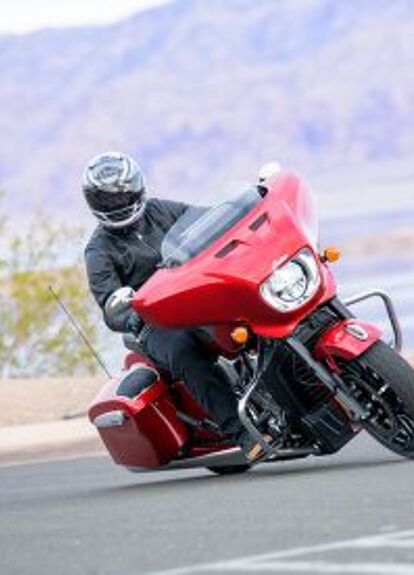
- Helmet: Arai Contour-X
- Gloves: Alpinestars Oscar Crazy 8
- Jacket: Alpinestars Dyno
- Pants: Alpinestars Copper V3
- Boots: Alpinestars Monty V2
Specifications | Chieftain PowerPlus | Challenger | Roadmaster PowerPlus | Pursuit |
|---|---|---|---|---|
Available Trims | Base, Limited, Dark Horse | Base, Limited, Dark Horse | Limited, Dark Horse | Limited, Dark Horse |
Engine Type | Liquid-Cooled PowerPlus 108 or 112 | |||
Transmission | 6-speed, constant mesh / foot shift | |||
Battery | 12 volts / 18 amp/hour, 310 CCA | |||
Bore x Stroke | 108mm x 96.5mm for 108ci 110 mm x 96.5mm for 112ci | |||
Displacement | 1,768cc (108ci base, Limited or Dark Horse) 1,834cc (112ci Limited or Dark Horse) | |||
Clutch | Wet, multi-plate, assist | |||
Compression Ratio | 11.0:1 (108ci models) 11.4:1 (112ci models) | |||
Exhaust | Split dual exhaust with resonator | |||
Final Drive | Belt drive, 152 tooth | |||
Fuel Capacity | 6.0 Gallons | |||
Fuel System | Closed loop fuel injection / 52 mm dual bore | |||
Oil Capacity | 5 qts (4.73 L) | |||
Primary Drive | Gear drive wet clutch | |||
Peak Torque | 128 ft-lbs at 3,800 rpm (PowerPlus 108, claimed) 133 ft-lbs at 3,600 rpm (PowerPlus 112, claimed) | |||
Horsepower | 122 hp at 5,500 rpm (PowerPlus 108, claimed) 126 hp at 5,500 rpm (PowerPlus 112, claimed) | |||
Front Suspension | Inverted telescopic fork, 5.1 inches of travel | |||
Rear Suspension | Single shock with hydraulic preload adjustment 4.5 inches of travel | |||
Brake System | Individual front and rear control with ABS | |||
Front Brake | Brembo Calipers, Dual semi-floating 320 mm rotors | |||
Rear Brake | Single 298 mm floating rotor | |||
Front Tire | Metzeler Cruisetec 130/60B19 66H | |||
Rear Tire | Metzeler Cruisetec 180/60R16 80H | |||
Front Wheel | 19" x 3.5" | |||
Rear Wheel | 16" x 5" | |||
Rake/Trail | 25°/5.9 inches | |||
Wheelbase | 65.7 inches | |||
Ground Clearance | 5.4 inches (claimed) | |||
Seat Height | 26.5 inches | |||
Length | 98.5 inches | |||
Curb Weight | 833 lbs (base model, claimed) 842 lbs (Limited/Dark Horse, claimed) | 842 lbs (base model, claimed) 855 lbs (Limited/Dark Horse, claimed) | 933 lbs (all trims, claimed) | 937 lbs (all trims, claimed) |
Display | Bright, 7" touchscreen display with glove-touch compatibility and visibility in all conditions | |||
Infotainment | RIDE COMMAND+, turn-by-turn navigation, Apple CarPlay and more. (Limited/Dark Horse) | RIDE COMMAND+, turn-by-turn navigation, Apple CarPlay and more. | ||
Standard Technology | Ride modes, cylinder deactivation, cruise control, keyless ignitaion, ABS, tire pressure monitoring system | |||
Advanced Technology | Bike hold control, electronic combined brake system, blind spot warning, tailgate warning, rear collision warning (112 models only). | |||
Warranty | 2 years, unlimited miles | |||
2025 Indian PowerPlus Family Review Gallery

We are committed to finding, researching, and recommending the best products. We earn commissions from purchases you make using the retail links in our product reviews. Learn more about how this works.
Become a Motorcycle.com insider. Get the latest motorcycle news first by subscribing to our newsletter here.
A lifelong interest in anything with two wheels, Nic combined his passion for motorcycling with a rare and mysterious skill known as typing to join the motojournalism ranks. Motorcycle.com's Senior Editor and sometimes club racer displays an unrivaled desire to sample baked goods across the globe and partake in post-track day celebratory pizza.
More by Nic de Sena






Comments
Join the conversation
@Imtoomuch
Let’s face it: “American” motorcycle brands like Harley-Davidson and Indian are stuck in the past. They’re banking on nostalgia, assuming riders will pay premium prices for outdated designs and underwhelming performance. Harley-Davidson's global retail sales dropped 7% in 2024, with North American sales down 4% . Indian Motorcycle fared worse, with North American retail sales plummeting approximately 20% year-over-year . Clearly, clinging to the past isn't a sustainable business strategy.
Fixed it for you: It's not about heritage; it's about stagnation. Time to innovate or get left behind.
Indian Motorcycle's global sales over the past three years have experienced notable fluctuations:
These figures indicate a downward trend in Indian Motorcycle's global sales since their peak in 2022.