


2026 Aprilia Tuono V4 Factory — Track Review

Big updates for 2026 should make it more track ready than ever. But is it really?

The Aprilia Tuono V4 Factory has always lived in a strange but wonderful gray area — technically a hyper-naked, spiritually a superbike sans fairings (although that’s getting to be debatable). For 2026, Aprilia is trying to further delineate the Tuono from its RSV4 cousin. Where the RSV4 is becoming even more focused for the track, Aprilia says the direction it’s going with the Tuono is to channel the RSV4’s tech, power, and speed into a bike that’s happy on the streets. This means, for 2026, the Noale engineers faced a duality of tasks: make both bikes better using largely shared architecture, while having them perform different duties. All this without losing the Tuono’s core identity.
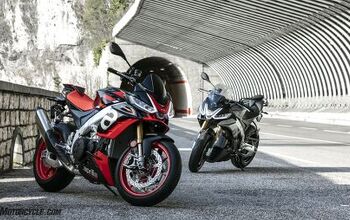
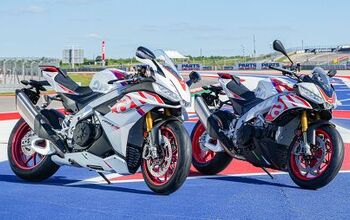
2026 Aprilia Tuono V4 Factory
Aprilia’s continued refinement of the Tuono platform brings us the most powerful version for 2026. Now with a true 1100cc V4 engine, the Tuono V4 Factory also sports electronic suspension, winglets, and improved rider aids. On track, it proved as enjoyable as ever.
Highs
- One of our favorite engines ever
- One of our favorite chassis ever
- A relative bargain in its class
Sighs
- Not a fan of buying options through an app
- Adaptive wheelie control inconsistent
- Could not figure out CornerByCorner traction control
This is still a Tuono, yes — and I wanted to find out what its refinements amounted to on a racetrack. Because, let’s be real, despite the fact Aprilia calls the Tuono a machine meant for the streets, its capabilities can really only be fully harnessed at the track. But before we get into the track impressions, let’s first take a look at exactly what Aprilia changed with the Tuono V4 Factory over its predecessor.

The headline change is the engine. Displacement grows from 1,077cc to 1,099cc, making it a true 1100cc V4. This is achieved via a new bore and stroke (81 x 53.32 mm). Like the RSV4, the new Tuono V4 gets new 52mm throttle bodies, a revised intake system, and it shares the same upper crankcase and crankshaft with the RSV4. The result is a claimed 180 horsepower at 11,800 rpm and 89 lb-ft (121 Nm) of torque at 9,650 rpm, making this the most powerful Tuono ever produced, though it’s still not as powerful as its RSV4 cousin. For reference, Aprilia says the RSV4 now makes 220 hp to the crankshaft and 94 lb-ft (127 Nm) of torque, making it the most powerful street-legal motorcycle Aprilia has ever made. Equally as important, both engines are also Euro5+ compliant. New cooling fans and revised bodywork shapes help draw more cool air to the engine while keeping warm air away from the rider.
Aero Tweaks

While the bigger engine is the biggest talking point with the new Tuono, the next change comes in the aero department, as the latest Tuono incorporates a noticeable front wing reminiscent of Aprilia’s RS-GP MotoGP contender. The goal here, obviously, is to add more downforce to the front for greater stability under braking and through corners. As part of this revision with the nose fairing, the windscreen gets reshaped and slightly extends further over the dash. In theory, this should redirect more air over or around the rider. Lastly, re-worked side deflectors and extractor ducts help move hot exhaust heat away from the rider.
The Constant — With a Twist
Despite the changes to the engine and bodywork, Aprilia knows the winning formula for the Tuono and RSV4 is its chassis. Essentially the same for over a decade, the 2026 Tuono V4 embodies the motto “If it ain’t broke, don’t fix it.” It’s still a twin-spar aluminum frame with similar geometry as before, with the ability to change the swingarm angle, steering head angle, rear ride height, and engine mounting position. Oh, there is one change: it’s now matte black.

As a Factory model, the Tuono V4 gets the full Öhlins Smart EC 2.0 semi-active suspension package that includes a 43mm NIX fork with TiN coating (4.7” travel), Öhlins rear shock (5.1” travel) and an Öhlins steering damper. Naturally, the fork and shock are adjustable, with the semi-active component meaning it adapts in real time to road conditions with its event-based Aprilia Damping Control system that offers Active and Manual modes, with Track, Sport, and Road presets that are fully customizable. It also integrates with Aprilia’s CornerByCorner technology to allow for Aprilia Damping Control (ADC), which changes suspension behavior automatically based on GPS-defined track sectors. That is, assuming you purchase the Suspension Pack option within the Aprilia app. Our particular test bike wasn’t equipped, so a review of that will have to wait.
More Electronics
People sometimes forget that Aprilia was actually the first manufacturer to incorporate an IMU into its lean-sensitive traction control with the RSV4, and while other manufacturers have caught up (and arguably surpassed) Noale’s electronic prowess, Aprilia’s a-PRC electronics suite still continues to be one of the most comprehensive in the industry. For track riders, highlights include:
- Predictive Wheelie Control (AWC) with adaptive learning
- Slide Control (ASC)
- Launch Control (ALC) and Pit Speed Limiter (APL)
- Race dashboard mode
- Six total riding modes, including Track 1, Track 2, and Race
Last, but certainly not least, is Aprilia’s CornerByCorner Traction Control system, or ATC. A separate item from the Adaptive Suspension mentioned above, but using the same technology, CBC has been around on the Tuono and RSV4 for a few years, but earlier versions relied on an external GPS unit (the rider’s phone in some cases) to provide the GPS signal for the bike to locate itself. Since a lot of people don’t want to sacrifice their phones should, as the saying goes, the rider’s ambition outweigh their talent, the latest version now incorporates the GPS internally. Like the CornerByCorner suspension, you only get the CBC traction control if the owner buys the optional Race Pack through the app. Our particular Tuono Factory tester was so equipped. More on this later.

While it’s not a track feature, the Tuono Factory also gets cruise control and adaptive cornering lights. All of the bike’s information is fed to you via a 5-inch TFT that’s clear to see even in bright sunlight.
Street Biased or Track Ready?
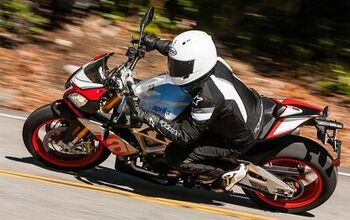
Aprilia calls the Tuono a street bike to offset the RSV4 track machine, but history has shown us the Tuono can more than handle itself on the track. Plus, to really understand what the new electronics and winglets can do, the track was the natural testing ground. Buttonwillow Raceway was our venue this time, where we participated in a Let’s Ride trackday. To get the most out of the bike, we spooned on some Pirelli Diablo slicks in the SC1 compound in the front and SC2 compound in the rear.

The goal, like it always is, was to evaluate the bike. But I wanted to dig deeper and understand if the electronic suspension and rider aids could really help me feel more comfortable pushing to a higher degree.
While it’s been some time since I’ve flogged the previous generation around a track, the new V4 impressed straight away the minute I opened it up on the, ahem, straightaway. When ridden in the Race mode, I was a little surprised by the progressiveness of the throttle. Expecting a full surge once I cracked the throttle, power comes in gently at first and builds to its rapid crescendo as the revs start to climb. Anticipating this, as the laps ticked off, I would open the throttle slightly early mid-corner to bypass the initial gentle power phase, control the apex speed with front and/or rear brake, then let off the brakes and unleash the power once I was ready to blast forward. It was a fun experiment, made possible by the communicative power delivery.

Being a (heavily clothed) naked bike, the laws of aerodynamics eventually take over. Acceleration out of a corner is brisk, but down the front straight at Buttonwillow, one starts to feel the acceleration taper despite the revs inching towards redline. Upshifting helps (especially with the Tuono’s up/down quickshifter), but at a certain point the lack of fairings to slice a cleaner hole through the air means terminal velocity approaches sooner. Not that you need to worry about being slow by any means!
Of course, what speeds up must slow down, and the Tuono Factory’s Brembo M50 calipers biting on 330mm discs scrub speed just as quickly as the V4 builds it. If you’ve read just about any motorcycle reviewer's thoughts on this braking combo, including ours, you’ll know how good they work. Also, the reshaped fuel tank gives the rider more real estate to lock in their legs to brace for the corner and to hang off. The question I had was whether I’d be able to notice the winglets and their downforce. The answer? I’m not sure. Yes, the front end felt planted and I could trust where it was going, but one of the hallmarks of the RSV4 and Tuono family is its excellent chassis. That said, Buttonwillow’s Riverside corner is a high-speed, banked turn with a long entry and late apex that has you leaned over quite a while before needing to tighten your line to hit the apex. While I can’t attribute all of my confidence in the front end to the winglets, in the back of my mind I know they were contributing to the feeling.

Knowing that the engine and chassis would be standout pieces of the new Tuono, my attention turned to the electronics. The Öhlins Smart EC2.0 system is slightly behind compared to the latest 3.0 system used on other motorcycles, but it’s still a solid performer. The event based tuning should resonate with riders less familiar or comfortable with traditional suspension tuning terminology. On our particular test bike, I noticed the rear would squat a bit when accelerating out of corners. The fix? Going into the suspension menu, finding “Acceleration Support” and clicking up a couple times. This not only increases rear compression damping (preload is still set manually) to reduce squat, but also slows front rebound so both ends are working in harmony. In addition, there are settings for front end support and cornering support. All of which adjust damping at both ends simultaneously.
Our test bike was equipped with the optional Race Pack, and two features I was particularly interested in was the adaptive wheelie control and CornerByCorner traction control. As a terrible wheelie practitioner, anything the bike can do to make me look better than I am is appreciated, and Buttonwillow’s famous “Wheelie Bump” was the perfect section of track to test this feature. For those who don’t know, the Wheelie Bump is a raised lip in the middle of a short straight that you approach after exiting a slow-ish speed corner prior. On most bikes you’ll reach the bump in the meaty part of the powerband, and if you’re hard on the gas at this point, the front will naturally come up. You can’t hold the wheelie very long, however, because a fast right kink awaits after the bump.

Usually motorcycles with standard wheelie control will either allow you to keep the front in the sky or keep it on the ground, depending on how free or restrictive you have the setting. Aprilia’s adaptive wheelie control is somewhere in the middle — and that’s what I found to be annoying. Typically, if I was able to gently bring the front off the ground over the Wheelie Bump, AWC would allow the front to continue rising before gently bringing it back down. All the while my hand hardly fluctuated on the throttle.

However, gunning it over the bump and forcing the wheelie quickly would result in AWC abruptly cutting power, slamming the front back to the ground before the tire really ever gets very high. The problem? What the rider thinks is a smooth or abrupt wheelie could be different from what the bike thinks, so intervention may or may not match the rider’s expectations. Ultimately, this unpredictability led me to turn off Adaptive Wheelie Control and stick with standard wheelie control. At least this way intervention was more predictable.
Adaptive Traction Control — A Primer and A Confession
The tech I was most interested in was the CornerByCorner Traction Control that allows TC intervention specific to each corner of the racetrack. Without going into every nitty gritty detail, the tech works like this: First, the user downloads a track map from the Aprilia app. If the track doesn’t exist in the database, notify Aprilia through the app and the team will add it using their internal software, as I had to do with Buttonwillow Raceway. With the app loaded with the correct track, the user then goes into the app and picks a traction control level for each corner on the track. Sync the app with the bike and go ride (making sure ATC is selected from the Race Mode menu screen). If you don’t like the TC settings you picked, go back to the app, adjust the TC levels as needed, and re-sync with the bike.

Sounds great, right? Unfortunately, after spending an absurd amount of time watching Youtube videos, searching the internet, and calling around, I couldn’t access ATC on the bike (I was told it was equipped), nor could I on the app. And so, we’ll have to wait for another opportunity to try the technology. Hopefully the customer experience isn’t the same as mine.
Still A Favorite
As annoying as it was trying and failing to figure out the ATC system, it ultimately did little to dampen my enthusiasm for the Tuono V4 Factory as a whole. The magic of this motorcycle is its engine and chassis. The latter is still as amazing as we’ve always experienced, and the additional power from the bigger engine is a welcome addition. The only thing that could have made things sweeter is if the Tuono got the same 220 horsepower as the RSV4, but I digress.

From a hardware standpoint, the Tuono V4 Factory is easy to recommend. No, the software isn’t as intuitive as some of its rivals, nor is it very cool to have to buy options through an app, but I suspect in this case the right dealership makes all the difference.
Personally, I’m not buying a bike based on apps. I’m buying based on the smile it puts on my face after riding it. And at $19,799, the Tuono undercuts its main Italian rival, Ducati’s Streetfighter V4, which starts at $23,995. BMW’s S1000R is slightly less expensive ($17,715 comparably equipped), but like the Ducati, BMW’s M1000R starts in the low-20s ($22,695). In that regard, just like it always has, the Aprilia Tuono V4 Factory delivers once again.
Scorecard
Engine | 19/20 | Suspension | 13.5/15 | Transmission | 8.5/10 |
Brakes | 9/10 | Instruments | 4/5 | Ergonomics | 9/10 |
Appearance | 9/10 | Desirability | 9/10 | Value | 9/10 |
Editors Score: 90.0% | |||||
In Gear

- Helmet: Arai Corsair-X Nakagami 4
- Suit: Vanson VE94 Custom Leather Suit
- Airbag: Alpinestars Tech-Air 7x
- Gloves: Alpinestars GP Pro R4
- Boots: Alpinestars Supertech R
Specifications | 2026 Aprilia Tuono V4 Factory | 2026 Aprilia Tuono V4 |
|---|---|---|
MSRP | $19,799 | $16,399 |
Engine Type | Aprilia 65° longitudinal V4, 4-stroke, liquid-cooled, DOHC, four valves per cylinder. | |
Bore And Stroke | 81 x 53.3 mm | |
Displacement | 1099 cc | |
Horsepower | 180 CV (132.4 kW) at 11.800 rpm | |
Torque | 121 Nm at 9.650 rpm | |
Air Intake System | Airbox with dynamic front intakes | |
Fueling | 4 Weber-Marelli 52 mm throttle bodies with 4 injectors and full Ride-by-Wire multimap management, which can be selected by the rider whilst on the bike. | |
Ignition | Magneti Marelli digital electronic ignition integrated into the engine management system, with one spark plug per cylinder, stick-type coils | |
Start-Up | Electric | |
Exhaust | 4-2-layout, two lambda oxygen sensors, single lateral silencer with throttle valve controlled by the engine management unit and dual catalyst with ceramic matrix substrate. | |
Gearbox | 6-speed, cassette style gearbox with Aprilia Quick Shift (AQS) electronic system | |
Clutch | Wet multi-plate slipper clutch | |
Primary Transmission | Straight-tooth gears and integrated dampers, gear ratio: 73/44 (1,659) | |
Secondary Transmission | Chain: gear ratio: 42/15 | |
Frame | aluminum double beam frame with cast and pressed sheet metal elements. Modifications available: steering head angle and position, engine height, swingarm pivot height. Öhlins steering damper with Smart EC 2.0 electronic control | aluminum double beam frame with cast and pressed sheet metal elements. Modifications available: steering head angle and position, engine height, swingarm pivot height. Sachs steering damper. |
Front Suspension | Öhlins NIX fork with SmartEC 2.0 electronic control, with TIN surface treatment. Forged aluminum radial calliper mounting feet. Fully adjustable spring preload system, hydraulic compression and rebound. 4.7 inches of wheel travel. | Sachs “one by one” upside-down fork, Ø 43 mm stanchions. Forged aluminum radial calliper mounting feet. Fully adjustable spring preload system, hydraulic compression and rebound. 4.6 inches of wheel travel. |
Dual upside-down swingarm in aluminum. | ||
Rear Suspension | Aluminum swingarm, Öhlins monoshock with piggy-back with Smart EC 2.0 electronic management. Progressive linkage APS. 5.1 inches of wheel travel. | Aluminum swingarm, Sachs monoshock with piggy-back, fully adjustable as follows: spring preload, hydraulic compression and rebound]. Progressive linkage APS. 5.1 inches of wheel travel |
Front Brakes | Dual 330 mm diameter floating discs with lightweight stainless steel braking track and 6 pawls. Brembo M50 monobloc radial callipers with 4 opposing pistons, Ø 30 mm. Sintered brake pads. Radial master cylinder and brake tubes in metal braid. Sintered brake pads. Radial master cylinder and brake tubes in metal braid. | |
Rear Brakes | 220 mm diameter disc; fixed Brembo calliper with 2 insulated pistons Ø 32 mm. Sintered brake pads. Pump with integrated reservoir and metal braided pipe. | |
ABS | Bosch 9.1 MP ABS with cornering function, adjustable to 3 mapping types, with RLM strategy, disengageable. | |
Front Wheel | 3.5”X17” aluminum alloy spindles, 3 split spokes. | |
Rear Wheel | 6.00”X17” aluminum alloy spindles, 3 split spokes. | |
Front Tire | 120/70 ZR 17 tubeless radial. | |
Rear Tire | 200/55 ZR 17 (alternative: 190/50 ZR 17;) tubeless radial. | 190/55 ZR 17 tubeless radial. |
Wheelbase | 57.1 inches | |
Length | 81.5 inches | |
Width | 32.7 inches | |
Seat Height | 32.9 inches | |
Rake / Trail | 24.4°/ 3.8 inches | |
Curb Weight | 465 pounds (claimed) | |
Fuel Capacity | 4.8 gallons | |
2026 Aprilia Tuono V4 Factory 1100 Review Gallery

We are committed to finding, researching, and recommending the best products. We earn commissions from purchases you make using the retail links in our product reviews. Learn more about how this works.
Become a Motorcycle.com insider. Get the latest motorcycle news first by subscribing to our newsletter here.
Troy's been riding motorcycles and writing about them since 2006, getting his start at Rider Magazine. From there, he moved to Sport Rider Magazine before finally landing at Motorcycle.com in 2011. A lifelong gearhead who didn't fully immerse himself in motorcycles until his teenage years, Troy's interests have always been in technology, performance, and going fast. Naturally, racing was the perfect avenue to combine all three. Troy has been racing nearly as long as he's been riding and has competed at the AMA national level. He's also won multiple club races throughout the country, culminating in a Utah Sport Bike Association championship in 2011. He has been invited as a guest instructor for the Yamaha Champions Riding School, and when he's not out riding, he's either wrenching on bikes or watching MotoGP.
More by Troy Siahaan





Comments
Join the conversation
I have owned a 2019 Tuono Factory since new and have NEVER missed having winglets. The torque and the handling are enough to keep a smile on my face.
Now how much power and torque does it really make at the rear wheel? And an actual, fully gasses up ready to go weight?