


2026 Ducati DesertX Review – First Ride

The shift from heritage to modernity

The mid-to-upper-middleweight adventure segment has been a playground for manufacturers trying to capture the elusive sweet spot between off-road capability and on-road manners. For years, the original Ducati DesertX has sat high on my list of personal favorites. I’ve ridden that first-generation machine at its global press launch in Colorado, hammered it through the Black Hills of South Dakota, piloted it at the grueling Los Angeles Barstow to Vegas (LA-B2V) event — the last two of which were alongside our dearly departed Evans Brasfield — and spent days powering its premium Rally sibling around the dunes of Morocco.
2026 Ducati DesertX V2
The 2026 DesertX builds on the character of its predecessor while undergoing a wholesale change in its fundamental construction.
Highs
- Lighter and more agile handling
- Switchable tech on the fly
- Stable and willing to get rowdy
- Quickshifter/shifting quirks persist for the V2 platform
- TC could use some better tuning
- Front end can feel vague at low speeds
It was a fantastic motorcycle — punchy, stable, and styled with a nostalgic nod to the iconic twin-headlight Cagiva Elefant rally racers of the early 1990s. But time marches on in Borgo Panigale. For 2026, Ducati has issued a ground-up, clean-sheet redesign that shifts the DesertX out of what they call a "post-heritage concept" and drops it squarely into a more of what it calls a "modern concept." We’re told there are no parts in common with the outgoing model — which, considering the new engine and chassis design, is not surprising.
VIDEO: 2026 Ducati DesertX Review | First Ride
The DesertX V2 marks the sixth machine in Ducati’s lineup to inherit the compact, non-Desmo V2 platform. Built around an all-new structural monocoque chassis and showcasing re-engineered ergonomics, I jetted off to the sun-baked, rocky landscapes of Almería, Spain, to find out if this radically changed machine retains the rowdy character that made the original such a willing dance partner.

The V2 engine: Trimming fat and dropping Desmo
We’ve covered it thoroughly in the previous five reviews and even penned a dedicated piece about the new V2 when it was introduced. While we’d like to think you’ve read every piece of hard-hitting journalism “printed” on our digital pages, we understand there may be a select few new to the site, so let’s recap what we’re working with in the engine department. The beating heart of the second-generation DesertX is the new 890cc Ducati V2 power plant. This engine represents a significant engineering pivot for the brand, utilizing standard spring-actuated valves rather than Ducati's traditional Desmodromic valvetrain. Purists might scoff, but adventure travelers will rejoice when they see the numbers that matter for long-range travel and ownership in general: valve clearance intervals of 28,000 miles and oil changes recommended every 9,000.

On paper, the new engine puts out the exact same peak figures (at slightly different rpm) as the outgoing Testastretta mill with 110 horsepower at 9,000 rpm and 68 lb-ft of torque at 7,000 rpm being wrung out of the new V2. However, the delivery has been smoothed out. Thanks to a new Intake Variable Timing system (IVT), the torque curve is more broad. Ducati’s engineers state that 70% of peak torque is available at a 3,000 rpm, giving the engine a good amount of shove as you roll on the ride-by-wire throttle.
The transmission ratios have also been reworked specifically for ADV duty. The first four gears are shorter to help crawl over technical terrain. Sixth has been elongated as an overdrive gear to lower highway cruising rpm with the intent of maximizing fuel economy and reducing engine vibration during long stretches of pavement pounding.
Monocoqued

The most radical departure from the original bike is its foundational architecture. Ducati discarded the traditional steel trellis main frame in favor of an aluminum monocoque chassis that uses the 890cc V2 engine as a fully stressed structural member — as it has with the other family members. In addition to utilizing the engine as a stressed member, this, in conjunction with a lower, smaller fuel tank (4.8 gallons compared to the previous 5.5-gallon tank) has brought the weight lower in the chassis, greatly contributing to handling. More on that in a bit.
This front portion of the frame isn't just a mounting point; the monocoque casting pulls double duty by acting as the bike's airbox. This packaging design along with the more compact engine keeps the core of the motorcycle narrow between the knees and cuts down on bulk throughout. It also resolves a massive serviceability headache that plagued owners of the first-generation machine: accessing the air filter. It now requires removing just three screws right at the front of the frame near the fork neck. No specialized tools, no stripping down half the bodywork and removing the tank — just unbolt the cover, slide the filter out, clean it after a dusty trail ride, and get back to rippin’. Oh, and you no longer need a special socket to remove the rear wheel nut — a standard metric socket will do.

Bolted to the rear of this assembly is a steel trellis subframe designed to handle whatever you’ve got mounted back there, and/or an accessory 2.1-gallon auxiliary rear fuel tank — though, like the original, the question of whether you’ll be able to use luggage with the new design remains unanswered. A new aluminum double-sided swingarm cradles the unchanged 18-inch spoked tubeless wheel shod in the same Pirelli Scorpion Rally STRs as its predecessor.
And loaded
Up front, a 46mm KYB fork yields 9.0 inches of travel. Unlike standard split-function configurations where compression is adjusted in one leg and rebound in the other, these KYB components incorporate independent, fully adjustable hydraulic circuits inside each leg in addition to spring preload adjustment.

At the rear, the shock layout represents a functional evolution. The previous generation used a direct, linkage-less connection from the shock to the swingarm. The 2026 model introduces a progressive linkage system operating with 8.7 inches of travel. This linkage assembly has been positioned above the swingarm rather than underneath the bike. While the obvious benefit is eliminating the danger of snapping or scraping costly suspension components on jagged rocks, Ducati claims the new design allows for more progressive suspension performance.
The braking components look a bit different on the spec sheet this year. While the Brembo M4.32 radial monobloc four-piston front calipers return, they clamp down on smaller 305mm dual discs (down from 320mm). While it’s easy to think of this as a downgrade, losing 15mm of rotor diameter can actually be a benefit. It shaves rotating, unsprung weight from the 21-inch front wheel assembly, which leads to quicker steering — not to mention, superbike-sized rotors certainly aren’t necessary when the pavement ends. In an attempt to balance the downsized rotors, Ducati fitted an axial master cylinder with a redesigned lever configuration to optimize hydraulic leverage, alongside an all-new pedal layout for the rear brake.

Tubeless cross-spoked wheels are wrapped in Pirelli Scorpion Rally STR rubber (90/90-21 front, 150/70-18 rear), though the bike is also homologated to run the more aggressive Scorpion Rally model as well.
Throwing a leg over the 2026 DesertX feels familiar, but less intimidating. The overall geometric triangle has been nudged forward to help the rider naturally control the front tire contact patch. The seat and bars have been moved slightly while the footpegs are moved backward a touch. The bodywork has also been revamped and is slightly smaller overall than the previous version — as is the previously mentioned fuel tank. The polymer unit has been reshaped, carrying its fuel lower along the flanks of the V2 engine. The tank's outer edges are now protected by integrated, plastic crash pads designed to absorb the brunt of tip-overs, since they’re now lower than before. The midsection is slim, and it does feel easy (enough) to reach the ground with a 30-inch inseam, despite the seat being 0.2 inches taller than the previous model at 34.6 inches.

At the dash, the new horizontal 5-inch TFT display is tucked directly behind a standard utility bar, leaving space to mount dedicated GPS units, cellphones, or whatever you feel like.
Revised tech
Brace yourself for abbreviations beginning with the letter D. Ducati has impressed with its rider aids in other segments, but the ADV one hasn’t been quite as up to snuff in the past as its fully-faired track-focused siblings. The DesertX V2 leverages a six-axis Inertial Measurement Unit (IMU) to manage an array of safety tech: Cornering ABS, Ducati Traction Control (DTC), Ducati Wheelie Control (DWC), Engine Brake Control (EBC), and the Ducati Quick Shift (DQS) 2.0 that operates without external sensors.

The bike features six ride modes: Sport, Touring, Urban, Wet, Enduro, and Rally. To alter display and functionality with certain modes, the TFT display offers three configurations: Road, which gives you all of the standard info one might need, Road Pro which adds in the parameters of the aforementioned rider aids, and Rally, which adds a rally-esque trip meter on the right, but more importantly, the ability to toggle through rider aids on the right and change them on the fly.

The Cornering ABS features four distinct settings. Levels 3 and 4 are calibrated for pavement and utilize the IMU for lean sensitivity. Level 2 provides a loose off-road safety net designed for intermediate riders, allowing for slight rear wheel locking while retaining ABS on the front wheel but removing some of the initial bite that could get new riders in trouble off-road. Level 1 allows for full rear wheel locking while retaining a lower level of ABS at the front. ABS can also be shut off entirely, but only when operating within the Enduro or Rally modes. If you shut off ABS, it will revert back on during key cycling because regulations.
Fast and Loose in España

Rolling out of our hotel parking lot in Almería, Spain, onto the asphalt, my initial impression was instantly familiar. Maneuvering through tight corners at low speeds, the front wheel feels pretty far out there, delivering a vague, disconnected feeling through the wide handlebars at low speed.
The chassis geometry — wheelbase, rake, and trail — remains nearly identical to the original version, meaning that same, long-wheelbase stability continues to be the dominating theme on the street. It handles highway sections and sweeping mountain roads confidently, mostly immune to wallowing or chassis instability until you're really pushing the limit.
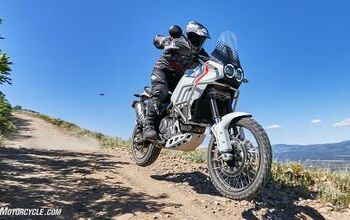
Our testing loop covered approximately 123 miles, the vast majority of which was spent flying down wide, sweeping gravel roads with a couple chances to test some slightly more technical double track.

The bike handles a fair bit lighter than its predecessor, side-to-side transitions require very little effort at the wide handlebar, and it’s easy to steer and pivot the machine using just your knees and footpeg pressure. Despite weighing nearly 500 pounds with fuel, the low-slung tank placement and compact engine mitigate the top-heavy feel of the first-generation machine.
The new V2 engine changes how the bike moves down the trail. The old bike felt slightly punchier, with a sharp, aggressive hit when you’d wind it on that was ready and willing to break the rear tire loose. The new 890cc V2 is deceptively smooth and highly tractable. I rode it the same way as the previous DesertX, only to be met with more traction and less spinning from the rear wheel as I hurdled toward the next apex. I like hooning around, but the new setup drove forward with more traction than expected. Don’t get me wrong, it will break loose should you want it to, but the engine seems to make traction better than before.

When I first took off in Enduro Mode, I found myself underwhelmed. The medium power setting and safety-biased algorithms of Traction Control (set at level 2 of 8) and ABS (at level 2) felt overly intrusive. The system cut ignition power whenever I tried to step the rear end out to steer into loose gravel switchbacks. The ABS aids also proved too intrusive to get my direction changed with a little rear brake slide. The solution? Swap over to Rally mode. This defaults to the engine’s high-power mapping, drops traction control to level 1, and ABS to level 1, removing it at the rear tire and backing it off a bit at the front. I must say that Ducati has a history in both the Multi and DesertX lines of its traction control being far too intrusive for the amount of levels they offer. Ducati says settings 1-4 are dedicated to off-road, but I wouldn’t be interested in using anything but 1, so I can’t imagine 4 working out very well on loose surfaces, and certainly not on an incline.
Rally is really the place to be with the DesertX off-road. The engine is so linear that you can easily turn the traction control completely off and manage the rear tire purely with your right wrist. That said, with the default settings at level 1, TC will let you step out the rear enough to drift a bit, and with ABS at level one, you can initiate the slide at the rear and finish on the throttle. It’s a more refined, precise way of going fast off-road, requiring a slight mental recalibration if you're used to the old bike’s character.

The updated KYB suspension is nice, though it leans heavily toward high-speed comfort out of the box. Over groomed gravel roads, ripples, and shallow ruts, the KYB components keep the ride comfortable, absorbing small hits with aplomb. There is some dive under hard braking on-road, but it does have nine inches of travel up there. At speed, with the wide handlebar, it’s easy to bend the bike to your will through a set of curves, and the stability calms any nerves the somewhat vague front end may stir up. Adding a bit of preload may have helped, but I didn’t have a chance to test that.

However, when I had a chance to venture down some two-track with larger obstacles and chances to huck the DesertX off of a few jumps, I noticed the suspension blew through the mid-stroke of its travel a bit faster than expected. Launching the bike off a few downhill ledges, I found myself blowing through the mid-stroke and firmly into the final, stiffer damping designed to prevent bottoming, which it did.

If you plan on riding your DesertX hard, you may want to make use of the suspension’s full adjustability to tweak the damping and preload. Our test bikes were slightly modified from stock suspension settings per the Ducati lead and chase rider’s pre-event scouting experience:
Fork Settings:
- Rebound: 2.5 clicks from fully closed (OEM)
- Compression: 14 clicks from fully closed (OEM is 12)
- Preload: OEM
Shock Settings
- Rebound: OEM (1 turn from fully closed)
- Compression: 14 clicks from fully closed (OEM is 9)
- Preload: OEM (fully open)
The downsized 305mm front brake rotors are plenty off-road. Lever modulation is easy, and offers good feedback. The initial bite of the front brake is quite sharp, but easy enough to get used to. On-road, the brakes handled things wholly adequately.

Unfortunately, there is one issue we’ve seen with the V2 platform that persists: the shifting. I used Ducati’s Quickshift 2.0 throughout the ride, and enjoyed doing so most of the time. However, once we started wicking up the pace on twisty canyon roads and shifting quickly through the gears, the transmission would occasionally experience a distinct fueling stutter right after gear engagement. It felt like an extended ignition cut, causing the bike to bog momentarily before cleanly restoring power.
This occurred multiple times moving from first-to-second and second-to-third gear. We’ve noted similar quickshifter anomalies across the V2 platform with the Hypermotard exhibiting the same issue — it’s not a dealbreaker, especially since it could possibly be fixed with a software update, but certainly worth noting since it’s happened on other models using the V2.
A smarter, faster desert fox
By redesigning the DesertX around a modern aluminum monocoque frame, Ducati has built a superior ADV machine compared to its predecessor. It is slimmer between the legs, handles with much better agility, and features a non-Desmo valvetrain that values your time and wallet with 28,000-mile valve service intervals.

It still retains its core identity as a willing dance partner that is down to get slideways, but it’s now a far easier machine to ride hard when the terrain turns technical. Arriving in North American dealerships in June 2026 with an MSRP of $16,995, it will be offered exclusively in Matte Star White Silk livery.
Scorecard
Engine | 19/20 | Suspension | 13/15 | Transmission | 7/10 |
Brakes | 8/10 | Instruments | 5/5 | Ergonomics | 9.5/10 |
Appearance | 9/10 | Desirability | 9/10 | Value | 8/10 |
Editors Score: 87.5% | |||||
In Gear

- Helmet: Klim F3 Carbon
- Goggles: Klim Edge
- Jacket: Klim Marrakesh
- Airbag: Alpinestars Tech-Air Off-road
- Gloves: Klim Badlands Aero Pro
- Pants: Klim Jackson
- Boots: Sidi Crossfire 3 TA
2026 Ducati DesertX Specifications | |
|---|---|
MSRP | $16,995 |
Engine Type | Ducati V2 engine: 90° V2, 4 valves per cylinder, intake variable valves timing system, liquid cooled |
Displacement | 820cc |
Bore x Stroke | 96 mm x 61.5 mm |
Compression Ratio | 13.1:1 |
Power | 110 hp at 9,000 rpm (claimed) |
Torque | 68 lb-ft. at 7,000 rpm (claimed) |
Fuel Injection | Electronic fuel injection system, Ø 52 mm throttle body with Ride-by-wire |
Exhaust | Electronic fuel injection system, Ø 52 mm throttle body with Ride-by-wire |
Gearbox | 6 speed with Ducati Quick Shift (DQS) up/down 2.0 |
Primary Drive | Straight cut gears, ratio 1.84 : 1 |
Ratio | 1=13/38 2=17/35 3=20/32 4=22/29 5=24/27 6=26/25 |
Final Drive | Chain 520; Front sprocket Z=15; Rear sprocket Z=46 |
Clutch | Hydraulically controlled slipper and self-servo wet multiplate clutch. |
Frame | Aluminium monocoque |
Front Suspension | KYB Ø 46 mm upside-down fork, fully adjustable; 9.1 inches of travel |
Rear Suspension | KYB shock absorber, fully adjustable, remote preload adjustment, full floater progressive link; 8.7 inches of travel |
Front Wheel | Cross-spoked, tubeless, 2.15”x21” |
Front Tire | Pirelli Scorpion Rally STR 90/90 – 21 M/C 54V M+S TL (A) |
Rear Wheel | Cross-spoked, tubeless, 4.5”x18” |
Rear Tire | Pirelli Scorpion Rally STR 150/70 R18 M/C 70V M+S TL |
Front Brake | 2 x Ø 305 mm semi-floating discs, radially mounted Brembo monobloc 4-piston 2-pad calipers, radial master cylinder, Cornering ABS |
Rear Brake | Ø 265 mm disc, Brembo 2-piston floating calliper, Cornering ABS |
Instrumentation | 5” TFT colour display |
Weight | 461 pounds (claimed, wet weight but no fuel) |
Seat Height | 34.6 inches |
Wheelbase | 63.6 inches |
Rake | 27.0° / 4.5 inches |
Fuel Capacity | 4.8 gallons |
Number Of Seats | 2 |
Safety Equipment | Riding Modes, Power Modes, Ducati Traction Control (DTC), Ducati Wheelie Control (DWC), Engine Brake Control (EBC), Bosch Cornering ABS, Ducati Brake Light (DBL) EVO |
Standard Equipment | Riding Modes, Power Modes, Ducati Wheelie Control (DWC), Engine Brake Control (EBC), Ducati Quick Shift up/down (DQS), Cruise control, full LED lighting system, DRL, Ducati brake light (DBL), USB power socket, 12V socket, self canceling turn indicators, Steering damper, Ducati Quick Shift (DQS) up/down 2.0, Lithium-ion battery, Quick adjustment buttons, Coming Home, Cruise control, TFT colour display, Full LED lighting system, Daytime Running Light (DRL), Dynamic turn indicators, Self cancelling turn indicators, Two USB ports |
Ready For | Anti-Theft, Additional LED lights, Tyre Pressure Monitoring System (TPMS), Ducati Multimedia System (DMS), Heated grips, Turn-by-Turn navigation system |
Warranty | 48 months, unlimited mileage |
Maintenance Service Intervals | 9,000 miles / 24 months |
Valve Clearance Check | 28,000 miles |

We are committed to finding, researching, and recommending the best products. We earn commissions from purchases you make using the retail links in our product reviews. Learn more about how this works.
Become a Motorcycle.com insider. Get the latest motorcycle news first by subscribing to our newsletter here.
Ryan’s time in the motorcycle industry has revolved around sales and marketing prior to landing a gig at Motorcycle.com. An avid motorcyclist, interested in all shapes, sizes, and colors of motorized two-wheeled vehicles, Ryan brings a young, passionate enthusiasm to the digital pages of MO.
More by Ryan Adams




Comments
Join the conversation
I'm afraid it's gonna cost me when the Rally version comes out...
Got any clues at the launch of when that might be Ryan?
WHY did they do that to the headlights? The old Dx was easily my favorite looking ADV bike... now it looks like Bender the robot squinting. I thought I'd get used to it after seeing the launch photos, but so far definitely not.