


Pirelli Diablo Powercruiser Tire Review

A tire for cruiser riders who value performance more than mileage

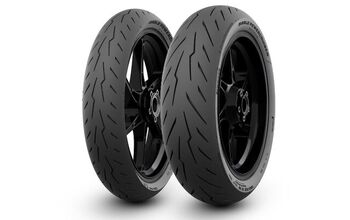
Pirelli didn’t specify the popularity of MotoAmerica’s Mission King Of The Baggers Championship, or the Harley-Davidson Bagger World Cup, but something compelled the Italian tire manufacturer to engineer a new performance tire for the cruiser crowd. Enter the Diablo Powercruiser, a tire that, at first glance, reveals its high-performance intentions through a tread pattern more akin to a Diablo Rosso IV sportbike tire than to its cruiser counterpart, the Night Dragon. The large slick area between the edge of the tire and where the rain grooves end provides a larger contact patch than Pirelli’s own sport-touring tire, the Angel GT.

To showcase the new tire’s sportability, Pirelli chose one of America’s best proving grounds for a sporty, road-going tire: US Highway 129, better known as The Tail of Dragon. Famous for its 318 curves packed into 11 miles, that claim averages out to 29 curves per mile and a curve every 182 feet. Traveling at an average speed of 40 mph, you’re assailing a bend every three seconds for 17 minutes. Aggressively navigating that many corners aboard an 800-pound Street Glide is demanding, fun, and physically and mentally tiring all at once.
As hard as I pushed, I could get the tires to do no wrong. In fact, it may be that the Diablo Powercruiser works too well for the cornering clearance limitations of the average bagger. More than once, I found myself mid-corner, well beyond lightly scraping a floorboard to the point of gouging the pavement with one hard-mounted part or another. Yes, this can be achieved on tires with less grip, just not with the same ease or confidence as the Diablo Powercruiser.

Compared to the Night Dragon’s rear tire, the Diablo Powercruiser features a rounder profile, increasing turn-in agility while also providing a larger contact patch when leaning through a turn. Combined with the grip of the tire’s slick shoulder, the Diablo Powercruiser provides rider confidence in spades. According to Pirelli’s radar chart, where the Night Dragon is constructed to perform equally well in each of six benchmarks (mileage, comfort, stability, wet, dry handling, dry grip), the Diablo Powercruiser increases stability and dry handling by a factor of one, while doubling comfort, wet, and dry grip. The chart displays a questionably nominal drop in mileage.

The specific blend of ingredients (rubber, polymers, silica, carbon black, oils) used to create the Diablo Powercruiser is information Pirelli won’t divulge other than to say “new silica compounds” went into the recipe of the Diablo Powercruiser’s front tire. But like the rear tire, I had nothing to complain about regarding the front tire’s performance. As hard as I was squeezing the front brake lever entering some of the Dragon’s tighter switchbacks, the front tire never gave me cause for alarm. With all 1,000 pounds of combined bike-and-rider weight loading the front tire, it never once pushed wide and held its line as it transitioned from vertical to a lean angle through the corner. Even when one of the bike’s hard parts was attempting to leverage a wheel off the ground, the tires managed a firm grip on the pavement.

The Diablo Powercruiser is available in a variety of sizes, ranging from a narrow 100/90-19 all the way up to a sasquatchian 260/40-18. Construction varies between radial and bias-ply, depending on a motorcycle's specific needs. Interestingly, Pirelli supplied a diagram of the rear tire’s construction, showing how it uses various compounds, each applied independently from one tire to the next. Of course, Pirelli wouldn’t disclose what the compounds are, how they varied, or why they differed between tires, only to say that the “compound schemes developed to enhance overall performance.”

By Pirelli’s own admission, mileage will suffer compared to the Night Dragon. The question is, by how much? Lacking the ability to ride thousands of identical miles aboard identical bikes rolling on both types of tires, we cannot determine the outcome. A quick internet search returns a range of 4,000-8,000 miles, which is disparate, to say the least. Pirelli performed thousands of miles of its own testing and provided “technical evidence” on various aspects of the tires’ performance, but none regarding mileage.

What it comes down to is individual rider preference. If you’re willing to sacrifice some mileage in trade for increased performance, give the Diablo Powercruisers a try. If you don’t like the tires, replace them with something different when the time comes, and the mileage warrants it.
Front Sizes | Rear Sizes |
|---|---|
130/90 B 16 M/C 73H TL Reinforced | 150/80 B 16 M/C 77H TL Reinforced |
150/80 B 16 M/C 71H TL | 180/70 B 16 M/C 77H TL |
160/70 R 17 M/C 73V TL | 180/70 B 16 M/C 77V TL |
160/60 R 18 M/C 70V TL | 160/70 B 17 M/C 79V TL Reinforced |
100/90 - 19 M/C 57H TL | 180/55 B 18 M/C 80H TL Reinforced |
110/90 - 19 M/C 62H TL | 240/40 VR 18 M/C (79V) TL |
130/60 B 19 M/C 61H TL | 260/40 VR 18 M/C (84V) TL |
130/60 B 21 M/C 63H TL | |
Price: $203 - $389 per tire | |
Testing Pirelli Diablo Powercruiser Tires on The Tail of Dragon

Become a Motorcycle.com insider. Get the latest motorcycle news first by subscribing to our newsletter here.
A former Motorcycle.com staffer who has gone on to greener pastures, Tom Roderick still can't get the motorcycle bug out of his system. And honestly, we still miss having him around. Tom is now a regular freelance writer and tester for Motorcycle.com when his schedule allows, and his experience, riding ability, writing talent, and quick wit are still a joy to have – even if we don't get to experience it as much as we used to.
More by Tom Roderick






Comments
Join the conversation
500 or 600 hundred w/o installation for a set of tires for my full dresser Harley that last 4k miles or so? No thank you.
I don't believe it, not one shot shows the bike dragging hard parts so how are are those tires really working?