


2026 Norton Manx R Review — First Ride

One of motorcycling’s most historic marques is back
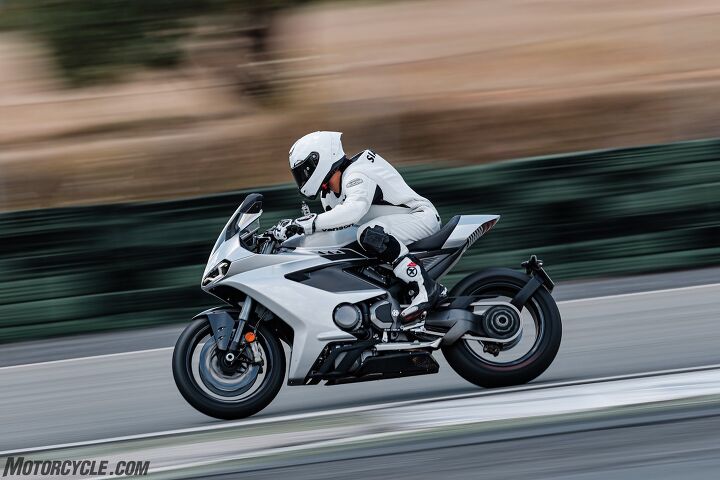
You can be forgiven for not knowing the brand Norton — or at least I’ll forgive you. At one point in time, Norton was a global powerhouse, both on the roads and in competition. That time, however, is an era my dad remembers fondly. Historic models like the original Manx and the Commando carry a rich history and remain the stuff of legend. If you’re reading this and getting angry that an entire generation might be unfamiliar with the name, it might be time to look in the mirror and count your gray hairs. In my lifetime, save for the rotary-powered F1 in 1990, Norton has been a mere footnote in the pages of modern motorcycling history books. An important one, certainly, but a marque whose best days seemed firmly locked in the past. Until now.
With the new Manx R, Norton is marking its return by fully embracing its past, but with a clear eye towards the future. And this time, the revival feels very real.
2026 Norton Manx R
Norton is announcing its return with a flagship sportbike. But unlike other flagship sportbikes, the all-new Manx R isn’t aiming to be the fastest around a track. Norton’s going a different direction with a sportbike that actually makes sense in the everyday world — and also happens to be able to haul ass around a racetrack.
Highs
- The 1200cc V4 engine is mega
- Sophisticated looks, MotoGP aero be damned
- Incredible brakes
Sighs
- Electronics don’t give you absolute control
- Price tag isn’t for the faint of heart
- Dealer network will be sparse (hopefully, not for long)
The TVS Resurgence: Real Backing, Real Scale
Over its 128-year history, Norton has changed hands 13 separate times. It’s been a turbulent existence of financial heartbreak, empty promises, and brief flashes of racetrack brilliance. But the 2026 Norton Manx R represents the dawn of the TVS era.
India’s TVS Motor Company happens to be the third largest motorcycle manufacturer on the planet — overtaking Yamaha in global production volume this year — producing and selling nearly six million vehicles annually. When they purchased Norton and injected over £200 million into the brand, they built a state-of-the-art global headquarters in Solihull, England, and established a dedicated engineering team of roughly 60 people split across the UK, Italy, and India. That number doesn’t take into account the vast number of engineers at TVS who might also dabble in Norton projects in addition to other TVS entities.
VIDEO: 2026 Norton Manx R Review
An underrated, but very important aspect to consider is that, with TVS’s size, it gets Tier 1 supplier relationships. Because TVS buys components at an order of magnitude larger than boutique OEMs, Norton gets something it never had before: priority access to the newest technology, and at fair prices. The Manx R, and the models to follow, aren’t parts-bin specials; it's thoroughly engineered and developed with the same fit and finish that we’re used to from Norton’s own contemporaries. And that’s the point — Norton wants to be in the conversation straight away.
The Aston Martin of Superbikes
Norton wants to be in the conversation, but at the same time, it also wants to stand out. If you look at the current crop of modern superbikes, the common throughline is MotoGP aero for the road. Winglets, aggressive aerodynamic appendages, and angry lines dominate the landscape. Simon Skinner, Norton’s Head of Design, who has steered the styling ship through 17 years of company transitions, decided to take a different approach.

The Manx R is positioned to be the "gentleman’s sportbike." In Skinner’s own words, he compared Norton as motorcycling’s equivalent to Aston Martin in the automotive world — the sensible, beautifully proportioned supercar sitting among the loud, ostentatious Ferraris, Lamborghinis, and Porsches of the world.
The proportions are balanced. The smooth lines flow naturally from the front fairing straight through the compact tail section. You won’t find a single aerodynamic winglet here. In a nutshell, the Manx R’s styling takes us back 20 years to when sportbikes doubled as art and everybody wanted a piece. If you ask me, the pictures don’t do it justice. It’s sleek.

The cockpit is just as clean. There aren’t complicated buttons everywhere. Instead there’s a simple, tactile thumb dial on the left and a couple buttons on the right switchgear let you turn the bike on and change ride modes. Otherwise, most adjustments are handled directly via the massive 8-inch TFT touchscreen display that doesn’t at all look out of place considering the compact proportions of a sportbike. Navigating that display will require a learning curve, but the same could be said for any bike. The main theme was function and form pushing together in total harmony. Which meant the design and engineering teams were working together from the start instead of one taking precedence over the other.
Engineering A Real-World Sportbike
Chief Technology Officer Brian Gillen (formerly the engineering mastermind at MV Agusta) shares this exact philosophy. The Buffalo, NY native didn't want to design a peaky, unrideable racetrack special — he’d already done that at his previous job. To guide the Manx R’s development, Gillen and his team took three benchmark competitors — the Ducati Panigale V4S, Aprilia RSV4, and BMW S1000RR — and logged over 135,000 miles across real-world roads and tracks.

The data returned something we already know deep down inside: sportbike riders spend the vast majority of their time between 3,000 and 7,000 rpm. Chasing ever-higher peak engine speeds at the expense of midrange usability was deemed useless for a gentleman’s road bike. This guided the tuning of an all-new 1,200cc, 72-degree liquid-cooled V4 engine. It shares absolutely nothing with Norton’s previous V4 units except for the number of cylinders and the V-angle. Peak power is a claimed 206 hp at 11,500 rpm, with maximum torque hitting 96 lb-ft at 9,000 rpm. Crucially, 55% of that torque is available at a low 4,800 rpm, and a massive 80% is ready by 7,000 rpm.
Packaging this motor was a puzzle dictated by the bike’s tight 56.5-inch wheelbase. A wider 90-degree V4 would have forced the chassis out by an extra two inches. By sticking to a narrow 72-degree angle, the rear cylinder head sits in line with the crankcases, and the front cylinder is just above the oil filter. Vertically, the engine is remarkably short, which allowed Gillen to raise the crankshaft and center of mass for better handling. The cam drive system utilizes a cam chain that sits 17mm lower because it doesn't loop all the way over the cam sprockets. A balance shaft spins counter to the crank to help negate primary vibrations, and the narrow V layout allows the transmission shafts to be raised completely out of the engine oil to minimize parasitic drag (and raise the CoG a little).

For better low-speed response, the front and rear cylinder banks use independent ride-by-wire throttle bodies. Essentially, it behaves like two twin-cylinder engines sharing a common crankshaft, providing smooth power delivery at small throttle openings.
Then there is the "Phased Pulse" firing order, engineered specifically to maximize mechanical traction and belt out a distinctive soundtrack. When Cylinder 1 fires at 0º, Cylinder 3 fires just 180º of crank rotation later. These two power pulses hit in rapid succession to firmly dig the rear tire into the asphalt. Then, the tire gets a breather: it takes another 252º of rotation before Cylinder 2 fires (432º), followed 180º later by Cylinder 4 (612º), leaving a 108º window before the cycle resets at Cylinder 1. This isn’t a new concept, as Yamaha’s crossplane crankshaft in the YZF-R1 operates with an offset firing order for the same reason — to give the rear tire a big push forward, followed by time to recover traction between hits.
Chassis, Suspension, & Electronics
On the chassis side, Gillen deliberately didn’t want to make an ultra-stiff, race-replica. The five-piece die-cast aluminum frame is engineered with less torsional stiffness compared to its rivals. This allows the chassis to flex laterally under load, when the fork isn’t effective, and gives clear feedback to the rider when the bike is leaned over. Longitudinal stiffness remains high to ensure rock-solid composure under heavy acceleration or braking.

Wanting to showcase the best they have to offer, Norton had the assembled press ride the Manx R Signature edition, complete with carbon goodies all over, including carbon fiber Rotobox wheels, claimed to shed 10 pounds over the standard cast aluminum wheels. The Signature edition also upgrades the chassis to Marzocchi semi-active suspension equipped with integrated linear potentiometers. These sensors actively measure fork and shock velocity every three milliseconds, continuously feeding real-time pitching and load data to the central IMU to adapt to the road and your riding style in real-time.
Braking components are top-shelf Brembo Hypure monobloc calipers clamping down on 320mm floating front discs, backed by a 245mm rear disc and full stainless steel braided lines. Lean-sensitive Bosch Cornering ABS EVO comes standard.

But that’s just one small piece of the electronics package. The rest of the package includes:
- Three Street Ride Modes: Rain, Road, and Sport
- Two Customizable Track Modes
- Rider Aids: Fully adjustable 7-level traction control, a bi-directional quickshifter, launch control, wheelie control, rear-wheel slide control, hill-hold control, and a segment-first cornering cruise control.
Most of the functions to change things around can be controlled via simple taps on the switchgear dial, but higher level functions will need to go through the 8-inch touchscreen. There is also a companion Norton Rider app that lets you handle turn-by-turn navigation directly mirrored on the TFT display (among other things like ride tracking, keeping up on maintenance schedules, and receiving OtA software updates).
Specifications & Range Breakdown
While U.S. pricing is still being finalized, Norton is currently establishing a global dealer network, of which, the initial launch will include 25 dealerships around the United States by the end of the year, strategically focused across the coasts and southern regions before expanding inward. To back up their quality claims, every single Manx R rolls out of Solihull with a comprehensive 36-month, unlimited-mileage warranty.

The bike is structured into four distinct model variants (keep in mind EU pricing includes VAT):
Specification Level | Core Features | UK Price | EU Price |
|---|---|---|---|
Manx R (Standard) | Manual passive Marzocchi suspension, cast aluminum wheels, 210kg wet weight (no fuel). | £20,250 | €23,250 |
Manx R Apex | Semi-active Marzocchi suspension, forged aluminum wheels, 207kg wet weight (no fuel). | £24,750 | €29,750 |
Manx R Signature | Full carbon fiber bodywork, Rotobox Bullet carbon fiber wheels, 203kg wet weight (no fuel). | £38,750 | €43,750 |
Manx R First Edition | Ultra-limited volume, Akrapovic titanium exhaust, titanium fixings, fully machined billet componentry, numbered top yoke. | POA | POA |
So, no. The Manx R won’t be cheap. But you likely gathered as much from the Aston Martin reference earlier. But what does it offer for the money?
Riding Impressions
The Road Ride
Swing a leg over the 33.0-inch seat and press the keyless ignition — the V4 settles into smooth, distinctive mechanical thrum, reminiscent of the Aprilia RSV4 (and not the Ducati Panigale V4). Sitting in the paddock of the Circuito Monteblanco, waiting for our road ride to start, it didn’t take but 100 yards for it to become clear: the engine is the absolute star of this show. The lovely V4 sound gave us a clue, but the torque so early in the rev range sealed the deal.

As promised, the engine makes power precisely where you naturally want it during street riding. Because of the short gearing and tall final drive, you can leave the bike in third gear and surf an ocean of midrange grunt without having to wring its neck. Of course, you can let it scream to its 12,500 rpm redline if you want, and if you do, the soundtrack coming from the exhaust will reward you for it. Power delivery felt strong and robust, with clean fueling off the bottom. Then, I looked at the dash to see I was starting my day in Road mode. If Road mode was already saucy, what did Sport mode have in store?
When we broke into the canyons, I found out. A simple toggle of the starter button to change into "Sport" mode, and we were off. The power delivery was aggressive, bordering on too abrupt, requiring a highly disciplined right wrist. Once your brain recalibrates, and the road is long and smooth enough to take advantage of it, it's an absolute blast. But if the asphalt gets rough and bumpy, those bumps can be enough to jostle the wrist enough to get jerky throttle response. In those cases (in most cases, really), you’re better off switching back to Road mode. Heck, I even tried Rain mode out of curiosity and was pleasantly surprised by how much power is still delivered. The reduced response from the throttle still spat back plenty of power — enough to make me wonder if it would be too much in actual sketchy conditions.

However, our initial road loop revealed a chassis setup issue: the bike felt incredibly heavy to steer at slow speeds, requiring constant inner handlebar pressure just to initiate and hold a cornering line. The issue got better the faster we went, but there was clearly something wrong.
The Track Ride
When we flagged this to Brian Gillen before our track sessions, he already knew — other riders had given the exact same feedback. His fix was to lower the fork tubes in the triple clamps by 6mm (a massive geometry change) and add a turn of front spring preload. By raising the front end, the bike’s center of mass was raised, and more trail was added. The transformation was instant; the slow-speed sluggishness vanished, and the Manx R began falling into corners fluidly.

Out on the Monteblanco circuit, the torque-heavy characteristics of the V4 shone beautifully when digging out of the track's slower, technical corners and launching down the short chutes. However, once you crest the mountain of midrange torque and hit the main straightaway that stretches for over a kilometer, you can feel the top-end rush tapering off, which sounds weird when you have 206 horses to work with. But because usable power was the mission, when you do have a chance to stretch the Norton’s legs, you find yourself rowing through the six-speed gearbox rapidly because of the short gear ratios.
Speaking of which, while going through the gears on the long front straight, I noted a delayed ignition kill time on one test unit, while another shifted perfectly. When I asked Gillen about this, he explained that the current software sets the ignition kill window at 600 milliseconds for smooth street upshifts, but acknowledged that a tighter 400-millisecond kill time would be better for upshifts on a racetrack.

The downshifts are generally smooth, and the auto rev-matching works perfectly on the road. On the track, however, the gearbox software is designed to protect against mechanical over-rev; if you try to stamp down a gear too quickly before the engine speeds drop into the safe zone, the lever can feel quite stiff and unresponsive until the rpm drops. The solution? Use the clutch and downshift manually or wait for the revs to drop before downshifting.
A motorcycle that puts out as robust a power output as this one needs brakes that are up to the task of slowing it down. The braking performance here can best be described as absolutely fierce. Norton claims the Manx R can pull up to 1g of deceleration under maximum braking, and after hauling it down from speed lap after lap, I am a firm believer. The Brembo Hypure calipers, steel lines, and radial master cylinder offer an incredibly firm lever feel with zero fade. To put it in perspective: at the Suzuki GSX-R1000R launch I attended just two weeks prior, my braking marker for Turn 1 was at the (nonexistent) 250-meter mark. On the Manx R, I could comfortably sail past it and drop the anchors at the 200-meter marker.

For the gentleman who has a bit of a hooligan streak in them, the built-in rear wheel slide control function is an incredibly fun party trick. Even if it’s not exactly how a seasoned racer backs a bike into a corner manually. Basically, while applying the front brake like normal, the system lets you stomp on the rear brake to step the rear out sideways, and the ABS will modulate brake pressure to keep you from taking it too far. It instilled enough confidence in me to try it at speeds I’ve never had the courage to attempt before (like at the end of the front straight). I missed plenty of apexes playing around with it, but I had a massive grin on my face the whole time.
That grin would occasionally wash away on corner exits, especially slow-speed exits. There were times when a noticeable delay would set in before power got to the rear wheels. We were told this was the IMU and traction control limiting power, but the momentary lack of any throttle response while leaned over was jarring to say the least. Gillen suggested turning off the TC entirely, which would give total control of the engine back to my right wrist and solve said issue.

The results were mixed. The bikes come fitted with Pirelli Diablo Supercorsa V4 SP tires as standard, as Norton engineers and test riders felt like its soft carcass aligned with the lateral flex characteristics they were going for. It’s a fine tire, but by the end of the day, they were down to the wear bars, and I could feel them squirming around under power in the lowest TC setting. In my head, the TC, even in its lowest setting, gave me the confidence I needed to keep the throttle pinned. It’s true, with TC off, the connection between my right wrist and the back tire was much more direct, but I became paranoid not to go full stick too soon and risk a highside. The paranoia might have been all in my head since the tire never squirmed at all, but better safe than sorry.
And that brings us to a potential sticking point with the electronics. While the rider has a lot of control over the rider aids, said aids aren't completely independent — the semi-active suspension algorithms are locked to their respective ride modes, and while you have a little more leeway in the Track modes, they don’t compare to the level of sophistication as the Öhlins EC3.0. And traction control can’t be adjusted on the fly. Riders who like having independent control of each electronic aid aren’t going to like that. We’ve become used to rider aids being infinitely split across individual sub-menus, which is great if you know what you’re doing, but just as data has shown most people don’t spend as much time at wide open throttle as they think they do, it’s unlikely most users really adjust settings beyond the initial setup and maybe a little bit here or there at the odd trackday. Norton’s banking on its target demographic for this motorcycle appreciating the (mostly) pre-set approach will be fine for the majority of their needs. They don't want to spend a lot of time trackside fussing with multiple tech parameters; they want minimal button presses so they can focus on enjoying the ride.

The Verdict
Before getting into the ups and downs of the Manx R, let’s understand the target audience. The brutal truth is that you’re likely to find the Manx R outside a Starbucks more than a racetrack. And you know what — that’s fine. While U.S. pricing hasn’t been announced at press time (you can expect something near $50,000 for the premier Signature version we tested), it’s the motorcycle for the sportbike enthusiast who’s realistic about their wants, needs, and their abilities. Chasing lap times isn’t what the Manx R is about, but don’t be confused — it’ll still haul ass. Think of it as the anti-sportbike. It’s free from the constraints of trying to be “the most” or “the best.” Instead, it’s a good looking sportbike for the real world. And who’s to say how styling will stand the test of time, but I’ll go out on a limb and say the Manx R’s looks will age well.

Splitting a short launch schedule between the road and the track left me wanting more time in both environments, but what is clear is that the Manx R is an astonishingly accomplished first effort for a motorcycle that literally didn’t exist 2.5 years ago. The engine will take your breath away, so will the brakes, and the chassis/electronics combination will just fade into the background. It needs a few minor software refinements for track duties, but over-the-air updates are natively built-in. With the massive financial bedrock of TVS beneath them, Norton’s future looks remarkably bright. There are already three more models in the immediate pipeline (the Manx, Atlas, and Atlas GT), and even more platforms brewing in the rumor mill. One hundred twenty eight years and 13 owners in the making, it looks like Norton is finally back. For real.
Scorecard
Engine | 19/20 | Suspension | 14/15 | Transmission | 9/10 |
Brakes | 9.5/10 | Instruments | 4.5/5 | Ergonomics | 8/10 |
Appearance | 9/10 | Desirability | 9/10 | Value | 6/10 |
Editors Score: 88.0% | |||||
In Gear: Street

- Helmet: Scorpion EXO-Warp Apex
- Jacket: Spidi Equinox Net Windout
- Airbag: Alpinestars Tech-Air 5 Plasma
- Pants: Spidi Charged
- Gloves: Spidi NKD
- Boots: XPD XP9-R Air
In Gear: Track

- Helmet: Scorpion EXO-Warp Apex
- Suit: Vanson VE-94 Leather Suit
- Airbag: Alpinestars Tech-Air 5 Plasma
- Gloves: RST Moto Tractech Evo 4
- Boots: XPD XP9-R Air
2026 Norton Manx R Specifications | ||||
|---|---|---|---|---|
Trim | Manx R | Manx R Apex | Manx R Signature | Manx R First Edition |
Engine Type | Norton 72-degree liquid-cooled V4, 1200cc. Chain-driven cams with idler gear for reduced engine height. Titanium inlet valves. | |||
Bore x Stroke | 82mm x 56.8mm | |||
Compression Ratio | 14:01 | |||
Fuel Injection | Multi-point sequential fuel injection system with 8 injectors, ride-by-wire throttle with independent input on front and rear cylinder banks for ultimate control and feel. | |||
Horsepower | 206 hp at 11,500 rpm (claimed) | |||
Torque | 96 ft-lb at 9,000 rpm (claimed) | |||
Exhaust | Underslung 4-2-1 steel exhaust system with two catalytic converters and three lambda probes. | Underslung 4-2-1 Akrapovic titanium exhaust system (road-legal) with two catalytic converters and three lambda probes. | ||
Transmission | 6-speed with bi-directional up/down Quick Shift | |||
Clutch | Cable-operated Assist & Slip multiplate wet clutch | |||
Primary Drive | Straight cut gears; Ratio 1.66:1 | |||
Final Drive | X-ring 525 Chain; Front sprocket 17; Rear sprocket 41 | |||
Frame | Die-cast aluminum | |||
Swingarm | Single-side die-cast aluminum | |||
Seat | Two-seat configuration (rider and pillion) | Split rider & pillion | Single rider seat | Single rider seat |
Front Suspension | Marzocchi 45mm USD chromed inner tubes, full manual adjustment, passive damping, 4.7 inches of travel | Marzocchi 45mm USD DLC inner tubes, full electronic adjustment, semi-active damping, 4.7 inches of travel | ||
Rear Suspension | Marzocchi monoshock RSU, full manual adjustment, passive damping, 5.0 inches of travel | Marzocchi monoshock RSU, full electronic adjustment, semi-active damping, 5.0 inches of travel | ||
Steering Damper | Adjustable | |||
Front Brakes | 2x 320mm semi-floating discs, radially mounted Brembo Hypure 4-piston calipers with Bosch Cornering ABS EVO | |||
Rear Brake | 245mm disc, 2-piston caliper with Bosch Cornering ABS EVO | |||
Front Wheel | Cast aluminum, 17” x 3.50” | Rotobox Bullet Pro Carbon Fibre 3.50" x 17" | ||
Rear Wheel | Cast aluminum, 17” x 6.00” | Rotobox Bullet Pro Carbon Fibre 6.00" x 17" | ||
Front Tire | Pirelli Diablo Supercorsa SP-V4 120/70 ZR17 | |||
Rear Tire | Pirelli Diablo Supercorsa SP-V4 200/55 ZR17 | |||
Wet Weight, No Fuel | 463 pounds (claimed) | 463 pounds (claimed) | 448 pounds (claimed) | 443 pounds (claimed) |
Fuel Tank Capacity | 3.8 Gallons | |||
Seat Height | 33.1 inches | |||
Ground Clearance | 5.2 inches | |||
Wheelbase | 56.5 inches | |||
Rake/Trail | 24.1° / 3.72 inches | |||
Service Interval | 12 months / 10,000 miles / 16,000 kilometres | |||
Warranty | 36 months / 30,000 miles / 50,000 kilometres | |||
2026 Norton Manx R Review Gallery

We are committed to finding, researching, and recommending the best products. We earn commissions from purchases you make using the retail links in our product reviews. Learn more about how this works.
Become a Motorcycle.com insider. Get the latest motorcycle news first by subscribing to our newsletter here.
Troy's been riding motorcycles and writing about them since 2006, getting his start at Rider Magazine. From there, he moved to Sport Rider Magazine before finally landing at Motorcycle.com in 2011. A lifelong gearhead who didn't fully immerse himself in motorcycles until his teenage years, Troy's interests have always been in technology, performance, and going fast. Naturally, racing was the perfect avenue to combine all three. Troy has been racing nearly as long as he's been riding and has competed at the AMA national level. He's also won multiple club races throughout the country, culminating in a Utah Sport Bike Association championship in 2011. He has been invited as a guest instructor for the Yamaha Champions Riding School, and when he's not out riding, he's either wrenching on bikes or watching MotoGP.
More by Troy Siahaan


Comments
Join the conversation
It's been too long from Norton's glory days ......... until now. The decades of continuity or consistency in the line are missing, so these newer Nortons are essentially just like every other/any other modern bike being made, except with a Norton logo on it. WHAT makes it a Norton? There's been so long of a hiatus for Norton that it renders them more irrelevant. Sorta like if someone decided to make a new version of a Stutz Bearcat ...... and it looks like every other Ford, Toyota, Nissan, Chevy, Ford, etc. SUV. It's just been so long between productions that the marque has essentially lost its relevance. The only way that bike companies do this successfully it seems, is by introducing a retro model or two in an attempt to then tie the more modern bike to it. They need to be "rebranded" somehow to regain some cachet. British Racing Green and dodgy electrics anyone?
I don't think this is what anyone interested in the "Norton" name is looking for - it certainly isn't anything *I* would be interested in. And why change the logo? Triumph was smart enough to keep theirs reasonably true to history.