


2026 Zero XB and XE Review – First Ride

Part one of Zero’s All-Access Initiative starts in the dirt

Fun fact: Zero Motorcycles was founded 19 years ago, in 2006, by a former NASA engineer, Neil Saiki. The bike Neil produced back then was called the Electricross, and it had the fit and finish of a garage project because, well, that’s basically what it was. An overgrown electric mountain bike minus the pedals, the Electricross was Saiki’s own creation to explore the amazing single-track in his backyard of Santa Cruz, California.
Since then Zero’s ascension has only grown. Saiki left the company long ago, and the brand carried on thanks to the generosity and patience of its investors. Early models may have looked a bit cobbled together, but with the help of some industrial design expertise, modern Zeros have evolved into proper motorcycles we would all recognize as such, only powered by electricity.
2026 Zero XB and XE
The first two models in Zero’s All Access initiative, the XB and XE take Zero back to its roots of making a fun and lightweight single-track ripper.
Highs
- Both models are easy to ride
- Tons of torque, but easily manageable
- Battery life seems adequate for intended purpose — plus, they’re swappable
Sighs
- The XB isn’t for tall people
- Standard tires are lacking
- Additional batteries aren’t cheap

Here’s the thing: Zero’s ascension has also resulted in higher price tags, which is also a problem electric motorcycles in general are faced with. Not wanting to price itself into extinction, while also recognizing that the industry as a whole could use some new blood, Zero has launched its “All-Access” initiative which aims to bring in a slew of new models across various segments, all for under $10,000. The first of those is the X Line — the 2026 XB and XE — marks a clear push into that space. With price points starting at just $4,395 for the XB and $6,495 for the XE, Zero is playing a new game of affordability and accessibility.
But there’s a catch — the pricing above is valid only until November 30, 2025. After that, prices for the XB and XE climb up to $5,095 and $7,395, respectively. Zero isn’t immune to the tax and tariff confusion going around these days, and these new prices reflect that.

So, what's the difference between the XB and XE? We covered all that in greater detail in the XE and XB First Look piece, but the Cliff Notes is that the XB is the smaller of the two, sized marginally larger than a full-suspension mountain bike or similar to other electric dirt bikes like the Surron Light Bee that are blitzing neighborhoods all over the country. There’s less power (7.5kW), less battery (2.4kWh), and less weight (139lbs). But you’re also limited to a lower top speed (50 mph) and less range (40 miles at 31 mph average). The silver lining? You have 275 lb-ft of torque at your disposal.
The XE slots in as the more full-size machine, but is still marginally smaller than your typical motocrosser — consider it more like a ¾-scale model. It’s almost as big, but not quite. Here you have a little over double the power (15.5kW), double the battery (4.3kWh), not quite double the weight, but clearly more (223lbs). Top speed is 53 mph, and range tops out at 65 miles (at a 31 mph average). What about torque, you ask? How does 468 lb-ft sound?

Both the XB and XE feature batteries that can be swapped out easily, without tools, in about a minute or two, depending on how easily you can disconnect a few plugs. Of course, additional batteries are not included and will cost you $1,599 for the XB and $2,749 for the XE, but the option is there.
From a rider aid standpoint, both models give you some interesting features like the ability to control the amount of regenerative braking, hill hold control, traction control, cruise control, and even reverse. Just because these are light bikes doesn’t mean that these features aren’t welcomed.
Final note: both the XB and XE are being sold as road-legal motorcycles in other markets, but here in the US of A, both models are strictly off-highway vehicles.

Recently, I had the chance to spend a day in the dirt at the Austin Moto Adventures offroad training course on both machines. Now, long-time readers will know that playing in the dirt is not my specialty. But I thought the small, unassuming nature of both bikes, and the lack of shifting, would help coddle me and my lack of skill. Here’s how it went.
XB First Impressions
Zero had us starting with the XB as more of an appetizer to the XE main course, but for me, the XB was the one I had been gravitating to all along. Its smaller dimensions were more approachable and inviting. However, a note to the taller riders reading this: if your height starts with the number six, you’re going to have a hard time fitting on the XB. The cockpit is compact and, as you can see from the photos, the seat simply ends. Taller riders on our demo had a hard time fitting on the XB and had to be conscious of not scooting themselves too far in the saddle or risk falling off the back. The taller handlebar from the aftermarket catalog helped free up space for their legs, but it was still tough for them to hang on. Even my 5-foot, 8-inch frame ended up skirting with the rear of the seat at times.

Get yourself on the bike and the actual ride dynamics are what I was expecting from the smaller XB model. Having 275 lb-ft of torque at the whim of your right wrist is no joke, but choosing between the three power modes — Eco, Standard, and Sport — on the 2.4-inch TFT display gives you some reassurance. The more talented among us chose Sport mode, but I stuck with Standard. Here, power delivery was modest and smooth, without an instant hit. Sport increases the sensitivity of the throttle and delivers a bigger burst when you ask for it.
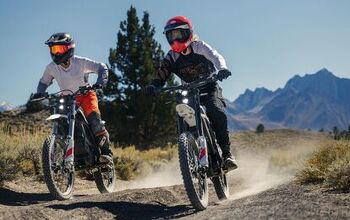
Standard was perfect for me as we wound our way through the open course the Austin Moto Adventures team laid out for us. Spinning the rear is incredibly easy, but is commensurate with the amount of twist I gave the throttle. No surprises. With such a small and narrow bike, it’s hard to grip anything between your legs when standing, but its lightness means it also changes direction quickly when you decide to weight either peg. The 19-inch wheels wear a pair of CST knobby tires, with tubes, on them. The lugs themselves aren’t very big, and even with my meager talent, it felt to me like the rubber was glancing off the terrain instead of digging in. My impressions were reinforced when we were led to the Hard Enduro course, and though I didn’t take part, I watched as others tackled the course gingerly because of the lack of grip. When given the chance to try the course again on an XB equipped with better tires with bigger lugs, the speed and the confidence was visible even to my naked eye watching from the sidelines.

The XB does impress in the fact it comes with fully adjustable KKE suspension at both ends with 7.9 inches of wheel travel in the front and 6.9 inches in the rear. Despite its size, you get hydraulic brakes all around, with a single 220mm disc up front and 203mm disc in the back. Unlike a traditional motorcycle, Zero’s moved both brake levers up to the bars. The front brake is in its usual location, but rear brake moves to a lever on the left side, like a scooter. There are no foot controls, whatsoever. I found this setup more to my liking, as I have better feel and dexterity with my hand than I do with my foot that’s wrapped in a stiff moto boot.
The telling thing about the XB was the looks on all the riders faces after 15 minutes riding it. Everyone in the group thought it would be a toy. Again, the appetizer to the XE main course. But it proved more than that. The more experienced riders kept hooting and hollering after hoisting wheelies or grabbing some major air time. In the right environment, the XB is just right. Assuming you fit on it.
XE First Impressions
Physically, switching to the XE felt like hopping on a “normal” motorcycle. The size is bigger and the dimensions are more relatable, even if they are a tad smaller than traditional motocrossers. Seat height is a little taller, 35.4 inches, compared to the XB’s 32.7 inches, but the narrow nature of the bike makes it easy to get a foot on the ground. There’s no concerns about falling off the back, either. Otherwise, the user interface feels fairly similar. The same TFT display is mounted on the left side of the bar and has the same functions as it does on the XB.

The real difference is the power. There’s simply more torque at your disposal, and though the power is metered very smoothly in Standard mode, where I had it the whole time, the XE reminds you right away that you need to respect the torque or it can come back to bite you. It makes sense both these bikes have traction control, but since we spent our entire ride in the dirt, Zero turned TC completely off for our purposes.
Part of the ride route on the XE led us down some single-track, and this narrow path highlighted some of the bike’s strengths and weaknesses. To go back to the power, a rowdy powerband would have been difficult for me to tame while also navigating the tight trail. Instead, the lack of having to modulate a clutch, combined with the linear power delivery allowed me to focus on simply going where I was supposed to. Sure that sounds easy and obvious to more skilled off-road riders, but with very little single track training under my belt, this was a big deal for me. Another helping hand? The left hand rear brake lever. Being able to course correct, or slide the rear, with my hand instead of my foot really helped me stay on course.

Like the XB, the XE also comes with fully adjustable suspension and CST rubber, this time on a 21-inch front wheel and 18-inch rear. Still, the standard tires on the XE didn’t instill any confidence that they were grabbing onto anything. I also found the suspension overdamped for the terrain, with both wheels harshly bouncing over everything instead of absorbing the impacts. But with everything being adjustable, a sweet spot is attainable, assuming you’re not at either extreme of the body weight spectrum.
The Inevitable Question
You can’t go far in a review of electric motorcycles and not ask, “How far can it go?” As usual, the answer still comes back to, “It depends.” Zero quotes a range of 40 miles for the XB if you’re averaging 31 mph. The XE will go 65 miles at the same speed. As off-road motorcycles, 40 and 65 miles is plenty if you stick with technical terrain the whole time. Or not, if your riding is more open and fast. Skill level comes into play as well, as riders who tax their machines will obviously use up more battery. Our loop around Austin Moto Adventures was short and technical, which played into the Zero’s strengths. Even the most heavy handed in our group was far from running the battery dry.

Since both bikes, but especially the XB, are seen as dirt toys you’d throw on the back of the RV on the way to an adventure, battery life seems adequate for what they’re meant to do. And in European cities, where these are street legal, it seems entirely capable of commuting you to the city, where you can then take out the battery and charge it at work before heading home for the day with a full charge.
The Verdict
If dipping your toes in the dirt scene is what you’re interested in, and you want as gentle of a learning curve as possible, then the XB and XE are worth a look. They’re about as easy to ride as you can ask for, without any of the added complications of an internal combustion engine. Plus, they’re fairly (but not completely) quiet. For machines meant to explore and appreciate nature, doing it with minimal disturbances to the wildlife is extremely underrated. And when you want that burst of excitement, all you have to do is twist your wrist and unleash the torque.

My recommendation: try both. Zero’s going around doing demo tours, where you can see for yourself which, if any, is right for you. If you’re lighter, less aggressive, or just want fun trail rides, the XB is a no-brainer. If you want more power, more capability and are fine with swapping batteries or planning around range, go for the XE.
If the off-road e-bikes I see whizzing around neighborhoods all over Southern California are an indication of what the youth consider cool on two wheels these days, maybe Zero is on to something here. If Zero can capture these kids on an XB or XE now, there’s potential to step up to an SR/S or DSR/X in the future. And if today’s youth are tomorrow’s motorcycle riders, then we all win.
In Gear

- Helmet: Fox Racing V1 Flow
- Goggles: Fox Racing Airspace Fade
- Jersey: Fox Racing 360 Fade
- Chest Armor: Fox Racing Raceframe Impact CE Roost Vest
- Knee Braces: Alpinestars SX-1 Plasma Knee Protectors
- Pants: Fox Racing 360 Fade
- Gloves: Fox Racing Dirtpaw
- Boots: Fox Racing Motion
Specifications | Xero XB | Zero XE |
|---|---|---|
MSRP | $4,195 | $6,495 |
Battery Capacity | 2.4 kWh | 4.3 kWh |
Charger type | 800 W, off-board | 800 W, off-board |
Charge time (standard) | 2.5 hours (95% charged) | 5.0 hours (95% charged) |
Input | Standard 110 V or 220 V | Standard 110 V or 220 V |
Removable Battery | Yes | Yes |
Horsepower | 10 hp (claimed) | 20.1 hp (claimed) |
Motor Torque | 30.9 lb-ft. (claimed) | 42.7 lb-ft. (claimed) |
Rear Wheel Torque | 275 lb-ft. (claimed) | 468 lb-ft. (claimed) |
Top speed | 50 mph (claimed) | 53 mph (claimed) |
Range (at 31mph) | 40 miles (claimed) | 65 miles (claimed) |
Front suspension | Fully adjustable suspension, 7.9 inches of front wheel travel | Fully adjustable suspension, 8.7 inches of front wheel travel |
Rear suspension | Fully adjustable suspension, 6.9 inches of rear wheel travel | Fully adjustable suspension, 9.8 inches of rear wheel travel |
Front brakes | 220mm front rotor, hydraulic brakes | 240mm front rotor, Dual Piston DOT hydraulic brakes |
Rear brakes | 203mm rear rotor, hydraulic brakes | 220mm rear rotor, Dual Piston DOT hydraulic brakes |
Front wheel | 19 inches | 21 inches |
Rear wheel | 19 inches | 18 inches |
Seat height | 32.7 inches | 35.4 inches |
Weight | 139 pounds (claimed) | 223 pounds (claimed) |

We are committed to finding, researching, and recommending the best products. We earn commissions from purchases you make using the retail links in our product reviews. Learn more about how this works.
Become a Motorcycle.com insider. Get the latest motorcycle news first by subscribing to our newsletter here.
Troy's been riding motorcycles and writing about them since 2006, getting his start at Rider Magazine. From there, he moved to Sport Rider Magazine before finally landing at Motorcycle.com in 2011. A lifelong gearhead who didn't fully immerse himself in motorcycles until his teenage years, Troy's interests have always been in technology, performance, and going fast. Naturally, racing was the perfect avenue to combine all three. Troy has been racing nearly as long as he's been riding and has competed at the AMA national level. He's also won multiple club races throughout the country, culminating in a Utah Sport Bike Association championship in 2011. He has been invited as a guest instructor for the Yamaha Champions Riding School, and when he's not out riding, he's either wrenching on bikes or watching MotoGP.
More by Troy Siahaan






Comments
Join the conversation
You may wish to re-consider how you quote torque to help temper expectations: Rear wheel torque is never quoted on gas motorcycles. Consider that the little Yamaha TW200 has 369 lb-ft of torque at the rear wheel after the 11 lb-ft at the crank passes through the gearbox. The 144cc KTM 150 exc has 524 lb-ft at the rear wheel. These e-bikes are pretty cool and lots of fun but they are completely comparable to 50cc and 125cc gas bikes. That’s not a bad thing at all but your article makes it seem like these things are monsters.
Interesting review, I simply don’t understand why these aren’t being offered in street legal trim here.