


Beyond the TT: The Accessible, Authentic Isle of Man Race Meets

The first time I ventured to the Isle of Man, in 2008, it was for the Manx Grand Prix rather than the TT. The Manx was considered the ‘amateur TT’ but incorporated classic bikes and drew a fine mix of experienced and newcomer racers, spectacular machinery, and a raft of associated events around the island for the off-race days, in a more relaxed and less-crowded environment than the TT. I signed on as a TT Course Marshal, worked the practice and race sessions, met wonderful people, and was enveloped in a new-to-me world of motorcycle real roads racing and culture. It was magnificent.
And while I now generally lean into the TT fortnight for my annual hejira to the beautiful island nation and the incredible 37.73-mile Mountain Course, it can be logistically difficult and expensive for U.S. enthusiasts to partake in the TT experience. After two years of COVID cancellations, the TT rebounded from ’22 and is now experiencing growth and change. While over 40,000 visitors come to the TT, the Island’s capacity in terms of lodging (hotels, homestay, and camping) is only around 28,000 visitors at any one time. The TT is absolutely the pinnacle of motorcycle sport and worth the effort to go, but is not an easy lift for U.S. enthusiasts, requiring flight or ferry connections that book up far in advance, a late May/early June schedule that may not align with vacation time opportunities, and challenging accommodation options.
But here’s the thing many American motorcycle enthusiasts may not realize: the TT is only one chapter in the island’s road-racing year. And depending on what kind of experience you want, it may not even be the best one. For those who seek a rich connection to the island’s overall heritage and tourism sites, more intimate access to riders and machines, some vintage race action, and an easier, more affordable trip, the Isle of Man’s other road-racing events may be exactly what you’re looking for.
These are the Pre-TT Classic, the Southern 100, the Manx Grand Prix, and the reborn Classic TT. And they form some of the most authentic and accessible celebrations of real-roads racing anywhere in the world.
So, if you’re an enthusiast who digs road racing, history, natural beauty, and some not-bad cask ales, and wish to experience the Isle of Man’s mix of speed and tradition outside the mega-event that is the TT, this is where you should begin.
The Southern 100 and Pre-TT Classic : As Real as it Gets

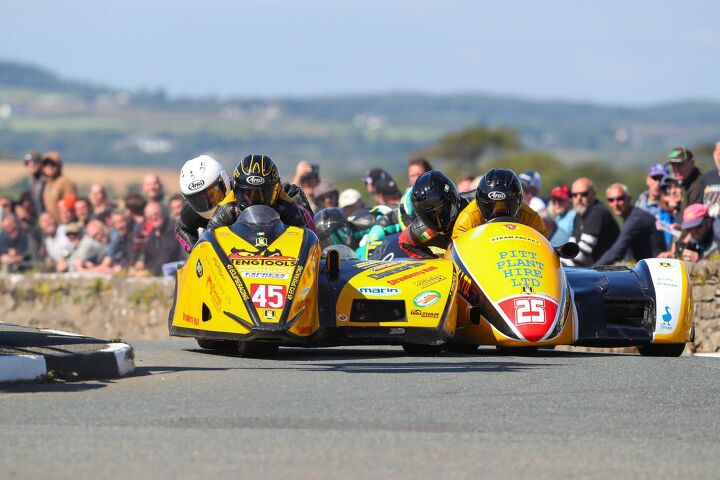
The Southern 100, often lovingly called “the Friendly Races,” has been run since 1955 on the narrow, two lane, once agricultural roads of the 4.25-mile Billown Circuit, just outside Castletown. The Southern 100 has been built by the faithful, cherished by the real road racers, and cared for through generations by the Manx folk who swear by it as the best race meet of the year.
Unlike the now-global TT, the Southern 100 keeps its feet firmly planted in local soil, a family affair with organizers, racers, teams, marshals, and fans all tightly connected. The racing is free, but you absolutely should buy a program and some merch to support the cause and toss a few quid into the coffers of the racers.
With a mass start, bikes and sidecars blast past spectators and navigate incredibly tight corners on public roads, inches away from spectators and stone walls. And in the paddock, you’ll hear relaxed banter, get up close to the racers themselves, and smell the pungent Castrol R fumes, without a VIP marquee in sight. Nightly activities and prize presentations are held in the square at Castletown, in the shadow of 800-year young Castle Rushen, one of the best-preserved medieval castles in the British Isles.

The Southern 100 has never been shy about its ethos. The Friendly Races isn’t marketing language; it is a cultural fact. The paddock is open, the hedges are close, and the atmosphere is genuine in a way that few race meets can replicate. Fans get closer to the action, participants, and each other here than just about anywhere else in professional motorsport.
If you’re an American spectator used to catching motorcycle racing in grandstands high atop fenced-off tracks, the Southern 100 will feel like stepping into motorsport’s past, except the racing is modern, fast, and very real. The Southern 100 runs from July 6-9, 2026, a lovely time on the Isle of Man.

A brief note about the Blackford’s Pre-TT Classic races. These are also run on the Billown Circuit, by the Southern 100 organization, but held on the weekend leading into the TT Practice week. They run from May 22-24 this year, right up against the TT fortnight which begins on May 25. The meet attracts over 250 entries for its nine-race program, with everything from 125’s to 1100cc classic superbikes running. Pro-tip: If you want to experience racing on both the Billown and Mountain Circuits in one week, book a trip to the Pre-TT Classic and first half of TT Practice Week. Easier accommodations and travel, smaller crowds, fantastic qualifying and race action, and immense fun.
The Manx Grand Prix: The Soul of Road Racing on the Isle of Man
The Manx Grand Prix, which runs this year from August 16-28, is nearly as old as the TT itself. Founded in 1923 as the Manx Amateur Road Races, the MGP became the great proving ground, where many future TT legends learned the Mountain Course, built reputations, and staggered up that impossible learning curve. It still is.
While the TT evolved into a polished, global, commercially driven spectacle, the MGP kept its roots deliberately deep in the soil of privateer racing, and in the capable hands of the Manx Motorcycle Club. The atmosphere remains somewhat “unplugged,” the paddock even more accessible, the speed a little less blistering, and the crowds thin enough to let the landscape shine. Some riders compete for decades in “The Manx” without venturing up to the TT, with Supertwin and Supersport classes providing the core of the racing these days.

When the MGP underwent restructuring a few years ago, many traditionalists feared that some of the old spirit would be lost. And, quite frankly, it was. A shortened meet, compounded by a few years of post-COVID financial challenges and bad weather made The Manx a mere shell of what it used to be. But in 2025, the Isle of Man Government and race organizers brought the event back to full strength — reinstating a complete program of practice and racing, co-scheduled with the re-born Classic TT, and recommitting to its long-standing purpose.
In their official announcement, race officials said the expanded schedule would offer competitors and fans “a highly competitive and thrilling spectacle.” They weren’t exaggerating. In 2025, the Manx looked and felt alive again, a proper Mountain Course event, but with room to breathe, a more favorable practice and race schedule for teams, riders, and Marshals, and down time for visitors to take in the many moto-themed events and towns and backroads around the beautiful island.
For the American enthusiast, the Manx is a real gift. It is scheduled in late August, generally up against our Labor Day weekend, so the vacation time might be easier to get. It is run concurrently with the Classic TT (see below), so you’ll experience modern and classic racing galore. You can fly or ferry in, get a hotel in Douglas, Peel, Castletown, or Ramsey for quite a bit less than TT rates. Walk, take public buses, cabs, the Manx Historic Railways, or a rental car (rental motorcycles are extremely rare on the IOM) to spectator sites around the course, and watch incredible road racing from the mountain, hedges, pubs, churchyards, or farmers’ fields without fighting through shoulder-to-shoulder crowds. It is nothing like anything you can experience in the U.S.

The Manx is also where you see the “next wave” intertwined with the grizzled veterans. Young riders learning the ropes, privateer teams doing miracles with tight budgets, and the older riders and teams who love the Mountain Course too much to leave it to the TT stars.
It’s authentic. It's human. And it’s a chance to experience Real Road Racing in the most charming place imaginable, the Isle of Man.
The Classic TT: Legendary Bikes and Riders Return to The Mountain Course

When the Isle of Man relaunched the Classic TT in 2025, after a multi-year hiatus, vintage racing fans worldwide rejoiced, and for good reason. The Classic TT brings the past back to life with the grit and thunder of vintage and classic race bikes breathing fire again on the Mountain Course.
A 2025 statement by the Isle of Man Department for Enterprise made the government’s intentions clear: they were committing to reviving the Classic TT alongside the MGP, celebrating the island’s racing heritage and supporting the tourism economy. “The Classic TT will celebrate the iconic legacy of the TT and pay homage to the legendary riders and machines that shaped road racing’s history.”
And that is exactly what it does. Running from August 17th to the 28th, mixed in with the Manx Grand Prix schedule, this year’s meet will be dedicated to honoring John McGuinness MBE, as the “Morecambe Missile” marks 30 years of racing on his beloved TT Mountain Course. Formula One, Historic Junior and Senior races will showcase the best road racers in the world on exotic machines from the 1960s through the 1990s. The new Junior 600 Classic TT will run with pre-injection 600cc Supersport bikes roaring down Bray Hill. A gaggle of ’90s icons including the Honda CBR600F, early Yamaha R6s, Suzuki GSX-R 600s, and Kawasaki ZX-6Rs will compete. Even 125cc two-stroke banshees are making a return to the TT Mountain Circuit in ’26 with the Ultra Lightweight Classic TT.

For American fans, especially those who grew up with 1980s and ’90s bikes pinned to their bedroom walls, this is a rare thrill. The Classic TT is the only place in the world where machines like these are raced with such abandon on such a massive public road course.
And because it runs concurrently with the MGP, late August becomes a two-week festival of both heritage and modern racing with the full spectrum of the sport in a single experience.
Planning your Trip to the Isle of Man

Motorcyclists want to motorcycle, of course, and The Isle of Man is a spectacular place to ride a motorbike. I bought a trusty Suzuki V-Strom 650 years ago and left it stashed there, as the cost mitigated over many years works out…or at least that’s how my moto-rationalization works.
Having a bike on the island during the meet allows you to reach view spots and backroads and the towns and villages at your leisure. But there are only a handful of rental bikes on the island, and it is very expensive. You can rent a bike in the U.K. and take it across the Irish Sea on the ferry, of course, but you’ll need to coordinate that far in advance. If you are doing a U.K. or European motorcycle tour of any kind, you very well may want to add a leg over to the Isle of Man for one of these meets. It is worth it.
Most American visitors fly to the Isle of Man. Flying is the simplest and most hassle-free way to go, although you’ll have to connect. The Ronaldsway Airport (IOM) receives daily flights from London, Manchester, Liverpool, Birmingham, Belfast, and Dublin. U.S. travelers usually connect through Heathrow, Gatwick, Manchester, or Dublin, with Aer Lingus and United having the most trans-Atlantic options. In my experience, Dublin is the best option, with US Customs Pre-clearance for the return and a shorter hop over the pond. The Steam Packet Ferry from Liverpool, Heysham and other ports delivers most U.K., European, and Irish visitors, the racers and their teams, with vans, bikes, and cars, but I’ve never found it a useful tool for my US compadres on tight schedules. Your results may vary.

For getting around the IOM, the bus network, Bus Vannin, is comprehensive and inexpensive. Taxis and vans are plentiful, can be pre-booked, and can take you anywhere on the island, including your preferred hedge, but there is no Uber or Lyft. And rental cars are available for those who want more mobility (book way in advance). Many of the best viewing points for all IOM events are reachable on foot or by bus, but one must heed Mountain Road and TT Course closures, which are well-publicized and managed. Most of the roads outside and inside the course remain open during racing.
Douglas, the capital, provides the densest accommodation, entertainment and activity options, the best access to the main grandstands, Fan Park, and paddock, and is ideal for your IOM visit. Castletown is the natural base for Southern 100. Peel, Port Erin, Port St. Mary, and Ramsey, all lovely coastal towns, offer quieter stays and access to the course via bus routes but you’ll need to plan accordingly.
And when the roads are open, you can explore the island’s history: Manx Historic Railways, the Laxey Wheel, the old Norse parliament site at Tynwald, castles in Castletown and Peel, and a coastline dotted with footpaths that feel unchanged since long before the first motorcycle arrived. The dining, shopping, museum and pub options are many. And each town generally hosts motorcycle shows and themed gatherings throughout the meets.

The best advice I can give is to sign up as a Marshal for the races. There are no sessions held without a full contingent of volunteer marshals spaced out around the course, over 500 for the Mountain course at any time. You’ll immerse yourself in the event, be closer than anyone else to the action, meet some of the finest people on earth, and provide a most valuable service…call it "Voluntourism."

Some official travel partners, including Duke Marketing, offer organized Manx Grand Prix travel packages, including ferry/ airfare, hospitality packages and official grandstand seating, and Visit Isle of Man has ample resources to help you plan accommodations etc. Links below.
As a vacation, summertime on the Isle of Man lets you build a trip around Manx culture, not just motorcycle racing. One could argue they are one and the same!
Why These Events Matter Now
The TT will always be special. The Mountain Course in June is a spectacle with no equal. But the Isle of Man’s traditional, more intimate race meetings, the Southern 100, the Manx Grand Prix, and the Classic TT, are where the island’s racing heart beats purest.
They are more accessible for Americans bound by work, school and other May/June obligations. They are more affordable. They are less crowded. They retain the homespun, hedge-side atmosphere that once defined the TT before it grew into a global brand.
For vintage enthusiasts, they offer a concentration of heritage machinery doing what they were meant to do, not sitting in a museum. For racing fans, they provide modern motorcycle action at close quarters. And for newcomers who have dreamed of a Manx pilgrimage but can’t deal with June’s logistical gauntlet, these events are the ticket.

The Isle of Man isn't just one race. It’s a season. A tapestry. A living, breathing landscape where motorcycle racing is part of the soil and psyche. Come in July. Come in August. Come see how deep that tradition runs, and how close you can get to the road-racing experiences that grew into today’s sport, while enjoying the many features of a beautiful island in the Irish Sea. And you’ll understand why the Isle of Man is still the spiritual home of motorcycle road racing.
Here are some links for sorting out your travels, and hit me in the comments for any additional input:
Become a Motorcycle.com insider. Get the latest motorcycle news first by subscribing to our newsletter here.

More by Andrew Capone







Comments
Join the conversation
Astounding article, thanks! I wish I could teleport myself from MW MT to the Isle of Man just once, cost be diddled.
I hate that so many people have died.
I love that something like this event, with all the risks, still exists to push man and machine.
I still hate how many people have died.
I hope the event never ceases but I hope somehow the fatal risks can be greatly minimized.