


2026 Aprilia RS 660 Factory Review

Moving up to the Factory ride

Middleweight sportbikes seized the spotlight a few seasons ago, and when Aprilia launched its RS 660 platform, it flipped the script on what middleweight performance meant. No longer defined by compromise, the RS 660 forced the class to evolve from sporty things with street leanings into a category of motorcycle that can reward riders no matter where they are in their motorcycling journey. From those graduating out of entry-level bikes all the way to steely-eyed trackday fanatics used to the sheer power of superbikes, midsized sport machines attract broad audiences. Now, the 2026 Aprilia RS 660 Factory’s upgraded bits improve its sport chops without abandoning its inclusive spirit.
2026 Aprilia RS 660 Factory
The Aprilia RS 660 has served as the tip of the spear within the middleweight sportbike segment since its introduction in 2021. This year, it gains Aprilia’s coveted Factory badging, enjoying upgraded suspension among other platform-wide updates.
Highs
- Ripping middleweight engine
- Superb handling
- Easygoing ergonomics
Sighs
- Emissions slump is still there (but improved)
- Cockpit could be tight for taller riders
- Quickshifter can be sticky at low rpm

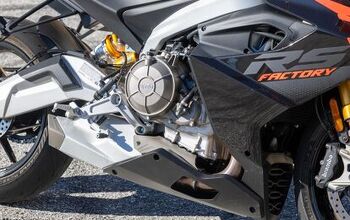
At a quick glance, the ritzy RS 660 Factory ($13,999) distinguishes itself from the base model RS 660 ($11,749) in ways that only matter to those who intend to push harder in the twisty sections of road: suspension. Where the standard machine uses quite capable KYB components, the up-spec Factory bolts on Öhlins kit, helping it double down in the handling department for an additional $2,250. Yes, the Factory version offers an exclusive “Dark Banshee” livery, but the gilded suspenders are what you’re paying for because the rest of it is the same: an updated engine, new electronic features, and stellar aluminum chassis. Short as the Factory list of differences may be, it makes a clear distinction as soon as you pull out of the parking lot: the RS 660 is the all-arounder, while the Factory makes no compromises with its athletic intent.
Aprilia’s lively 659cc Parallel-Twin engine remains the fiery heart and soul of the RS 660 platform. Engineers haven’t dulled its senses in the face of Euro5+ emissions, and in fact, its power seems a sniff more linear than before despite facing stiffer emissions. Larger 52mm (was 48mm) throttle bodies are fitted and work in conjunction with revised intake cams to help ensure tractable power delivery. Digging a bit deeper, the brand cites optimized valve bowl shaping, but that’s not all for this peppy little thing. Its 270-degree crank design helps deliver a torque-rich, characterful riding experience as well as a lovely exhaust note, quite reminiscent of the brand’s legendary V4 powerplants. In fact, the P-Twin takes quite a lot of architectural inspiration from the Noale-built 1,099cc superbike engines, now said to be borrowing their flywheel and intake manifold designs outright.

Among the other requisite tweaks is an updated tune, which bumps the rev limiter up 300 rpm to 11,800, sprinkling a touch more top-end zest into the mix. When strapped to the Motorcycle.com dyno, the RS 660 Factory puts down 89.9 horsepower at 11,300 rpm and 44.5 lb-ft of torque at 9,800 rpm through the rear wheel. Here’s how it plays out: it’s ready and willing to pull from the get-go, while its quick-revving nature encourages rpm exploration. Ample midrange runs right on through to the top end and while things taper at the tippy top, it won’t fall flat. It doesn’t overwhelm with brute superbike-level force, but it never feels lacking, either, and always keeps up the excitement. Heck, the P-Twin is comfortable at freeway speeds and hums along with the tach smack in the middle, leaving plenty of puff on hand to pass.
Oh, readers, this mill is a good one. There is a lingering hiccup specific to our North American market: the dreaded EPA noise emissions slump, a problem affecting a great many motorcycles in the United States, specifically. The power dip is still most noticeable in second gear, making itself known by sapping roughly 1,800 rpm worth of fun between 4,600 and 6,400 rpm. Importantly, the engine tweaks and mapping have certainly reduced the prominence of this lull, though we all know the solution: an ECU flash. Keeping the 659cc engine on the pipe and avoiding the dip can be done, though slow, tight sections of road will see you stepping into that emissions hole. Outside of that quirk, throttle response is clean and predictable in all five ride modes.

The gearbox itself is precise, but the bi-directional quickshifter receives mixed scores. It works as advertised when under load at higher rpm, delivering clean, clutchless shifts that suit spirited riding. However, grabbing a gear at low rpm can feel clumsy at times and occasionally requires more effort than expected. Around town or during relaxed riding, it sometimes reminds you that this system is happiest when the bike is being ridden with intent.
Aprilia is a brand synonymous with chassis development, which is traced directly to its dominance in the 250 Grand Prix World Championship. Less power means an even greater emphasis is placed on cornering abilities, which brings us to the RS 660’s class-leading twin-spar aluminum chassis. Tipping the MO scales at 403 pounds fully fueled, the engine-as-a-stressed-member design not only contributes to weight savings but aids in making things feel sportingly stiff. The middleweight Ape carves tidy lines wherever you guide it, staying composed yet responsive to any inputs. While smaller in stature, there are strong echoes of the RSV4’s impressive feedback ring true.

Of course, what helps bolster the handling narrative is the Öhlins suspension. The NIX 30 fork and STX 46 shock offer a wider range of adjustment than the KYB units found on the standard RS 660, and their actuation is noticeably more refined. The fork diameter grows from 41mm to 43mm, too, giving it an even stouter front-end feel. The setup is firm, no question about it, and the benefits are obvious when pushing hard on any remotely smooth surfaces. The bike remains composed under braking, steadfast under acceleration, and communicates clearly through both ends. On a winding mountain road, the RS 660 Factory is armed with all the right stuff to hunt down and fluster liter-bike riders with ease. Thankfully, the Factory shock’s damping adjustments are easily accessible. The base bike’s shock is hidden by the subframe and other bits, requiring owners to remove the left-hand side body panel off to access the rebound clicker.
When faced with beat tarmac, freeway expansion joints, and the like, the Factory transmits more feedback to the rider than the standard RS 660. Viewed through a sport rider’s lens, those are welcome attributes, though they are a double-edged sword in a way. Riders who prioritize comfort or spend most of their time commuting may find the KYB-equipped bike more agreeable, simply because the baseline setup isn’t as discerning. But for anyone with sportier intentions or track aspirations, the sturdy Öhlins stuff is the logical step forward.

Brembo’s tried-and-true M4.32 calipers return for another tour of duty, clamping onto 320mm rotors. Paired to a radial master cylinder, the braking system delivers strong stopping power with commendable feel at the adjustable lever. Managing speed while trail braking, lane splitting, or simply popping down to the shop is all done in a snap. We’ve also got steel-braided brake lines, which is a nice touch, too. Three-level ABS offers a range starting with maximum nannying meant for road use, all the way down to a front-only setting designed for the racetrack that will let you trail brake as deep as you’d like without any unwanted intrusion.
There are a few attributes where Aprilia marketers can throw around the term “class leading” and mean it, which is the case with its extensive six-axis IMU-supported rider aid package. Cornering ABS, lean-angle-sensitive traction control, wheelie control, engine braking management, throttle mapping, and cruise control are not new to the RS 660 platform. What is new are two functions that come to us directly from the RSV4: launch control and a pit lane limiter. Arguably, the 90-ish horsepower at the rear wheel is so manageable that these systems will be shut off by experienced riders, though they serve as a meaningful safety tether for those building their skills.

The riding modes offer meaningful changes in throttle response and electronic intervention rather than superficial differences. In calmer modes, the RS 660 Factory is approachable and easy to ride, even in less-than-ideal conditions. Switch to the more aggressive settings, and the bike feels sharper and more responsive, encouraging you to push harder. Describing things as a night-and-day difference would be a stretch, yet they are perceptible. While on the subject, we should mention that all this electronic wizardry is fiddled with via the new optically bonded five-inch TFT display. The UI isn’t the most intuitive, though a bit of prodding at the now-backlit switchgear and riders will figure it out.
The RS 660 platform is wound tight in the best way imaginable: a stout midsizer, ready to take on all comers. There are two sides to that middleweight coin, wherein its compact nature makes for cockpit accommodations that my 5-foot-10-inch frame can squeeze into, though taller riders may find it a little more challenging. Cozy works as a descriptor, but the rider triangle is one that informed its later competition, such as the Triumph Daytona 660 and Suzuki GSX-8R — riser handlebars integrated into the upper triple clamp combined with adequate leg room and an approachable 32.3-inch seat height. With your upper body propped up in an athletic position, the slightly canted-forward stance takes weight off your wrists without sacrificing front-end feel. It sits somewhere between a naked bike like the Tuono 660 and a traditional supersport, making it easier to live with on the street while still feeling purposeful.

Among all the platform updates, the Aprilia RS-GP-inspired mustache fairing is the most visually striking. According to the brand, the revised fairings improve airflow and stability and offer more effective cooling, but it’s worth noting that downforce expectations need to be realistic on a middleweight. Top speeds won’t be nearly as high as an RSV4, which can put downforce-generating aero features to good use. The updates here are aimed at improving rider comfort, and how beneficial they will be can depend on your physical size. Stuffing my frame behind the bubble is tricky, though shorter riders can manage.
Living with the RS 660 Factory highlights its dual nature. It’s perfectly capable of everyday riding, provided you’re comfortable with its firm suspension and sport-oriented ergonomics. Fuel consumption is reasonable, and the engine is engaging without being exhausting. At the same time, it truly shines when ridden with intent. Find a twisty road or take in a track day, and it proves its versatility every time. It is pricey and there’s no denying with its $14k MSRP, which is enough moolah to pick up quite a few different bikes, including larger-displacement options. The Aprilia is aimed at a particular type of rider, one that’s zeroing in on a midsized sport machine.

The 2026 Aprilia RS 660 Factory balances two opposing goals quite well, those being practicality and seriousness. It doesn’t dilute its performance to appeal to everyone, offering a chassis a genuinely impressive sporting experience. On the same note, it doesn’t take things to extremes and make it inaccessible in any capacity. Afterall, it is a middleweight and a seriously potent one at that. Instead, it offers a clear, confident vision of what a modern middleweight can be. For riders stepping up, it’s an inviting and rewarding next chapter. For experienced riders stepping down, it’s a reminder that enjoyment doesn’t necessarily follow the same path horsepower. Since its release in 2021, the RS 660 platform has pushed the envelope within its class and when dolled up in Factory trimmings, continues to that fine tradition.
Scorecard
Engine | 19/20 | Suspension | 15/15 | Transmission | 8/10 |
Brakes | 9/10 | Instruments | 4/5 | Ergonomics | 8/10 |
Appearance | 9/10 | Desirability | 10/10 | Value | 7/10 |
Editors Score: 89.0% | |||||
In Gear

- Helmet: Scorpion Covert FX
- Jacket: Alpinestars MO.ST.EQ Field WP Primaloft Jacket
- Airbag: Alpinestars Tech-Air 5 Plasma
- Gloves: Alpinestars Phenom Leather Air
- Pants: Alpinestars Cult-8 Jeans
- Boots: Alpinestars Superfaster Riding Shoes
2026 Aprilia RS 660 Factory Specifications | |
|---|---|
MSRP | Starting at $13,999 |
Engine Type | Parallel-Twin, 4-stroke, liquid-cooled with radiator and water-oil heat exchanger, double overhead camshaft (DOHC) with silent chain drive on the right side, four valves per cylinder. |
Bore And Stroke | 81 x 63.93 mm |
Displacement | 659 cc |
Compression Ratio | 13.5: 1 |
Horsepower | 89.9 hp at 11,300 rpm (measured) |
Torque | 44.5 lb-ft. at 9,800 rpm (measured) |
Fuel System | Electronic injection with 1 injector per cylinder and 2 motorized throttle bodies (ride-by-wire) with fixed length intake trumpets. 1 dynamic air intake. Selectable multimap. |
Ignition | Electric |
Lubrication | Wet sump with heat exchanger coaxial with oil filter |
Gears | 6 gears with Aprilia Quick Shift (AQS) up-and-down system |
Clutch | Multi plate wet clutch with mechanical control lever on left side of the handlebar. Anti-juddering and slipper clutch systems. |
Final Drive | 520 chain, 17/43 transmission ratio |
Electronic Management | 6-axis inertial platform, a-PRC suite which includes lean-sensitive ATC (traction control), AWC (wheelie control), AEB (engine brake management control), AEM (engine map management), cornering ABS (anti-lock braking system), Pit lane speed limiter, ALC (launch control), ACC (cruise control) 5 Riding modes (Road and Track, 3 fixed and 2 customizable) |
Frame | Adjustable composite structure double beam aluminum frame with cast elements. |
Front Suspension | Öhlins upside down fork ∅43mm adjustable for rebound & compression damping and spring preload. 4.7 inches of wheel travel. |
Rear Suspension | Alumin um swingarm with asymmetrical trusses. Öhlins shock absorber with piggy-back reservoir and adjustable preload and hydraulic brake compression. 5.1 inches of travel. |
Front Brake | Double 320mm discs, Brembo Monoblock radial calipers with 4 ∅ 32mm opposing pistons. Radial pump and metal braided brake hose |
Rear Brake | 220mm diameter disc; Brembo caliper with two ∅ 34mm pistons. Pump with integrated tank and metal braided hose |
Abs | Bosch 9.1MP Cornering ABS |
Front Wheel | Cast aluminum alloy 3.50 x 17 in. |
Rear Wheel | Cast aluminum alloy 5.50 x 17 in. |
Front Tire | Tubeless Pirelli Diablo Rosso IV radial 120/70 ZR 17 |
Rear Tire | Tubeless Pirelli Diablo Rosso IV radial 180/55 ZR 17 (alternative: 180/60 ZR17) |
Wheelbase | 53.9 inches |
Length | 78.5 inches |
Width | 29.3 inches |
Seat Height | 32.3 inches |
Rake / Trail | 24.3° / 4.1 inches |
Fuel Capacity | 4.0 gallons |
Curb Weight | 403.5 pounds (claimed) |

We are committed to finding, researching, and recommending the best products. We earn commissions from purchases you make using the retail links in our product reviews. Learn more about how this works.
Become a Motorcycle.com insider. Get the latest motorcycle news first by subscribing to our newsletter here.
A lifelong interest in anything with two wheels, Nic combined his passion for motorcycling with a rare and mysterious skill known as typing to join the motojournalism ranks. Motorcycle.com's Senior Editor and sometimes club racer displays an unrivaled desire to sample baked goods across the globe and partake in post-track day celebratory pizza.
More by Nic de Sena






Comments
Join the conversation
KTM's 990 Duke's quickshifter is similar. KTM maintains their own parts access direct. KTM should do a RC7 version of their 790 Duke. Think it would be a winner, just like the new 990 RC 8
I hate to be "that guy", because this was a thoroughly informative article. I just can't help but wonder if a 5-year old Gixxer wouldn't leave it for dead.