


2026 Harley-Davidson Road Glide Limited, Street Glide Limited Review

Testing two Grand American Touring machines

If a bat fought a shark, who would win? While this might sound like the sort of thing someone would ask at a cage fight in a gothic-themed sushi restaurant, this scene from one of Jacques Cousteau’s nightmares came to mind while testing motorcycles.
On a recent ride from a halcyon stay in Charleston, South Carolina, to the hullabaloo of Florida’s Daytona Beach Bike Week, Harley-Davidson rolled out its 2026 Street Glide Limited and Road Glide Limited models to test. Both of these exclusive models have many years of history, and both have received some major updates for 2026. Over 400 miles of riding helped demonstrate the improvements and upgrades, as well as some design aspects we might question on these flagship bikes.
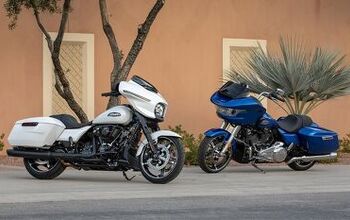
2026 Harley-Davidson Road Glide Limited
The combination of Harley’s Milwaukee-Eight VVT engine with its distinctive sharknose fairing arguably results in the smoothest long-haul touring motorcycle in Harley’s lineup. A powerful Skyline OS infotainment system, improved seating, and refined wind management make long days in the saddle feel effortless - even if the rider position might feel a bit small.
2026 Harley-Davidson Street Glide Limited
The Harley-Davidson Street Glide Limited blends classic Harley batwing styling with a modern refresh for 2026. New engine, new infotainment system, and a refined touring package bring contemporary performance and technology to one of Harley’s most recognizable touring machines.
Highs
- Ultra smooth 117 VVT engine
- Excellent wind management
- Highly legible and responsive TFT
Sighs
- Floorboards tucked in too far
- Lacks adaptive cruise control
- No interior luggage lighting
VIDEO: 2026 Harley-Davidson Road Glide Limited, Street Glide Limited Review
A Quick History — Two Philosophies of Touring

Both the Street Glide and Road Glide models come from Harley-Davidson’s Grand American Touring platform. However, they evolved differently. While the Street Glide moniker debuted in 2006, the iconic “batwing” fairing design can be traced back to early 1970s Electra Glide models. At the end of that same decade, Harley mounted the fairing to the frame of a Tour Glide motorcycle and the “sharknose” front end was born.
In the late 1990s, the sharknose fairing became the prominent feature of Harley’s Road Glide motorcycles. In today’s Harley-Davidson parlance, debate and decision between fork-mounted versus frame-mounted fairings for long-distance touring comes down to Street Glide versus Road Glide.

What’s New For 2026
Arguably, the most significant update to this year’s Street Glide and Road Glide motorcycles is the engine. The Milwaukee-Eight 117 engine now features variable valve timing, which was previously exclusive to Harley’s CVO and RevMax models. Where in some cases, VVT technology in motorcycles is primarily designed to take better advantage of high RPM, Harley’s low-revving and torquey 117 engine now boasts smoother throttle response at low RPM and stronger mid-range torque. The new powerplant claims 7% more torque and 14% more horsepower over 2024 models.

Heat management in the new engine has also been improved with a “center cooling” system. Redesigned cylinder heads now route a discrete liquid-cooling system around the hottest parts of the engine near the combustion chambers and exhaust valves, while maintaining the classic Harley air-cooled design for the cylinders.
After powering the bike up, riders are greeted with an updated infotainment interface on the 12.3-inch full-color TFT display. A faster processor and new Skyline OS offers customizable layouts, embedded navigation, and integrated ride modes. In addition to the factory-activated navigation, the display also features Apple CarPlay connectivity for navigation and use of all the other CarPlay bits (Android Auto is not available, but users can still connect their phones via Bluetooth).

While the engine and infotainment system updates aren’t readily apparent until the bike is fired up and ridden, some tweaks to the 2026 Limited bikes are noticeable at first glance. The redesigned fairings now have LED fog lights integrated into the fairing lowers, which also double as individual 4.2-liter storage compartments.
Redesigned Grand Tour Pak luggage has increased its overall capacity by 9% to 144 liters of combined storage. The top case has LED Tour-Pak lighting on the exterior, a 12-volt power port on the interior, and 68 liters of storage capacity — enough to hold two full-face helmets.

All these new updates ride on redesigned Showa suspension, which now features an easily accessible hand-operated rear preload adjustment knob, and dual outboard emulsion reservoirs replacing the previous single-sided system. Surprisingly, even with all of these updates, both of the Limited models have shed a significant amount of weight. The Road Glide lost 13 pounds compared to the 2024 model and the Street Glide leaned out by 24 pounds over the 2024 Ultra Limited version.
Also new for 2026 are the color options of Olive Steel and Purple Abyss. Had the latter color been around in 1984 Prince might have been riding a Harley instead of a Honda CM400A. However, I don’t think he would have changed the name of the movie to “Purple Abyss”.

Initial Impressions
Before wheels started turning, the large and vivid TFT display provided initial impressions of a bike with a lot of updates. The touch screen interface seemed flawless, even with gloved hands. Whether tapping the screen or pressing the handlebar switch cluster buttons, the new processor and Skyline OS seemed to live up to Harley’s claim of being faster and more responsive than previous infotainment systems.

Given that CarPlay is mostly uniform for any brand or vehicle, I opted to work with Harley’s factory-activated embedded navigation system. Developed in conjunction with an undisclosed “global leader in navigation, traffic, and map products”, pulling up locations and reviewing directions was straightforward, and enhanced by the infotainment system’s three layout options of Cruise, Sport, and Tour. The Tour layout provides a navigation-focused screen, with the map dominating over three quarters of the display.
Tunes Before Turns
Thankfully, neither the Street Glide Limited nor Road Glide Limited models skimp on storage. Aside from the panniers and behemoth top case, over eight liters of storage in the fairing lowers is mirrored by twin compartments in the Road Glide fairing, and a convenient pull-out tray on the Street Glide. Both the Road Glide’s right fairing compartment and the Street Glide’s storage tray have a USB-C power lead inside, and plenty of room for a full-size phone.

Pairing my phone via Bluetooth was an intuitive process which resulted in a stable connection over the next couple days of riding. Audio controls on the bike’s display allowed me to navigate a Pandora playlist running on the phone, and 200 watts of power split between the bike’s four Rockford Fosgate speakers did not disappoint. Even when wearing earplugs, the sheer volume of the system overpowered the plugs, helmet isolation, and road noise. I hope the local traffic field enjoyed the Primus concert.
The Lindy, the Charleston, and the Limited
Beginning the tour from The Lindy Hotel in Charleston, the obvious question came to mind: how would these bikes dance on the road? As I spun the Road Glide around to exit the first parking lot, it immediately felt more nimble than a visually-imposing machine like that might imply.

Some of both the Street Glide and Road Glide’s low-speed handling prowess could likely be credited to the new, smoother VVT 117 engine. Each pulse of the loping 45-degree V-twin felt like the edges had been rounded off. Personally, I never found the throttle response of the earlier 103 or 107 engines to be overly jerky or snatchy, but the new 117 VVT is impressively smooth by comparison. Whether cruising in sixth gear with the engine loping along just above 1,500 rpm or quickly banging through the gears up to redline at around 5,500 rpm, the 131 pound-feet of torque felt quite linear and built power in an even way, albeit in a rapid way as well — redline comes up quick, and you’ll find yourself swiftly reaching sixth gear on hard acceleration.
With the addition of ride modes, different engine and throttle profiles can be selected either from the three presets of Road, Sport, and Rain, or tuned to your liking in the Custom mode. The latter offers individual adjustment of engine torque delivery characteristics, engine braking, throttle response, traction control, and ABS. For long days in the saddle while operating the infotainment system, a particular arrangement of the Custom mode became my go-to choice.

Overall, Sport mode offered the most connected feel to the bike. However, while navigating the infotainment system with the right-side switch cluster during a long tour, the highly reactive throttle in Sport mode could feel slightly jerky as my throttle hand became less precise on the gas, while attention was directed to flipping through a playlist. Copying the Sport mode profile into the Custom mode, and then dialing back the throttle response a notch or two (as well as engine braking) created a mode with the preferred power delivery, and a smoother throttle which required less diligence.
Fairing Fundamentals
Even before getting the bikes up to speed, the fairing differences set them apart. Weight of the Road Glide’s ravenous sharknose fairing is carried by the frame, whereas the Street Glide’s vampiric batwing fairing ties its bulk to the fork. Aside from the visual aspects, storage differences, and wind-management solutions, slow-speed maneuvering feels quite different between the Street Glide and Road Glide models. Deciding which is better is a very personal choice — a theme that will be repeated in this review.
Where the Road Glide has a noticeably lighter steering feel and requires less input on the bars, the Street Glide arguably has a more intuitive and connected steering characteristic, with a fairing that points you where you’re going and gives you more steering feedback through the bars.

Front-end philosophy between the Street Glide and Road Glide models is equal parts form and function. The classic look of the Street Glide’s batwing fairing also provides a more “classic” ride feel. At highway speeds, wind forces on the fairing can translate to the handlebar. That feedback creates a sensation of being more involved with the ride — like you’re connected to the environment at a different level. It could also be argued that this additional sensory input might result in increased fatigue after many long miles in the saddle.

By having wind forces isolated from the handlebars, the sharknose fairing offers maximum smoothness and stability at highway speeds. In a very real sense, the Road Glide’s frame-mounted fairing design isolates you to a greater degree from the surrounding environment, and the road itself. The resulting effortless ride could be thought of as less visceral, and designed for longer tours.
Aboard either the Street Glide or Road Glide, engine heat was surprisingly minimal. In the hottest and slowest portions of the rides, some heat could be felt coming off the right side of the bike, but given the colossal look of the Milwaukee-Eight 117 and gleaming header pipes, the small amount of right-leg toastiness that was experienced was thankfully underwhelming. Furthermore, among the various airflow-management features, both the Street Glide Limited and Road Glide Limited incorporate adjustable vents in the fairing lowers which can help either break up or isolate heat around the floorboard area.

During a couple of the colder portions of the ride, firing up the heated grips revealed another welcome detail in the electronics package of both bikes — a bar end button. While activating the heated grips through the TFT menu is quite straightforward, there’s no need for it. Pushing in on the end of the left grip cycles through the four modes of low-medium-high-off, and activates an icon on the display indicating the currently selected mode.
Finding the Right Footing

From the fairing back, both the Street Glide and Road Glide models are essentially identical. The redesigned saddles on both bikes offered a level of comfort you’d expect of a long-distance cruiser. After two days and over 400 miles, I did not experience any pressure points or hot spots from the seat, lower back fatigue, or forearm issues from the large, heavy-cruiser style grips.
Everything was pretty much as I would wish for, with the exception of the knee angle and foot positioning. The floorboards seemed positioned farther back than I would have expected, while the highway pegs were pushed a bit farther forward than I’d like. To achieve what felt like an optimum knee angle, placing a toe on the highway peg and a heel on the floorboard seemed to sort out the rider triangle for my frame.

On a couple occasions, when jumping on the bike after a quick stop I would find my feet perched precariously close to the outer edges of the boards. While my boots never blew off the boards while riding, they do have a very tucked-in feel. I’m told this design is intentional to prevent anything from touching down before the bikes reach their maximum 31-degree lean angle.
Whether rolling over straight-line highway stretches or carving through twisty backroads, the redesigned Showa suspension seemed to live up to Harley’s claim of having improved damping response. Early into my ride, I was able to bottom the forks with a couple aggressive braking tests. What appeared to be soft and plush spring rates led to some doubt that the suspension would be entirely stable at speed, however I was pleasantly surprised by the handling of both the SGL and RGL after many highway hours in the saddle.

Rolling through sweepers with both early and late entries felt confident, and both bikes offered great mid-corner stability. Granted, this test was done without a passenger, and with virtually no luggage, so I may have been experiencing an ideal setup for a single rider. Thankfully, the new easily-adjustable rear preload knob offers quick adjustment without the need of tools or removing luggage. However, the range of preload adjustment is claimed to accommodate “an additional 100 pounds of cargo”. This cargo is referring to both passenger and luggage, which should work fine as long as your riding partner is a famine victim.
Police motorcycle rodeos might demonstrate the agility of heavy cruisers like the Street Glide and Road Glide models, but burning long road and highway miles is what these bikes were designed for. Part of the Grand American Touring platform’s genesis was U.S. soldiers returning from WWII and seeking out Autobahn-like roads for extended tours.

Fortunately, you don’t need to go through a war to appreciate the finery of Harley-Davidson’s new Street Glide Limited and Road Glide Limited motorcycles. Nor do you need to wrestle a shark or battle a bat. You just need to test ride both and decide which is for you.
Scorecard
2026 Harley-Davidson Road Glide Limited
Engine | 18.5/20 | Suspension | 13/15 | Transmission | 7.5/10 |
Brakes | 8/10 | Instruments | 5/5 | Ergonomics | 7.5/10 |
Appearance | 9/10 | Desirability | 8.5/10 | Value | 8/10 |
Editors Score: 85.0% | |||||
2026 Harley-Davidson Street Glide Limited
Engine | 18.5/20 | Suspension | 13/15 | Transmission | 7.5/10 |
Brakes | 8/10 | Instruments | 5/5 | Ergonomics | 6.5/10 |
Appearance | 9/10 | Desirability | 7/10 | Value | 8/10 |
Editors Score: 82.5% | |||||
In Gear

- Helmet: Arai CT-Z (discontinued)
- Jacket: Aether Mulholland
- Pants: Scorpion Covert Ultra Jeans (discontinued)
- Boots: Aether Moto Boot
- Gloves: Olympia 100 Mens Roper Classic
Specifications | 2026 Harley-Davidson Road Glide Limited | 2026 Harley-Davidson Street Glide Limited |
|---|---|---|
MSRP | Starting at $32,999 | Starting at $32,999 |
Engine Type | Milwaukee-Eight 117 VVT, air/liquid-cooled 45° V-Twin, single cam actuating four valves per cylinder via pushrods and hydraulic valve lash adjustment | |
Capacity | 1,923cc (117ci) | |
Bore x stroke | 103.5 mm x 114.3 mm (4.075" x 4.50") | |
Compression Ratio | 10.3:1 | |
Horsepower | 106 hp at 4,600 rpm (claimed) | |
Torque | 130 lb-ft at 3,250 rpm (claimed) | |
Engine control | Electronic Sequential Port Fuel Injection (ESPFI) | |
Clutch | Mechanically actuated 10 plate, wet Assist & Slip | |
Transmission | 6-Speed | |
Primary Drive | Chain, 34/46 ratio | |
Final Drive | Belt, 32/68 ratio | |
Frame | Mild steel; tubular frame; two-piece stamped and welded backbone; cast and forged junctions; twin down-tubes; bolt-on rear frame with forged fender supports; MIG welded. | |
Front Suspension | 49mm Dual Bending Valve fork; 4.6 inches of travel. | |
Rear Suspension | 3 in. Dual adjustable emulsions suspension with remote preload adjustment on the left shock, and threaded preload on the right shock; 3.0 inches of travel. | |
Front Brake | Dual 4-piston fixed axially mounted calipers, 320mm discs | |
Rear Brake | Single axially mounted caliper, fixed 300mm disc | |
ABS | Standard | |
Rake / Trail | 29.25° / 6.8 inches | 29.25° / 6.7 inches |
Wheelbase | 64.0 inches | |
Front Wheel | 3.50 x 19" Cast Aluminum | |
Rear Wheel | 5.0 x 18" Cast Aluminum | |
Front Tire | Dunlop Harley-Davidson Series D408F, 130/60B19 M/C 61H | |
Rear Tire | Dunlop Harley-Davidson Series D407T, 180/55B18 M/C 80H | |
Length | 103.3 inches | |
Width | 40.7 inches | |
Seat Height | 27.5 inches | 29.0 inches |
Curb Weight | 893 pounds (claimed) | 919 pounds (claimed) |
Fuel Capacity | 6.0 gal. | |
Warranty | 24 months (unlimited mileage) | |
Service Intervals | First 1,000 miles (1,600 km), every 5,000 miles (8,000 km) thereafter | |
2026 Harley-Davidson Road Glide Limited Review Gallery

2026 Harley-Davidson Street Glide Limited Review Gallery

We are committed to finding, researching, and recommending the best products. We earn commissions from purchases you make using the retail links in our product reviews. Learn more about how this works.
Become a Motorcycle.com insider. Get the latest motorcycle news first by subscribing to our newsletter here.
More by Jon Beck











Comments
Join the conversation
Harley builds big, slow motorcycles that make limited horsepower, have limited acceleration, limited suspension travel, limited cornering clearance and limited stopping ability?
And then, they put “limited” in the NAME of the motorcycles.
Now that’s MARKETING!
Love my new street glide. Iron Horse gray. Disappointed the installed map system does not allow skipping a way point.