


2025 CFMOTO 675SS Review

Another country tries its hand at a 675cc Triple

For years, Chinese motorcycles have been called cheap knockoffs lacking both performance, refinement, and quality. These stigmas weren’t born out of thin air — there are tons of Chinese-made motorcycles that exemplify the stigma. It’s become so commonplace that we’ve automatically assumed everything that comes out of China is junk.
CFMOTO has been working hard to break that mold, and the 675SS is the latest example of that effort. In case you missed it, we’ve ridden quite a few CFMOTOs over the years. We tried our hands on the CL700CL-X back in 2022 and were impressed enough to include it in our Budget Bike Battle the following year. In that same year, guest contributor Will Roberson threw a leg over the 450SS, which intrigued me enough to include it in a comparison test between it and the Aprilia RS 457 on both the street and the track, where it had no problem holding its own. But we’re not done! We followed that up with a review of the 800NK in 2024, and Ryan flew all the way out to the Philippines to give CFMOTO’s dirt offering, the Ibex 450, a proper rip. And while none of these bikes were perfect by any means, they are much better than past Chinese bikes we’ve ridden. Each time we came away thinking that CFMOTO is doing everything it can to shed the stigma around Chinese motorcycles.

2025 CFMOTO 675SS
CFMOTO chose a distinctive number and engine configuration for its latest sportbike, but unlike its British counterpart, the CF carves a lane for itself for packing a lot of features for not a lot of money.
Highs
- Lots of bang for the buck
- Impressive tech for the money
- It looks good, too
Sighs
- Top end power is a little lacking
- Brakes could be stronger
- Weird ergonomics
Which leads us to the 675SS. Based on everything we’ve experienced with the brand so far, the 675SS came to us with a certain level of expectations. First and foremost: will it continue to shed the negative stigma like all the CFMOTO’s we’ve ridden before it? Naturally, we were keen to find out.
First thing’s first: the 675SS is $7,999. Trying to find comparable bikes in this price range is difficult because middleweight “sporty” bikes with similar engine sizes like the $9,199 Yamaha R7, $9,195 Triumph Daytona 660, $9,699 Suzuki GSX-8R, and $11,749 Aprilia RS660 all cost significantly more, while lower displacement models like the $7,399 Honda CBR500R, and even the $6,899 Aprilia RS 457 might be closer in price, but don’t match the CFMOTO’s power or performance. Really, that leaves us with Kawasaki’s Ninja 650, which starts at $7,599 sans ABS. Add ABS to match the 675SS and you’re at $8,199. That’s close enough, we think.

With the market placement out of the way, we can take a closer look at what the 675SS brings to the table. To do so, we rode the bike on the street in and around our SoCal digs to get a feel for its road manners, then we took it to Chuckwalla Valley Raceway to really see what it could do. The result? Something more of a mixed bag.
The Styling
Who wants an ugly motorcycle? CFMOTO didn’t think so either. Styling is an important part of any motorcycle purchase, but when you’re dealing with this price point, you’re also generally dealing with a younger demographic. To them, a motorcycle should appeal to their youthful senses and tastes.

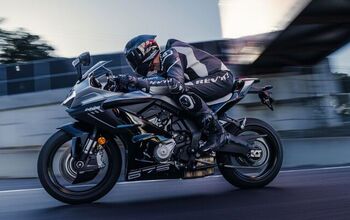
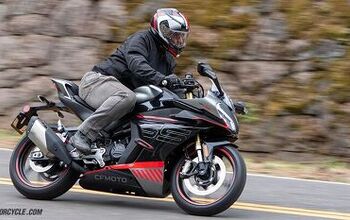
That’s where CFMOTO hit the mark. Looking at the 675SS, you can see the family lineage that came from the 300SS and 450SS before it. You have the distinctive nose and headlight, plus the sharp lines and angular cuts that look edgy and, visually, put a lot of the weight forward. There are even winglets integrated into the overall design, not just slapped on the side to look like extensions. Move to the rear of the bike and, visually, it’s pretty sparse with just the tail of the bike holding up the LED light bar that serves as the brake light and turn indicators. It looks futuristic — almost like they came out of a “Tron” movie. If you’re old enough to remember the movie, the first one, then this may not be for you — it’s certainly distinctive and anything but bland.
The Engine
If imitation is the best form of flattery, then Triumph should be flattered CFMOTO chose to stick a 675cc Triple in this bike. However, the engine size and number of cylinders is where the similarities end. This is not a knockoff of the Triumph engine, but a clean-sheet CFMOTO design. With a bore and stroke of 72mm x 55.2mm, it isn’t at all the same as the Triumph’s 76mm x 49.6mm. Both are DOHC engines with four valves per cylinder, but the CF’s compression ratio of 11.5:1 also doesn’t match the 13.0:1 the Daytona was using back in the day.

There are other differences as well, but I think you get the point. The Daytona 675 was far more performance oriented while the CF is tuned for the street. In the end, CFMOTO claims crankshaft figures of 95 horsepower at 11,000 rpm and 51.6 lb-ft of torque at 8,250 rpm. On the dyno, I was able to get 79 hp at 10,500 rpm and 46.8 lb-ft. at 8,200 rpm to the 675SS’ back tire. Back in 2013, we coaxed 110.8 hp at 13,200 rpm and 48.8 lb-ft. to the back tire of the Triumph 675R we were testing. Clearly a big difference, and in our minds, enough to end the CFMOTO vs Triumph comparison.

Looking at the dyno chart above, quite a few things stick out. For one, the waviness of the graph leaves room for improvement in the fuel mapping. The weird dip at around 9,000 rpm before it rises again to its peak power near redline is also strange. It seems as though the engine is willing to make more power as the revs climb (which performance-oriented engines tend to do), but the mapping culls the power towards the top, presumably for emissions and/or regulatory reasons. To the CF’s credit, you’re getting most of the bike’s torque early on, and it stays throughout the rev range. This certainly helps in everyday riding.
In the real world, the engine is easy to get along with. It makes that familiar three cylinder sound, with smooth fueling and decent grunt when you ask for it. Despite what the dyno might show, the objective of a streetable engine is achieved here, as the healthy mid-range lets you be relatively lazy with the gears. The old-school, cable-actuated throttle is a throwback to a bygone era in all the best ways. Sure fly-by-wire throttle is technically better because it allows more data to be captured for modern amenities, but the natural feel from the cable throttle is nice to experience again. Take advantage of the slick quickshifter and change up through the gears without the clutch as slick as you like, even from first to second. CFMOTO even includes a mounting position for the shift rod on the other side of the shifter arm, so you could switch to reverse shift in a matter of minutes. Clever.

We chose to ride with our friends at Race Pace Trackdays as we like their no-sessions format, which meant I could spin as many laps as the fuel tank, or my body, would allow. Chuckwalla’s layout favors momentum over power, which should favor the 675, but nonetheless, the bike felt noticeably flat upstairs. Riding alongside former MO staffer Tom Roderick aboard his personal Kawasaki Ninja 650 racebike circa 2007, I was surprised to discover the 675SS basically matched the Ninja for power. Granted, Tom’s Ninja is significantly lighter after going on the race bike diet program, but I was hoping the 675 would have … more. The CF gets off a corner nicely and with smooth power delivery, but it revved a little slower than I thought it would. The milder street environment didn’t bring this out, but it was noticeable on track.
I was also surprised I spent the vast majority of the lap in either third or fourth gear. I expected to be rowing through more gears, including the last two, considering the lack of power, but the bike’s gearing is broadly spaced and negates the need for more than one shift in either direction once up to speed. It was actually quite nice. More shifts mean more opportunities to mess up, so dedicating less brain power to shifting allowed me to focus on the rest of the bike and maximizing momentum. There’s no autoblip downshift feature here, as the cable-actuated throttle makes that difficult. Despite the fact some of its competitors offer the feature, they also cost significantly more. For the CF’s price, omitting a bi-directional quickshifter isn’t a big deal. The clutch pull is light enough.

There was one major concern I had with the engine: it ran extremely hot at the track. I saw coolant temps on the dash reach as high as 232ºF (111ºC). This was while riding too, not simply sitting idle in the pits for long periods of time. I verified that, yes, there was coolant in the reservoir and it was at the proper levels, and yes, the fans were trying their mighty best to keep temps under control. Granted, our trackday was run in 100ºF weather, but it still seemed out of the ordinary, and I don’t remember other bikes running this hot. It also wasn’t something I experienced at the dyno, either. A quick shout to our CFMOTO rep revealed that the high-temp warning light comes on at 239ºF (115ºC). Since the bike was running normally otherwise, and each time I came off the track I didn’t see or smell anything out of the ordinary, I continued with our testing.
Electronics
It wasn’t too long ago that having a basic electronic suite on a sub-$8,000 motorcycle would be unheard of. But the times are changing, and the 675SS comes standard with three levels of traction control (2, 1, and off) that you can adjust from the menus on the five-inch TFT screen (it’s a nice one, too), or you can turn it off via a button just beside the high-beam button. There’s also ABS, but it’s not adjustable, nor can you disable it, as is fairly common in this segment. The Aprilia RS660 gives you the ability to disable rear ABS and has IMU-assisted capabilities, but again, its price tag reflects as much.

Considering the perfect riding conditions we have here in Southern California, I left the traction control in level 1 (the least intrusive) for most of my time and never noticed it intervene on the street or the track. That could mean it’s unobtrusive, or there wasn’t enough power to light up the tire to begin with. Either way, it didn’t get in the way of the ride. As for the ABS, smooth application of the brakes keeps the ABS at bay. It was never an issue on the street, and only twice on track did I stab the brakes a little too hard and feel the ABS pump the lever while I was squeezing it. That said, Chuckwalla is easy on brakes, so my experience could have been very different at a heavy-braking track. Considering the stickiness of the Metzeler Racetec RR rubber underneath me, I was confident in the grip I had, and would have preferred an option to turn ABS off. That said, I still think ABS overall is a net positive and wasn’t a bother for the majority of the track riding.
The overall braking system consists of 300mm discs clamped by four-piston J.Juan radial-mount calipers. There’s even an air scoop attached to the fork to help cool them off. Scroll up and you’ll notice steel-braided lines connected to a radial master cylinder.

On paper, those are the ingredients for a solid braking system, and yet the brakes feel soft at the lever. Not at all dangerous, but considering the components, I thought the lever would be a little firmer. There’s plenty of braking power for the calmer street environment, where this bike will spend most of its life, and the amount of lever travel could appeal to those who prefer longer lever stroke. During our street testing, ABS only activated over a particularly choppy section of road that’s a real challenge for a lot of bikes we test.
While stopping power itself is linear and plenty powerful for street riding, I’m often an advocate for more aggressive pads. The same applies here. Same with a different master cylinder. The tricky balancing act is being able to take advantage of either modification without triggering the ABS sooner than you’d like.

One particular feature I was surprised to see on the 675 was a tire temperature monitor. Sure tire pressure monitors are commonplace (at least on more expensive touring and naked bikes), but this is the first I’ve seen temps getting measured, and certainly the first I’ve seen a sportbike in this price range feature both capabilities. A secondary feature of the TPMS inside the wheel, I used my own tire pressure gauge to verify the accuracy of the bike’s TPMS (there was only one PSI difference). Since I don’t have a way to measure tire temps, I could only assume the tire temp was fairly accurate, too. To clarify, we’re talking about the internal air temp inside the tire, not the temperature of the rubber or carcass itself. If that were the case, the numbers would be entirely too low. Nonetheless, it’s a cool feature. I even caught myself staring at the dash at different times on the highway to notice any differences from the last time I took a glance.
Chassis, Suspension, Ergonomics
If you’re used to reading reviews about other bikes in this budget category, you’ll know that the low price point is reached by sacrificing braking ability and/or cheaping out on suspension. For the price, CFMOTO offers quite a lot in both departments. On the chassis side, the frame has a good balance of stiffness for spirited street riding while still holding its own on track. The bike feels neutral, either on the street or track, the bars are wide enough to flick it fairly easily, and there’s decent feedback at all lean angles. Plus, there’s adjustable suspension — a rarity in this price range!

The fork offers preload, compression, and rebound adjustments, while the shock lets you play with preload and rebound. On the street, the shock struggled with the initial damping of sharp bumps on the road, causing an initial jolt before the shim stack would open to allow oil through, but at a place like Chuckwalla, that’s relatively smooth in comparison, both ends provided the support and feedback I wanted. All I had to do was stiffen the adjusters at both ends two turns. Even spring rates seemed well suited to my 168-ish pounds (sans riding gear). If I was being picky, I’d add more preload to get the bike on its nose a little more, but obviously your experience will vary.
There’s a caveat when it comes to the 675SS’s chassis and suspension and it ties into the bike’s ergonomics. CFMOTO markets the 675SS as a streetable sportbike, meaning there are elements of comfort for the real world sprinkled in with its performance flair. I’ll give it credit for having a well-padded seat, but after that the 675SS is all sportbike. Whether that’s a good thing or not is entirely up to your tastes. The tank is slightly on the long side and the clip-ons are mounted in line with the triple clamp. This puts you in a classic sportbike stance. In fact, it reminds me of the Yamaha YZF-R7 and the YZF-R9 in that regard.

The real oddity isn’t up top, but down below. The footpegs are both forward and high compared to typical sportbike setups that place the pegs rearward. For my 5-foot, 8-inch frame and 30-inch inseam, it created some awkward body positioning. Instead of the knee bend being extreme, as is the case on other sportbikes that have pegs up and back, in this case my hip angle was tight, which created its own discomforts. After having ridden a few CFMOTOs now, I’m noticing a trend — we usually praise the overall bike, but often complain about the pegs being in weird positions. The 450SS, CL700, and even the 800NK, to an extent, are all guilty.
The Best Bargain Sportbike?
Constantly during our testing of the 675SS, I’ve had to remind myself of just how little the bike costs. The 675SS is proof that CFMOTO is serious about building competitive motorcycles. It’s not perfect — the engine feels a step behind its natural rivals, the brakes need more bite, and the ergonomics are a little weird. But again, it’s only $7,999. For that price you have a chassis, quickshifter, and a surprising level of tech that shows that CFMOTO is not just “good for a Chinese bike.” Plus the fit and finish is solid, too.

The 675SS makes a strong case as an affordable middleweight sportbike with real potential, especially if the aftermarket gets involved. If the CFMOTO 450SS grabbed your attention as a first bike and you’re ready to graduate, the 675SS is a natural next step. I know my sample size of one doesn’t amount to much, but I’m already seeing more and more CFMOTOs out and about in the greater Southern California area. Perhaps we’re no longer trying to convince the masses that CFMOTO is legit. Now it’s time for competitors to take notice.
In Gear: Street

- Helmet: Arai Corsair-X Doohan Re-Style
- Jacket: Vanson Full Throttle
- Airbag: Alpinestars Tech-Air 5 Plasma
- Pants: Alpinestars Cult-8
- Gloves: Alpinestars Phenom Leather Air
- Boots: Sidi Rex Air
In Gear: Track

- Helmet: Arai Corsair-X Doohan Re-Style
- Suit: Vanson Velocity One Piece Leather Suit
- Airbag: Alpinestars Tech-Air 7X
- Gloves: Alpinestars GP Pro R4
- Boots: Sidi Rex Air
Scorecard
Engine | 16/20 | Suspension | 12/15 | Transmission | 8/10 |
Brakes | 7/10 | Instruments | 5/5 | Ergonomics | 7.5/10 |
Appearance | 9/10 | Desirability | 8/10 | Value | 9/10 |
Editors Score: 81.5% | |||||
2025 CFMOTO 675SS Specifications | |
|---|---|
MSRP | Starts at $7,999 |
Engine Type | Liquid-cooled DOHC Inline-Three |
Bore x Stroke | 72 mm x 55.2 mm |
Displacement | 674cc |
Compression Ratio | 11.5:1 |
Fuel System | EFI |
Starter | Electric |
Lubrication System | Pressure splash |
Horsepower | 79.8 hp at 10,500 rpm (measured) |
Torque | 46.8 lb-ft. at 8,200 rpm (measured) |
Final Drive | Chain |
Clutch | Wet multi-plate clutch |
Transmission | 6-Speed |
Front Fork | ⌀41mm KYB inverted fork, with adjustable preload, compression and rebound; 5.1 inches of travel |
Rear Shocks | KYB central monoshock, preload & rebound adjustable; 1.8 inches of travel |
Front Brake | ⌀300mm twin discs, four-piston radial J.Juan calipers |
Rear Brake | ⌀240mm single disc, single-piston sliding caliper |
Front Tire Size | 120/70 R17 CST S3N |
Rear Tire Size | 180/55 R17 CST S3N |
Wheelbase | 55.1 inches |
Fuel Capacity | 4.0 gallons |
Instrumentation | 5-inch TFT |
Rake/Trail | 23.7º/3.7 in. |
Length | 79.5 inches |
Width | 28.6 inches |
Height | 43.5 inches |
Seat Height | 31.8 inches |
Ground Clearance | 5.5 inches |
Curb Weight | 434 pounds (claimed) |
We are committed to finding, researching, and recommending the best products. We earn commissions from purchases you make using the retail links in our product reviews. Learn more about how this works.
Become a Motorcycle.com insider. Get the latest motorcycle news first by subscribing to our newsletter here.
2025 CFMOTO 675SS Review Gallery
Troy's been riding motorcycles and writing about them since 2006, getting his start at Rider Magazine. From there, he moved to Sport Rider Magazine before finally landing at Motorcycle.com in 2011. A lifelong gearhead who didn't fully immerse himself in motorcycles until his teenage years, Troy's interests have always been in technology, performance, and going fast. Naturally, racing was the perfect avenue to combine all three. Troy has been racing nearly as long as he's been riding and has competed at the AMA national level. He's also won multiple club races throughout the country, culminating in a Utah Sport Bike Association championship in 2011. He has been invited as a guest instructor for the Yamaha Champions Riding School, and when he's not out riding, he's either wrenching on bikes or watching MotoGP.
More by Troy Siahaan





Comments
Join the conversation
Does the 675NK have the same engine heat/temp issue?
Just make your check out to the CCP. It will come back to you one day.