


Continental ContiAttack SM2 Review

An all-new trackday tire for lightweight bikes

Two of my favorite things in motorcycling are lightweight sportbikes and trackday tires. The former delivers on the fun quotient without the hit to the senses (or the wallet) as big bikes, and the latter enables all that fun without the added hassle of tire warmers and the associated bits and bobs you need to use them.
This is why trackday tires have grown in popularity. Lots of brands have their own versions, including Continental with its Race Attack and Sport Attack rubber. However, Continental discovered its tires weren’t ideally suited for lightweight bikes, which have also grown in popularity. We’re talking bikes 500cc and under. Everything from Yamaha R3s, Kawasaki ZX-4RRs, and even supermotos. The problem stems from the carcass and the structure of Conti’s tires not being able to flex and deform enough to reach optimal temperature. The little bikes simply weren’t stressing the tires like a supersport or superbike and weren’t generating enough heat, and thus, grip.

Enter Continental’s answer: the ContiAttack SM2. The SM2 is Continental’s third-generation ContiAttack supermoto tire and, despite the name, is designed specifically for lightweight bikes, supermotos or otherwise. If all you care about is how they did it, then the answer is by using a softer carcass. But you know there’s way more to it than that, as Continental incorporated its full onslaught of tech into the SM2. If you feel like nerding out, follow the slightly technical dive below. My riding impressions will come after.
Technology breakdown — what each bit actually does for you
BlackChili compound — Continental’s headline rubber tech that combines synthetic rubbers and tread mixtures with specific elements to best suit the tire’s intended use. It’s so specific, it’s only produced in Continental’s Korbach, Germany plant. The name is silly, but in this case what it means is the compound of the front tire is a full silica recipe that warms up extremely quickly and has more flex to provide grip even in wet or cold conditions. New resin mixtures make the SM2 even more sticky than its predecessors, too.
MultiGrip — You’ve heard of dual compound technology in tires, where the sides are softer than the middle for cornering grip and higher mileage. The SM2 (and other Conti tires with MultiGrip technology) achieves this same thing, but not with two separate compounds glued together. Continental uses a single compound across the tire’s contact patch that gives you the same end result: a tougher center for braking/acceleration durability and softer shoulders for cornering grip. In the manufacturing process, the specific sections of rubber are heated and cured at different temperatures, pressures, and durations to achieve this goal. The end result is a seamless transition from upright to full lean and back.
TractionSkin — This is a rough tread surface that you can only see on a micro level. The point of it is to make tire “break-in periods” a thing of the past. In the old days, tires would have a mold-release agent to make it easy to get the tire out of the mold when it was done. You’d then have to ride the bike gingerly for a few miles to wear off that agent. The tire would be fairly slick otherwise. TractionSkin uses a completely different mold coating technology to get the tire out of the mold without the need for slick resins you need to wear off later.

ZeroDegree — This one’s almost self explanatory. The SM2, like so many radial tires, regardless of brand, uses a radial belt laid with near-zero degree steel cords. This helps prevent the tire from expanding while it’s spinning, while also helping it keep its shape while decelerating, both of which could severely impact handling if the belt wasn’t there. The result: rock-solid braking stability and predictable behavior at speed.
GripLimitFeedback — this is more an overall design philosophy and tread geometry than an actual technology, and it’s basically Continental’s way of saying the tire will communicate with the rider when at extreme lean angles, so you have as much warning as possible that the tire is reaching its limits. Of course, it’s up to you to actually heed the message.

While those are the technologies, the underlying “secret sauce” is that SM2’s carcass is more flexible — so much so that it has an H rating, compared to the W rating of the RaceAttack and SportAttack, meaning it’s only rated to 130 mph — with tread compounds that are also more flexible, resulting in fast warm-up times and maximum contact patches for little bikes.
Putting it to the test
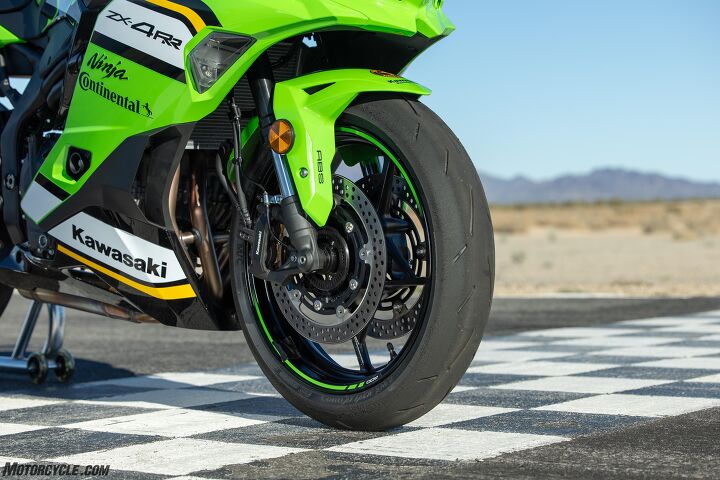
To see if the SM2 does what Continental says it can do, I was invited to Chuckwalla Valley Raceway and tried a set on a bone stock Kawasaki ZX-4RR. With not a lot of power, the test would be how quickly I could feel comfortable pushing the bike and tire combination to their limits (or mine, whichever came first). Apart from simply getting the tire up to working temperature quickly, I also wanted to see how much edge grip the SM2 would offer. Since small displacement sportbikes rely on momentum and corner speed, the sides of the tire have to be able to withstand high cornering loads. Chuckwalla’s layout is perfect for a test like this because its flowing layout plays into the strengths of low-horsepower, high corner speed machines.

I’ll get right to it: I was impressed. On my out-lap, I charged fairly hard into the second corner at Chuck to gauge any slippage, and when none appeared, I figured I’d go straight for knee-down by the next turn. I didn’t slam the bike on its side, but I was surprised by how fluid I could go from full upright to knee on the deck. From there, the first half of the lap was run at about an 80% pace, upping it to 90% by the second half, just to make sure the tires were nice and warm (they were).
From the second lap onwards, it became a test of what would flinch first, me or the tires. MotoAmerica crew chief, and Kawasaki test rider, Derek Keyes, took an identical ZX-4RR on the same tires out for some laps earlier in the day and told me he eventually didn’t touch the brakes at all for the second and third corners. In fact, he challenged himself to huck the bike into those corners faster and faster each lap. With this in the back of my mind, I tried doing the same.

Now, mind you, I’ll at least touch the brake on most bikes if for nothing else but to load the front before turning in. On the 4RR, a slight lift of the throttle before getting back on was what I could manage. The little Kawasaki charged into the corner with fluidity, needing very little input from me after I had initiated the turn. With the bike on my knee and the throttle nearly wide open, I was waiting for a sign that the tires were having enough. It never came. The stability and edge grip from the SM2’s were very impressive. Chuckwalla doesn’t have much in the way of hard braking zones, so evaluating front end stability on the brakes wasn’t in the cards this particular day.
However, Chuckwalla’s last corner, when run in the clockwise direction, is a double-apex, decreasing radius sweeper that you enter with some serious lean angle while trailbraking. No matter how brave I thought I was, the front SM2 never chirped, slid, hopped, or otherwise gave me a sign that it couldn’t handle the loads being thrown at it.

So, in the end, the answer of who would cave first was — me. I know some readers will wonder about lap times, and unfortunately, lap times weren’t taken at this test. Sorry, but riding impressions will have to do. That said, if chasing lap times is your goal, then a trackday tire is the wrong choice of rubber for you. By the end of the day, the tires looked surprisingly good, with little tearing and plenty of meat to easily do another trackday, or three. Chuckwalla is traditionally hard on tires, but the SM2s impressed by barely showing any signs of abuse.
The Continental SM is available in the following sizes:
Size | Front/Rear | Weight (lbs) | Price |
|---|---|---|---|
110/70R17 | Front | 9.8 | $256.45 |
120/70R17 | Front | 9.6 | $279.45 |
140/70R17 | Rear | 11.9 | $333.45 |
150/60R17 | Rear | 12.0 | $343.45 |
160/60R17 | Rear | 13.2 | $352.45 |
In Gear

- Helmet: Arai Corsair-X MVK Oakley
- Suit: Vanson Veolocity One Piece Leather Suit
- Airbag: Alpinestars Tech-Air 7X
- Gloves: Alpinestars GP Pro R4
- Boots: Alpinestars SMX-6 V3
We are committed to finding, researching, and recommending the best products. We earn commissions from purchases you make using the retail links in our product reviews. Learn more about how this works.
Become a Motorcycle.com insider. Get the latest motorcycle news first by subscribing to our newsletter here.
Troy's been riding motorcycles and writing about them since 2006, getting his start at Rider Magazine. From there, he moved to Sport Rider Magazine before finally landing at Motorcycle.com in 2011. A lifelong gearhead who didn't fully immerse himself in motorcycles until his teenage years, Troy's interests have always been in technology, performance, and going fast. Naturally, racing was the perfect avenue to combine all three. Troy has been racing nearly as long as he's been riding and has competed at the AMA national level. He's also won multiple club races throughout the country, culminating in a Utah Sport Bike Association championship in 2011. He has been invited as a guest instructor for the Yamaha Champions Riding School, and when he's not out riding, he's either wrenching on bikes or watching MotoGP.
More by Troy Siahaan






Comments
Join the conversation
It wasn't mentioned but were tire warmers used during this test?
That great and all but all TD providers here in CA only sell Pirellis. There are a few that maybe sell Michelins. Good luck having a guy selling Contis
Comment section is just become a clown show. No idea why Motorcycle.com doesn't send Imtoomuch a PM and tell him/her to do something worthwhile.