


2025 Harley-Davidson Pan America 1250 Special Review – First Ride

Milwaukee’s homebrewed ADV marches on

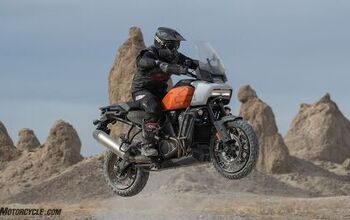
If you ask me, tradition is a dirty word. Placing ourselves in the hot seat, we've all heard the safe advice of "go to school, get a job, and get married." Those aren't bad pointers per se, setting our nation's youth on a traditional life trajectory destined for a white-picket-fence-shaped mortgage and healthy stability. Pah! But who wants that when we've got motorcycles? The perfect vehicle for any rebellious spirit! Much to the chagrin of any two-wheeled nonconformist, clutching at heritage hamstrings progress, and American V-Twin culture is certainly guilty of that time-honored rigidity. The only solution, then, is to build a machine capable of jumping your neighbor's pretty little fence — that's where the 2025 Harley-Davidson Pan America 1250 Special comes in.
2025 Harley-Davidson Pan America 1250 Special
Harley-Davidson turned heads when it launched the Pan America 1250 Special, creating a competitive ADV platform in its first attempt. Now, four years after its launch, we revisit the Pan Am outside Nelsonville, Ohio.
Highs
- V-Twin for the win!
- Great all-around ergonomics
- Versatile chassis
Sighs
- Dated electronics
- Snatchy fueling
- Wonky quickshifter and shifting part deux!

Harley's Pan America 1250 Special turned heads when it launched in 2021 because of what it's not: a cruiser. Though there are far more genre-defying layers to explore, as it's a bold play for any manufacturer to jump into the ultra-competitive and high-tech liter-class ADV field, let alone one that hasn't dabbled in the dirt since Disco dominated. Back to the matter at hand: in its maiden model year, the Pan Am was America's top-selling ADV machine, cementing its place within the category. Now, four seasons after its debut, we find ourselves in Nelsonville, Ohio, a heartland locale with quality on- and off-road riding abound.
What's new in 2025? Paint options. H-D's ADV platform received its most significant technical update in model year 2024, revamping its entire electrical and charging system, which starts with a more robust wiring harness. Following that up, a new stator and rotor increase the charging system's low-rpm output by 14 percent, backed by a larger battery with a higher cold-crank rating. The result is a Pan Am platform that can support additional powered accessories without being overwhelmed. When coupled with the bike's various software updates, all serve to address electrical gremlins seen in prior-year examples. According to H-D staff, these upgrades are backward compatible with 2021-2023 models. Consult your authorized dealer for more information.

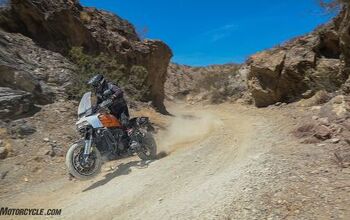
The 2025 Harley-Davidson Pan America 1250 Special starts at $19,999. Shown above in the optional Blue Burst (+$550) colorway, our test units were equipped with a host of off-road-ready parts, including tubeless wire-spoke wheels ($1,000) and the 11-inch Adventure windscreen ($160). In addition, a host of Screamin' Eagle-branded crash protection was installed, including a sturdier skid plate ($399), brush guards ($320), headlamp guard ($125), radiator shield ($175), exhaust shield insert ($85), muffler guard ($171), rear brake reservoir guard ($60), and 'Street Cannon' muffler ($1,025). Both Adaptive Ride Height ($1,200) and the bi-directional quickshifter ($340) are optional on the Special, although they are standard on the Pan America 1250 ST. Lastly, H-D tossed on a set of Michelin Anakee Wild tires for ADV duty. That brings us to an as-tested price of $25,609 (excluding tire pricing).
Homework: done. Now, for the fun stuff. The Motor Company went all out when it developed the aptly named liquid-cooled Revolution Max 1250 engine, looking toward a future that doesn't include pushrods. It kicks Milwaukee engine convention to the side in favor of a modern roller-finger (AKA finger-follower) valvetrain and maintenance-free hydraulic lash adjusters. Yet, there are some aspects that the Bar & Shield brand won't stray from, and that's its V-Twin configuration, tapping into a legacy of stump-pulling torque monsters while also incorporating new flair with a sportier 60-degree V-angle design.

See, the Rev Max is as comfortable revving out to redline as it is plodding along and letting its bountiful low-end do the heavy lifting. Thanks to its variable valve timing system, there's a heaping serving of punch just about wherever and whenever you need it. You're well taken care of in most circumstances, whether you're railing along the tarmac or feeding in its tractable power to steer with the rear while exploring Ohio's endless network of gravel roads. H-D claims 150 horsepower and 94 lb-ft of torque, but we've sized this lump up on the MO dyno before. With no notable mechanical changes since then, it's likely that the 124.6 horsepower at 8,800 rpm and 76.8 lb-ft of torque at 6,700 rpm to the rear wheel still stand.
It's a good'un in performance terms, and when comparing peak claimed figures, the Pan Am sits around the upper mid-pack in a stacked liter-class ADV field, which tends to favor twin-cylinder arrangements. Those include the BMW R 1300 GS ($19,495), Honda Africa Twin Adventure Sports ES ($$17,599), KTM 1390 Super Adventure R (MSRP TBA), Suzuki V-Strom 1050DE ($16,499), Triumph Tiger 1200 Rally Pro ($23,195), and Ducati Multistrada V4 S ($28,995).

The Pan Am keeps up with the Joneses, offering IMU-supported rider aids such as cornering ABS, lean-angle-sensitive traction control, and wheelie control. Cruise control, hill-hold assist, and a tire pressure monitoring system (TPMS) are also standard. Unlike the ST, the Special uses Showa semi-active suspension in conjunction with ARH. On deck, we have a plethora of riding modes, which all start with five presets: Rain, Road, Sport, Off-Road, and Off-Road Plus. Digging into the menu reveals two fully customizable modes, which, not unlike our experience with the Pan America ST, you'll make full use of, though for slightly different reasons.
The throttle response in any of the preset modes, namely those street-aimed, is sharp to the point of abrupt. Activating the custom settings in the 6.8-inch full-color TFT display allows full fiddling of the throttle response, power modes, engine braking, traction control, ABS, suspension damping, and ARH settings. With our route constantly changing between dirt and tarmac surfaces, it was wise to keep the Pan Am in its Off-Road modes primarily. Using the standard Off-Road mode, the TC is limiting to the point that ascending a mild incline on a gravelly surface felt like it'd elicit a stall at slow speed — akin to what we observed in the 2021 Ducati Multistrada V4 S which was subsequently massaged in later iterations.

Off-Road Plus does ease on the traction leash considerably while also disabling ABS in the rear, which is handy when getting the bike aimed where you'd like to go — rear ABS is too intrusive for that in the standard setting. However, Off-Road Plus is a decent starting point for those new to off-road riding, although it's sensitive to lateral movement. If the rider wags the tail end out beyond 15-ish degrees or initiates too much wheel spin, TC will step in. Meanwhile, front Off-Road ABS performance is quite impressive, especially on marbly trail surfaces.
Much like the ST, my preferred setting was found in custom mode: crank up the power while softening everything else to eliminate the snatchiness, and disable TC with its dedicated button on the right switchgear. The hiccup for certain riders is that it doesn't leave much wiggle room between Off-Road Plus and off. As tractable as the engine may be, we're still dealing with considerable power, and being able to work through a more refined selection of TC settings, like those offered by European competitors, would be highly beneficial. Likewise, wheelie control isn't independently adjustable and is coupled to TC, meaning that any entertaining loft over the many rises on our route elicits heavy intervention. That's all to say the Pan Am's rider aids keep up in spec-sheet shootouts but haven't progressed since their introduction and feel unrefined by today's cutting-edge standards.

The six-speed gearbox slots into gear sweetly, and with the optional bi-directional quickshifter installed, you'll be able to make quick work of it. Again, we experienced inconsistency, wherein gear changes could be incredibly clean or met with a harsh hit. Low-rpm performance is darn good, yet a few false-neutral instances occurred once again when downshifting from third to second. H-D staffers have since informed us that a software update is in the works, although we can't confirm when it will be available.
Turning our attention to the chassis, things look far brighter. The Pan Am's lengthy wheelbase helps this steed remain steadfast on- or off-road, allowing it to recover from slides nicely and stay on the straight and narrow. The 19-/17-inch wire-spoke wheel combo takes hits on the chin like a champ and settles into turns predictably. A quick note here is that our chunky Michelin Anakee Wild rubber, which provides good grip off-road, also affects the handling character. The street-oriented Michelin Scorcher Adventure will highlight its inherently agile nature a bit better. Not to nearly the same degree as the 17-inch wheel-equipped Pan America ST, but you get the idea. Tire and wheel choices have their positives and negatives, friends.

The Showa semi-active units and accompanying Adaptive Ride Height system remain unchanged for the 2025 model year, though they still perform admirably. A healthy 7.5 inches of travel front and rear is by no means the longest in class, but it is beyond capable when blasting along a few routes while catching up to the pack or when this scribe was let off the leash for a quick solo rip. Preload is automatically adjusted to aim for approximately 30% sag. Tarmac or no, the five semi-active settings offer a decent adjustment range, finding a good balance between comfort, feedback, and hold-up. Personally, my settings leaned toward the sportier end of the spectrum in any environment simply because it keeps things tauter and more predictable for this claimed 569-pound machine.
Ah, then there's ARH, a piece of technology that Milwaukee can claim to have pulled off long before any of the hoity-toity European brands did and have nearly all adopted since. It helps! The Pan Am's two-position seat measures 34.4 inches when in the high position, making it on par with many liter-class ADV. With ARH activated, the saddle is lowered to 33.7 inches in height, allowing riders to plant their boots on the deck in challenging situations or when stopped.
As we're circling the comfort topic, we might as well dive right in: the MoCo's ADV is a comfortable place to be. The adjustable windscreen has a decent range of movement, and the low position creates a sufficient pocket of air for my 5-foot-10-inch frame. Its handlebars sit a smidge high when seated for my liking, though all the controls are reachable when chilling out or standing up — there's an adjustable brake pedal, too. Knee bend is casual for my 32-inch inseam. The Special is also equipped with handguards, which is nice when doing a bit of bush hunting. Touring, commuting, and off-highway rips are accommodated nicely.
As we slow down here, we'll turn our attention toward the Brembo 4-piston calipers and 320mm rotors. Braking performance is good, and the linked braking system operates silently in the background. Where there is room for improvement is with the rear brake's single-piston caliper and 280mm rotor. Combined with the knobby Michelin rubber, amplified by sky-high OE-spec street pressures, it can be difficult to modulate, and locking the rear comes quickly. There's some benefit to that in an off-road setting when trying to set a trajectory, but there's a learning curve to be sure.

The ADV segment is arguably one of the most sophisticated segments in motorcycling, nipping at the heels of superbikes when viewed through that lens. It nearly goes without saying that engineering machines of this size to do half of what they do is an impressive feat, making Harley's worthwhile entry a noteworthy achievement.
Yet, four years is a long time in a class where its competitors are engaged in a perpetual game of one-upmanship. Its engine is keen, offering the kind of soul-satisfying V-Twin torque that Milwaukee is renowned for delivering. The chassis far exceeds the needs of our gravel paths, underscoring its skill on the road, while its comfort sprinkles extra favorable feelings on top. In this tech-laden class, the Pan America 1250 Special is starting to be held back by what could start being described as unrefined electronics. If nannies and the like are essential to you, that'll rate high. If you're of the old-school affinity, then you can work around it because the core bike is still a trailblazer. And one tradition worth keeping.
In Gear:

- Helmet: Arai XD-5
- Gloves: Alpinestars Morph Street
- Jacket: Alpinestars ST-7 2L Gore-Tex
- Pants: Alpinestars ST-7 2L Gore-Tex
- Boots: Alpinestars Tech 7 Enduro
Scorecard
Engine | 19.5/20 | Suspension | 13/15 | Transmission | 7/10 |
Brakes | 7/10 | Instruments | 5/5 | Ergonomics | 9/10 |
Appearance | 8/10 | Desirability | 8/10 | Value | 7.5/10 |
Editors Score: 85.5% | |||||
2025 Harley-Davidson Pan America 1250 Special Specifications | |
|---|---|
MSRP | Starts at $19,999 |
Engine | Revolution Max 1250 |
Valves | Chain-driven, DOHC, hydraulic self-adjusting lifters, intake & exhaust VVT; four valves per cylinder |
Bore x Stroke | 105 mm x 72 mm |
Displacement | 76.3 ci (1,252 cc) |
Compression Ratio | 13.0:1 |
Fuel System | Electronic Sequential Port Fuel Injection (ESPFI) |
Air Cleaner | Downdraft intake, tuned velocity stacks, washable filter media |
Exhaust | 2-into-1-into-1; catalyst in header |
Lubrication System | Semi-dry sump |
Horsepower | 150 hp at 9000 rpm (claimed) |
Torque | 94 lb-ft. at 6750 rpm (claimed) |
Final Drive | Chain, 19/48 ratio |
Clutch | Mechanical, 8 plate wet, assist & slip, 1090N |
Transmission | 6-Speed |
Frame | Stressed-member, high strength low alloy steel trellis frame; stamped, cast, and forged junctions; MIG welded; aluminum forged mid-structure |
Swingarm | One-piece cast aluminum |
Front Fork | 47mm inverted fork with electronically adjustable semi-active damping control and optional Adjustable Right Height (ARH). Aluminum fork triple clamps. |
Rear Shocks | Linkage-mounted monoshock with automatic electronic preload control and semi-active compression & rebound damping and optional Adjustable Ride Height (ARH). 7.5 inches of travel. |
Front Brake | Radially mounted, monoblock, 4-piston caliper, 320mm rotor |
Rear Brake | Floating, single piston caliper, 280mm rotor |
Front Wheel | 19-inch aluminum cast, satin black |
Rear Wheel | 17-inch aluminum cast, satin black |
ABS | Standard |
Tires | Michelin Scorcher Adventure, Radial |
Front Tire Size | 120/70R19 60V |
Rear Tire Size | 170/60R17 72V |
Rake / Trail | 25° / 4.3 inches |
Wheelbase | 62.4 inches |
Maximum Lean Angle | 42° left, 42° right |
Lights | Daymaker Adaptive LED Headlamp with 6-segment LED banking lamp, LED tail lamp, LED bullet turn signals |
Fuel Capacity | 5.6 gallons |
Instrumentation | 6.8 inch viewable area TFT display with speedometer, gear, odometer, fuel level, clock, trip, ambient temp, low temp alert, side stand down alert, TIP over alert, cruise, range and tachometer indication BT capable – phone pairing to access phone calls, music, navigation (H-D App ONLY) |
Length | 89.4 inches |
Overall Width | 38.4 inches |
Overall Height | 59.4 inches |
Seat Height | 32.7 inches, low seat position with ARH. |
Ground Clearance | 6.9 inches |
Curb Weight | 569 pounds (claimed) |
2025 Harley-Davidson Pan America 1250 Special Review Gallery

Become a Motorcycle.com insider. Get the latest motorcycle news first by subscribing to our newsletter here.
A lifelong interest in anything with two wheels, Nic combined his passion for motorcycling with a rare and mysterious skill known as typing to join the motojournalism ranks. Motorcycle.com's Senior Editor and sometimes club racer displays an unrivaled desire to sample baked goods across the globe and partake in post-track day celebratory pizza.
More by Nic de Sena






Comments
Join the conversation
Dear Harley. Nice try but no thanks.
My used 2025 (with factory upgraded charging system) is pretty neat - apart from the weird moaning/wailing intake sound and the fierce heat on the right leg. I can get used to the strange intake sounds but the heat come summer in Az. may prove to be too much.