


2026 Ducati Panigale V4 R — First Look

Ducati’s production superbike is more advanced than ever.

In Ducati land, the Panigale is the pinnacle of the brand. But when it comes to the pinnacle of Panigales, then that’s where the R model comes in. Following the release of the updated Panigale V4 S last year comes the much-anticipated Panigale V4 R. The Ducati Panigale V4 R has always been Ducati’s homologation special — the direct bridge between showroom and racetrack, built so Borgo Panigale can race, and win, in World Superbike, which limits four-cylinder engine displacement to 1000cc. For 2026, Ducati has pushed the R model closer to its MotoGP cousins, introducing features never before seen on a production motorcycle.
Engine: MotoGP Influence in a Street-Legal Package

Ducati trickles down its MotoGP tech more than any other manufacturer and we see that with the new V4 R. At the center is the 998cc Desmosedici Stradale R, now fitted with lighter cast aluminum pistons with DLC coating that shave off 5.1% of weight compared to the previous R model, gun-drilled titanium connecting rods with controlled shot peening at the big end, and a crankshaft with more rotational inertia (read: heavier), potentially slowing the engine’s rev characteristics to help make the power more manageable before the electronics kick in. Exhaust camshafts now have a different profile with a longer duration for a more complete burn. The secondary fuel injectors have been repositioned closer to the throttle body for smoother airflow, while a slight tweak to the front air intake — co-developed with Ducati Corse — adds a better ram-air effect that provides an extra 1.3 hp at speed. A new hi-flo air filter reduces the air pressure drop compared with a traditional paper filter. All in, the engine’s torque curve is broadened while throttle response has been further smoothed out.
Customers abroad, who get to experience the full potential of the engine, will be treated to a claimed power output of 218 hp at 15,750 rpm and 84.5 lb-ft of torque at 12,000 rpm. Bad news if you’re in North America, though — power gets cropped to 208.4 hp at 13,250 rpm and 83.7 lb-ft at 12,000 rpm. However, since the R is meant to be raced, Ducati, in cooperation with Akrapovič, have developed a track-only exhaust system with two silencers under the seat to extract maximum power from the engine. With it, Ducati says you get 235 hp and a weight savings of 14.5 lbs. If you want the absolute maximum — 239 hp — you can achieve it using Ducati Corse Performance Oil.
In another shocking claim, Ducati says redline sits at 16,000 rpm in most gears, with sixth stretching to 16,500 rpm. For reference, Kawasaki’s ZX-4RR, and its tiny pistons that fit into its 57mm bore, doesn’t even rev to 16,500 rpm. The fact that Ducati were able to make the V4 R, with its 81mm bore, rev that high speaks to the lightness of the pistons, among other things. Whether or not North American models will see a similar rev ceiling remains unknown as of this posting.
Aerodynamics: Corner Sidepods Make Their Debut

While wings have become commonplace, the V4 R debuts Corner Sidepods on a production bike. First seen in MotoGP in 2021, the sidepods generate downforce at lean, while the now commonplace winglets make downforce in a straight line. Downforce while leaned over increases grip and allows the bike to hold tighter lines mid-corner. Combined with the larger wings introduced on the 2025 Panigale V4, which provide up to 13.2 lbs of downforce at 186 mph, the result is greater stability under braking, the ability to hold tighter lines, and improved acceleration out of corners.
Chassis and Suspension: Tuned for Modern Slicks

Ducati’s Front Frame and Hollow Symmetrical swingarm carry over from the seventh-generation Panigale platform, which, if you remember, reduces lateral stiffness from the 2022 Panigale V4 in the front frame by 35% and 40% in the rear thanks to the double-sided swingarm. Unlike the semi-active suspension on the V4 S, the R model uses a fully mechanical Öhlins NPX25/30 fork and TTX36 shock to favor consistency over semi-active adjustment, while the new SD20 steering damper allows for finer tuning.
As expected on a homologation bike, geometry is widely adjustable. The swingarm pivot can be set in four positions, and the rear ride height adjustment can be changed via the tie-rod on the suspension linkage. The actual range of adjustment has been increased from 0.5 in on the previous R model to 1.27 in now. Ducati also prepped the chassis for a linear suspension travel sensor, tying into the Ducati Data Logger system for professional-grade data acquisition.
Gearbox: Race-Style Neutral

A first for a production motorcycle, the Ducati Racing Gearbox (DRG) adopts what superbikes and MotoGP machines have been using for years — placing neutral below first gear. This eliminates the risk of accidentally finding neutral between first and second while braking hard into corners. The Ducati Neutral Lock (DNL) system adds further insurance, requiring the rider to engage a lever at the right handlebar to put the transmission into neutral. The end result: faster, cleaner shifts and more consistent engine braking when it matters most.
Brakes, Wheels, and Tires

New Brembo Hypure calipers bite into 330 mm discs, designed for improved heat management and consistent performance over long stints. The forged aluminum wheels can be swapped for lighter carbon units via the Ducati Performance catalog. Street-legal Pirelli Diablo Supercorsa SP V4 tires come standard, but the chassis is homologated for the same slick sizes used in WSBK racing.
Electronics: Data-Driven Rider Aids

Ducati’s latest Vehicle Observer (DVO) algorithm refines traction, wheelie, and engine braking control. Race Brake Control allows more aggressive rear brake use at lean, helping riders brake deeper into corners with MotoGP-style precision. The 6.9-inch TFT carries over, but the R model adds a “Grip Meter” display for real-time traction feedback. It’s a race-only feature and only works with slicks or rain tires, but it helps the rider understand the level of grip they have at their disposal.
Ergonomics and Rider Interface
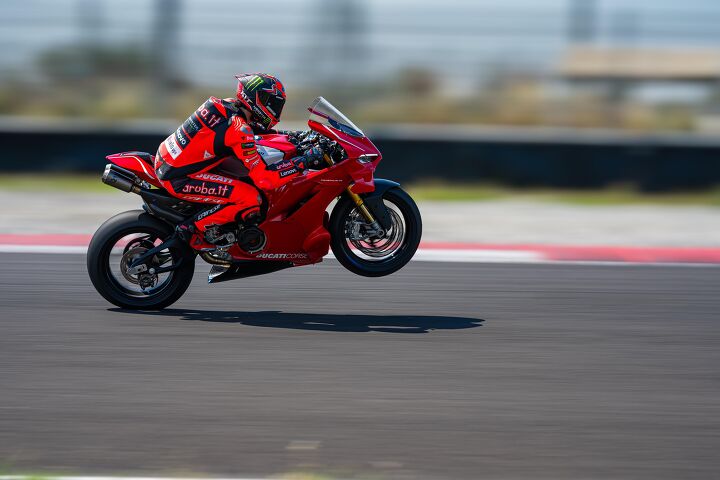
Small tweaks make the V4 R easier to ride at the limit. The footpegs are tucked 10 mm inward for better leverage, while the tank and seat layout give riders more support under braking. Together, these refinements make it easier to lock in an aerodynamic tuck or hang off the bike mid-corner.
Price and Availability

The 2026 Panigale V4 R will retail for $49,995 in the U.S., which neatly fits under World Superbike’s updated price cap of €44,000, or roughly USD $52,000, with availability beginning March 2026. Each bike is produced in numbered series, with the model name and serial number displayed on the steering plate.
The V4 R’s changes may look incremental on paper, but they reflect Ducati’s steady march of integrating MotoGP technology into its road bikes. With features like Corner Sidepods and a MotoGP-style gearbox, the 2026 V4 R is the clearest link yet between what Nicolo Bulega races on Sunday and what dedicated riders can buy on Monday.
2026 Ducati Panigale V4 R Specifications | |
|---|---|
MSRP | US$49,995 |
Engine Type | Desmosedici Stradale 90° V4, counter-rotatingcrankshaft, Desmodromic timing, 4 valves percylinder, liquid-cooled |
Displacement | 998 cc |
Bore x Stroke | 81 x 48.4 mm |
Compression Ratio | 14.0:1 |
Horsepower | 208.4 hp at 15,250 rpm (claimed, US-spec) 218 hp at 15,570 (claimed, EU-spec) |
Torque | 83.9 lb-ft. at 12,000 rpm (claimed, US-spec) 84.5 lb-ft. at 12,000 rpm (claimed, EU-spec) |
Fuel Injection | Electronic fuel injection system. Twin injectors per cylinder. Full ride-by-wire elliptical throttle bodies. Variable length intake system |
Exhaust | 4-2-1-2 system, with 2 catalytic converters and 4 lambda probes |
Gearbox | 6 speed (N123456 with Ducati Neutral Lock) |
Primary Drive | Straight cut gears; Ratio 1.80:1 |
Ratio | 1=36/15 2=34/17 3=33/19 4=32/21 5=30/22 6=27/22 |
Final Drive | Chain 520; Front sprocket 16; Rear sprocket 43 |
Clutch | Hydraulically controlled slipper dry clutch. Self bleeding master cylinder. |
Frame | Aluminum alloy "Front Frame" with optimized stiffnesses |
Front Suspension | Fully adjustable 43 mm Öhlins NPX pressurized fork with TiN treatment, 4.9 inches of travel |
Rear Suspension | Fully adjustable Ohlins TTX36 unit with adjustable rebound, compression and hydraulic spring preload, 5.1 inches of travel. Aluminum Hollow Symmetrical Swingarm. Adjustable pivot position +/- 3 mm. Adjustable pivot position +/- 3 mm .Adjustable rear suspension tie-rod length +/- 5mm |
Front Wheel | 5-spokes forged aluminum alloy 3.50" x 17" |
Rear Wheel | 5-spokes forged aluminum alloy 6.00" x 17" |
Front Tire | Pirelli Diablo Supercorsa SP-V4 120/70 ZR17 |
Rear Tire | Pirelli Diablo Supercorsa SP-V4 200/60 ZR17 |
Front Brake | 2 x Æ 330 mm semi-floating discs, radially mounted Brembo Monoblock Hypure 4-piston calipers. Cornering ABS with eCBS. Self bleeding master cylinder. |
Rear Brake | Æ 245 mm disc, 2-piston calliper with eCBS |
Instrumentation | Digital unit with 6,9" TFT display and Optical Bonding - 1,280 x 480 px resolution |
Wet Weight No Fuel | 411 pounds (claimed) |
Seat Height | 33.7 inches |
Wheelbase | 58.1 inches |
Rake/Trail | 24°/3.9 inches |
Fuel Capacity | 4.5 gallons |
Seats | Single seat |
Electronics | Riding Modes, Power Modes, Ducati Slide Control (DSC), Bosch Cornering ABS, Ducati Brake Light (DBL), Ducati Vehicle Observer (DVO), Ducati Traction Control (DTC) DVO, Ducati Wheelie Control (DWC) DVO, Auto tyre calibration, Engine Brake Control (EBC) DVO, Race Brake Control, Road eCBS |
Standard Equipment | Ducati Power Launch (DPL) DVO, Ducati Quick Shift (DQS) up/down 2.0, Full LED headlights with Daytime Running Light (DRL), Ducati Electronic Suspension (DES) 3.0 with Öhlins Smart EC 3.0, Lithium-ion battery, Quick adjustment buttons, Pit Limiter, Auto-off indicators, Forged aluminium wheels |
Ready For | Ducati Data Logger (DDL), Anti-Theft, Cruise Control, Tyre Pressure Monitoring System (TPMS), USB socket*, Ducati Multimedia System (DMS)*, "Turn By Turn" navigator* *Please refer to your local dealer for availability |
Warranty | 24 months unlimited mileage |
Maintenance Intervals | 12,000 km (7,500 mi) / 12 months |
Valve Adjustment Intervals | 24,000 km (15,000 mi) |

Become a Motorcycle.com insider. Get the latest motorcycle news first by subscribing to our newsletter here.
Troy's been riding motorcycles and writing about them since 2006, getting his start at Rider Magazine. From there, he moved to Sport Rider Magazine before finally landing at Motorcycle.com in 2011. A lifelong gearhead who didn't fully immerse himself in motorcycles until his teenage years, Troy's interests have always been in technology, performance, and going fast. Naturally, racing was the perfect avenue to combine all three. Troy has been racing nearly as long as he's been riding and has competed at the AMA national level. He's also won multiple club races throughout the country, culminating in a Utah Sport Bike Association championship in 2011. He has been invited as a guest instructor for the Yamaha Champions Riding School, and when he's not out riding, he's either wrenching on bikes or watching MotoGP.
More by Troy Siahaan




Comments
Join the conversation
58.1 wheelbase was unheard on top performance sport bikes not that long ago. This metric is a close 2nd to the 215 hp metric that points to the fact that these types of bikes and street riding are growing further apart. These aren’t the best choices for fun canyon & tighter mtn roads.
is it time to re-think racetrack designs?
so this is what happens to a bike when it gets mumps