


2026 Honda Rebel 300 E-Clutch Review – First Ride

Honda’s made the barrier to entry for new riders lower than ever

It used to be that being able to drive a manual transmission car set you up well for learning how to ride a motorcycle. The concept of clutches, slipping, engagement points, and changing gears could be learned on four wheels without any fear of falling over. Then, once you were ready, most of those concepts carried over onto two wheels. By this point shifting gears would be fairly easy, so your primary concern could switch to not falling over with half the contact patch as before.
2026 Honda Rebel 300 E-Clutch
The Rebel 300 now gets fitted with Honda’s E-Clutch technology, making it extremely accessible to brand new riders curious about motorcycling. And while the tech works great for its intended audience, one wonders what happens when it’s time to step up to something bigger and more traditional.
Highs
- E-Clutch has made the learning curve almost non-existent
- New riders will appreciate the blank canvas for customization
- It doesn’t get much more user friendly than this
Sighs
- There’s a slight hesitation in power delivery in the first two gears
- Mid-mount pegs might be uncomfortable for taller riders
- What do you do when it’s time to step up?
Nowadays the landscape has changed. A lot. Motorcycles still come with manual transmissions. Cars, for the most part, do not. If you’re a prospective rider with zero prior experience (no dirt bikes as a kid), what are you supposed to do? You could hope a buddy has an old car with three pedals you can borrow, or you can take the gamble and learn on a small motorcycle. Neither option sounds great.
Video: 2026 Honda Rebel 300 E-Clutch Review — First Ride
Leave it to Honda to figure out a solution. Honda made its stake in America by making two wheels far more accessible to the masses with the Cub, and now, with the 2026 Rebel 300 E-Clutch, Honda’s doing it again.
What’s E-Clutch?

Honda’s E-Clutch is not an automatic transmission, and it’s not a Dual-Clutch Transmission (DCT). Instead, it’s a smart, compact system that controls the clutch for you — when you want it to. Consider it the up/down quickshifter 2.0. If you want an in-depth overview of the system, Dennis Chung wrote a detailed breakdown here. And if you’re curious what it’s like to ride on a CBR650R, you can read my review of it here. In a nutshell, the hardware inside the transmission is the same as a normal bike. Honda simply added a lightweight electronic actuator and split the clutch lever shaft in two so either the rider can control it with the lever or the ECU can take it over. The electronic control system weighs under 4.5 pounds, too. If you pull the lever, E-Clutch temporarily disengages. Let go, and it takes back over.
What does it all mean? Simply this:
- You don’t need to use the clutch lever to start moving from a stop — no matter what gear you’re in.
- You don’t need to use the clutch lever when coming to a stop — no matter what gear you’re in.
- You don’t need to use the clutch lever to upshift or downshift.

You just tap the shifter like normal. The system handles clutch engagement and disengagement electronically. The only time you need the clutch lever is when you’re starting the bike in gear. And this is the only time you can stall it, too. If you start the bike with the clutch pulled in, the E-Clutch needs a moment to activate (it’s very fast), and a symbol on the display will shine once it’s working. Release the clutch without any revs before that and the engine will stall. It’s unlikely you’ll find yourself in this situation, but not entirely impossible, either.
And lastly, because this needs reiterating: You can still use the clutch lever manually anytime you want.

Back To The Rebel
Many of us, myself included, got our starts on the Rebel 250 way back when, as rider courses throughout the country relied on these bikes to get new motorcyclists out on the streets. That bike was introduced in 1985 and effectively stayed the same until 2016. When Honda revived the Rebel in 2017, it didn’t just update a nameplate — it finally gave the bike contemporary styling. The Rebel 300 was still light and approachable, but it also went a long way to convince new riders that a beginner bike didn’t have to be bland or embarrassing. The new Single-cylinder engine was now 286cc, with a peanut tank, steel tube frame, and 16-inch wheels. In 2020, the suspension was revised a little, the seat was tweaked for comfort (but is still a low 27.2 inches off the ground), as was the LCD gauge cluster, and the bike got LED lighting.
Fast forward to 2026, and Honda’s smallest Rebel is largely the same bike except for one thing: E-Clutch technology. In case you’re wondering what the bike was like to ride with a traditional transmission, Ryan Burns wrote a review of it for you to check out.

E-Clutch has found its calling
It goes without saying that the Rebel 300 is aimed towards new or newer riders. Specifically, Honda cites riders with absolutely zero previous experience as a target demographic. So I’ll do my best to approach this review from the eyes of a new rider.
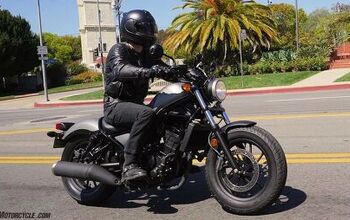
Ergonomics remain friendly: mid-mount pegs, wide bars, and a relaxed reach feels natural whether you’re 5-foot-nothing, 5-foot, 8-inches like me, or well over 6 feet. The 286cc Single is unchanged, which means you’re dealing with less than 30 horsepower — perfect for those with little to no experience. Coming in at 379 pounds wet (which means in full running condition with a full tank of gas), the Rebel 300 feels light and balanced between the legs, both while moving or at a stop.

If you have ridden before, there’s a slight difference in how you get started. As mentioned before, you just need the clutch to start if you’re in gear. If the bike is in neutral when you start, you don’t need to pull the clutch. Once running, you can just kick down into first gear without using your left hand. The little engine won’t mesmerize any speed freaks, so when you pull away from a start the Rebel just… goes. Since you don’t need the clutch, there’s no throttle-clutch coordination needed. Just roll on and ride. Little engines mean you’re shifting a lot, and in this case you’re rowing through the gears quickly to get away from the cars behind you. Clicking up through the gears is as straightforward as it gets since you don’t need the clutch. Flick your foot up for upshifts, down for downshifts. I noticed a very slight hesitation in power delivery in the first two gears after the shift was made, but you really have to be picky to notice (or care) about that. From third gear onwards there’s no discernable hesitation in power delivery. If you live somewhere where you can filter between lanes, it’s a revelation. If you’re trying to get to the front of the lane at a red light you can creep along at walking pace, stop, start, and inch forward without thinking about your left hand at all. How smoothly this happens depends on how delicately you twist your wrist.
Just as the Rebel clicks up through the gears smoothly, downshifts are equally slick. Better still, if you’re shedding speed and nervous about downshifting, or you get caught out in an emergency situation and have to panic stop, E-Clutch lets you focus on stopping without worrying about shifting. You can come to a complete stop in any gear and never have to pull in the clutch lever, though an indicator on the dash will flash telling you to move to the correct gear — which you can do, again, without manually operating the clutch. Even at a standstill. Conversely, the Rebel will also get moving from a stop no matter what gear you’re in. It’s extremely sluggish starting from a stop in sixth gear, but it’ll do it.

Speaking of brakes, the Rebel’s single discs at either end are paired with axial-mounted calipers. You get rubber lines, too, and while nobody will mistake these binders for world-class units, they scrub speed well enough. Feel at the lever is adequate without being too grabby. For the brand new rider, it’s a good starting point that won’t overwhelm them or the bike. That said, ABS is there in case the rider decides to grab a handful.
As for the overall ride, the Rebel 300 is fairly neutral. Mid-mount controls mean your feet aren’t far in front of you, though depending on your inseam some taller riders might find the knee bend a little high and tight. Overall, the ride is comfortable and compliant considering the budget suspension. It handled choppy Los Angeles roads in relative comfort, but still felt confident in the bends — confident enough to scrape the peg feelers! Granted, I assume most Rebel 300 riders won’t be aiming to do this. For riders commuting, learning, or just cruising town, it’s well suited to the task. Slow speed maneuvering is also a breeze, made easier with the low seat height. Nervous about making a U-turn? Dab a foot on the ground to help you along. It’s no problem.

E-Clutch makes sense. Until…
The pairing of the E-Clutch with the Rebel 300 makes total sense. Honda’s got a reputation for bringing in new blood to the sport, and it’s done it by bringing down the barrier to entry. With the Rebel 300 E-Clutch, the learning curve is nearly as easy as it gets short of a fully automatic transmission. It’s easy to ride, not the least bit intimidating, and the classic Rebel styling is a blank canvas to make the bike your own. At $5,349, it won’t break the bank either.
Experienced riders might shun the technology, but they’re also not the target audience. Speaking as an experienced rider, E-Clutch in the Rebel didn’t bother me. One of the worst aspects of manual transmissions — in a car or a bike — is dealing with traffic. Honda chose to take us all over congested Los Angeles streets specifically to show how much less stress-inducing the E-Clutch makes things. Yes, I did use the clutch once or twice just to see what would happen, but the vast majority of the time I let my left hand roam free and relax. The E-Clutch was just so convenient.

However, my question is this: What happens when a rider is ready to make the step up to a bigger bike? Assuming they don’t want the CB650 or CB750, both now only equipped with the E-Clutch, this rider may be lacking the finesse needed to work a traditional clutch on virtually every other motorcycle out there. Sure they can use the clutch on the Rebel like normal, but it’s not quite the same since it’s extremely hard to stall.
Don’t let this take away from the overall mission. Honda’s trying to bring in new riders. The Rebel 300 E-Clutch is likely to do that job very well. If the original Rebel 300 showed new riders that motorcycling could be cool, the E-Clutch version shows them that it can also be stress-free.
And that might be Honda’s most important upgrade yet.
Scorecard
Engine | 16/20 | Suspension | 12/15 | Transmission | 9.5/10 |
Brakes | 7/10 | Instruments | 4/5 | Ergonomics | 8/10 |
Appearance | 8/10 | Desirability | 8.5/10 | Value | 9/10 |
Editors Score: 90.0% | |||||
In Gear

- Helmet: Arai Contour-X Swirl
- Jacket: Vanson Full Throttle
- Airbag: Alpinestars Tech-Air 5 Plasma
- Pants: Alpinestars Cult-8 Riding Jeans
- Gloves: Alpinestars Phenom Air
- Boots: Alpinestars Superfaster Shoes
2026 Honda Rebel 300 E-Clutch Specifications | |
|---|---|
Engine Type | 286cc liquid-cooled single-cylinder four-stroke |
Valve Train | DOHC; 4 valves |
Bore x Stroke | 76.0mm x 63.0mm |
Compression Ratio | 10.7:1 |
Induction | Programmed electronic fuel injection (PGM-FI); 38mm throttle body |
Ignition | Full transistorized |
Starter | Push-button electric starter |
Transmission | Six-speed manual |
Clutch | Multiplate wet |
Final Drive | #520 chain; 14T/36T |
Front Suspension | 41mm conventional telescopic fork; 5.5 inches of travel |
Rear Suspension | Dual shocks; 3.7 inches of travel |
Front Brake | Single hydraulic caliper w/ 296mm disc; ABS |
Rear Brake | Single hydraulic caliper w/ 240mm disc; ABS |
Front Tire | 130/90-16 |
Rear Tire | 150/80-16 |
Rake / Trail | 28° / 4.3 inches |
Length | 86.8 inches |
Width | 32.4 inches |
Height | 43.0 inches |
Seat Height | 27.2 inches |
Ground Clearance | 5.9 inches |
Wheelbase | 58.7 inches |
Fuel Capacity | 3.0 gallons |
Curb Weight | 379 pounds (claimed) |
Colors | Matte Black Metallic; Pearl Smoky Gray |
Warranty | 1 year |
Valve Intervals | 16,000 miles |
2026 Honda Rebel 300 E-Clutch Review Gallery

We are committed to finding, researching, and recommending the best products. We earn commissions from purchases you make using the retail links in our product reviews. Learn more about how this works.
Become a Motorcycle.com insider. Get the latest motorcycle news first by subscribing to our newsletter here.
Troy's been riding motorcycles and writing about them since 2006, getting his start at Rider Magazine. From there, he moved to Sport Rider Magazine before finally landing at Motorcycle.com in 2011. A lifelong gearhead who didn't fully immerse himself in motorcycles until his teenage years, Troy's interests have always been in technology, performance, and going fast. Naturally, racing was the perfect avenue to combine all three. Troy has been racing nearly as long as he's been riding and has competed at the AMA national level. He's also won multiple club races throughout the country, culminating in a Utah Sport Bike Association championship in 2011. He has been invited as a guest instructor for the Yamaha Champions Riding School, and when he's not out riding, he's either wrenching on bikes or watching MotoGP.
More by Troy Siahaan







Comments
Join the conversation
I get the whole "attracting new riders" argument when discussing E-clutch and DCT etc. but frankly, this looks like a dangerous motorcycle to ride! Look at that picture at the top of this article-wow! We're talking about fat tires and e-clutch technology, but you know, motorcycles have to lean over--they're designed to --it's part of riding a motorcycle and it's not optional. What are you going to say--Well he's or she's a new rider so we'll worry about leaning over later. So oh great, the first ride they go straight down the road and into the woods--ride's over! Seriously, the rider in the picture is not trying to do his best Marc Marquez impression--it looks like he's barely leaning over and looks to be dragging his boot and exhaust. Many new riders may not be wearing motorcycle appropriate gear (now of course that's not Honda's fault) but rubber soled shoes could grab the pavement and yank that leg out and when that exhaust hits the ground it will likely lever that bike up and the rider will go down, or at least likely panic a new inexperienced rider into other over-reactions and mistakes! I think e-clutch tech is good (if optional). I know styling matters too, but at the expense of rider safety??
Honda used to have a mandate that the first part to touch the ground had to be the footpegs. That's why some of the sport bikes with high pegs had what looked like 6 inch long feelers attached. Is that no longer the case? Or has someone taken the feelers off the pegs, maybe for photos?