


2026 Kawasaki KLX 230 Sherpa S ABS – First Ride

Refining the standard for small displacement dualsport

The approachable dual-sport holds a soft spot in the hearts of many motorcyclists; the farm bikes, the RV-hitchrack dwellers, the toddle-around-camp and run to get firewood in town. For some, it's what you were taught to ride on, robust enough to withstand a fall or two while learning the intricacies of the clutch and throttle. Nearly everyone on two-wheels has a fond memory of an entry-level motorcycle, usually one that’s a stepping stone, as they set their sights on new goals and faster paces.
But what if that entry-level, small displacement dual-sport was hiding some guts in its middle gears? Enter the redesigned Kawasaki KLX230 Sherpa S. Everything tucked under those tasteful cream-colored cowlings is centered around improving torque and power in lower gears, and a test on the trails here in Southern California proved that the difference was noticeable.
2026 Kawasaki KLX 230 Sherpa S ABS
When improvements are made on an already stellar platform, with every tweak and upgrade aimed at improving the trail experience for the rider, it guarantees that anyone who pilots a Kawasaki KLX Sherpa S will have a blast, no matter the terrain.
Highs
- Seat height is a 32.5-inch dream come true
- Improved power in the lower gears
- Lightweight and balanced
Sighs
- Front brake lever is quite far from the bar and front brake is very bitey
- Brush guards defeated after one or two tipovers
- Mirrors are functionally useless.

The first thing immediately evident is the reduced seat-height, measuring at 32.5 inches and combined with its narrow shape, my 29-inch inseam was able to comfortably touch the ground with both boots at the same time. While I wasn’t flat-footed, any shorter rider will know that just touching the ground is a massive confidence boost, and one that we’ll happily trade ground clearance for. Though ground clearance is not compromised at 9.4 inches, which is the same between the base KLX 230 S model, as well as the KLX 230 DF. While the DF does have a taller seat and a few smart add-ons, everything else is identical to the Sherpa S model.

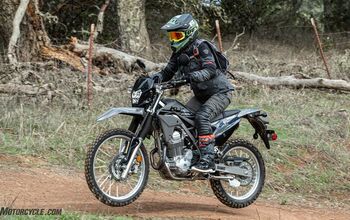
Hopping on to some trails after a significant time away from off-road, this bike went above and beyond to fill in the gaps in my talent. Once the cobwebs were thoroughly shaken off, I was thrilled to find that the promise of power in the lower gears was fulfilled. Second gear was perfect for navigating out of ruts and diving around puddles on the trail, happy to maintain a steady pace through twists and sandy banked turns, and still had plenty to give when the trail turned steep, almost like it was just waiting to be turned loose on the silty rocky inclines. This little Sherpa is happiest when chugging up a long varied ascent, using all of its claimed 17 horsepower which comes in at 8,000 rpm and 13.3 lb-ft of torque peaking at 6,400 rpm. Easing off the throttle won’t impede momentum in the way that other smaller displacement motors might, an extra twist sees the Sherpa dig its rear-end in once more.

The Showa 37mm telescopic front fork provides 6.2 inches of front wheel travel and 6.6 inches with the Uni-Trak single shock in the rear, more than enough for easy fire roads and adequate when facing intermediate trails with more obstacles. In reality, there were plenty of less than stellar line choices during my day of riding, and the front suspension surprised me more than once at its ability to soak up the sharp edges of ruts, easily rolling over babyheads and jumbled rocky trails with little to no harshness at the bar.

The age-old ABS question: What is it really doing off-road? Kawasaki calibrated the ABS to handle both paved and unpaved roads, and included the ability to completely switch it off when riding. This feature has been standard on the KLX230 dual-sport models since being introduced as an option on the 2023 KLX 230 S.
My first brush with the ABS on the trail came when braking hard at the crest of a hill, I grabbed as much of the front brake as I could reach, and felt that familiar ABS stutter of the front wheel. Easing off the brake had the wheel rolling again, and applying the brake with a lighter touch had me at a complete stop. While the initial engagement of the ABS was a bit of a shock, I appreciated that I didn’t otherwise encounter it much, it didn’t engage while on a slow descent over a rock face, even though I had grabbed a handful of the front brake a few times. Inexperienced riders may benefit from leaving it on, though I’d argue that they should be learning to ride off-road without, in order to build a solid skill set.
Turning the ABS off is simple. At a stop, you hold the red button on the left switchgear until the ABS OFF light illuminates on the dash. The ABS resets to on every time the bike is keyed on/off. If you’re just stopped for a quick trailside chat, using the kill switch will keep the ABS in whatever setting you’re using.

A quick note while discussing brakes, the brake lever was just a hair too far out from the bar and while I do have fairly small hands, other riders reported they felt the same about the placement. Personally, this made the ability to manipulate that front brake difficult, as it also had a solid bite not far into the sweep, which caused the fork to dive easily. Inversely, the rear brake could have used a bit more bite, and I had a hard time feeling like it was helping on some of the descents off-road.

I had the absolute pleasure of picking the Sherpa S up multiple times and am happy to report that the lightweight bike was easy to get upright and maneuver back into a stable location. Despite the claimed 299 pound weight, the Sherpa S benefits from its low center-of-gravity and short 53.7-inch wheelbase, which made this bike easy to turn on the trails and redirect in tricky terrain. Leaning it over in a sandy corner felt natural and it tracked with ease. The single seat fitted in black leather (according to Kawasaki) afforded plenty of room to move around while aboard, and was pleasantly comfortable while transferring between trails on the street.

On-road handling is easy and predictable, a short stint on the highway saw a top speed of about 71mph before we caught up to traffic and took the next exit. The beginning of our ride was a long wind-filled push up to Lake Arrowhead, and the ascent coupled with the high wind blowing down the mountain, capped most of our speed at about 55mph, with throttles wide open. The two-gallon tank was tracking for about 100 miles of range, depending on how much time you spent on-road or off, as always, your mileage may vary. A digital fuel gauge and trip counter makes the guesswork much easier, located on the left side of the digital dash.
It seems as though Kawasaki has aimed this mighty little dual-sport at those who want to get out for more than just a day’s jaunt in the woods, with many choices reminiscent of larger adventure bikes – one notable choice being the tubeless rear wheel. This was chosen specifically to make a road or trailside repair easier, and remove the rear wheel to patch a puncture. For entry-level off-road riders, this means one less opportunity to learn just how hard it is to change a rear tire with spoons on the side of the trail. An experience I know not everyone enjoys.

The tires themselves are appropriate for dual use, IRC GP-21 on the front and GP-22 on the rear, fitting the aluminum 21-inch front and 18-inch rear wheels. These sizes offer a healthy selection of alternate options, if you’re looking for something more or less aggressive.
I wouldn’t be surprised to see a Sherpa packed to the gills bounding up a Backcountry Discovery Route (BDR). Fitted with a few optional accessories like the engine guards and rear luggage rack, this pint sized dual-sport could go anywhere, as long as you’re in no rush to get there. Kawasaki is offering the KLX230 Sherpa S ABS at an MSRP of $5,899, and is already available at dealerships across the country.

In Gear

- Helmet: Bell MX-9 Adventure Helmet
- Communication Device: Cardo Packtalk Pro
- Gloves: Bilt Tempest Waterproof Gloves
- Jacket: REV’IT Lamina GTX Ladies Jacket
- Pants: ATWYLD Adventure Pants (Out of production)
- Boots: Alpinestars Tech 7 Boots
- Gloves: Bilt Tempest Waterproof Gloves
Scorecard
Engine | 18/20 | Suspension | 12/15 | Transmission | 8/10 |
Brakes | 6/10 | Instruments | 44/5 | Ergonomics | 9/10 |
Appearance | 9/10 | Desirability | 10/10 | Value | 9/10 |
Editors Score: 85.0% | |||||
2026 Kawasaki KLX230 Sherpa S ABS Specifications | |
|---|---|
MSRP | $5,899 |
Engine Type | 4-stroke single, SOHC, air-cooled |
Bore x Stroke | 67.0 x 66.0mm |
Displacement | 233cc |
Compression Ratio | 9.4:1 |
Fuel System | DFI with 32mm Keihin throttle body |
Ignition | TCBI Electronic Advance |
Clutch | Wet multi-disc manual clutch |
Transmission | 6-speed |
Final Drive | Chain |
Frame | High-tensile steel, box-section perimeter |
Front Suspension | 37mm telescopic fork/6.2 in. of travel |
Rear Suspension | Uni-Trak linkage system and single shock with adjustable spring preload/6.6 in. of travel |
Front Brake | Single 265mm petal disc with a dual-piston caliper, ABS |
Rear Brake | Single 220mm petal disc with single-piston caliper, ABS |
Front Tire | 2.75 x 21 |
Rear Tire | 4.10 x 18 |
Rake / Trail | 24.4° / 3.8 inches |
Wheelbase | 53.3 inches |
Seat Height | 32.5 in. |
Ground Clearance | 8.5 inches |
Curb Weight | 297.7 lb. / 299.9 pounds 50-state model (claimed) |
Fuel Capacity | 2.0 gallons |
2025 Kawasaki KLX230 Sherpa S ABS Review Gallery

We are committed to finding, researching, and recommending the best products. We earn commissions from purchases you make using the retail links in our product reviews. Learn more about how this works.
Become a Motorcycle.com insider. Get the latest motorcycle news first by subscribing to our newsletter here.
Cait is a motorcycle enthusiast first and foremost, often spending weeks at a time crisscrossing the country on her Moto Guzzi V7. She got her start in the industry running a women’s moto gear market that travelled the country, and has been able to see the women’s moto community grow from the inside out over the last 10 years. She is typically found on pavement but has been eagerly diving outside her riding comfort zone for the sake of a good story, previously riding her TW200 through two Biltwell 100 races and one very well intentioned LAB2V. While not glued to her motorcycle, Cait lives a secret life as a hairdresser and quilter.
More by Cait Maher





Comments
Join the conversation
I have the 230SM version for my commuter bike and absolutely love it. I use my commuter bikes as tools and they get beaten like pinatas at a kid party. I never expected to enjoy it as much as I have. I even change the oil in it. All that is to say any bike built on that platform is going to be a winner. These take me back to the 70s when everything was simpler. Can't beat that at any price.
Nice review - I love small bikes. Tubeless rear wheel = yes!