


2026 Yamaha YZF-R7 Review – First Ride

Small Changes, Big Impact
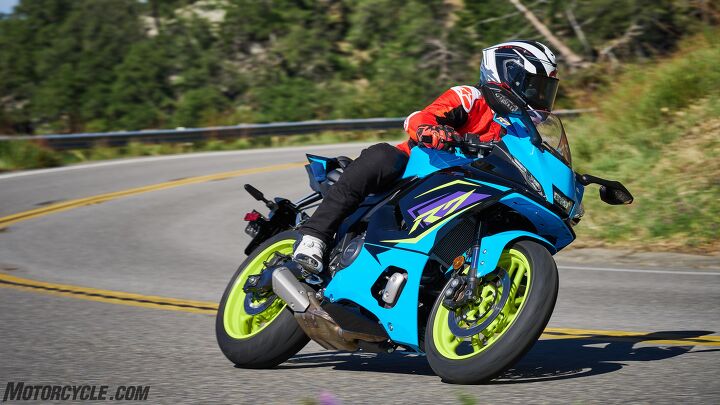
The Yamaha YZF-R7 is Yamaha’s best-selling motorcycle in the US, selling more than even the PW50 (or any other of Yamaha’s dirtbikes, for that matter). The formula here is simple: provide attractive sportbike-like styling, without the high-strung engine characteristics of traditional middleweight sportbikes (we’re looking at you, R6…), wrapped up in a price 20-somethings can afford. How do we know this? Because that’s exactly what Yamaha’s focus groups asked for. And as the sales numbers would point out, the formula is working.
2026 Yamaha YZF-R7
Several little changes to the R7 supplement one big change — YZF-R1-levels of electronics — to make Yamaha’s best-selling bike in the US that much more attractive. All for under $10,000.
Highs
- Impressive electronics suite
- The lovable CP2 engine hasn’t changed
- The seat/tank junction is easier on a man’s nether regions
Sighs
- Bars might be higher, but the seating position is still committed
- More shock adjustability would be nice
- The lovable CP2 engine hasn’t changed
Video: 2026 Yamaha YZF-R7 Review — First Ride

So when it comes to updating something like the R7, Yamaha had to be really careful in keeping the things that work and updating the things that don’t — all while meeting a sub $10,000 price point. After a day riding the updated 2026 YZF-R7 in and around the famed Palomar Mountain Road in San Diego county, I came away with two big takeaways: First, it’s remarkable that top-level electronics, once reserved for flagship models, are now found in budget-minded motorcycles. And second, several small changes prove the 2026 R7 is an evolution, not a revolution of the bike that came before.
Sharper Looks, Smarter Aero
There’s no mistaking the R7 when you first see it. The silhouette, the proportions — it’s all very familiar. You really have to get up close to see the differences, and most of them are up front.

When the R7 was last updated, in 2022, Yamaha claimed it was the most aerodynamic production motorcycle it had ever made. So Yamaha had to be careful with this update not to go backwards in the aero department. Overall, the frontal area has been slimmed down a little, but the biggest visual update is the new headlight integration into the M-shaped front cowl. Gone is the previous projector-style setup, replaced with a smoother, more cohesive design that looks cleaner and, in my opinion, better (I wasn’t a fan of the projector light hiding inside the cowl before). In the search for cleaner aero, the chin spoiler and even the cover under the bottom triple clamp were revised. In total, Yamaha says aerodynamic efficiency has improved thanks to these revisions.
The Same Engine — And That’s Fine
One thing that hasn’t changed is the engine. Yamaha’s popular 689cc CP2 Parallel-Twin engine has been left untouched. Considering model refreshes typically include some kind of engine change, the fact Yamaha left this one alone, except for a small change in the intake shape for acoustic reasons, had me scratching my head. That said, the new R7 now benefits from YCC-T — or Yamaha’s Chip Controlled Throttle. In regular motorcycle speak, we know this as ride-by-wire. No, R-b-W doesn’t add any power, but it does free up a world of electronic possibilities for the R7, which we’ll get to later.

We last had the 689cc Parallel-Twin on the dyno when we compared the 2025 MT-07 with the Honda CB750 Hornet and Suzuki GSX-8S. There, it put down 65 horses and 46 lb-ft to the wheel — the lowest in our comparison. Does it matter? Not really. Around town and on the street, the R7’s engine is exactly what it needs to be. The broad torque, smooth delivery, and direct connection to the rear wheel are as redeeming as ever. And while I can’t prove it, I imagine the new R-b-W throttle has something to do with the last two points.
Aiding in the smooth power delivery are two changes you’ll find under the clutch. First, there are now six gear drive dogs in the first three gears. There were only five before. Also, narrower gear drive dog angles in the last three gears reduces back lash. Initially I thought these claims were something I wouldn’t be able to feel, but I was impressed with the overall smoothness of the power delivery.

If you’re stuck on the fact there are no power adders in the CP2 engine, don’t be. Sure, there are bikes in the class that make more power — but that only really matters if you’re chasing lap times. And if you are one of those serious about chasing lap times on a R7, you likely already know the tricks you need to get more power. The reality is the majority of R7 owners will spend more time on the street than the track. In that regard, the CP2 engine is lively and exciting. But not overwhelming.
In addition to the ride-by-wire throttle, there’s now an updated quickshifter that works both up and down (it was only up before). It’s a welcome upgrade. Shifts are smooth, more direct, and less abrupt, thanks in part to internal transmission tweaks like revised drive dogs and reduced lash.
Chassis: Stiffer, More Composed
Yamaha claims a 12% increase in chassis rigidity in all three dimensions from significant portions of the steel frame getting bulked up, primarily through thicker piping. In addition, the swingarm pivot is more rigid thanks to a new center frame brace, and the engine mounts themselves are also thicker, reducing flex. Moving to the back, there’s a new, stiffer swingarm and revised linkage with thicker brackets. The actual linkage leverage, however, is reduced by four percent.

The updated KYB fork still retains adjustable compression, rebound, and preload, but the piston rods change from steel to aluminum, shaving off a little bit of weight. To compensate for the stiffer chassis, front spring rates are softened just a touch, but the low- to mid-speed damping is increased. The shock only gives you rebound and preload adjustment (this is a price-point bike, after all), but Yamaha revised its damping circuits to account for the stiffer chassis and revised linkage.
Without a previous-gen bike for back-to-back comparison, that number is hard to verify — but don’t let that take away from the R7’s on-road behavior. Charging up Palomar Mountain and back down the East Grade, the R7 felt planted and predictable. There’s a reassuring level of front-end confidence, and at no point did the chassis feel vague or unsettled. Whether that’s the stiffer frame, revised suspension damping, or a combination of all the above, the end result is a bike that’s easy to trust. The R7 changes direction nicely and gives good feedback even at street speeds — but I don’t particularly recall the previous bike being much different. At least from memory.

Would a trackday expose its limits? Probably. But on the street, it’s more than composed enough.
Brakes
I’m giving the R7 brakes its own section because Yamaha has been slammed in the past for its wooden brakes. And yes, I’ve accused the Tuning Fork folks of the offense as well. The R7 brakes haven’t changed from before. You still have twin 298mm discs up front, radial calipers, rubber lines, and a Brembo radial master cylinder. ABS comes standard.

Maybe it’s because I’ve gotten used to Yamaha brakes, but I felt the stopping performance was where a bike at this price point should be. Initial bite is softer than I like, but I’m picky that way. Once you squeeze past that first moment, there’s decent stopping power on tap. You just have to squeeze harder. More importantly, the system is easy to modulate, which inspires confidence when trail braking into corners. It’s not the most aggressive setup in the class, but it’s effective.
Ergonomics
Yamaha says the riding position is more open, with slightly higher, wider, and closer clip-ons, along with a flatter seat and revised tank shape. This is all true, and those changes are noticeable. Especially the updated seat positioning. The flatter seat no longer pushes you into the tank, which my “family jewels” appreciated, and the tank’s gentler slope makes it more comfortable to brace against. The tank itself is slightly wider than before at its widest point, and the deeper cutouts also give your outside knee something solid to hook into while cornering.

But let’s not kid ourselves — the R7 is still the most committed, sportbike-like riding position in its class. The clip-ons are still mounted below the triple clamp, and the weight bias still leans heavily onto your wrists. Compared to rivals like the Aprilia RS 660, Triumph Daytona 660, or Suzuki GSX-8R, the R7 demands more from the rider physically.
On track, that makes perfect sense. On the street — especially on the freeway — it gets old pretty quickly. Or maybe I’m the one getting old? The R7 was influenced by focus groups, focus groups whose participants were mainly in their 20s. As such, it feels like a bike designed with input from younger riders chasing that R6 experience, and it delivers exactly that. Whether that’s a good thing depends on your priorities. Considering Yamaha sells more R7s than anything else, maybe I am getting old…

Electronics
If there’s one area where the R7 truly leaps forward, it’s electronics. Having ride-by-wire unlocks a world of opportunities — like having an R1-derived electronics suite. There’s a 6-axis IMU now, which unlocks all the rider aids: traction control, slide control, lift control, engine brake management, launch control, and more. Yamaha’s Ride Control (YRC) system lets you tailor power delivery and intervention levels, while the new 5-inch TFT display and smartphone connectivity bring the interface up to modern standards.
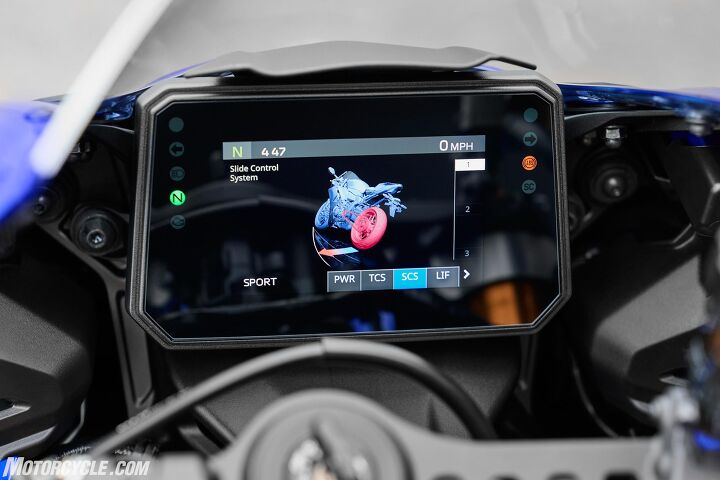
Let’s also not forget the four ride modes for the street: Sport, Street, Rain, and Custom, plus the four different track modes. Sport, Street, and Rain have preset parameters you can’t change, while all the rest allow the rider to change virtually any setting they want. The track modes also give the added benefit of being able to turn off rear ABS. If it wasn’t clear before, let me spell it out for you: the R7 now has R1 levels of electronics. All for under $10,000. The R7 will come in Team Yamaha Blue, Raven (black), or Breaker Cyan/Raven for $9,399. Or you can opt for the 70th Anniversary Edition for $9,699. This is trickle-down technology at its best and we’re all the beneficiaries. You even get cruise control to help give your wrists a break when droning on the freeway, and a variable speed limiter — a request from the Europeans trying to find ways to not get popped by speed cameras.
To be honest, a canyon ride didn’t give me the chance to explore the depths of the R7’s electronics suite, but from past experience on the R1, MT-10s, and other models, I have no reason to believe it’s not well integrated and effective. Same goes with toggling through the menus and screens to find and adjust what you want. The interface is similar among Yamahas, with the joystick on the left switchgear able to take you to various screens. It’s good stuff, and it works, and now it’s on the R7. Bravo, Yamaha.

The Verdict
At first glance, the 2026 Yamaha YZF-R7 doesn’t seem to be much different than its predecessor. At least that’s what I thought. The more I learned about the subtle visual differences — and the big electronic one — the more I understood what Yamaha did here.
The styling is just a little sharper, and the chassis seems a little more composed. By gracing the R7 with the R1’s electronics the overall riding experience feels more polished. Individually, each update might seem minor. Together, they add up to a bike that feels like the next evolution of the model that came before it. The engine remains a highlight, and the value proposition is stronger than ever. It’s easy to see the R7 continuing to be Yamaha’s best-selling motorcycle in the U.S.

My biggest gripe remains the ergonomics. For street riding, they’re still more aggressive than necessary, and that will be a dealbreaker for some. But aside from that, Yamaha has done exactly what it needed to do: build on the R7’s strengths without making its weaknesses any worse. Expect to see more of these roaming the roads soon.
Scorecard
Engine | 18/20 | Suspension | 12/15 | Transmission | 8.5/10 |
Brakes | 8/10 | Instruments | 4/5 | Ergonomics | 7/10 |
Appearance | 9/10 | Desirability | 9/10 | Value | 9/10 |
Editors Score: 84.5% | |||||
In Gear

- Helmet: Alpinestars S-R7 A-Core
- Jacket: Alpinestars T-GP Air
- Airbag: Alpinestars Tech-Air 5 Plasma
- Pants: Alpinestars Cult-8 Riding Jeans
- Gloves: Alpinestars SP-9
- Boots: Sidi Rex Air
2026 Yamaha R7 Specifications | |
|---|---|
MSRP | $9,399 ($9,699 for 70th Anniversary Edition) |
Engine Type | 689cc liquid-cooled, 4-stroke, DOHC inline twin-cylinder; 4-valves per cylinder |
Bore x Stroke | 80.0mm x 68.6mm |
Compression Ratio | 11.5:1 |
Fuel Delivery | Fuel injection with YCC-T |
Ignition | TCI: Transistor Controlled Ignition |
Transmission | 6-speed; multiplate wet clutch; with Assist & Slipper clutch |
Final Drive | Chain |
Fuel Capacity | 3.7 gallons |
Front Suspension | Telescopic fork; 4.7-inches travel, adjustable for preload, rebound and compression |
Rear Suspension | Linked-type Monocross shock, adjustable preload and rebound; 4.8-inches travel |
Brakes/Front | Dual 298mm hydraulic disc; Brake Control System and ABS |
Brakes/Rear | 245mm hydraulic disc; Brake Control System and ABS |
Tires/Front | 120/70ZR17 Bridgestone BATTLAX HYPERSPORT S23F |
Tires/Rear | 180/55ZR17 Bridgestone BATTLAX HYPERSPORT S23R |
Length | 81.5 inches |
Width | 28.5 inches |
Height | 45.7 inches |
Seat Height | 32.7 inches |
Wheelbase | 54.9 inches |
Rake/Trail | 24.0°/3.6 inches |
Ground Clearance | 5.3 inches |
Fuel Capacity | 3.7 gallons |
Wet Weight | 417 pounds (claimed) |

We are committed to finding, researching, and recommending the best products. We earn commissions from purchases you make using the retail links in our product reviews. Learn more about how this works.
Become a Motorcycle.com insider. Get the latest motorcycle news first by subscribing to our newsletter here.
Troy's been riding motorcycles and writing about them since 2006, getting his start at Rider Magazine. From there, he moved to Sport Rider Magazine before finally landing at Motorcycle.com in 2011. A lifelong gearhead who didn't fully immerse himself in motorcycles until his teenage years, Troy's interests have always been in technology, performance, and going fast. Naturally, racing was the perfect avenue to combine all three. Troy has been racing nearly as long as he's been riding and has competed at the AMA national level. He's also won multiple club races throughout the country, culminating in a Utah Sport Bike Association championship in 2011. He has been invited as a guest instructor for the Yamaha Champions Riding School, and when he's not out riding, he's either wrenching on bikes or watching MotoGP.
More by Troy Siahaan




Comments
Join the conversation
I made no mention of the original homologation OW-02 R7! And I'm (not necessarily) a huge inline twin guy ( I own a 2003 R1, a 2016 R1S, and a Kawasaki Z900abs), but I think these new bikes are pretty damn good. My post was really more about this Real Men ride I-4's BS! I paid $6995 (1996 dollars) for my F3 Honda. I've seen new Kawasaki ZX-6R's discounted into the Nines...adjusted for inflation that's a huge performance value--There are choices for those "real Men"
Not really interested in the R7, but I'm excited about the headlight design change. I hated the recessed projector light. It looked ugly and I can only imagine how many bugs it eats. If this makes it to the R3 then I'm gonna be interested in one. I been wanting a small bike to relive those first bike days where I could redline all over the place and not to to jail.