


2025 KTM 390 Adventure R Review – First Ride

Adventure bikes break into the small time

Thankfully, the apparent sugar high of displacement one-upmanship between adventure motorcycle manufacturers seems to have worn off enough in recent years to allow some consumer sentiment to creep into the market.
Back in 2008, the modern middleweight adventure bike class kicked off when BMW introduced the F 800 GS. Slowly building up momentum over the years, middleweight bikes now arguably dominate the adventure bike class with a wider range of models available than their larger off-road counterparts. The freedom of exploring trails without the heft of a machine producing triple-digit horsepower numbers perhaps sparked a trend of wringing adventure-worthy performance out of smaller and smaller bikes.
2025 KTM 390 Adventure R
A rally-inspired adventure bike, without the rally-inspired price tag.
Highs
- High build quality.
- Robust feature set.
- Cool aesthetic
Sighs
- Quickshifter not standard equipment.
- Cruise control not standard equipment.
- Heaviest bike in its class.
Video: 2025 KTM 390 Adventure R Review
Thanks to Rokform for making this video possible. Use discount code Moto25 for 25% off at www.rokform.com.
KTM’s claim that the 2025 390 Adventure R is “the most off-road capable adventure platform in the segment” is a big statement. Defining what segment the 390 Adventure R fits into can get a bit fuzzy after analyzing the details. Where does the middleweight adventure bike class end and a “lightweight” adventure bike class begin? In addition to factoring in weight and displacement, it also seems necessary to factor in the era.

While the “modern” middleweight adventure bike class was kicked off with the F 800 GS, that might have been a case of history repeating itself. Roll the clock back 45 years to 1980, and it could be argued that BMW’s R80 G/S represented the beginning of the middleweight adventure motorcycle class before it had a name. That bike had a displacement of 798cc, produced 50hp, and weighed 410 lbs. That’s more displacement and more horsepower, with vastly less weight than a present-day Kawasaki KLR 650 or Royal Enfield Himalayan 450.
The KTM 390 Adventure R tips the scales at 388 lbs, and produces 44hp from its 399cc LC4c engine. These numbers put it in the same ballpark with bikes like BMW’s 310GS, Kawasaki’s Versys-X 300, and Honda’s CRF300 Rally. In general terms, bikes under 450cc, producing less than 50hp, and weighing in at under 400 lbs with fuel.

Considering the above examples, KTM’s claim of being a class leader would seem to be justified based on power-to-weight ratio. The 390 Adventure R is the heaviest in that list of bikes, but also produces the most horsepower by a significant margin. Kove’s 450 Rally potentially throws this entire lightweight adventure bike class out of balance by being under 450cc, producing over 50hp, and tipping the scales at 368 lbs even while carrying eight gallons of fuel. However, the Kove brings up another factor when trying to define the parameters of a lightweight adventure bike class — price. Achieving the Kove’s specs will set you back between $9,300-$14,000, while all the other bikes mentioned are between $5,700-$7,000.

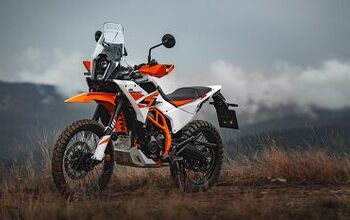
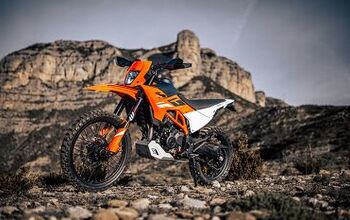
Describing the KTM 390 Adventure R is perhaps easier than assigning it to a class. It’s a bike that provides a rally-like feel without the rally-like price. It provides big adventure without big dimensions. Among the goals in KTM’s redesign of 390 Adventure, was to make the bike more off-road worthy, without alienating early adopters of the approachable 390 platform.
Building a motorcycle for the dirt typically means taller suspension, and taller seat heights. Unique changes to the chassis for 2025 means the 390 Adventure R can boast 9” of travel both front and rear, and maintain a 34.2” seat height. Partially hidden beneath the body work, the shock can be seen repositioned farther to one side of the bolt-on steel trellis subframe, allowing the upper portion of the chassis to drop, without sacrificing ground clearance.

Perhaps one of the most visually apparent aspects of this redesign is the strikingly small end can. Tucked away beneath the swingarm, this diminutive design shaves four pounds of weight off the bike compared to the previous exhaust system. The positioning of what little weight is there is another component that brings the overall weight of the bike lower to the ground, contributing to its light feel on the trail.
Being an adventure bike, there’s a good chance many riders of the 390 Adventure R will be using luggage of some sort, and this new exhaust design eliminates the need to run asymmetrical panniers for those opting for hard cases. For adventurers running soft luggage, there’s no longer a need for heat shields.

At the heart of this new adventurer, the 390’s engine benefits from 38 years of development since the first LC4 design was debuted in 1987. The 399cc version is the smallest LC4c built by KTM and produces a class-leading 44 hp (presuming we’ve roughly defined what class this bike belongs to). Like many KTMs, it’s a high-revving engine, producing peak power at 8,500 rpm and nearly 29 ft-lbs of torque at 7,000 rpm.
The fly-by-wire throttle provides a fun and accurate feel, with some adjustability available through the five-inch color TFT in three ride modes of Street, Offroad, and Rain. This display also offers navigation, communication, and multimedia features through the KTMconnect App. One of the electronic features that sets the 390 Adventure R apart from similar bikes is an available cruise control option — a first in this class.

Our test bikes were still running a Beta version of the optional Quickshifter+ ($274.99), but the feature seemed to work great in most contexts. Whatever tweaks KTM’s engineers have in mind for the Quickshifter+ will be available as a software update shortly after this review is published.
I’d ridden many of these same trails aboard several different LC4 bikes over the years (as well as several different LC8 models - bikes which began as two LC4 engines stuck together in the one-off 1992 Bepono prototype). Going from a 790, 690, or even a 640 or 620 (much less a big twin) to the 390 would seem to be an underwhelming switch. However, as addicting as the power of those big bikes can be, the fun of the 390 Adventure R proved to be just as addicting in the terrain around Mammoth Lakes.

The rally aesthetic is cool and inspiring, and tossing a bike around the trails that is over 90 lbs lighter than its nearest adventure cousin in the 790 Adventure R is made more fun by the highly responsive engine. Comparatively small displacement would reveal itself in situations like the little adventurer struggling a bit during top-gear climbs on tarmac. That said, many of the aforementioned climbs were often at or very near 11,000’ in elevation. While this will cause almost any motorcycle to struggle for breath to some degree, you’re likely not going to be outrunning any big adventure bikes in a road race aboard the 390, regardless of altitude. In a way, off-road the 390 Adventure R seems to be a filter for rider skill over sheer horsepower. Use the engine and chassis correctly, and you’ll find yourself pushing triple-digit speeds in the dirt.

Another fun surprise aboard the 390 Adventure R was the suspension. More than once, sections of trail had me anticipating some harsh landings or G-outs but the 43mm WP APEX forks and shock easily sucked up all but the biggest hits. While 388 lbs might not be considered svelte, the spring rates felt dialed in for the weight distribution of the bike.
Given the “adventure” designation for this bike, the 390 Adventure R’s heft when compared to other bikes in this same class made a bit more sense on the road. It feels larger and more planted on tarmac than the displacement would seem to indicate. I’d put in some long miles aboard the original 2020 390 Adventure, doing trans-state on and off-road trips, both unladen and fully packed up with camping gear, and the 2025 model felt vastly better suited for long-distance adventure travel.

A more open cockpit feel, more grunt from the little thumper, improved braking, and surprisingly decent wind protection were among the line items which made this redesigned bike feel completely different when compared to the original. While it’s the heaviest in class, it’s also the most powerful. Power-to-weight ratio plays an important part in making the 390 Adventure R feel like a larger and more capable bike than a casual glance would imply.
Both the 390 Adventure R and more dirt-focused Enduro R sport a 240mm rear brake rotor, however the Adventure R gets a larger 320mm rotor up front compared to a 280mm rotor on the Enduro R — another feature dialed in for the weight of the rally-inspired 390 Adventure R. The Bybre calipers never struggled with stopping power in the dirt or on the tarmac, and the ABS system is lean-angle sensitive.

For my tastes, the stock Mitas Trail E07+ tires are closer to a 50/50 road/off-road tread pattern, versus the claimed 60/40 ratio. Some of the deep pumice and sand that’s found throughout the Long Valley Caldera is exactly the sort of thing that can put less aggressive tires like this to the test. While the Mitas rubber performs great for its intended purpose, it’s also a great test of the traction control systems on the 390 Adventure R.
In general, I tend to prefer deactivating traction control systems when riding off-road. There are exceptions to that rule, such as KTM’s 790 Adventure and 890 Adventure R. The almost hyperactive power of those larger bikes is more usable to me with all the rider aids fired up. The comparatively docile engine of the 390 Adventure R, coupled with its accurate throttle response made the bike fun to unleash entirely, without the same level of concern for things getting too rowdy.

Mixing some of the deeper sandy sections with the 50/50 tires reveals the level of refinement in the traction control and ABS systems on the 390 Adventure R. This mini adventure bike includes an IMU, which provides the lean-angle sensitive traction control and ABS. Perhaps I’m still a bit scarred by memories of early-generation systems working mostly against you in the dirt, but it’s still shocking to grab handfuls of throttle or brake and have the bike hook up or slow down where your brain says you should be sliding.
Look and feel of a motorcycle are less empirical components to analyze, but no less important. The 390 Adventure R does a great job capturing rally-inspired aesthetics in an entry-level bike. This aesthetic lends itself to the feel on the trail, however there are also some measurements which give this bike a more commanding presence than its size might imply.

Having spent a good deal of time aboard the original 2020 390 Adventure, I was familiar with its street-biased Duke chassis lineage. The rider cockpit was somewhat cramped for me at 5’11”, and featured footpegs which were angled forward. While aftermarket solutions appeared to deal with some of these issues, in stock form, the original 390 Adventure seemed at best suited only for limited off-road travel.
In redesigning the 390 model range, the Adventure R was KTM’s first priority to develop and draw from in creating other models such as the Enduro R. Riding the new 390 flagship bike is an entirely different experience compared to five years ago. The new peg-seat-bar triangle created a cockpit ideal for riding standing or seated. New distribution of weight gives the 390 Adventure R a lighter feel on the trails than the claimed weight might imply. Even details like the windscreen seemed purpose-built for my height.

I’d heard some reports of 390 sidestand issues, both with the switch and the stand itself. I’ve done plenty of trailside sidestand repairs on several bikes, in a few different countries, and in general am not a huge fan of sidestand switches. In some specific trail situations, the 390’s engine could be felt stumbling from my boot hitting it or perhaps even just the weight of the stand itself causing the switch to momentarily engage. Fortunately, the solution was to simply use the rubber band retainer strap while on the trail, which solved the problem. That said, KTM is clearly aware of the issue, as we were told an updated version of the sidestand was in the works and would be released just a couple weeks following the press event.

The more you dive into the details of KTM’s new 390 Adventure R, the more justified the claim of being “the most off-road capable adventure platform in the segment” seems to be. Its combination of high performance, curb appeal, and relatively low price would seem to push this bike past the “entry-level” barrier, and into the realm of something almost any adventure rider should consider. Deciding what class to put this bike in is perhaps more difficult than making a purchase decision.
In Gear

- Helmet: Alpinestars SM10
- Goggles: Alpinestars Vision 5
- Gloves: Alpinestars Freeride
- Jacket: Alpinestars Pro-Dura
- Pants: Alpinestars Racer Compass (discontinued)
- Booots: Alpinestars Tech 10
Scorecard
Engine | 18/20 | Suspension | 13.5/15 | Transmission | 9/10 |
Brakes | 8/10 | Instruments | 4.5/5 | Ergonomics | 10/10 |
Appearance | 10/10 | Desirability | 9.5/10 | Value | 10/10 |
Editors Score: 92.5% | |||||
2025 KTM 390 Adventure R Specifications | |
|---|---|
MSRP | $6,999 |
Engine Type | Single-cylinder, 4-stroke (EURO 5+) |
Displacement | 398.7cc |
Bore x Stroke | 89 x 64mm |
Power | 44 hp at 8,500 rpm (claimed) |
Torque | 28.8 lb-ft. at 7,000 rpm (claimed) |
Compression Ratio | 12.6 : 1 |
Transmission | 6 gears |
Fuel System | Bosch EFI (electronic throttle body 46mm) |
Control | 4 V/DOHC |
Cooling | Liquid cooling |
Clutch | PASC slipper clutch, mechanically operated |
Engine Management | Bosch EMS with RBW |
Frame | Steel trellis frame, powder coated |
Subframe | Bolt on steel trellis frame, powder coated |
Handlebar | Aluminum |
Front Suspension | WP APEX open cartridge 43mm, Compression and Rebound adjustable - 30 Clicks; 9.1 inches of travel |
Rear Suspension | WP APEX Split Piston, Preload and Rebound adjustable - 20 Clicks; 9.1 inches of travel |
Front Brake | 320mm floating disk, Bybre radial calipers with 2 pistons |
Rear Brake | 240mm disc, Bybre floating caliper 1 piston |
Front Wheel | 1.85 x 21 inch spoke wheel |
Rear Wheel | 2.5 x 18 inch spoke wheel |
Front Tire | 90/90 R21 Mitas Enduro Trail E07+ |
Rear Tire | 140/80 R18 Mitas Enduro Trail E07+ |
Wheel Base | 58.3 ± 0.6 inches |
Seat Height | 34.2 inches |
Tank Capacity | 3.7 gallons |
Curb Weight | 388 pounds (measured) |
2025 KTM 390 Adventure R Review Gallery

We are committed to finding, researching, and recommending the best products. We earn commissions from purchases you make using the retail links in our product reviews. Learn more about how this works.
Become a Motorcycle.com insider. Get the latest motorcycle news first by subscribing to our newsletter here.
More by Jon Beck





Comments
Join the conversation
I really doubt this can cruise all day at 70 mph and be able to walk afterwards. First off it is too light for interstate riding of any significance and would be a fight to keep it in its lane with any wind; second, it doesn't have the comfort level and possibly the correct ergonomics that are needed for long distance riding. The paper-thin seat for one would need to be replaced, and the plastic front fender flopping around in the wind would not help either. A heavier Kawasaki KLR though less power, would be much more at home on the road for anything more than a 100-mile tour. A V-Strom 650 or larger displacement motorcycle are really the starting point for adventure touring with the exception of the KLR.
there is no "one size fits all" bike. We all have to ride a considerable distance on paved roads to finally enjoy some dirt roads. Thats the real issue with the Adv segment. To light or to heavy for paved and no paved. There is no balance, perhaps the chinese bikes like kove rally or Mt450 are fitting the gap.