


2025 KTM 390 SMC R Review – First Ride

Because the answer is always supermoto

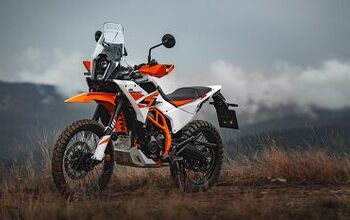
Following on the heels of KTM’s 390 Adventure R and 390 Enduro R models, Team Orange completes the trifecta with this, the 2025 KTM 390 SMC R. The baby brother to the 690 SMC R, the 390 arrives as a playful, pint-sized urban assault vehicle because that’s effectively what a supermoto with lights and a license plate really amounts to. What makes this package better is the price: $5,499. For those following along at home, that’s less than half the price of the $12,999 690 SMC R.
2025 KTM 390 SMC R
A reminder of how much fun supermotos can be. Now in a lite version.
Highs
- Lots of fun for little money
- Supermotos make great canyon carvers
- Great all-round commuter
Sighs
- Not great for extended highway jaunts
- Mediocre tires AND they require tubes
- Shock is a tad soft
Supermotos are always a crowd favorite around here, and at such an attractive price point, the 390 SMC R packs a lot of punch for not a lot of bite out of your wallet. Let’s break down what KTM did to shrink the SMC formula, and why this little thumper punches above its weight — if you’re the right kind of rider.

Making a Supermoto-lite
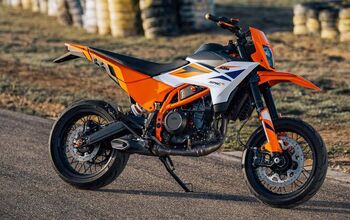
The design of the 390 SMC R follows a similar trajectory as the 390 Adventure R and Enduro R. There are clear off-road roots here, with the slim and narrow waistline, and beak poking out from the front. And just like a traditional supermoto is a motocrosser with 17-inch wheels and bigger brakes, the 390 SMC R effectively takes the Enduro R and follows the same recipe. Gone are the 21/18 wheels, and in its place are 17-inchers with Michelin Power 6 rubber. To keep costs down, KTM chose to go with tubed spoked wheels instead of tubeless versions, or even cast wheels. According to KTM, the cast hoops on the 390 Duke actually weigh less than the tubed spokes on the SMC R, but in their eyes, a supermoto isn’t really a supermoto without spoked wheels. A larger 320mm single front brake rotor replaces the 285mm disc on the Enduro and is still clamped by a radial-mount ByBre caliper. Dual-channel ABS comes standard and is backed by a Bosch 10.3MB modulator. Front ABS always stays on, but you can turn off ABS in the rear. More on that later.

After that, there’s not a ton of difference. The engine is still the same 398.7cc Single seen in the most recent 390 Duke and shared across the 390 platform, which is claimed to put out 44 hp and 28 lb-ft of torque. It’s housed inside the Gen 3 Duke chassis, which is a two-piece steel trellis frame. It’s torsionally stiffer than before, meaning the side-to-side chassis flex is reduced, resulting in a motorcycle that doesn’t feel like it has a hinge in the middle whenever you take a corner. The steering head angle, triple clamps, and subframe mounts are also different from the Gen 2 chassis – all to make it better suited for off-road duty. If you consider the dirt sections and jumps supermotos face, then you could say the design target still works here.
The new frame also makes space for the bigger radiator and cooling system, while also moving the footpegs into a slightly more aggressive stance for proper supermoto riding. Other subtle changes include a reshaped airbox, which moves the rear shock offset on the swingarm. The sum total of these changes is being able to keep the seat height as low as possible (33.8 inches) without sacrificing seat foam, or more importantly, suspension travel. For comparison, the 390 Duke’s seat is only 32.2 inches off the ground, and the 390 Enduro’s is 35 inches.

To that end, the SMC R uses the same WP APEX open cartridge fork and APEX shock as the Enduro and Adventure R models. This means you get the same 9 inches (230mm) of travel at each end, as well as rebound and compression adjustment up front in 5-click increments. Preload adjustment isn’t available. The shock is adjustable for rebound with 20 clicks, while preload can be changed, too. Keeping the suspension from the Enduro and Adventure essentially untouched means you get a lot of pitch from either end, which keeps the ride fun and engaging when you start to attack the corners because the bike gives you tons of feedback. But the secondary benefit is a comfortable ride when you’re just cruising down the street, enjoying a more leisurely ride.
If you’ve read carefully, you’ll notice the suspension from the Enduro R remains, yet the wheels have been swapped for smaller, road-appropriate 17-inchers. This naturally changes the bike’s geometry, making it sharper for its new duties on the road. Rake is now 26.9º, a slight bit sharper than the Enduro’s 27.1º, while wheelbase comes down from 58.1 inches to 57.2 inches. To put that in a little context, KTM’s own 450 SMR supermoto racer has a 26.1º rake angle and a 57.9-inch wheelbase.

Finally, the 390 SMC R, like the rest of its 390 stablemates, gets updated electronics. Here, the options are kept clean and simple. You get two ride modes – Street or Sport. The former softens throttle response slightly and keeps ABS and traction control on the conservative side. Sport quickens up the throttle response, puts the ABS in Supermoto mode, and loosens up the traction control. If you’re feeling saucy, ABS and traction control are both adjustable. ABS can be set to standard, Supermoto, or Supermoto+, which completely deactivates rear ABS and gets very generous with the front. Traction control can be set to Standard, Sport, or Off.
All this information is viewable through the 4.2-inch TFT display that, while small, is impressively easy to read and shows you the information you really need to know (road speed, engine speed, and gear position). A secondary screen display option keeps things even simpler, showing only miles per hour and gear position. Buttons on the left switchgear are used to toggle through the menus, and if you’re used to KTM’s menu screens and UI, this will be second nature. Even if you’re not, this is one of the easier ones to wrap your head around.

Supermoto is always the answer
While all that is well and good, I’ve had mixed feelings about KTM’s 390 engine, especially the 390 Duke. I was not a fan of it in its original 373cc displacement, but have started to come around once Team Orange bumped the engine size to a proper 400 a couple of years ago. But even then, I’ve struggled to fully support the 390 Duke when parallel-Twin-powered competitors like the Aprilia Tuono 457, CFMoto NK450, and Kawasaki Z500. exist.
But as the subhead says, supermoto is always the answer. In SMC R form, the 390 is a barrel of laughs. Maybe it’s because competition in this field basically comes down to the new Suzuki DR-Z4SM, but the 390 SMC R had me giggling from ear to ear during my short day ride with it. As we left KTM North America’s HQ in Murrieta, California, it didn’t take but the first stop sign for me to stab a few downshifts and get a feel for how it slides the rear end. Cleanly is the answer, and I knew from that point we were in for a bit of fun.

Throwing a leg over it, there’s no denying the bike sits tall — at least if you’re used to riding street bikes. If you come from the dirt world, then the SMC will feel right at home. It’s a tiny bit thicker than your average motocrosser or purpose-built supermoto, but compared to most any street bike, it’s svelte. Once you’re sat on it, if you’re over 150 pounds and 5-foot, 8-inches like I am, the shock compresses enough to solidly get both balls of the feet on the ground. From there, it’s game on.
We started our day in the Street setting, which initially had me worried. With only 44 horses on tap, did the power delivery really need to be neutered? I was surprised to find the 39 lb-ft of torque came on strong enough to keep me satisfied. It certainly didn’t feel sluggish, but after a few miles, I couldn’t help but switch to Sport mode to feel the difference.

Really, the difference was small. Noticeable, sure, but not overwhelmingly different. So Sport stayed on the rest of my ride. Considering the small engine, you’re rowing through the gears a lot. But life is made so much easier with KTM’s accessory quickshifter, which our bikes were equipped with. It’s a $275 accessory, but it's worth every penny in my opinion. Upshifts are smooth from second gear upwards, but a little snatchy from first to second. That’s not surprising considering the gearing between the first two gears is quite wide.
As we meandered our way in and out of Murrieta and wrapped around the hills, naturally, we found a mixture of roads. Some flowing and open, others a little tighter, with city streets and freeway riding sprinkled in for good measure. On open roads, one finds themselves staying in the upper two gears most of the time, and when a fast curve does appear, the SMC R doesn’t at all feel like there’s a hinge in the middle of the bike, which is more than I could say about early iterations of the Duke chassis. It feels stable, like a bigger bike, belying its $5,500 price tag.

By the very nature of it being a supermoto, wind protection is non-existent. It’s not much of an issue if you’re wearing an aerodynamic road helmet since you’re not hitting crazy speeds, but if you opt for a dirt helmet with goggles, you’ll be feeling the pull on your beak in no time. Despite the lack of aero, there’s enough power to move away from traffic from a stop and keep more than enough pace on most roads. There’s enough pull to keep from being a moving target on the freeway – 80 mph clocks in at 7,000 rpm, but you’ll want to be careful beyond that. Redline hits at 9,500 rpm, and there really isn’t much power left in between. If continuous highway riding is a priority, this is not the bike for you.
But you’re not reading this review because you’re looking for a highway bike. Supermotos are bikes you toss around. Tighter roads are perfect for that. There, the svelte nature of the bike and the leverage you get from the handlebars are perfect for tossing into corners. The brakes don’t come in aggressively, but they’re strong enough for the job. Steel-braided lines ensure a consistent lever pull each time.

If you didn’t know, supermotos are made for carving apexes, which is exactly what we did. In our case, we headed to the aptly named Apex kart track to really get the full experience. The tight and twisty confines of the supermoto track proved to be a great playground for experiencing the 390 SMC R in its element. In short, it’s a great training tool for all but the most experienced supermoto enthusiasts. Its 45-ish horsepower is delivered smoothly, and isn’t at all a shock to the senses as the 65-ish horses the 450 SMR delivers in a more aggressive fashion. Though the quickshifter on our bike was an accessory, it’s one I highly encourage any potential buyer to opt for. It’s a cheap upgrade that is entirely useful.
Notably, the thing that makes a supermoto a supermoto is the 17-inch wheels, big brake, and street rubber. Heading down Apex’s back straight, I could only muster fifth gear before needing to stomp on the brakes, downshift, and hook around the tight 180º bend. I wondered if the ByBre stopping system, which worked fine on the street, would be up for the task of track duty. The answer? Well, they’re wholly adequate for the job. There’s still decent bite coming back at the lever, aided by the standard steel-braided brake line. Anything more powerful would have overwhelmed the front tire and either caused it to tuck or flip me right over.

It was here, too, that I discovered the sensitivity difference between standard and Supermoto ABS (capital S). As it turned out, Supermoto ABS was supposed to be activated when the bike was switched to the Sport riding mode. Apparently, my particular test bike had been changed by someone, keeping the ABS in standard. That meant the front ABS would intervene the instant I grabbed the brakes aggressively, causing me to miss the corner. I eventually learned to progressively apply brake pressure to keep ABS away, but it was no way to ride on a kart track. That said, the assist and slipper clutch deserves credit for keeping the rear from hopping after I’d bang four downshifts and dump the clutch in my attempt to slide the rear and back it in.
Once I figured out the settings and properly put the bike in Supermoto ABS, the fun really began. Aggressive braking rarely triggered front ABS, and if the bike were equipped with better rubber, it might not have engaged at all. The rear was now allowed to step out at will, which is always a recipe for a good time. Maybe more impressive was the KTM’s chassis. I’d already gotten a taste for it around the fast, flowing roads on the street, but the tight and technical sections of the track highlighted how the stiffness makes the bike feel proper. Feel from both ends of the bike was better communicated and not dulled by a flexing chassis that couldn’t handle the stress.

In this particular case, the message was “low traction.” Whether it was the track surface or the Michelin Power 6 tires, grip levels weren’t enough to encourage substantial lean angle, so we played it safe. The 390 isn’t particularly fast with its direction changes compared to a “real” supermoto like the 450 SMR (the long-ish wheelbase is to thank for that), but it’s light and the bars are wide, so persuading the bike to go where you want is easy. Like most things, however, there’s a catch — the shock spring is on the soft side, so cutting a fast line through a quick switchback can be tricky since the shock will compress going in one direction and will rebound as you’re transitioning the other way. If you aren’t ready for it, that can upset the bike.
Lots of Bang. Little Buck.
After a day of riding the 390 SMC R, I came away pleasantly surprised by the package KTM delivered. It’s a manageable, lightweight bike that both entry-level riders or more experienced ones can enjoy all the same. That’s because supermotos encourage you to try what would otherwise be silly things. Want to jump off the curb? Go for it. Back it in? Of course. Even play in the dirt a little? Absolutely. When you’re done with that, you can scoot your way back home, taking all the fun roads on the way and have a blast. The power won’t rip your arms off, but the total package sings in harmony. It’s the kind of ride that nudges you to misbehave, and somehow still forgives your mistakes. That’s the sort of bike we need more of — regardless of skill level.

As I said before, the best part is the 390 SMC R will only set you back $5,500 MSRP (well, until you factor the perpetually moving target that are tariffs). That’s a lot of fun for not a lot of cash. If grinning like an idiot and backing it in sounds like a good time, KTM’s made your next bad decision remarkably affordable.
In Gear (Street)
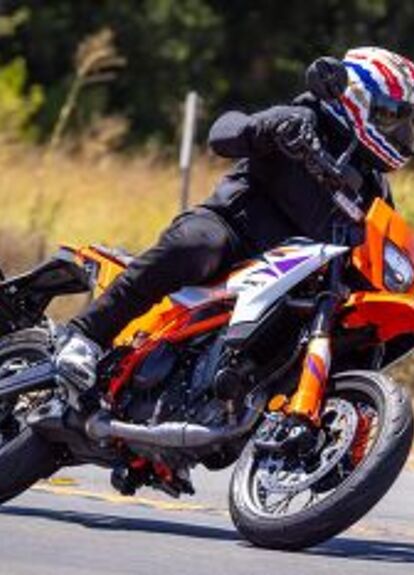
- Helmet: Arai Doohan Re-Style Corsair-X
- Jacket: Alpinestars MO.ST.EQ Hybrid
- Airbag: Alpinestars Tech-Air 5 Plasma
- Pants: Alpinestars Cult-8 Riding Jeans
- Gloves: Alpinestars Phenom Air Gloves
- Boots: Sidi Rex Air
In Gear (Track)
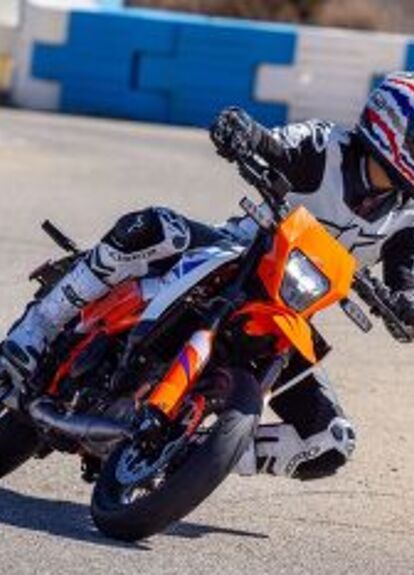
- Helmet: Arai Doohan Re-Style Corsair-X
- Leathers: Alpinestars GP Plus V4 Sprint Race
- Airbag: Alpinestars Tech-Air 5 Plasma
- Gloves: Alpinestars GP Pro R4
- Boots: Sidi Rex Air
Scorecard
Engine | 17/20 | Suspension | 13/15 | Transmission | 8/10 |
Brakes | 7.5/10 | Instruments | 4/5 | Ergonomics | 8/10 |
Appearance | 8/10 | Desirability | 7/10 | Value | 9/10 |
Editors Score: 81.5% | |||||
2026 KTM 390 SMC R Review Gallery

2025 KTM 390 SMC R Specifications | |
|---|---|
MSRP | $5,499 |
Engine Type | Single-cylinder, 4-stroke (EURO 5+) |
Displacement | 398.7cc |
Bore x Stroke | 89 / 64mm |
Power | 44 Horsepower @ 8,500rpm |
Torque | 28.8 lb-ft. @ 7,000rpm |
Compression Ratio | 12.6 : 1 |
Transmission | 6 gears |
Fuel System | Bosch EFI (electronic throttle body 46mm) |
Control | 4 V/DOHC |
Cooling | Liquid cooling |
Clutch | PASC slipper clutch, mechanically operated |
Engine Management | Bosch EMS with RBW |
Frame | Steel trellis frame, powder coated |
Subframe | Bolt on steel trellis frame, powder coated |
Handlebar | Aluminum |
Front Suspension | WP APEX open cartridge 43mm, Compression and Rebound adjustable - 30 Clicks; 9.1 inches of travel |
Rear Suspension | WP APEX Split Piston, Preload and Rebound adjustable - 20 Clicks; 9.1 inches of travel |
Front Brake | 320mm floating disk, Bybre radial calipers with 2 pistons |
Rear Brake | 240mm disc, Bybre floating caliper 1 piston |
Front Wheel | 17 inch spoke wheel |
Rear Wheel | 17 inch spoke wheel |
Front Tire | 110 / 70 R17 MRF |
Rear Tire | 150 / 60 R17 MRF |
Wheel Base | 57.2 inches |
Seat Height | 33.9 inches |
Tank Capacity | 2.4 gallons |
Weight | 340 pounds (claimed, without fuel) |
We are committed to finding, researching, and recommending the best products. We earn commissions from purchases you make using the retail links in our product reviews. Learn more about how this works.
Become a Motorcycle.com insider. Get the latest motorcycle news first by subscribing to our newsletter here.
Troy's been riding motorcycles and writing about them since 2006, getting his start at Rider Magazine. From there, he moved to Sport Rider Magazine before finally landing at Motorcycle.com in 2011. A lifelong gearhead who didn't fully immerse himself in motorcycles until his teenage years, Troy's interests have always been in technology, performance, and going fast. Naturally, racing was the perfect avenue to combine all three. Troy has been racing nearly as long as he's been riding and has competed at the AMA national level. He's also won multiple club races throughout the country, culminating in a Utah Sport Bike Association championship in 2011. He has been invited as a guest instructor for the Yamaha Champions Riding School, and when he's not out riding, he's either wrenching on bikes or watching MotoGP.
More by Troy Siahaan




Comments
Join the conversation
great
My last pay check was $9500 working 12 hours a week online. My sisters friend has been averaging 15k for months now and she works about 20 hours a week. I can't believe how easy it was once I tried it out. ..www.get.money63.com