


2025 Yamaha MT-07 Review

Yamaha’s middleweight naked contender stays in the fight with major updates
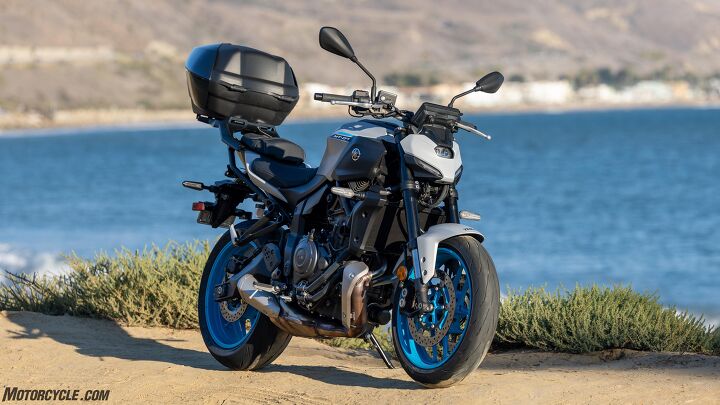
The middleweight naked sportbike category is the place to be, chockablock of impressive motorcycles rolling out from nearly every manufacturer under the sun. After a decade on the market, the Yamaha MT-07 is now a class veteran and earned its stripes way back in 2015 when it debuted in North America as the FZ-07 — your memory doesn't deceive you, friends. Since then, the Tuning Fork brand's middleweight contender has resonated with audiences to the tune of 40,000 units sold by delivering a foolproof formula to the masses: a fun-loving, torquey engine, loaded into an agile chassis, and offered at a reasonable price. This year, the fourth-generation 2025 Yamaha MT-07 boasts its most significant update yet while focusing on what made it so popular: it's still a darn good time.
2025 Yamaha MT-07
Yamaha’s popular middleweight naked sportbike returns with its most significant revision to date, boasting an all-new chassis complete with an inverted fork, updated electronic features, and fresh looks.
Highs
- Easy-going ergonomics
- Still wickedly entertaining
- Improved handling characteristics
Sighs
- Quickshifter isn't standard
- A touch of fork dive
- Lack of brake feel
The 2025 model year isn't a mere visual spit-shine for the MT-07 platform, no sir! Or madam, perhaps. Previous updates introduced mild changes to the platform, including suspension fiddling, emissions-compliance engine tweaks, and styling updates. However, it remained largely the same machine in terms of its core components. Yamaha has wisely safeguarded the rambunctious personality of its beloved MT-07 while elevating the whole package by finally bestowing it with a proper inverted fork, stiffening the tubular steel frame and steel swingarm, adding radial-mounted brakes, spiffier technology, and more for $8,599. For those keeping score, that's $400 above the outgoing 2024 model, and you're getting a significantly improved machine.

Those are some noteworthy changes, which is why we felt the mid-sized Yam deserved its time to bask in the sun after including it in our latest middleweight naked comparison. The mid-sized MT did finish third in the three-bike comparison, narrowly, though this author’s scorecard placed it ahead of the Honda CB750 Hornet because the MT-07's ergonomics are far superior for riders of my 5-foot-10-inch size.
Beyond those tidbits, our loaner unit will be a staple in the MO garages for the next few months, outfitted with convenient commuter-inspired accessories that demonstrate where owners can take customization. To that end, we're working with heated grips ($229.99), a comfort seat/passenger seat ($184.99/$159.99), a rear rack ($289.99), and a 34-liter top case ($249.99), which brings our as-tested price to $9,463.96.

The heart and soul of the MT-07 is none other than the liquid-cooled 689cc Parallel-twin CP2 engine, boasting its signature 270-degree crankshaft design that now permeates the sub-800cc middleweight segment. Yamaha pioneered that firing order, first deployed in the 1995 Yamaha TRX850. That design has stood the test of time for two reasons: punchy, linear torque that's become this mill's hallmark trait and a throaty V-Twin-inspired exhaust note. Even 50-state-legal stock trim sounds pleasing to the ear, as it now borrows a few cues from the MT-10 and MT-09 machines, adding acoustic sound ports to the 3.7-gallon fuel tank to get a more direct shot of the intake growl.
When strapped to the Motorcycle.com dyno, the 2025 Yamaha MT-07 produced a nod-worthy 65.1 horsepower at 8,500 rpm and 46.3 lb-ft. of torque at 6,300 rpm, offering an energetic hit that won't overwhelm the senses of riders rising through the ranks. It cruises sweetly, spins up predictably, and has enough bottom-end snarl to loft the front end with a stern throttle whack. These days, this powerplant's characterful low-to-midrange wallop is brought to us by a new ECU and well-tuned ride-by-wire system, helping lay the foundation for more new rider aids such as adjustable traction control, adding another safety net for those building up their skills — hooligans can disable TC and wheelie their way home, should that be their style. Non-switchable ABS is standard.

Riders can switch between preset Sport and Street modes, as well as a Custom setting, while exploring the user-friendly five-inch full-color TFT display. In the past, Yamaha struggled with snatchy ride-by-wire throttle tunings, and we're happy to say that isn't the case here: Sport has an athletic response while Street tamps things down appropriately for a commute. Things look quite snazzy these days, indeed. There's no Rain mode, though this kind of horsepower is easy to wrangle should gray skies form above your head.
The six-speed gearbox is lightly massaged, working in conjunction with revised shifting dogs for improved engagement, and gains a slip-and-assist clutch for the first time. An ultra-light clutch pull is a one-finger affair, which is more than welcome as it's missing a feature becoming more common within the category: a standard bi-directional quickshifter — the optional accessory will set you back $199.99. Meanwhile, the slipper function is handy if riders get too aggressive with their downshifts. Add all that up and we've got a tidy transmission, though it doesn't offer quite the same precision as some of its competitors. Rounding out the refinements is a minor tweak that sees the clutch actuator repositioned 35 degrees forward, providing extra clearance for the rider's leg.

Where significant progress is made is with respect to an all-new chassis. Naturally, the non-adjustable 41mm KYB inverted fork is an attention-getter, replacing the far more flexible conventional unit of the past. Those are held in place by triple clamps, said to save 0.9 pounds lighter this time around, while the reworked tubular steel frame performs the real heavy lifting this year. Save for the headstock, nearly every bit of tubing is reshaped or uses updated thicknesses to increase torsional, longitudinal, and lateral rigidity roughly 13%. Beefier mounts at the swingarm pivot point capture a completely new steel swingarm with a direct-mount KYB shock featuring preload and rebound adjustment. Wrapping all this up in a bow is refreshed geometry, which sees the rake steepen to 24.3 degrees from 24.8, the trail grow to 3.7 inches from 3.5, and the wheelbase is shortened fractionally to 54.9 inches from 55.1.
It wasn't too long ago that sport-minded riders would describe the chassis and suspension in this class as "noodly." While being comfy and compliant at reasonable paces, the prior-generation MT-07 was not immune to wallowing when one got cooking in the canyons. Recent additions to the category, such as the Aprilia Tuono 660 Factory ($11,499), Honda CB750 Hornet ($7,999), KTM 790 Duke (currently MIA in the United States), Triumph Trident 660 ($8,595), and Suzuki GSX-8S ($9,209), have all contributed to making those class-specific notes fit for the history books. Thankfully, we can add the MT-07 to that esteemed list as well. In fact, the remaining holdout still equipped with a less robust traditional fork is the Kawasaki Z650 ($7,749).

The Yamaha's handling is akin to a golden retriever's personality: it's easygoing, with eager-to-please light steering that will be inviting to riders rising through the ranks or new to the fold. Meanwhile, the sturdier fork provides far better front-end feedback, and instead of getting upset by mid-corner undulations, it tracks through with greater stability. Alas, the stiffer design strategy and updated geometry deserve a hearty hat tip, as they aid in improved confidence while on the edge of the Dunlop Sportmax Q5A rubber. The whole package feels more planted with a 180-plus-pound rider at the helm. We should also give gentle nods to the lighter spin-forged alloy wheels that shaved off 1.1 pounds of all-important unsprung weight — it all helps, kids!
Speaking of weight, Yamaha reports that despite a stouter build, the MT-07 has lost a total of three pounds and currently weighs 403 pounds curbside. Our tester, equipped with the accessory rear rack, heated grips, and comfort seat, tipped the MO scales at 413 pounds fully fueled.

Still, there are a few nitpicks. The suspension is comfortably sprung and damped nicely, yet the initial part of the fork stroke can feel divey when grabbing the new radial-mounted brakes. Control the suspenders with smooth input, and it's manageable, though additional compression damping would help riders who are still developing those skills. The shock holds up decently under hard acceleration after a couple of preload turns are added to compensate for my American heft. Lighter riders such as Troy have opinions that differ, as he feels that the shock doesn’t react fast enough, especially when taking high-frequency hits.
With a USD fork in play, we've also got radial-mounted ADVICS four-piston calipers borrowed from the YZF-R7 and paired up to 298mm discs. Stopping power is improved by a solid margin and exceeds what a machine with this type of performance on tap would ever need. Yet a longstanding Yamaha gripe remains: a lack of feel at the axial master cylinder. In the rear, a single-piston caliper and 245mm disc provide approachable bite, handy when negotiating traffic or settling in while hard on the binders.

Familiar as the tidy cockpit is, things are evolving in a slightly more casual stance. A new handlebar greets us, resting 0.4 inch closer, 0.9 inch lower, 0.4 inch wider on each side, and with an additional 1.3 degrees of rise. Taken together, the rider's upper torso is propped up in a more neutral riding position that's all-day comfortable. The downside is that we aren't drawn quite as close to the front end, and we lose a bit of connectivity. Likewise, you're in the wind while on the freeway, and that observation applies to all naked bikes, honestly. Solution? Lean forward a bit and use the human body's terrible aerodynamics! Or invest in a windscreen — your call.
Following that, the 31.7-inch-tall seat will seem more accommodating for the shorter-statured among us, thanks to a noticeably slimmer seat junction. Lastly, the rearsets sit 0.4 inch lower, and my 32-inch inseam didn't once feel excessive knee bend. Things are cozy for my 5-foot 10-inch frame, but by no means are they cramped. The comfort seat lends an assist in this regard, as its thicker foam increases the seat-to-footpeg ratio. While my backside found it pleasing enough, your derrière may differ. And for the record, the three-level accessory heated grips get dang toasty, perfect for chillier rides.

Styling is also completely refreshed, expanding on the aesthetic launched with the recent MT-09 platform. Functionally, we have all-around LED lighting that performs decently during nighttime rides. Beauty is in the eye of the beholder, and we won't browbeat readers with personal opinions — you're welcome to duke it out in the comments politely. Instead, we'll discuss the 34-liter top case. For reference, it will comfortably fit a medium full-face helmet with room to spare for smaller items and is key-matched to your machine. There's plenty of carrying capacity for groceries, textbooks, or whatever cool kids lug around these days. It also dismounts easily, and the supporting rack could be used to strap odd-sized items if one needed to be creative.
Following up on success is a tall order for any brand simply because the market rightly expects the bar to go one way: up. The middleweight class is a testament to that, as we see more offerings boast improved chassis character, greater performance, and more sophisticated electronic features than ever before. The Yamaha MT-07 helped redefine this category, infusing a healthy dose of fun into the mix — a sentiment that remains the bike's central theme today. A capable canyon partner, commuter, and all-around road bike, the Yamaha's updates are a coming-of-age story that doesn't compromise that youthful flair that attracted so many riders to the platform in the first place.
In Gear
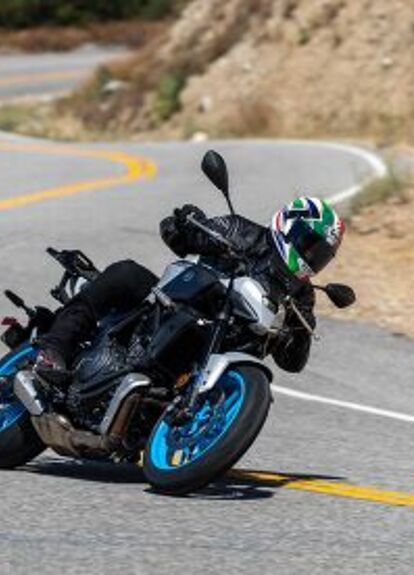
- Helmet: Arai Corsair-X Cadalora
- Jacket: Vanson Full Throttle
- Airbag: Alpinestars Tech-Air 5 Plasma
- Pants: Alpinestars Cult-8 Riding Jeans
- Gloves: Alpinestars Phenom Leather Air
- Boots: Alpinestars SuperFaster
Scorecard
Engine | 17/20 | Suspension | 13.5/15 | Transmission | 8/10 |
Brakes | 7/10 | Instruments | 4.5/5 | Ergonomics | 9/10 |
Appearance | 8.5/10 | Desirability | 8.5/10 | Value | 9/10 |
Editors Score: 85.0% | |||||
Yamaha MT-07 Specifications | |
|---|---|
MSRP | $8,599 |
Engine Type | Four-stroke, liquid-cooled, DOHC Parallel-Twin |
Displacement | 689cc |
Bore x Stroke | 80.0 mm x 68.6 mm |
Compression Ratio | 11.5:1 |
Horsepower | 65.1 hp @ 8500 rpm |
Torque | 46.3 lb-ft. @ 6300 rpm |
Fuel System | Fuel injection with YCC-T |
Ignition | TCI: Transistor Controlled Ignition |
Clutch | Wet, multi-plate Assist & Slipper clutch |
Transmission | Manual 6-speed |
Final Drive | Chain |
Front Suspension | 41mm KYB inverted fork; 5.1 inches of travel |
Rear Suspension | KYB single shock, adjustable preload and rebound damping, 5.1 inches of travel |
Front Brakes | Dual four-piston radial-mount calipers, 298mm disc; ABS |
Rear Brakes | Single one-piston caliper; ABS |
Front Tire | 120/70ZR17 Dunlop Sportmax Q5A |
Rear Tire | 180/55ZR17 Dunlop Sportmax Q5A |
Length | 81.3 inches |
Width | 30.7 inches |
Height | 43.7 inches |
Rake / Trail | 24.3° / 3.7 inches |
Wheelbase | 54.9 inches |
Ground Clearance | 5.9 inches |
Seat Height | 31.7 inches |
Curb Weight | 403 pounds (measured, 413 pounds w/ rack, acc seats, and heated grips) |
Fuel Capacity | 3.7 gallons |
Fuel Mileage (average) | 47.7 mpg |
Color | Team Yamaha Blue; Ice Storm; Matte Charcoal Black |
Service Interval | 4,000 miles (26,600 miles for valve adjustments) |

Become a Motorcycle.com insider. Get the latest motorcycle news first by subscribing to our newsletter here.
A lifelong interest in anything with two wheels, Nic combined his passion for motorcycling with a rare and mysterious skill known as typing to join the motojournalism ranks. Motorcycle.com's Senior Editor and sometimes club racer displays an unrivaled desire to sample baked goods across the globe and partake in post-track day celebratory pizza.
More by Nic de Sena







Comments
Join the conversation
We are currently obsessed with the torque made by two cylinder engines. It’s true that they make more power down low. But with just a few RPMs more the CB has more than enough torque to satisfy nearly anybody. You really have to ride the bike rather than take the word of journalists to find out what it’s all about. But like you said, to each his own.
I looked at the 2025 MT07's but I judge bikes by their power to weight ratio. With about 20lbs. more & a lot more HP I ended up with the 2025 MT09.