


2027 KTM 1390 Super Adventure S EVO Review – First Ride

What’s in a name?

Motorcycles used to be easier to define. Early big-bore adventure bikes inspired more riders to take to the dusty trail, yet getting there meant that the road-riding experience wasn’t as stellar as we’d hoped. Sport-tourers, on the other hand, sprinkle in streetwise performance zest while tackling any asphalt environment, but they usually stop when the pavement ends. Over the past decade, the lines have become increasingly blurred, giving rise to ADV-sport-touring motorcycles that dodge hardline definition or compromise. These days, ADV-influenced sport-tourers have technology on par with modern superbikes and performance that isn’t a far cry from them, either. Be it cross-country tour, urban commute, spirited canyon rip, or occasional gravel road, the 2027 KTM 1390 Super Adventure S EVO is here to do that, and do it at a rapid pace.
2027 KTM 1390 Super Adventure S EVO
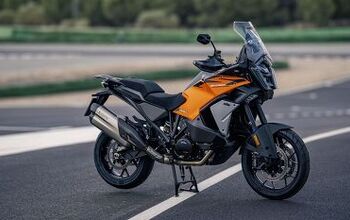
The 2027 KTM 1390 Super Adventure S EVO returns with a heaping dose of updates for the coming model year. It’s powerful V-Twin engine, updated chassis, and all aim to underscore the sport side of the ADV-sport-touring category. It’ll also blast up a fire road, too.
Highs
- Genuinely sporty handling
- Torque monster
- Quite comfy
Sighs
- Sometimes quirky shift choices
- Core electronic features are an accessory
- Luggage isn’t standard
Video: KTM 1390 Super Adventure S EVO Review
Visually, the 1390 Super Adventure S EVO is unmistakably KTM, but it is also more compact and muscular than before. The entire façade is reworked, with a slimmer headlight assembly and revised bodywork that tightens the bike’s proportions while improving aerodynamics. Wind tunnel development has paid dividends, as the easily adjustable windshield now offers a wider 2.75-inch range of movement and provides good wind protection with limited turbulence. The cockpit feels palatial with my 5-foot-10-inch frame stuffed inside. Practicality has also been improved in subtle but meaningful ways. The storage compartment ahead of the fuel cap is larger, featuring a USB-C charger for your smartphone, with another charging port near the dash for accessories. Revised radiator fans and bodywork manage heat better, redirecting hot air away from the rider. KTM even included a tool kit neatly packaged under the seat, which is a welcome nod to riders who travel.

The centerpiece of the Super Adventure platform is the 1,350cc 75-degree LC8 V-Twin, derived from the beastly Super Duke R, making it something of a wild child when measured against competitors like the BMW R1300 GS or Ducati Multistrada V4 S. Displacement is up this time around, thanks to a larger 110mm bore, and it also gains the brand’s “Camshift” variable valve timing technology, which sees two unique intake camshaft profiles, one optimized for low rpm and one for high rpm, respectively. The purpose: make its claimed 170 horsepower and 107 lb-ft of torque accessible anywhere, anytime, anyhow. Those numbers alone are impressive for a motorcycle intended to carry luggage (sadly, those are an accessory) and a passenger across vast distances, but the way the engine delivers that performance is far more important than the headline figures.
At low and midrange revs, the LC8 displays greater refinement than in the past. It still uses its rough and rowdy V-Twin character as its underpinning, but it’s more manageable, despite having more punch. Camshift allows the intake cams to operate with reduced lift and duration in the lower rev range, which enhances torque delivery where we’ll need it most. Rolling on the throttle with any authority and it’ll respond in kind: There’s immediate grunt on tap. It comes in handy when winding your way through tight, first-gear hairpin corners, using its unending torque to connect the dots between turns. The only hiccup is a twinge of throttle snatch, while power delivery remains linear.

As revs climb past roughly 6,500 rpm, the Camshift system transitions to its high-lift cam profile milliseconds later. The change is imperceptible in terms of feel, but thanks to model-specific cam profiles and a smaller throttle body compared to the Super Duke R EVO, it’s also more linear. Still, hitting the midrange reveals the V-Twin’s harder, more urgent character, pulling aggressively toward redline with a sense of effortlessness that belies the bike’s size. Passing traffic becomes a non-event, and fast sweepers can be dispatched with a single, decisive roll of the throttle. Despite the increase in performance, vibration is controlled well, and the engine never feels stressed or unruly. KTM is addressing long-term ownership concerns by extending valve clearance inspection intervals to 37,282 miles. That’s over double the mileage compared to the 1290 SA platform. It won’t cure consumer confidence regarding its publicized financial struggles, but it helps.
KTM’s Automated Manual Transmission (AMT) is making its debut aboard the 1390 Super Adventure S EVO and is a technology we’re told will likely make appearances in future models. AMT allows riders to choose between clutchless manual shifting and fully automatic operation, eliminating the need for a traditional clutch lever altogether. All you need to do is take it out of Park, place it in first gear, twist the grip to reach 1,900 rpm, and let the centrifugal clutch manage things from there. Likewise, it disengages gracefully when revs fall below that range. It fundamentally simplifies riding, making stalling impossible, easing starts on inclines, tight U-turns, and stop-and-go traffic. Gear changes are handled by a physical actuator controlled by the ECU and Transmission Control Unit, with shifts occurring in approximately 50 milliseconds.

In real-world riding, AMT is extremely effective. Manual mode allows riders to shift in a total of four main ways: hit the conventional shift lever, tap the left handlebar-mounted paddles, roll the throttle forward to downshift, the same way many bikes deactivate cruise control, or let it automatically grab the next gear once it hits the rev limiter (this setting can be turned off). In most cases, shifts are executed immediately and are akin to using a well-calibrated quickshifter. If you forget to downshift, the system will still bring it all the way down to first gear for you when pulling up to a stop. But what matters is the experience: There’s a videogame-like quality to Manual mode, and my console-raised mind instantly took to it like Mario to a mushroom. So much so that when chasing colleagues through seemingly unending cliffside roads, the paddle shifters became my default.
Automatic mode transforms the bike into a remarkably easy machine to live with on long highway slogs or when filtering through urban sprawl. The latter didn’t necessarily apply to us, since we were on the small island of Tenerife, the largest in Spain’s Canary Islands, though one can see how a quaint village might serve as an analog. Three individual transmission modes, Sport, Street, and Comfort, accurately live up to their names. Sport serves as the most “human” of the three and makes gear choices that seem accurate for the most part. Comfort is the most conservative setting and rushes to tall gears as quickly as possible. If you’d like to use any of the aforementioned Manual shifting methods, you can at will, and it’ll default back to automatic functionality after four seconds. Easy peasy.

That said, AMT is not entirely without quirks, and those familiar with other motorcycle-based automatic transmissions will note parallels. Much like Honda’s Dual-Clutch Transmission (DCT) or BMW’s Automated Shift Assistant (ASA), AMT’s behavior is guided by calculating optimal shifts based on data from the ECU, IMU, and TCU. That is to say, it might not make the same choices as the average human. For example, the bike can hold gears longer than expected. In other cases, it can delay downshifts when approaching corners, not producing the amount of engine braking you might desire. A quick workaround is to increase the amount of engine braking, which seems to improve shifting responsiveness.
There are instances in Manual or Automatic modes where longer-than-expected delays between gear changes can feel like a quickshifter with wonky kill times. As we’ve seen in recent examples from Ducati, engineers describe a gearbox protection strategy that ensures the whirring mechanical bits are fully seated before putting down power. Minor peculiarities aside, automatic transmissions have their place, easing situations in traffic, while reducing riding a motorcycle to its most basic inputs. One can imagine the wide variety of situations that tech such as this aids.

The tech wizardry does not end there, and to tackle that, we’ll turn our attention to KTM’s new eight-inch, portrait-oriented TFT. The touchscreen works reliably with most gloves, though waterproof liners do confuse it, and is incredibly intuitive. The interface is highly configurable, allowing riders to prioritize navigation, telemetry, adaptive cruise control information, or a simplified display based on preference. Offline map navigation is fully integrated and deserves high praise, as it eliminates the need for a tethered smartphone, exactly as we witnessed on the KTM 990 RC R. Meanwhile, Bluetooth connectivity accommodates the standard assortment of multimedia functions.
Our usual disapproving tuts still apply to the brand’s strategy of offering electronic adjustment features as part of optional accessory packages. To that end, two packages are offered. The Rally Pack ($350) allows nine-level adjustment of lean-angle traction control, throttle maps, adds a new “dynamic slip adjust” (a TC setting that slightly exceeds chosen traction control values when additional throttle is applied), adds two additional custom modes, and a telemetry screen. Following that up, the all-encompassing Tech Pack ($899) is the wiser purchase again. It includes the Rally Pack, while adding Motor Slip Regulation, Hill Hold Control, engine brake management, and Suspension Pro (additional semi-active suspension damping adjustment). We recommend the Tech Pack, though those on the fence can sample everything until the 932-mile Demo Mode expires. However, every other mind-boggling piece of technology mentioned is standard, and there’s a lot of it.

The fifth-generation Bosch front radar-based Adaptive Cruise Control (ACC) system is standard on the Super Adventure S EVO. We’ve seen these systems before, but nothing that quite behaves like what we’ve come to expect in the automotive market. It manages speed smoothly and adjusts following distance intelligently depending on your setting. The unique Stop & Go feature is the most intriguing aspect, since it will bring the bike to a halt, resuming once traffic clears within a three-second window. Additional radar-based features include braking assistance, collision warning, and distance warning, all of which integrate seamlessly into the riding experience. Brake assist is interesting, as it uses radar and all other available data to apply the brakes beyond what the rider is already inputting, if it feels that there’s stopping power being left on the table. Instead of feeling the brake lever pulse like you would with ABS, you’ll feel slack in the lever as the bike applies additional pressure.
There is a demographic that may not appreciate these systems, painting them in a Kubrick-esque HAL 9000 light. For those individuals, Rally or Custom riding modes are your saviors, as nearly all computer-aided nannies can be disabled. In another industry first, once the ACC is removed from the equation, conventional cruise control is left in its place. So, riders that don’t want those features can turn everything off, save for ABS. Even in that respect, we have the lean-angle-enabled Road setting, followed by a far less restrictive Off-Road setting borrowed from the Super Adventure R platform.

Impressive as all that is, nothing captured this scribe’s attention like the Super Adventure S EVO’s continued on-road evolution. While the steel trellis frame appears similar with its engine-as-a-stressed-member design, altered tube diameter and wall thicknesses have stiffened the chassis. That amounts to increased feedback without taking it too far. On that note, longitudinal rigidity is up 13 percent, lateral rigidity is up 23 percent, and torsional rigidity is up 73 percent, creating a machine that maintains composure while on the edge of its Dunlop Trailmax Meridian tires.
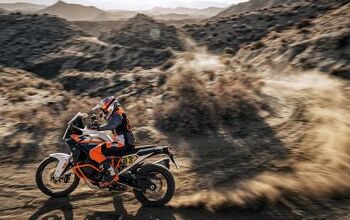
It defies any preconceived notions about what a motorcycle with a 19-inch front wheel can do. Turn-in is precise, midcorner stability is steadfast, and it holds its line when being pushed on Tenerife’s perpetually winding routes. A 17-inch hoop could offer more grip, sure, but when KTM has managed to make a roughly 537-pound motorcycle handle as spritely as this, the Super Duke GT starts looking like a third wheel. Of course, credit where credit is due, with the WP semi-active suspension pulling its weight. Comfort mode delivers impressive compliance over rough pavement, while Sport mode tightens things up decently. Personally, Suspension Pro’s conventional compression and rebound damping adjustment was my go-to, while also tossing the shock in its highest preload setting. Combine that with carryover Brembo braking components, and you have a big beauty that’ll keep up with sportbikes on Sunday.

Where the 2027 KTM 1390 Super Adventure S EVO sits in this ADV-sport-touring class is an interesting one. Seen in one light, it is the undeniably tech-rich machine offering AMT and ACC, along with a slew of other electronic features that argue practicality. Another layer reveals its monstrously powerful 1,350cc LC8 and the untold amount of excitement it brings. Of course, what shines through in these conversations is how excellently it handles itself in all on-road situations. Yet, there are other intangibles that KTM nails, namely that within all of this self-serious, performance-focused grandeur, it has the personality elements of a rip-roaring supermoto half its size, ready to hoist the front wheel skyward, should you be so bold. And taken together, readers, it’s a win in my book.
Scorecard
Engine | 18/20 | Suspension | 14/15 | Transmission | 9/10 |
Brakes | 9/10 | Instruments | 5/5 | Ergonomics | 9/10 |
Appearance | 9/10 | Desirability | 9/10 | Value | 9/10 |
Editors Score: 91.0% | |||||
In Gear:

- Helmet: Alpinestars Supertech R10
- Gloves: Alpinestars Hyde XT Drystar
- Jacket: Alpinestars Andes V4 Drystar
- Pants: Alpinestars Andes V4 Drystar
- Boots: Alpinestars RT-7 Drystar
2027 KTM 1390 Super Adventure S EVO Specifications | |
|---|---|
MSRP | Starting at $22,699 |
Engine Type | Liquid-cooled, four-stroke, 75° V-Twin, DOHC with 4 valves per cylinder |
Displacement | 1350cc |
Bore x Stroke | 71.0 mm x 110.0 mm |
Compression Ratio | 13:01 |
Transmission | 6 gear AMT |
Fuel System | Electronic fuel injection |
Clutch | Centrifugal clutch |
Ignition / Engine Management | Keihin EMS with Ride-by-Wire and cruise control, double ignition |
Traction Control | Cornering traction control |
Frame | Chrome-moly tubular space frame, powder-coated |
Front Suspension | WP semi-active technology, Ø 48 mm fork, 8.7 inches of travel |
Rear Suspension | WP semi-active technology monoshock, 8.7 inches of travel |
Front Brake | 2 x Brembo four piston, radially mounted caliper, 320mm discs |
Rear Brake | Brembo twin-piston fixed calliper, 267 mm brake disc |
ABS | Cornering ABS and offroad mode |
Front Wheel | Cast aluminum, 3.50 x 19” |
Rear Wheel | Cast aluminum, 5.00 x 17” |
Front Tire | Dunlop Meridian 120/70 ZR 19 M/C 60W Tubeless |
Rear Tire | Dunlop Meridian 170/60 ZR 17 M/C 72W Tubeless |
Rake / Trail | 24.7° / 4.3 inches |
Wheelbase | 61.3 inches |
Ground Clearance | 8.8 inches |
Seat Height | 33.3-34.1 inches |
Fuel Capacity | 6.1 gallons |
Weight | 500 pounds without fuel (claimed) |
2027 KTM 1390 Super Adventure S EVO Review Gallery

We are committed to finding, researching, and recommending the best products. We earn commissions from purchases you make using the retail links in our product reviews. Learn more about how this works.
Become a Motorcycle.com insider. Get the latest motorcycle news first by subscribing to our newsletter here.
A lifelong interest in anything with two wheels, Nic combined his passion for motorcycling with a rare and mysterious skill known as typing to join the motojournalism ranks. Motorcycle.com's Senior Editor and sometimes club racer displays an unrivaled desire to sample baked goods across the globe and partake in post-track day celebratory pizza.
More by Nic de Sena




Comments
Join the conversation
Costing nearly a "quarter of a brick", I think I'll wait to see how Bajaj sells and services this very complex machine before considering it. 🤔
I think they should have offered two versions, this one for the motonerds and a more conventional clutch-carrying, manual shifting version with some of the bells/whistles left off. Maybe even with just a fully adjustable manual suspension that would result in a significantly lower price point. I would consider lower spec to just get the motor performance and a still high level of comfort.