


2027 Suzuki GSX-R1000R Review – First Ride

A familiar friend gets some Euro5+ updates, and we definitely did not race it

UPDATE: Suzuki has announced details for the U.S. market surrounding the GSX-R. Full details can be found here. The unexpected difference is the addition of a third model. In addition to the GSX-R1000 and GSX-R1000R, the third model is the GSX-R1000RS, which is the same as the GSX-R1000R, except the RS has the winglets. The RS is the bike reviewed here. Pricing starts at $16,399 for the base model, $17,939 for the R, and $18,639 for the RS.
There aren’t very many combinations of letters in motorcycling that conjure instant familiarity like these four: GSX-R. Turn up anywhere in the world and mention the word “Gixxer,” and gearheads will know what you’re talking about. Of course, the GSX-R750 kicked things off in 1985, but in 2001 Suzuki unleashed the GSX-R1000, and soon after, the literbike wars really took off. Suzuki enjoyed all kinds of racing success with the GSX-R1000 over the years, both in domestic championships and internationally, but one area where Suzuki has found particular success is a form of racing that’s less popular globally: endurance racing.
2027 Suzuki GSX-R1000R
Suzuki has updated its venerable 1000cc flagship sportbike, making it legal to be sold around the world once again. But this update is far from a ground-up reboot. Refinements to the engine get it past the regulators, while updates to the electronics bring it within sniffing distance of its rivals. It may not sound like much, but the new GSX-R remains the familiar friend we’ve known for years.
Highs
- So easy to ride quickly
- Updated electronics are a big step up
- Pricing should be in its favor (still TBD at press time)
Sighs
- Brakes feel dated
- Why are we still using an LCD screen?
- Even after updates, the GSX-R1000R is far from leading the class
Sure, Suzuki has won Superbike titles and even a MotoGP championship, but its 21 titles in the Endurance World Championship since 1983 are a big deal. Fifteen of those were won on the GSX-R1000. While Superbike and MotoGP are obviously glamorous, endurance racing matters because the bikes not only have to be fast, but above all, reliable. It used to be the norm to conserve energy and ride conservatively during endurance races. These days, endurance races, including 24-hour ones, have turned into all-out sprints, and the bikes are taxed to the limit. Winning once is an achievement — winning 15 times on the GSX-R1000 is a statement.
But for the last few years, that statement went a little quiet. Since 2022, the GSX-R1000R has been absent from the European market, unable to meet tightening Euro5+ emissions regulations. While it quietly soldiered on in the U.S., its global presence — especially in racing-centric regions — took a hit.
VIDEO: 2027 Suzuki GSX-R1000R Review
Now, for 2026, Suzuki brings its flagship superbike back to the world stage. The mission was clear: meet modern emissions standards without diluting the GSX-R’s core DNA of performance, durability, and rideability. The result isn’t a ground-up reinvention, but a thoughtful refinement of a proven package.
And, as it turns out, one you can race for six hours straight, not that that’s what we did.

What’s New for 2026
At first glance, the GSX-R1000R doesn’t look radically different — and, well, it’s not. The frame, swingarm, suspension, and even most of the braking components and bodywork are the same. The R model now gets steel-braided brake lines and winglets, which the non-R version doesn’t.
To some degree the updates focus where they matter most: inside the engine, within the electronics, and in subtle refinements to the chassis and aerodynamics. Suzuki’s goal, apart from making the bike legal again, was to keep it reliable and easy to ride, but with a big caveat: the engineers gave a lot of headroom for race teams to develop it further.
Engine Updates
To meet Euro5+ regulations and improve performance potential, Suzuki made extensive internal changes.
The engine receives the bulk of the updates, starting with newly shaped finger followers that improve valve control and make it easier to develop more aggressive cam profiles for racing applications (something Suzuki engineers on hand were eager to point out to us). Complementing this change are larger exhaust valves, increased from 24 mm to 25 mm, to help the engine breathe more efficiently.

Suzuki also introduced new forged pistons that are not only lighter — shedding three grams each — but also reshaped to accommodate a higher compression ratio. That compression ratio now rises from 13.2:1 to 13.8:1, for a slightly more powerful bang each time the spark plug fires. Supporting these updates is a new crankshaft with thicker journals, designed to better withstand higher loads and improve long-term durability, especially under race conditions. To house this revised crankshaft, the crankcases themselves have been redesigned, and a new lubrication system ensures critical components receive consistent oil flow under extreme use.
Further refinements inside the engine include a wider cam chain to reduce frictional losses and updated camshaft profiles with reduced valve overlap. This, in turn, brings peak power and torque down slightly compared to before. But the overall spread of power is improved, helped by Suzuki’s mechanical Variable Valve Timing system carried over from the previous engine. On the intake side, larger 48 mm throttle bodies replace the previous 46 mm units, and the switch from dual-stage to single-stage intake funnels simplifies airflow while favoring high-rpm performance.
Fuel delivery has also been revised, with new injectors moving from a 10-hole to an 8-hole design. A new fuel pump supports these injectors by increasing fuel pressure for more consistent delivery under load.

Then there’s the exhaust — everyone’s favorite thing to bash on Gixxer Thou’s. This system is completely new, featuring a larger catalytic converter positioned closer to the engine for better emissions performance especially during cold starts. At the same time, the muffler shrinks from 8.3 liters to 5.5 liters. And instead of the fat, girthy shape of before, the new one is longer and slimmer. But it’s still pretty big and bound to get plenty of hateful comments.
With these changes, peak output is now rated at a claimed 192.3 hp at 13,200 rpm, and 81.1 lb-ft of torque at 11,000 rpm. As mentioned before, that’s actually down compared to the previous bike’s 199 horsepower at 13,200 rpm and 86 lb-ft at 10,800 rpm. Still, unless you’re only concerned about bragging rights, I wouldn’t get too caught up in the discrepancy.
Electronics Updates
The world of rider electronics has made huge leaps and bounds since the Gixxer was last updated in 2017. So it makes sense that Suzuki’s Intelligent Ride System (S.I.R.S.) got a major overhaul, with the six-axis IMU holding major executive functions.

To start, Suzuki updated the three ride modes (A, B, or C) for better throttle response. A mode still delivers a nearly 1:1 ratio, while B mode softens the initial throttle delivery. C mode softens power delivery even further still, but all three modes all deliver full power eventually.
However, the biggest leap comes in the new Smart TLR Control system, which integrates traction control, wheelie (lift) control, and roll torque control (how much power to give depending on lean angle and speed) into a single, more cohesive package. The downside to this is that all three are linked together, so changing a TC setting also alters the lift and roll control settings. They’re not independent, which we’d prefer. That said, Suzuki’s goal was to make the rider aids as seamless as possible, using data from an updated IMU that is both lighter and more precise, allowing for smoother, less intrusive intervention.

Even though the only visible update to the braking system from the outside is the steel braided brake lines, underneath the seat lies a new C-ABS module that is 51 grams lighter, with updated software for more refined intervention, especially under hard braking or when leaned over. The quickshifter system has been revised as well, improving shift smoothness and consistency both up and down the gearbox. The quickshifter also features two settings; one with slightly longer ignition kill times for smoother shifts on the street, and the other with shorter kill times for shifts at the track. Launch control and the ride-by-wire throttle system have also been recalibrated to provide more predictable and controllable power delivery.
Chassis & Body
There’s not a lot to report here because the chassis itself remains largely unchanged — same frame, same swingarm, even the same Showa shock and fork. But it’s not completely unchanged — there are now winglets! Derived from endurance racing efforts, where apart from the Suzuki Endurance Racing Team, Suzuki also fields a GSX-R1000R in the experimental class featuring as many carbon neutral components as possible. The winglets on the production bike are the same shape. Suzuki says the winglets “improve front-end lift suppression by 8.4%” but who among us can really notice 8.4% less wheelies? Finally, a new lithium-ion battery replaces the previous lead acid battery, shaving six pounds in the process.

While it’s understandable to criticize Suzuki for not doing much to the chassis, let’s look at two important upsides. First, Suzuki’s had a reputation for being able to undercut the competition in terms of price. At press time U.S. pricing is still TBA, but when a big chunk of the bike hasn’t changed, there’s reason to believe the Gixxer’s price will be very attractive in the category. And second, the GSX-R chassis has a reputation for being forgiving and easy to ride. It may not be razor sharp like some of its competitors, but it’s still plenty capable of doing the business. And Suzuki had a creative way of proving it…
Six Hours of Suzuki
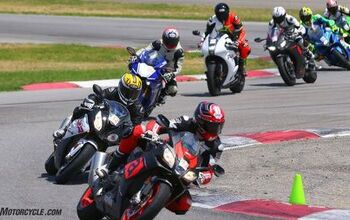
Instead of the usual handful of track sessions and a catered lunch, Suzuki did something different for this press launch. They threw us into a full-blown endurance “race” (though Suzuki’s legal team would like to emphasize this wasn’t an actual race).
Dubbed the “Six Hours of Suzuki,” the format was simple: six teams, three riders each, one GSX-R1000R per team, and six hours to prove a point. The format was an homage to Suzuki’s history with endurance racing, and SERT rider Dan Linfoot was on hand to tell us stories of what actual endurance racing is like.

I was teamed up with Bruce Wilson from Fast Bikes in the UK and Danny Kushmaro from Israel. We lined up for a Le Mans-style start at the Circuito Monteblanco in Spain and I was randomly chosen to take the start. A sprint across the track, throw a leg over the bike, thumb the starter, and we were off. I slotted into second place early, settling into a rhythm while trying to remember I had, you know… five hours and fifty-something minutes left to go.
We chose Ride Mode B for the race, figuring the softer throttle response would pay dividends as fatigue set in. Traction Control was set to 3 — a middle ground that felt safe without being overly restrictive.

Engine
The first thing that stands out about the updated GSX-R1000R is its bottom and midrange. There were times when there was a noticeable dead zone in ride mode B where I had to essentially pre-turn the throttle earlier than normal so power would get delivered when I actually wanted it, but otherwise the 999cc Inline-Four felt like our same familiar friend. It was strong. Accessible. Friendly, even.
There’s a noticeable emphasis on usable power rather than outright top-end fireworks. Rolling onto the throttle out of corners, the bike drives forward with a smooth, predictable surge that you only get out of a literbike, but it’s easy to manage over long stints.

But Mode B comes with a trade-off. Other than having to pre-turn the throttle, on the front straight, riders in Mode A and I would crack the throttle at the same time — but they’d inch away. Not dramatically, but enough to notice they’d get a better drive that I couldn’t recover.
Not surprisingly, top-end push feels a little flat and stagnant. Monteblanco’s front straight is a rare place that allows a literbike to hold sixth gear for a few seconds, but there’s not much to be gained there. I could see the GSX-R’s tach hover in the upper ranges, but the speedo was barely registering faster speeds. In stock form the bike’s strength clearly lives in the lower and middle rev ranges, but Suzuki built this engine platform with race teams in mind, so I’m naturally curious how much this engine could be woken up.
Chassis & Handling
A six-hour endurance race is a challenge for both man and machine, but a good chassis goes a long way in helping the human component last the distance. The bars are a bit narrow, which forces you to rely more on lower body input to initiate direction changes. It’s not a dealbreaker, but it’s noticeable — especially when fatigue starts creeping in.

In that regard the GSX-R1000R remains one of the most neutral, predictable literbikes out there. Turn-in is easy, transitions are smooth, and there’s a reassuring stability mid-corner that makes it incredibly easy to ride quickly. It’s not the most precise chassis in the class, and due to the nature of our event, we were highly discouraged from making time-consuming suspension changes. I would have liked a couple turns of rear preload added, since the bike wasn’t finishing corners as well as I would have liked, but breaking out the C-spanners and adjusting collars would have cost us too much precious time.
Braking & ABS
Endurance racing is brutal on brakes, and Monteblanco’s Turn 1 — scrubbing 160+ mph down to roughly 40 mph — was the ultimate test. With lap times just over 60 seconds, that 120 mph braking zone comes up a lot over the course of six hours. Needless to say, the brakes got an absolute pounding. The bikes ran stock pads and Suzuki mandated at least two pad changes per team during the race.

I had watched YouTube videos to learn the track and the riders would brake for turn 1 at the 200m board. With a reference in mind, I quickly learned I could not brake that late into the first turn. Initial bite is on the softer side, which is common for stock pads since it’s more forgiving for street riding but less ideal when you’re trying to brake as late as possible. Grabbing the lever at around 250 meters seemed to be where most people, myself included, dared to take it. Lever travel from the Brembo master cylinder did increase slightly during my stints, but it stabilized mid-session. Kudos to the steel-braided lines for keeping lever feel consistent, even as the system heated up.
While I don’t usually use the rear brake on track, I started incorporating it more during my stints — not just to help slow the bike, but to bring revs down and reduce strain on the front system. Interestingly, after doing this, the front lever occasionally firmed back up. It wasn’t consistent, which is odd, but at least the lever fade got better, not worse.

Usually we’re quick to turn off ABS (if possible) or turn it down to the least intrusive setting. However, since ABS is tied to the traction control system, which was set at 3, I was nervous if it would intrude too much. I’m happy to say that the system is a highlight, especially in a six-hour race, when fatigue can lead to sloppy braking. When activation hits, it’s subtle — gone are the harsh pulses of older systems. Instead, you get light, high-frequency feedback through the lever that doesn’t feel like you’ve lost all your braking. It’s informative without being intrusive.
Electronics: Smart TLR Control
I mentioned at the top that the new GSX-R1000R takes a clear step forward in the electronics department, and this braking example is just one instance. As I started to get tired and my wrists and hands started to ache, my ability to modulate my brake pressure wasn't nearly as precise as when I was fresh. I remember thinking how impressive it was that I could trail the brakes deep into some corners and with knee-down lean angles and the front never protested. A lot of that credit goes to the Bridgestone RS12 tires that were fitted to the bikes (RS11s come standard), but the Cornering-ABS deserves some credit for potentially metering my braking better than I could at the tail end of my stints.

Suzuki’s new Smart TLR Control — integrating traction control, lift control, and roll torque control — is nicely calibrated also (though I still wish the controls were independent of each other). You can feel it working, but it feels like it’s working with you, not for you.
The braking example above gives you a sense of how the bike behaves going into a corner, but if you get greedy with the throttle on corner exit, you’ll see the TC light flicker as the system gently trims power to keep things in check. It’s subtle — just enough to prevent excess spin without killing momentum. Monteblanco’s signature corner is a fast, uphill right hander with a blind crest. You enter it in third gear, which immediately compresses the suspension as the climb starts. If you clip the apex just right, you can get on the gas hard up the hill, as the exit of the corner is fairly open. Power over the crest and the GSX-R is in the meat of the powerband, eager to loft a wheelie. Get it right and you feel like a hero. If you’re a foot or two off the apex, you’ll get the wheel in the air with a decent amount of lean angle still.

In TC level 3 I could tell the power was edged off just a little as I powered up the hill, but there was still considerable drive at the same time. The front would get light over the crest, but the refined wheelie control would take care of that, too. With my right wrist cocked back pretty far, the front lifts, pauses, and settles back down smoothly. No abrupt cuts. No slammed front ends. I’m old enough to remember when TC systems would cut power so abruptly you felt like you were riding a bucking bronco with a mind of its own. I’m happy to say that rider aids have advanced a long way since then.
Considering our race scenario, our strategy of choosing ride mode B and TC level 3 had another advantage: tire conservation. After two hours Suzuki mandated a tire and brake pad change. While our pads had seen better days (but still had usable life left), our Bridgestone RS12 tires looked fantastic. Wear was even and smooth, with no scallops or shredding on the rear tire. We could have easily gone another two hours or more on the set. Ask trackday riders on literbikes about tires and they’ll tell you how tough it is to make a set last a whole day. The fact the GSX-R can be relatively easy on tires (with the right settings) should not be ignored.

The Verdict
After six hours of race — err, simulated race conditions — the checkered flag finally waved. All the bikes finished, nobody crashed, and not a single bike had a mechanical issue. I’m told we finished fourth, and rumor has it the top four teams were separated by one mile according to the tripmeters.
This level of consistency was Suzuki’s point all along. The 2026 Suzuki GSX-R1000R isn’t a revolution, nor is it the best bike in the class. But no matter who you are, you can ride it as fast as you can for a long time — and still meet Euro5 regulations. Odds are the price will make it pretty attractive in a class that’s getting more and more out of reach, too.

The engine shifts its focus toward usable performance rather than peak numbers. The chassis remains as neutral as it’s always been. And the electronics have made a much needed leap in sophistication. It’s like reacquainting with an old friend — one who just finished grad school.

Scorecard
Engine | 18.5/20 | Suspension | 12/15 | Transmission | 9/10 |
Brakes | 8/10 | Instruments | 4/5 | Ergonomics | 9/10 |
Appearance | 8.5/10 | Desirability | 8/10 | Value | 9/10 |
Editors Score: 86.0% | |||||
In Gear

- Helmet: Arai Corsair-X
- Suit: RST Race Dept V4.2 D30 Airbag Leather Suit (Custom)
- Gloves: RST Moto Tractech Evo 4 (Custom)
- Boots: XPD XP9-R Air
Specifications | 2027 Suzuki GSX-R1000 | 2027 Suzuki GSX-R1000R |
|---|---|---|
MSRP | $16,399 | $17,939 |
Engine Type | 4-stroke, 4-cylinder, liquid-cooled, DOHC | |
Bore x Stroke | 76.0 mm x 55.1 mm | |
Displacement | 999.8 cc | |
Compression ratio | 13.8:1 | |
Fuel system | Fuel injection | |
Starter system | Electric | |
Lubrication system | Wet sump | |
Transmission | 6-speed constant mesh | |
Frame | Twin-spar aluminum frame | |
Front Suspension | Fully adjustable Showa Big Piston Fork (BPF) | Fully adustable Showa Balance Free Front Fork (BFF) |
Rear Suspension | Fully-adjustable Showa Remote Reservoir Shock Absorber | Showa Balance Free Rear Cushion Light (BFRC-lite) |
Front Brake | Dual Brembo Monobloc four-piston calipers, 320 mm disc | Dual Brembo Monobloc four-piston calipers, 320 mm disc, steel braided brake lines |
Rear Brake | Single Nissin single-piston caliper, 220 mm disc | Single Nissin single-piston caliper, 220 mm disc, steel braided brake lines |
Front Tire | Bridgestone Battlax Racing Street RS511 120/70ZR17M/C (58W), tubeless | |
Rear Tire | Bridgestone Battlax Racing Street RS511 190/55ZR17M/C (75W), tubeless | |
Rake / Trail | 23°20’ / 3.7 inches | |
Wheelbase | 55.9 inches | |
Overall length | 81.7 inches | |
Overall width | 27.8 inches | |
Overall height | 45.1 inches | |
Ground clearance | 5.1 inches | |
Seat height | 32.5 inches | |
Curb weight | 448 pounds (claimed) | |
Warranty | Twelve-month unlimited mile warranty (extended warranty available) | |

We are committed to finding, researching, and recommending the best products. We earn commissions from purchases you make using the retail links in our product reviews. Learn more about how this works.
Become a Motorcycle.com insider. Get the latest motorcycle news first by subscribing to our newsletter here.
Troy's been riding motorcycles and writing about them since 2006, getting his start at Rider Magazine. From there, he moved to Sport Rider Magazine before finally landing at Motorcycle.com in 2011. A lifelong gearhead who didn't fully immerse himself in motorcycles until his teenage years, Troy's interests have always been in technology, performance, and going fast. Naturally, racing was the perfect avenue to combine all three. Troy has been racing nearly as long as he's been riding and has competed at the AMA national level. He's also won multiple club races throughout the country, culminating in a Utah Sport Bike Association championship in 2011. He has been invited as a guest instructor for the Yamaha Champions Riding School, and when he's not out riding, he's either wrenching on bikes or watching MotoGP.
More by Troy Siahaan






Comments
Join the conversation
GSX-R 750 was launched in 1984 not 85.
America didn't get Gixxer until 85 for various reasons (one being no one could supply enough radial tyres, another, Suzuki didn't think it would sell in USA)
It's been common knowledge for decades that GSX-R 600/750 gets 'BNG' update one year and GSX-R1000 the next year, the updates tend to be incremental until something new HAS to be done (i.e. switching from SACS to water cooling)
Mayber no one there is old enough or cares about the Gixxer history?
Suzuki GSXR line has never been the class leader in Sportbike category. I say theyre the "Goldilocks" not the "Gold standard". They don't bring leading technology to the Gixxer, they deliver proven design. You'll never go wrong in your purchase of a Gixxer.