


2026 Suzuki GSX-R1000 and GSX-R1000R First Look

Suzuki Celebrates 40 Years of GSX-R
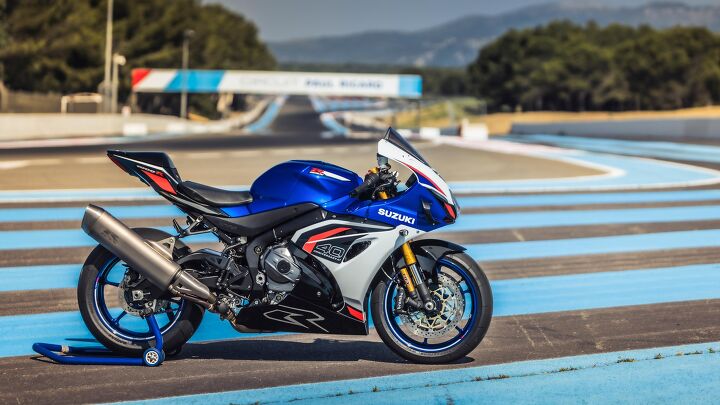
Sportbike fans rejoice: the 2026 Suzuki GSX-R1000 and GSX-R1000R are coming out swinging with significant updates to their 999.8cc inline-Four engines aimed at satisfying Euro5+ emissions. That isn’t all that’s in store, as the brand announced refinements to the platform’s electronic rider aids, and introduced optional aerodynamic winglets as part of a minor aesthetic refresh.
The original GSX-R750 was launched in 1985 and was instrumental in shaping sportbike design as we know it today. Coincidentally, the Japanese firm hailing from Hamamatsu has much to celebrate in calendar year 2025, as it's the GSX-R’s 40th anniversary. Today’s announcement is momentous since it is the first time that the current-generation GSX-R1000 L7 platform has received an update since it debuted in 2017. Moreover, this update also marks the big GSX-R1000R’s return to global markets — it, like some other 1000cc sportbike offerings such as the Yamaha YZF-R1, was pulled from select regions due to no longer adhering to emissions compliance requirements.

What’s new? Quite a bit. The 999.8cc screamer I4, an evolution of its current-gen mill which features a unique variable intake valve timing system to encourage broader power delivery, is set to receive quite the overhaul. Those changes include a new crankshaft, new camshafts, new crankcases, refreshed pistons and connecting rods, as well as a revised exhaust system.

Updates to the 999.8cc I4 screamer engine take the headlines, but it still produces a commendable 192.3 horsepower at 13,200 rpm, with peak torque of 81.1 lb-ft at 11,000 rpm, according to our friends at Suzuki UK — Suzuki Motor USA does not typically cite performance figures publicly. Notably, these claimed peak figures are down slightly in comparison to the 2017–2025 iteration that boasted 199 horsepower at 13,200 rpm and 86 lb-ft at 10,800 rpm.
Starting at the top: the finger-follower valvetrain utilizes a revised shape on the intake and exhaust sides to better match the updated camshaft profile. Supporting that cause are larger-diameter exhaust valves that have increased from 24mm to 25mm, working in conjunction with the new camshaft and a wider cam chain that reduces friction loss. The brand states that maximum valve lift remains the same as before, but noted that overlap was reduced to meet emissions targets — less overlap often results in better low-rpm performance and a cleaner burn, though it usually sacrifices some top-end horsepower, which helps explain the power discrepancy.

A higher-pressure fuel pump is being deployed, working with updated secondary top-feed fuel injectors that have reduced their injector nozzles from 10 to eight holes to run cleaner. Contrasting that change and maintaining performance goals is a larger 48mm (was 46mm) throttle body that is said to be lighter and more compact. Meanwhile, the velocity stacks now feature fixed, single-stage #1 and #4 funnels.
New forged aluminum pistons feature a completely revised shape that results in a higher 13.8:1 compression ratio (13.2:1 previously) while also accommodating the larger exhaust valve diameter. In addition, the pistons boast cutaway sides and a DLC-coated wrist pin to reduce friction. Taken together, the brand says that it all helps increase performance and durability while simultaneously reducing vibration. Regarding durability, Suzuki is also citing a new head gasket design.

Those pistons are put into action via steel connecting rods with a carburized surface treatment, and it’s here where Suzuki specifically mentions that it’s designed for reliability when applied to racing builds. Rounding out the main engine updates is a newly designed crankshaft with thicker journals, growing from 35mm to 37mm, again noting benefits at high loads that would be conducive to racing applications. Naturally, the crankcase design was updated in accordance with the new crank. The six-speed gearbox utilizing an assist-and-slipper clutch remains the same.

The final touch is an updated muffler, said to have reduced its volume from 8.3 to 5.5 liters. Meanwhile, the catalytic converter is relocated closer to the engine to encourage faster warm-up times.
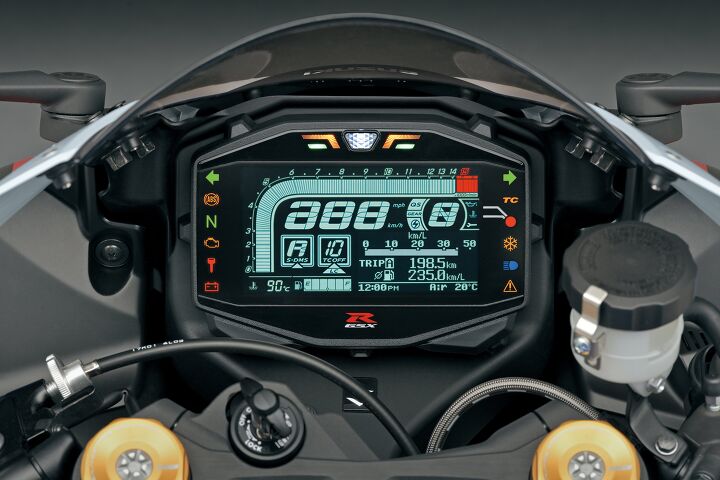
Helping meter all that power to the rear wheel is a six-axis IMU-supported suite of rider aids. Aside from updating the fuel maps, Suzuki has pointed to revised traction control and wheelie control systems to adapt them to its latest powerplant. The brand states that its latest “Roll Torque Control” system is integrated into this iteration of traction and wheelie control, with 10 levels of adjustment. In addition, a bi-directional quickshifter, lean-angle-sensitive ABS, launch control, low RPM assist, and Suzuki’s Easy Start function are all standard. Saving a few pounds is a new lithium-ion battery. The basic LCD instrument panel returns once again, though we would have preferred seeing an updated TFT variant on the GSX-R1000R.
The chassis remains the same as the current-generation L7 GSX-R, carrying over the twin-spar aluminum frame and aluminum swingarm. In addition, the fully adjustable Showa Balance Free suspension returns for another tour of duty aboard the GSX-R1000R. Meanwhile, the standard GSX-R1000 utilizes the same fully adjustable Showa Big Piston Fork and Showa shock with a remote reservoir as before. However, the GSX-R1000R does have one important trick up its sleeve: an adjustable swingarm pivot point.
Given the current crop of superbikes that have models boasting semi-active suspension, it would have been nice to see a significant change in this area, although not including said feature will help keep the unannounced MSRP manageable. An electronic steering damper is standard.

Braking is handled by the same Brembo monobloc calipers, clamping onto 320mm rotors that do show their age in reference to recent competitors like the Ducati Panigale V4 S, Aprilia RSV4 Factory 1100, and Honda CBR1000RR-R Fireblade SP that have updated to oversized 330mm rotors. However, Suzuki is citing a new ABS unit, claiming that it’s 51 grams lighter than what’s featured on the current GSX-R1000R. Notably, the GSX-R1000R will boast steel-braided brake lines over the base model GSX-R1000’s rubber brake lines.
As usual, cast aluminum 17-inch wheels will be standard and will feature Bridgestone Battlax Racing Street RS11 tires in 120/70 and 190/55 sizing. The rear tire sizing is somewhat dated in comparison, as most European and select Japanese competitors have moved to 200 width tires at a minimum, while vacillating between 55 and 60 aspect ratios. In general, these larger tire dimensions provide better edge grip at high lean angles, while taller aspect ratios encourage quicker steering responses. Fortunately, the 6-inch width of the rear tire means swapping rubber to match its contemporaries is an easy thing to do. However, whether the bigger tire will rub the fender is something the end user will have to verify.

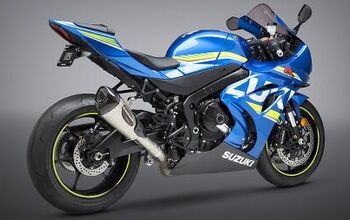
Aesthetically, the 2026 Suzuki GSX-R1000R is not a significant departure from what we currently know as the fairings and fuel tank are identical. Importantly, Suzuki has added optional carbon fiber aerodynamic winglets developed first on the GSX-R1000 the company races at the Suzuka 8 Hour with largely carbon neutral components. These are said to help produce downforce at high speeds, increasing stability and aid the anti-wheelie system.
Part of the 40th anniversary celebration is three dedicated liveries, all of which feature a 40th anniversary decal on the fairing and fuel tank. A classic “R” logo is on the belly pan of all colorways. For the U.S., the GSX-R1000 is available in Pearl Vigor Blue / Pearl Tech White and Pearl Ignite Yellow / Metallic Matt Stellar Blue, while the GSX-R1000R is offered in Pearl Vigor Blue / Pearl Tech White and Candy Daring Red / Pearl Tech White. Europe will not be getting the non-R model, so the GSX-R1000R will be available in all three colors. U.S. pricing and availability are not announced yet. We will update this story accordingly.

Specifications | 2026 Suzuki GSX-R1000 | 2026 Suzuki GSX-R1000R |
|---|---|---|
Engine Type | 4-stroke, 4-cylinder, liquid-cooled, DOHC | |
Bore x Stroke | 76.0 mm x 55.1 mm | |
Displacement | 999.8 cc | |
Compression ratio | 13.8:1 | |
Fuel system | Fuel injection | |
Starter system | Electric | |
Lubrication system | Wet sump | |
Transmission | 6-speed constant mesh | |
Frame | Twin-spar aluminum frame | |
Front Suspension | Fully adjustable Showa Big Piston Fork (BPF) | Fully adustable Showa Balance Free Front Fork (BFF) |
Rear Suspension | Fully-adjustable Showa Remote Reservoir Shock Absorber | Showa Balance Free Rear Cushion Light (BFRC-lite) |
Front Brake | Dual Brembo Monobloc four-piston calipers, 320 mm disc | Dual Brembo Monobloc four-piston calipers, 320 mm disc, steel braided brake lines |
Rear Brake | Single Nissin single-piston caliper, 220 mm disc | Single Nissin single-piston caliper, 220 mm disc, steel braided brake lines |
Front Tire | Bridgestone Battlax Racing Street RS511 120/70ZR17M/C (58W), tubeless | |
Rear Tire | Bridgestone Battlax Racing Street RS511 190/55ZR17M/C (75W), tubeless | |
Rake / Trail | 23°20’ / 3.7 inches | |
Wheelbase | 55.9 inches | |
Overall length | 81.7 inches | |
Overall width | 27.8 inches | |
Overall height | 45.1 inches | |
Ground clearance | 5.1 inches | |
Seat height | 32.5 inches | |
Curb weight | 448 pounds (claimed) | |
Warranty | Twelve-month unlimited mile warranty (extended warranty available) | |
2026 Suzuki GSX-R1000R First Look Gallery

Become a Motorcycle.com insider. Get the latest motorcycle news first by subscribing to our newsletter here.
A lifelong interest in anything with two wheels, Nic combined his passion for motorcycling with a rare and mysterious skill known as typing to join the motojournalism ranks. Motorcycle.com's Senior Editor and sometimes club racer displays an unrivaled desire to sample baked goods across the globe and partake in post-track day celebratory pizza.
More by Nic de Sena




Comments
Join the conversation
Brembo in the front and Nissin brake in the rear??? What is up with that???
Looks nice. They let themselves down keeping the Casio display. Even the midrange bikes now have a market leading TFT. Really Suzuki??