


2025 Yamaha YZF-R9 Review – First Ride

Yamaha’s long-awaited sportbike isn’t what you think

The worst-kept secret in motorcycling for the past few years, Yamaha’s long-awaited YZF-R9 is finally here for us to ride! We here at Motorcycle.com love the 890cc CP3 three-cylinder engine in everything it’s been in, and personally speaking, each time I ride a Tracer 9 or MT-09, I’ve yelled to the rooftops about how cool it would be to see this engine in a sportbike chassis, appropriately called… the R9. The gap in Yamaha’s sportbike lineup was obvious, especially once the R6 got the kibosh in 2020, that there needed to be something between the R7 and R1, and with the appropriate engine already in circulation the natural next step seemed obvious.
2025 Yamaha YZF-R9
Yamaha has kept us waiting for the R9 for years, and now that it’s here the landscape for Supersport motorcycles continues its evolution. Packed with one of our favorite engines surrounded by an all-new chassis, the R9 delights in so many ways. Yet, it is clearly forging a new direction for Yamaha.
Highs
- The 890cc Triple is as sweet as its always been
- Impressive electronics package
- It’s a lot of motorcycle for a reasonable amount of money
Sighs
- Brake pads are weak
- Chassis isn’t as precise as an R6 (by design)
- If you’re looking for an R6 successor, this may not be it
We clearly weren’t the only ones who wished for an R9, and Yamaha has heard us. It heard us years ago, really, and though it may have taken a while, considering the evolving landscape of what a “Supersport” motorcycle is these days, some would say the R9 has entered the game at just the right time. There’s a lot to get into with the R9, but before we get into the bike itself, let’s talk a little bit about the circumstances that got us here.

Sportbikes Are Dead… Or Are They?
We’ve heard it time and time again since 2008 and the collapse of the economy. “Sportbikes are dead!” they said. In some ways, it’s true. Ever since 2008 sportbike sales have never been the same. As cool as it is – on paper – to build the fastest, most advanced road-legal sportbikes every two years, doing so created a two-fold problem. First, the bikes became expensive. You don’t need me to remind you how much price creep set in with all manners of supersports, from 600cc on up. In Yamaha’s customer surveys, price was the number one reason why potential buyers didn’t choose a supersport model. The R6, for example, from its introduction in 1999 to its swan song in 2020 jumped in price 53%. If that wasn’t enough, from 2000 to 2024, the R1 jumped in price 84%! With that in mind, it’s no wonder why people don’t buy these things.
Second, and not quite as critical, the masses realized how impractical high-revving screamers are anywhere but the racetrack. Race replicas might be cool for street cred, but eventually you have to ride the things, and when you ride them on the street, you realize being hunched over with your hands down low and feet up high isn’t the most comfortable position to be in for miles on end. Not to mention the lack of torque forces you to rev the bikes to get anywhere.
Take this combination of impracticality and soaring prices and it’s no wonder new sportbike sales have tanked. However, read that sentence again and you’ll see an important qualifier: new sportbike sales. Aaron Bast, of Yamaha’s product planning team, pointed out used sportbike sales have stayed incredibly strong and consistent since the recession, based on registration data for new and used bikes (all brands) from 2002 to 2024.
What does that tell us? Well, apparently people don’t mind revving the crap out of sportbikes. In fact, considering how exhausts are usually the first thing people buy for their bikes, a lot of people probably enjoy it. Nor do they particularly mind the ergos. What they did mind was the cost. It’s just crazy to pay in the mid-to-upper teens for a new Supersport.

Case in point? Again according to Bast, Yamaha’s best selling motorcycle, street or dirt, in the United States for the past 12 months is the R7. Priced under 10 grand and with accessible performance (read: torque), the R7 is a motorcycle that looks like a proper sportbike, sounds pretty cool, and has modest capabilities that a wide range of riders can use. The key word there is modest. Once a rider graduated from the R7, without the R6 the next stepping stone would have been the R1. And we can all agree how huge a stepping stone that would have been.
This shaped Yamaha’s focus with the R9. Instead of razor sharp and expensive, the goal now is wide-ranging accessibility. This is all important to understand because, while you and I will naturally call it the successor to the R6, because of its softer intent, Yamaha insists that it is not. Instead, Yamaha says the R9 is somewhere in between the R7 and R6. Its goal is to provide sporty performance more riders can exploit – both in terms of price and riding characteristics.

On the price front, the R9 costs $12,499. Compared to competitors like the new Ducati Panigale V2 ($15,995 for the base version) and even the tried-and-true Suzuki GSX-R750 ($13,149), Yamaha’s already nailed it in terms of accessibility. As you’ll see from my riding impressions later on, Yamaha’s also met its goal of falling in line between the R7 and R6. More on that in a minute, but first, let’s run through the chassis decisions to see how Yamaha got here.
What Makes An R9?
If you haven’t already, go check out our First Look piece to get a breakdown of the R9’s components. The key takeaway here is that no, the R9 is not an MT-09 with clip-ons and fairings. The frames may look the same, but the R9 frame is a gravity-cast aluminum piece while the MT-09 is die-cast. If you were to look at the bare frames in isolation, you’d see that the R9 frame is one piece, whereas the MT-09 frame is two separate halves bolted together at the headstock and rear spar. What you can’t see is the fact the R9 frame is 10% lighter, weighing in at 21.4 lbs. In fact, it’s the lightest aluminum supersport frame Yamaha’s ever made.
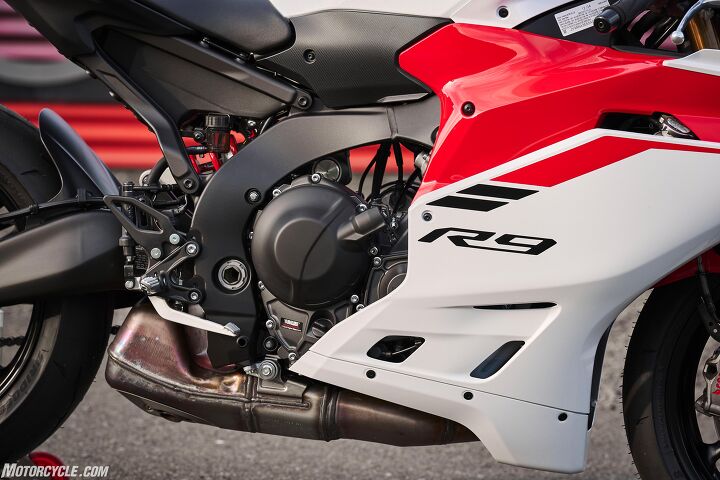
Not only is it lighter, but it’s more rigid in all three dimensions compared to the MT-09. Longitudinal stiffness is up 37%, torsional stiffness is up 18%, and lateral stiffness increased 16% – all to satisfy the increased demands a sportbike will see.
The 890cc CP3 Triple that we’ve come to know and love in the MT-09 and Tracer hasn’t changed mechanically. However, its ECU settings have been changed to account for the rider aids and the more aggressive nature the R9 might face comparatively. What’s interesting, though, was discovering from Kouji Tsuya, the R9 Project Lead and former chassis engineer for Jorge Lorenzo during his Yamaha MotoGP years, is that the CP3 engine actually posed a lot of challenges from a chassis design aspect. The cylinders tilt too far forward, forcing a longer wheelbase. To help compensate, there’s a little less rake and trail to bring the front wheel in slightly. To counter that instability, the swingarm (which is structurally the same as the MT-09) offers 16mm more adjustability for rear axle position front to back.

For comparison, let’s chart out the numbers between the R9, MT-09, and R6.
R9 | MT-09 | R6 | |
|---|---|---|---|
Rake | 22.3º | 24.7º | 24º |
Trail | 3.7 in. | 4.3 in. | 3.8 in. |
Wheelbase | 55.9 in. | 56.3 in. | 54.1 in. |
Length | 81.5 in. | 82.3 in. | 80.3 in. |
Width | 27.8 in. | 32.3 in. | 27.8 in. |
Height | 46.5 in. | 45.1 in. | 43.1 in. |
Seat Height | 32.7 in. | 32.5 in. | 33.5 in. |
Wet Weight | 430 lbs. | 425 lbs. | 419 lbs. |
When laid out like this, the geometry differences are clear. First, let’s look at the rake and trail numbers. The differences are huge compared to the MT-09, but the front wheel is also brought in compared to the R6. Shallow rake numbers help a bike turn quickly, to a degree, but you need the right amount of trail to feel stable once you’re on the side. You can see the R9 helps make up for its decreased stability with a longer wheelbase, especially compared to the R6.
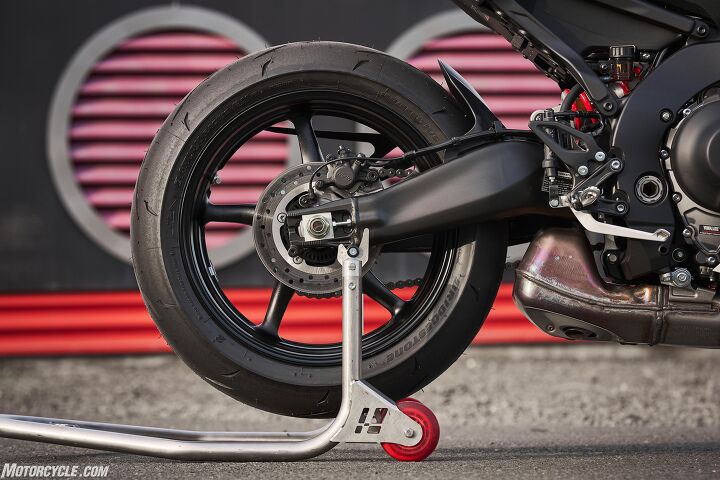
If you’re looking really closely, you might even recognize the R9’s wheels from somewhere. These are the same cast aluminum wheels from the R6, not the lighter, spin-forged wheels the MT-09 wears. Why? Yamaha says its testers actually preferred the handling characteristics from the heavier cast wheels over the spin-forged alternative. I’m not sure I buy that, but there you go. Mated to the front wheel is a pair of 320mm discs with Brembo Stylema calipers. Steel-braided brake lines come standard and an adjustable Brembo master cylinder sits on top. IMU-assisted ABS comes standard, with the option to disable the rear with the push of a button. Front ABS is always on… unless you decide to pull the ABS fuse.
KYB provides the suspension on both ends of the R9. Up front is the 43mm SDF (Separate Damping Force) fork, which simply means each damping component is isolated to a fork leg. Compression is on the left, rebound on the right. Inside the fork, a base valve has been added to the rebound side for more support under hard braking and to also provide a smoother transition when the fork goes from compression to extension.
Improving control is the name of the game here, and with the shock, KYB have added what it calls a “swing valve” to the shim stacks of both the rebound and compression. The swing valve effectively controls the flow of shock oil during ultra slow speed damping – the initial moment the piston in the shock is forced to move. Sometimes there can be a delay from when your rear tire hits a bump to when the shock actually compresses to absorb it. This happens when the shim stack can’t open fast enough to flow oil through it. What you feel from the saddle is a harsh jolt before you can sense the shock moving. The swing valve’s job is to reduce or eliminate that jolt. It’s a technology that has been used in racing, but the R9 marks the first time KYB has incorporated it into a production motorcycle.

What Yamaha and KYB were going for with these suspension tweaks was handling and control, especially at lean angle, without breaking the bank. Both ends are adjustable for high- and low-speed compression damping, rebound, and spring preload, with the rear having an easy-to-reach remote preload adjuster for quick changes. While there’s been a trend in suspensions to reduce the amount of clicks, the R9’s suspension has at least 20 turns or clicks of range, so the rider can fine-tune more precisely.
Naturally, a sportbike isn’t a sportbike these days if it doesn’t have a suite of electronics to save the rider from themselves. Don’t worry, the R9 has them. Borrowing from the R1, the R9’s IMU-assisted electronics suite includes all the things you expect like, traction control, slide control, lift control, up/down quickshifter, brake control, engine brake management, back slip regulator, and launch control.
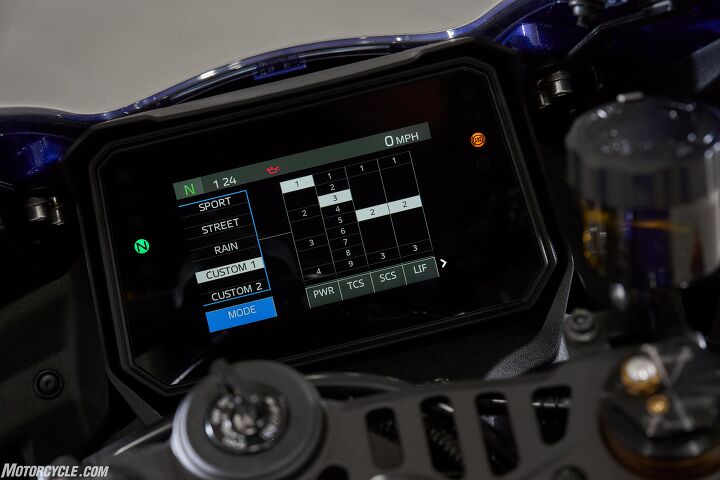
Of course, you also get different YRC ride modes, nine(!) in all. You have the customary Sport, Street, and Rain modes, two custom modes, and then four additional Track modes. Choosing any of the four Track modes lets you turn off the rear ABS, as well as customizing the other rider aids and power settings. The user interface will be familiar to Yamaha riders, as there are four different themes to choose from on the 5-inch TFT dash, and an additional Track display with lap timer function front and center. However, instead of the scroll wheel on the left switch gear to scroll through menus, now there’s a mini joystick that does the same thing.
Like other models in Yamaha’s line, the R9 features smartphone connectivity through the Yamaha Motorcycle Connect App (yes, the acronym is YMCA). YMCA lets you pair your phone to the bike’s screen so you can see notifications and navigation (via the Garmin StreetCross app) on the TFT display, among other things.

In the R9’s case, the standout feature is what you can do with, and to, the bike on the racetrack. Through the app you can create up to 40 different YRC settings, even while you’re away from the bike. Once you turn the bike on and connect, those settings then get saved. So, let’s say you’re lucky enough to consistently go to 40 different tracks and you have tailored YRC settings for each. You can save those settings in the app and they will be at your disposal once the app and the R9 connect again.
But that’s not all. If you’ve ever wanted to feel like a pro rider and receive communication from your crew on the wall while you’re riding, a secondary app called the Yamaha Y-TRAC Rev app can make that happen. With the TFT display on the bike in its Track setting, the Y-TRAC Rev app gives your pit crew (who are also connected to the app via phone or tablet) the option to deliver messages to you on the bottom of your screen. There are numerous preset messages like BOX, SAFETY CAR, and FINAL LAP, or your team can let their imaginations go wild with custom messages (within the character limit) to spur you on (or make fun of you). Sure it’s gimmicky for the majority of riders, but it’s also a fun feature to have if you crave data while you’re on the track.

What’s certainly not a gimmick is the data acquisition the Y-TRAC Rev app gathers while you ride. The same system Yamaha first introduced on the R1, the app utilizes an external GPS (usually your phone) in addition to logging 26 data signals from the R9 to capture exactly what you’re doing on the bike every lap so you can analyze, adjust, and go faster next time. This is the same kind of tech pro riders utilize, now available at your fingertips.
Other Odds and Ends

Yamaha is really trying to have the R9 plant one foot on the street and the other on the track. For example, cruise control comes standard, which is a welcome feature for the street rider who needs to slog through countless miles to get to the fun roads. But then there’s also what’s called Yamaha’s Variable Speed Limiter, presumably to set your pit speed limit. A USB-C charger and self-cancelling turn signals are more niceties for the street rider, while the shift pattern can easily be changed to GP shift by simply moving the shift rod from its standard position to another threaded hole on the opposite side of the shift pivot.
Riding It – The Good and The Bad
The obvious question on everyone’s mind is what is it like to ride? Is it a worthy replacement for the R6? Well, the answer is a bit more complicated than I had anticipated. Being a sportbike, it makes sense for Yamaha to have us out at Sonoma Raceway to push the bike to its limits. However, the conundrum here is that Yamaha has outright said the R9 is a streetbike first with racetrack capabilities. Sure this is a common thing for manufacturers to say, but after riding it, it seems like Yamaha met its goal – which isn’t necessarily a good thing. Let me explain.

Hopping on the R9, I got shades of the R7 right away. The tank is long, so there’s a reach to the bars. Being clip-ons mounted under the triple, you’re also hunched over a decent amount. Yamaha’s own rider triangle charts have the R9’s reach as being longer than both the R1 and R6. That said, the pegs are noticeably lower and further forward, so there’s some respite.
Out on track, the 890cc Triple is ever the sweetheart it’s always been, and it reminded me once again why I, like so many others, have been clamoring to see this engine in a sportbike application. Usable torque, available in the midrange, makes riding on track easier for so many – especially if you’re learning a track for the first time, or in my case, relearning a place after several years away. You don’t need to be as concerned about being in the right gear and can simply focus on where you’re going and how much to turn your right wrist. Here, the R9 clearly outguns the R6. It goes without saying that a bigger engine will give you more torque, but the reality of exploiting that difference on track underscores why this engine is easier to use.

The fun doesn’t stop there, though. With around 117 horses on tap in stock form, once you move towards the upper reaches of the rev range, the R9 still delivers a decent amount of power up top. Think of it in relation to a nicely tuned R6 engine. Except in the R9’s case, there’s a healthy amount of power still waiting to be unlocked from the aftermarket. The power is fun and accessible, while the quickshifter works seamlessly in either direction. To top it all off, the three-cylinder wail is, and always has been, music to the ears – even with the stock exhaust.
In FZ-09s and MT-09s of the past, we used to blast Yamaha for making the “aggressive” throttle mapping way too aggressive, even for track use. This simply isn’t the case anymore. Throttle connection and fueling is clean and direct in all modes. When put in Track mode especially, the connection between throttle and rear tire is worlds better than before.

There is one oddity, however, and it comes in second gear. When exiting slower corners in second, there’s a delay in response as you twist the throttle. Even in Power mode 1 (the most aggressive), the dead spot is noticeable and annoying. It’s easy to fault Yamaha for poor fueling or throttle mapping, but Yamaha staff confirmed I wasn’t imagining things, nor did they somehow screw up mapping for one singular gear ratio. You can thank EPA requirements for the throttle delay. Fortunately, there’s a relatively easy fix – a reflashed ECU.
Odd slow speed second gear stuff aside, the R9 engine is a real gem that, say, an R7 graduate can get comfortable with easily. Conversely, there’s enough performance that a pro like Josh Hayes, MotoAmerica’s winningest rider, will have no problem fighting for race wins – which is exactly what he intends on doing this year as he joins the Bryce Prince Racing team aboard an R9 in MotoAmerica Next Gen Supersport.

When Yamaha says it never intended the R9 to be a replacement for the R6, it would be hard to believe purely based on engine performance. However, turn your attention to the chassis and you start to believe what Team Blue are saying. In comparison to the MT-09, the stiffer gravity cast frame feels more composed and better suited for track riding. It doesn’t get out of shape and you don’t feel any chassis flex. In fact, it’s rather agile. It better be with rake and trail numbers like it has.
The difference comes when you’re really trying to hustle it and set your PB laps. When you’re pushing, you want to know exactly where the front tire is – or at least I do. With the R6, it felt as if the front tire were directly underneath you. Every move you made was directly transferred to the tire. The R9 feels more vague, as if the front tire is just a tiny step in front of you. You know it’s going in the direction you want it to, but you can’t be positively sure it’s exactly where you’re trying to place it. This isn’t to say it’s bad or unsettling – I never had a scare or instance where the chassis did something unexpected – it’s just… different. I’m not the only one who thought so either, as Josh Hayes admitted he had similar feelings, even with his race bike, as we debriefed in between sessions. He even went so far as to say the character of the R9 was different from any other Yamaha he’s ridden. It’s an adjustment Yamaha fans will have to get used to.

All of that is to say, if you’re looking for a direct successor to the R6, at least in the chassis department, the R9 may not live up to the expectations. That said, the KYB suspension does an admirable job. Sonoma has its share of bumps, and while the fork and shock are damped for a compliant street ride, they handle track duties just fine. I appreciated the number of clicks available in the adjustments, as I fiddled with the fork to get better front end feel. I added two turns of preload to the shock to put more weight on the front, which amounted to 8mm out of 10mm total, so the bike is clearly damped a bit soft.
Also soft are the brakes. The Brembo components are clearly up to the task of slowing the bike down, and it does so consistently, but the weak point is the brake pads. There was hardly any bite when I grabbed the lever. This is likely the reason why I was able to keep front ABS on the entire day and hardly notice it. I was even able to manage an unintentional endo braking for the double rights at the end of the Carousel turn. More aggressive brake pads would be a welcome change, in my opinion, but doing so would almost certainly mean pulling the ABS fuse and giving full braking control to the rider.

Adding to the feeling I had with the front tire, the ergonomics also play a role. The fuel tank is long, forcing a longer reach to the bars, which are then set slightly wide. When banking the bike left or right, I never truly got comfortable with my body position at full lean. Fortunately, the tank/seat junction is narrow, so it’s easy to touch the ground, and the rear of the seat opens nicely to give you room to move around. If it were mine, I might bolster the rear of the seat to prop me up slightly and move more weight to the front. But we’re really splitting hairs here…
Where the R9 really is impressive is the electronics. Why? Because according to the Y-TRAC app that monitors everything I was doing on the bike, I never tapped into any of them! Traction control, slide control, lift control, etc. were all set to their lowest settings and I didn’t need any of them. Maybe I’m a slow poke, or maybe the Bridgestone R11 tires we used had more than enough mechanical grip.

Yamaha’s New Direction
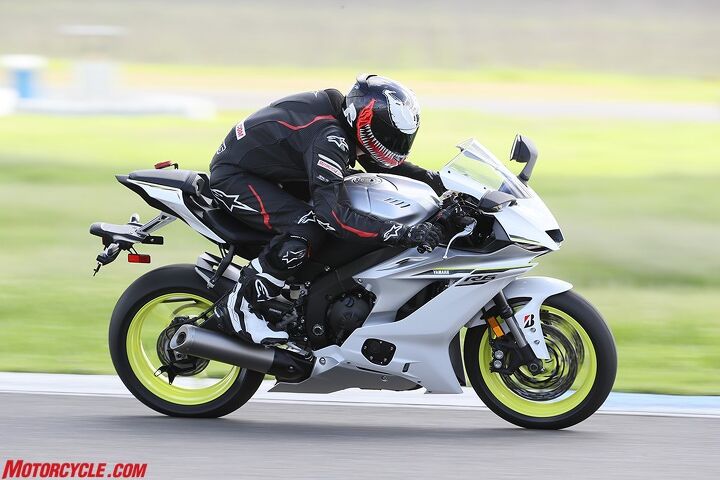
It’s an interesting time in R/World right now. With the R6 gone and the R1 nearly there, the sportbike landscape is changing and manufacturers who want to stay in the game are all trying to adapt in their own ways. One thing that hasn’t changed is the desire to go fast and push one’s own limits. Yamaha’s approach to helping you do this is a motorcycle that will adapt and grow with you, allowing you access to performance without having to push to the Nth degree. The R9 is hugely fun, easily adaptable, and well suited for a wide variety of rider types and skill levels. At $12,499, it packs a punch at a price tag its competitors can’t touch.

Don’t get me wrong, my time with the R9 was a ton of fun, but as I think back to Yamaha reps stressing this isn’t an R6 or R1 replacement, after riding it, I’d have to agree with them. Which now begs a new question: Will we see a new flagship Yamaha sportbike, or are those days truly over?
Scorecard
Engine | 19/20 | Suspension | 13/15 | Transmission | 9/10 |
Brakes | 7/10 | Instruments | 5/5 | Ergonomics | 8/10 |
Appearance | 9/10 | Desirability | 9/10 | Value | 9/10 |
Editors Score: 88.0% | |||||
In Gear
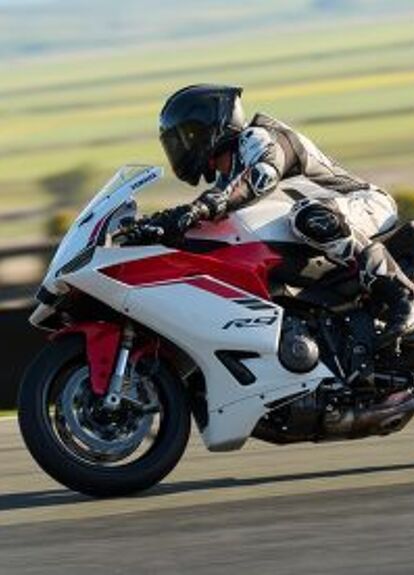
- Helmet: Alpinestars Supertech R10 Carbon
- Suit: Alpinestars GP Plus V4 Sprint
- Airbag: Alpinestars Tech-Air 5 Plasma
- Gloves: Alpinestars GP Pro R4
- Boots: Alpinestars SMX-6 V3
2025 Yamaha YZF-R9 Specifications | |
|---|---|
Engine Type | Liquid Cooled, 4-Stroke, DOHC Inline-Three, 4 valves per cylinder |
Displacement | 890cc |
Bore x Stroke | 78.0 mm x 62.1 mm |
Compression Ratio | 11.5:1 |
Horsepower | n/a |
Torque | 69 lb-ft. at 7,000 rpm |
Starting system type | Electric |
Lubrication system | Wet sump |
Ignition | TCI (Transistor) |
Final Drive | Chain |
Primary Reduction | 1.681 (79/47) |
Secondary Reduction | 2.688 (43/16) |
Clutch | Multi-plate wet clutch |
Transmission | Constant mesh 6-speed |
Frame type | Diamond |
Front Suspension | Coil spring / Hydraulic damper, 4.7 inches of travel |
Rear Suspension | Coil spring / Gas hydraulic damper, 4.6 inches of travel |
Front Brake | Dual 320mm discs, Brembo Stylema radial-mount four-piston calipers |
Rear Brake | Single 220mm disc |
Front Wheel | 17M/C x MT3.50 |
Rear Wheel | 17M/C x MT5.50 |
Front Tire | 120/70ZR17M/C(58W) |
Rear Tire | 180/55ZR17M/C(73W) |
Rake / Trail | 22°35′ / 3.7 inches |
Wheelbase | 55.9 inches |
Length | 81.5 inches |
Width | 27.8 inches |
Height | 46.5 inches |
Seat Height | 32.7 inches |
Wheelbase | 55.9 inches |
Ground Clearance | 5.5 inches |
Curb Weight | 430 pounds (claimed) |

We are committed to finding, researching, and recommending the best products. We earn commissions from purchases you make using the retail links in our product reviews. Learn more about how this works.
Become a Motorcycle.com insider. Get the latest motorcycle news first by subscribing to our newsletter here.
Troy's been riding motorcycles and writing about them since 2006, getting his start at Rider Magazine. From there, he moved to Sport Rider Magazine before finally landing at Motorcycle.com in 2011. A lifelong gearhead who didn't fully immerse himself in motorcycles until his teenage years, Troy's interests have always been in technology, performance, and going fast. Naturally, racing was the perfect avenue to combine all three. Troy has been racing nearly as long as he's been riding and has competed at the AMA national level. He's also won multiple club races throughout the country, culminating in a Utah Sport Bike Association championship in 2011. He has been invited as a guest instructor for the Yamaha Champions Riding School, and when he's not out riding, he's either wrenching on bikes or watching MotoGP.
More by Troy Siahaan







Comments
Join the conversation
Its a brilliant bike. The R6 was a track weapon, but a crap street bike. Squids bought it because they thought it was the fastest, but in their hands it might as well have been a Ninja 400...
The R9 is what most buyers want/ Guys that like to commute, or tear things up in the mtns or canyons, and then do a track day or two a year. For that rider, its PERFECT. All the tech, the handling, the look... its plenty fast for everyone not interested in top speed highway runs, and the price for what you get, it bang on...
Track day junkies and racers can keep their existing R6 platform, that's where that bike belongs... But for street riders, the R9 blows the R6 out of the water.
Hmmm really? I take a GSXR 750 with vario bars and rearsets. Just because it's a streetbike why does it get an crap chassis. This is what a sporbike used to cost before they ruined them with stupid wings, traction control, and then tacked on another $9000....They won't make another flag ship because they will charge too much and no one will buy it. Instead they will give you this crap...cheap components, cheap suspension, lower quality in general but they make more per unit. The glory days are over and the manufacturers can blame themselves. Fricken wings on a streetbike give me a break. I would buy a 5 or even 10 year old sportbike before I bought this!