


Shootout: 2025 Ducati Panigale V2 vs Yamaha YZF-R9 vs Suzuki GSX-R750

The next-generation supersport battle we’ve all been waiting for!

If you haven’t been paying attention, the supersport category is undergoing a seismic shift. This was once a category dominated by the Big Four producing effectively MotoGP-lite machines. All were powered by 600cc engines with four cylinders all in a row, and each placed the rider in a committed position, ready to attack the racetrack. Occasionally, a certain Italian brand would enter the fight with certain 748cc or 749cc twins, but for the most part the conversation centered around the land of the rising sun. At its height, each manufacturer played the game of one-upsmanship by introducing a new version of its supersport racer every two years! Think about that for a sec – each time a new model was introduced, its successor was already deep into its R&D cycle!
2025 Next Gen Supersport Shootout
What it means to be a “middleweight” supersport isn’t what it used to be. Hard-nosed sportbikes have softened as manufacturers like Ducati and Yamaha try to find the balance between comfort and performance. Meanwhile, the trusty Suzuki GSX-R750 is here to remind us what a “real” sportbike is supposed to be. Can the Suzuki teach the new kids a lesson, or has the next generation won out?
Ducati Panigale V2

Highs
- Super easy to ride
- Surprisingly comfortable
- Surprisingly quick
Sighs
- Most expensive here
- You have to pay more for cruise control
- Quickshifter occasionally hiccups
Suzuki GSX-R750

Highs
- The OG is still fun to rip on
- A screaming 750cc Four is still hard to beat
- In its element, it’s still magic
Sighs
- Not the most practical of the three
- Hard-nose ergos remind us why sportbikes suck on the street
- It’s really starting to show its age
Yamaha YZF-R9

Highs
- The CP3 engine is as sweet as ever
- Fantastic electronics
- Super slick up/down quickshifter
Sighs
- ECU tuning really brings a good bike down
- None of us truly got comfortable with the chassis
- Ergonomics are confusing
VIDEO: 2025 Next-Gen Supersport Shootout
It was a helluva time in the industry, and an exciting time to be a supersport enthusiast. But that pace simply wasn’t sustainable. Add in the global economic recession, and the supersport category as we know it has effectively died.

Read More:
At least in terms of sales. But not in terms of consumer interest. Used supersport sales are as strong as ever, and the passing of time has revealed that people still like performance-oriented sportbikes. Maybe it’s because the relative affordability is the closest most mortals will get to super-expensive hypercar levels of performance. Conversely, we’ve also seen that 200-plus horsepower superbikes, while great for ego-stroking, can be a bit much. A lot of people want performance, but they want it comfortably and at a reasonable price.
Enter the new breed of sportbikes, effectively dubbed the Next Gen Supersports. In it we have two main players: Ducati’s Panigale V2 and Yamaha’s YZF-R9. Both are all-new, and both exist precisely to prove that, when it comes to sportbikes being able to go fast and be (relatively) comfy, you can have your cake and eat it, too. Naturally, once these two bikes were announced, we knew we had to pit them together. Then after getting our respective First Rides on them, there was no doubt.

And now, here they are. Together. Ready to battle it out for supremacy. The plan is the same as it always is: We’d test the bikes on the roads to see if the claim of comfort and performance really holds true, and then we’d thrash the bikes at Sonoma Raceway to see if they really live up to the title of supersports. For this test, we rode with our friends at Volant Vivere trackdays, based in Northern California. Dylan Thieu, the owner and proprietor of Volant Vivere, puts on “White Glove” trackdays that, while not the cheapest around, arguably provide the most bang for your buck. Group sizes are kept low for maximum quality track time, plus coaching, photography, and a catered lunch are all provided.

Additionally, to ensure all bikes were on level footing, each wheel was fitted with Pirelli Diablo Supercorsa V4 SP rubber in OEM sizes. Designed specifically as a street-legal sport tire that could also handle trackday duty, it fit our needs perfectly for this test.
Lastly, a special thank you to Quad Lock for sponsoring this video. Quad Lock makes all types of mounts to securely place your phone and other electronic devices on cars, trucks, and yes, motorcycles, including sportbikes. Quad Lock mounts are clutch, no matter where you ride, and proved immensely valuable especially during our street testing.
The wildcard
You know the saying: You can’t know where you’re going until you know where you’ve been. The whole reason these Next Gen Supersports exist is because the old guard were too hyper-focused on one goal – going fast around a racetrack. Luckily for us, we’re fortunate that the oldest of the old guards is still around today.
I’m talking, of course, about the venerable Suzuki GSX-R750. The OG of sportbikes, the beloved GSX-R750 went from being the de facto superbike in the 90s and early 00s, to being the odd man out when superbikes jumped to 1000s and supersports switched to 600s. Suzuki remained loyal to its 750, and in the US anyway, refused to let it leave the market. And now it’s back in the spotlight.

For some perspective, back in 2011, when the GSX-R750 was last updated, Obama was president, William and Kate got married, Bin Laden was killed, “Rolling in the Deep” was the number 1 song, and the Earth’s population hit 7 billion people. A lot’s changed since then, especially in the moto world, but the essence of the supersport category as we once knew it is alive and well in the GSX-R750, making it the ideal benchmark to gauge where we’ve come with the Ducati and the Yamaha.
The obvious omission
If you’ve been paying attention to this new crop of motorcycles lately, you’ll notice there’s one glaring omission in this test. KTM’s 990 RC R was supposed to be the bike to complete this trifecta of Next Gens, but as we all know, KTM’s going through its struggles right now. Fortunately, there is light at the end of the tunnel with Indian manufacturer, Bajaj, investing a majority stake in the Austrian firm. Nonetheless, a bike wasn’t available for this test. But when it is, we’re stacking it up against the winner of this one.

Of course, if you’re wondering why bikes like the Kawasaki ZX-6R, Triumph Street Triple 765, KTM 990 Duke, and MV Agusta F3 R and RR aren’t in the mix, well, let’s be real. Neither the Kawi or MVs are new (nor was an MV available – we asked) or provide the historical perspective as the Suzuki. As for the Triumph and KTM, naked bikes, even if they form the basis of their racebred cousins, don’t provide an apples-to-apples comparison.
By the numbers
First things first, let’s compare each bike by their numbers. Naturally, we have to start with the engines. What’s interesting here is that we have three different engine configurations: An Inline-Four, an Inline-Triple, and a V-Twin. Both the Ducati (V-Twin) and Yamaha (Triple) displace 890cc, which is obviously bigger than the 750cc Suzuki Four, but seeing as how the V2 and R9 were specifically designed with a road bias in mind, neither engine belts out serious power. See the dyno chart below.

If you’re just focused on the numbers, the Suzuki really impresses with its 121.7 horses compared to the Ducati and Yamaha, which barely make over 100 ponies. Making considerably more power than the others from the smallest displacement is definitely commendable. But as we know, forcing more air via higher rpm limits will net you more power for a given displacement, as the dyno chart lays out in plain view. We can see the Suzuki’s advantage only comes through after the other two have signed off. Until roughly 10,000 rpm, the Suzuki is blitzed by its new rivals.

Another interesting point is how closely matched the Ducati and Yamaha power curves are, with neither having a big advantage over the other. If anything, it’s impressive that Ducati were able to get the V-Twin’s bigger pistons to spin nearly to 11,000 rpm while the Yamaha Triple signs off well before then.
What you don’t see here is the Yamaha’s run in second gear (all pulls were done in fifth gear), where the throttle mapping is intentionally restricted in order to meet EPA noise requirements. The dip in power off the bottom is huge and affects driveability, which we’ll get to in our ride impressions.

Looking at the torque graphs for all three bikes, we don’t really see any surprises. The smallest engine also makes the least amount of torque, and makes its peak far into its rev range. Meanwhile, the two 890s make nearly identical amounts of torque, but the Yamaha gets there earlier.
Lastly, we’ll look at some chassis numbers before getting into the meat of the conversation.
Ducati Panigale V2 | Suzuki GSX-R750 | Yamaha YZF-R9 | |
|---|---|---|---|
Rake/Trail | 23.6° / 3.7 inches | 23.5° / 3.8 inches | 22.6° / 3.7 inches |
Wheelbase | 57.7 inches | 54.7 inches | 55.9 inches |
Seat Height | 33.0 inches | 31.9 inches | 32.7 inches |
Wet Weight | 419 lbs | 428 lbs | 431 lbs |
A few interesting things to point out here. First is how much longer the Ducati is compared to the rest. Using the Suzuki as the control, the Ducati’s rake and trail numbers seem fairly standard in the sportbike world, but the added length should give it stability in the corners. Meanwhile, the R9’s steep rake, in theory, should help it initiate a turn. Otherwise, it’s interesting to note the Yamaha’s the heaviest here, even when you factor in the fact that we left the Suzuki’s toolkit in place when putting the 750 on the scales. It’s also impressive the Ducati came in as light as it did – a testament to Borgo Panigale’s insistence with the new V2 platform that light makes right.

With that, let’s get to our rankings. Remember, these rankings are based on our combined street and track impressions, and are given numerical subjective scores via our trusty MO scorecard for things like engine, handling, brakes, technology, and more. The scorecard also takes into account objective measures like price, weight, horsepower, and torque.
Third place: Suzuki GSX-R750
In the past, collecting street impressions on a sportbike test was something we did out of necessity, not because we particularly enjoyed it. And though time has faded our memories a bit, it didn’t take long for the GSX-R750 to bring those memories back to the forefront of our minds.

As Ryan notes, “When the Suzuki landed in my garage it didn’t take long before my curiosity got the better of me. I keyed the thing on, watched the analog tach needle move, smirked as the nostalgic thoughts came to mind, and rolled out of the driveway. No sooner had my feet landed on the high footpegs was I instantly reminded why I had never bought another sportbike after owning a CBR1000RR for daily use. The riding position is absurd. Not only are the high footpegs and low handlebars uncomfortable, it also limits your vision.”
Then again, as Nic reminds us, you know exactly what you’re getting with the GSX-R. “The Suzuki GSX-R750 has the most aggressive riding position and we wouldn't expect otherwise from a thoroughbred supersport motorcycle,” he says. “The tight cockpit is demanding, but the payoff is a motorcycle that riders can climb around on and utilize aggressive body positioning much more easily, as you're constantly in the attack position. The downside is one of the most common criticisms of fully-faired sportbikes in that they're uncomfortable in nearly all circumstances, save for canyon or racetrack riding.”

Ergos aside, the GSX-R750 still managed to charm each of us with its staying power. Maybe it was just its familiarity, having been around for so long. As we’ve established, the GSX-R is the old guard when it comes to sportbikes, even down to its mechanical, cable-actuated throttle. This is both good and bad, as Nic explains. “Its [GSX-R750] Inline-Four shouts, screams, and makes all the dramatic noises any motorcyclist could hope for. Its power rests firmly on the high end of the spectrum: low-end torque? Pah! Who needs that when you've got high-rpm thrills?” He continues, “It isn’t practical by any stretch of the imagination, but I can’t help but appreciate the absolute audacity of an engine that can basically only begin to perform once you’ve hit felonious speeds.”
I, too, can remember being young once and loving the shrill and scream of a howling engine. I gotta admit, it does get the blood pumping. But I’m also a fan of practicality and sensibility, and revving the Gixxer from stop light to stop light gets old fast. That said, since the Gixxer isn’t sold in Europe, it doesn’t have to worry about meeting Euro5 standards. As such, its fueling is smooth and predictable. Nic noticed a slight snatchiness during the initial throttle crack, but that could have been a result of slack in the cable lines and it certainly wasn’t a deal breaker.

Around town, the twin-spar frame and Showa suspension show their obvious track intent. “The GSX-R is the most firmly sprung and damped motorcycle in this comparison,” says Nic, “meaning that you will feel all of that road whether you like it or not.” When the roads are smooth, the Suzuki’s handling is hard to beat. But then again, how often are public roads ever smooth? Still, you get full adjustability with the Gixxer to change things however you’d like to suit the conditions. If it were us, we’d ditch the stock narrow bars and replace them with wider aftermarket clip-ons. The narrowness is just awkward, making it more difficult than it needs to be to get the bike to change direction. While we’re ditching things, replace the long-throw throttle for something shorter and realize all of the engine without repositioning your grip.
Back to the handling. Once you do get that direction change, what you’re left with is the stability of a chassis specifically designed for performance. There’s a sure-footedness to the Suzuki the others come close to but don’t quite meet. The front end tells you what it’s feeling – in fact, both ends do – with more inputs and data points than the others.

The most obvious relic from 2011, the rubber lines are just an injustice for this otherwise capable braking system. Even at street speeds the feel at the lever is mushy. To its credit, the initial bite is strong enough, and it remains consistent – until the lines start to flex and give you spongy feedback.
Obviously, if the brakes are less than stellar on the street, then it’s no surprise to learn that it’s a huge limiting factor at the track as well. Sonoma isn’t filled with hard braking zones, but it does have a couple, and the difference in lever feel and pressure from the first lap to the last was notable. As the laps went on, you’d have to adjust braking markers to account for the fade at the lever. It’s a shame, really, because without the hindrance of ABS, the GSX-R could be a demon on the binders with a simple change of hoses.

Nonetheless, when given the chance to eat, the 750 engine wastes little time establishing its dominance. “This is where I belong,” says Ryan in his notes about his first laps on the Suzuki. Nic adds, “The Ducati and Yamaha will often get the off-apex-jump. But once the Suzuki has a chance to stretch its legs, you'll see what those extra cylinders (or cylinder, depending on what you're comparing) can do.”
What it “can do” is pull away. Anytime one of us would follow the other, whoever was on the GSX-R would simply get smaller into the horizon. While fun to let the engine scream, there are two prices to pay for this exploitation of power. First, the Suzuki’s throttle throw is excessively long, forcing the rider to readjust their hand and wrist to reach the throttle stop. Second, is the lack of a quickshifter of any kind. Sure, it’s easy enough to shift the old way, but these two penalties alone cause you to lose time and get bigger as the Ducati and Yamaha come chasing. Finally, what brings the Suzuki back into the chase rider’s frame is the Gixxer’s aforementioned brakes forcing an early scrubbing of speed. Both the Ducati and Yamaha wear steel lines and feature quickshifters up and down, allowing them both to brake later and more consistently.

Now comes the necessary clarification: Yes, the GSX-R’s problems are all easy to remedy. And doing so would likely catapult its standings, on the street or track. But this test is about stock bikes, not modified ones, and though the lap times don’t factor in our overall scoring, it’s worth noting the Suzuki was the slowest, clocking a best of 1:52.5.
The reasons above go a long way towards achieving the lap times we did on the Suzuki, but it also highlights the GSX-R’s lack of an electronics suite that we’re used to seeing today. While this can be interpreted as either a positive or a negative depending on your view of today’s rider aids, when it came to going as fast as we could, not having a safety net to catch us was constantly in the back of our minds.

Taking a trip down memory lane was fun with the Suzuki, but it doesn’t take long riding it to understand why the other two bikes here exist.
Second place: Yamaha YZF-R9
We really wanted to love the R9 around here. None more so than Yours Truly. All three of us have raved about the CP3 engine in the other bikes it’s featured in, so naturally a sportbike with that engine would be stellar. Now that the R9 is here, Nic, Ryan, and I are all left to scratch our heads. Save for a giant lull in the first two gears, the R9 engine is as fun as ever. The issue is, overall, the R9 has a hard time deciding what it really wants to be.

Yamaha markets the R9 as a street-first sportbike, with comfort and an overall softer demeanor taking priority over all-out performance. While that’s easy to interpret as marketing BS, as I mention in my First Ride piece, the chassis isn’t as precise as the R6, but when you’re on the R9, ergonomically, it’s hard not to think about ripping up the canyons or setting a new personal best lap time.
“The Yamaha is confusing,” says Ryan. “I had assumed it would land somewhere between the Ducati and Suzuki, and while it does, it’s much more supersport than daily rider.” This is because its clip-ons are still below the triple clamp. Nic noted how this puts “heavy demands on the rider’s wrists when engaged in anything that isn’t spirited riding.” At least the bars are wider than the Suzuki’s, but that’s only a minor relief as the R9’s fuel tank is long, meaning you really have to stretch yourself to get out there.

“To be fair,” says Nic, “Yamaha did wisely lower the rearsets and ease knee-bend compared to the GSX-R750. However, the clip-ons conjure the same long-standing supersport ergonomic critiques that this new generation were supposed to avoid. Much like the GSX-R750, riser clip-on handlebars would be greatly beneficial.”
As much as we were surprised by the Yamaha’s ergonomics, we really shouldn’t have been. The playbook for the R9’s ergonomics has been out in plain sight for a few years now. It’s called the YZF-R7. Like the R9, the R7 sits as the lone wolf in a field of sporty bikes with its clip-ons placing the rider’s wrists relatively low. While it may be unfortunate to us that the R9 follows suit, what’s not surprising is Yamaha maintaining a similar rider triangle.

How this translates out on the road is equally as befuddling as our descriptions above. The CP3 Triple is described as “very streetable” from Ryan “with plenty of low-end punch and a strong mid-range.” Nic agrees, noting “Yamaha’s 890cc CP3 engine is a praiseworthy mill, striking a balance between high-revving Inline-Four engines and punchy V-Twin powerplants. It revs freely, while delivering excellent midrange punch and better low-end response than the Suzuki. The Tuning Fork brand's engine does resonate with a wide audience for those reasons, and it's also quite smooth — maybe not Inline-Four smooth, but smooth nonetheless.”
Of course, the Yamaha’s story isn’t so simple. As mentioned before, ECU tuning to meet EPA requirements hampers the R9’s performance and throttle response in all gears, but especially the first two. Making matters worse, it’s impossible not to find yourself in this second gear dead zone on the street.

Here’s Nic again: “The North American market does not receive the full-fat version of the CP3 engine, and it, too, suffers from the dreaded noise emissions slump. When riding in twistier canyons, the Yamaha can often find itself tripping and falling into that hole within the rev range, which would easily be fixed by ECU reflashing. That particular issue is also well documented in the MT-09 platform, but feels exacerbated in the YZF-R9 due to the bike's longer final-drive gearing, as well as model-specific throttle mapping.”
I happened to look at the tachometer right as the engine was pulling itself out of its self-imposed lull and 6,000 rpm was what stared back at me. Sure this only matters in the first two gears, but it’s easy to be in second gear, hovering at or below this engine speed frequently during street rides. That said, get the Triple moving, and even with its compromised tuning, it’s hard not to fall in love with the sound of a wailing three cylinder. This is made even sweeter each time you reach for an upshift and the quickshifter clicks it off with a sweet “pop.” Either up or down, we were happy with the R9’s shifting at street speeds, too.

Pick up the pace on the track and the CP3 engine exhibits all the fun qualities above and ramps it up a notch. The intake noise is intoxicating and the exhaust, even with the stock exhaust, is fairly rowdy. Put a pipe on it and it would undoubtedly get the soul stirring. But just as we did on the street, we complained about the restricted throttle mapping on track, too. Sonoma’s chicane and tight final turn should be taken in second gear, but because of the lull we’re forced to take them in first to get anything resembling drive on corner exit.
On the other side of the rev range, there’s no point taking the R9 all the way to redline either, but it’s hard not to because its rev limiter kicks in before you know it. If you’re used to revving traditional 600cc supersports, you need to adjust and move your shift points much earlier. A simple Google search for ECU flashes for the R9 will reveal the performance potential from this engine with no other changes, including increased redlines, but that’s a topic for another time…

More head scratching around the R9 comes when we move the topic to handling. We all noted how the Yamaha feels long, when in reality the Ducati sports a longer wheelbase. We suspect the reason we all felt this way likely has to do with the long fuel tank that forces the rider to reach further to get to the controls. By default, it also means the rider has less of their weight over the front end. We can only guess that this is one of the reasons the R9 has such a sharp rake angle, to encourage quicker turn-in.
The R9 isn’t slow to turn, but we struggled to find confidence in the front tire even at street speeds, giving it plenty of respect and not wanting to come close to finding the limits of the front Supercorsa. “The Yamaha never felt truly settled in the canyons,” wrote Nic in his notes. The mellower chassis attitude has a slight rearward bias, sacrificing a little bit of precision in exchange for comfort. To that end, the softly-sprung suspension pairs relatively well with the chassis when riding on the roads, but that does mean we couldn’t achieve far more pointed geometry on the street. You don’t feel every single bump in the road or highway. The tradeoff, as we’ve already mentioned, is a seating position that’s only slightly less committed than YZFs of the past and isn’t as planted, either.

“Where the YZF-R9 comes into its own is at the racetrack,” says Nic. He actually appreciated the aggressive riding position, as it “started to make sense in that environment.” While true, I didn’t find the same comfort as he did, since the length of the fuel tank made it difficult for me to get comfortable leaning off either side of the bike. Fortunately, the suspension is easily tuned to add much-needed shock support, “ridding it of its previously uninspiring chassis,” as Nic writes in his notes. He continues, “the Yamaha did well in long, fast corners where its stability could be put to use.” That’s something we can agree on — only after adding a bit of preload to the shock to pitch more weight over the front.
With its Stylema calipers and steel-braided brake lines, the Yamaha does well in the braking department. Initial bite isn’t the strongest, but it’s not weak either. More importantly, the lever feel is firm and consistent, and never wavered throughout our testing. Maybe because the rider feels like they’re sitting further back, the R9 exhibits great stability under hard braking. You don’t feel like you’re going to flip over the top. Both Nic and I noticed the ABS kick in at times, but the pulsing at the lever was very faint. It’s also important to note that the lean-sensitive ABS can be disabled and a less restrictive front-only ABS mode is offered. It's what we used primarily on track. Yes, pulling a fuse can defeat ABS entirely, but we kept it in for the duration of our testing.

The best way to show praise for a motorcycle’s electronics suite is to say nothing at all, right? You want the systems to work so seamlessly you don’t even notice them. Such is the case with the R9’s rider aids. All three of us can say with confidence that, if the R9’s traction control stepped in at all during our testing, we didn’t feel it. The same could be said about lift control also, but your esteemed MO crew suck at wheelies, so there’s that. The dash display is unoffensive on the R9 (it’s neither good or bad aesthetically), but the joystick and button presses seem more intuitive than with the Ducati, leading Nic to note the Yamaha’s menu screen was “easier to explore.”
Where the R9 really won bonus points comes down to two things: its quickshifter and cruise control. We’ve already talked about the “near faultless quickshifter,” according to Nic, but we haven’t praised Yamaha for including cruise control. Maybe they knew the seating position was weird, so cruise control is there so you can relax on the highway and give your wrists and back a break. It’s especially impressive considering it’s included in the purchase price of the least expensive bike in this test. Conversely, the Ducati costs the most here, but doesn’t have cruise control. It has the buttons for cruise control, but they don’t work. You have to pay extra for that. “What a total drag,” says Ryan.

Advantage (and a big one at that): Yamaha. Enough to usurp the Ducati? Not quite.
First place: Ducati Panigale V2
Not only has the Ducati Panigale V2 won this test, but it did so in convincing fashion. All three testers picked it as their winner, and the results of the MO scorecard show the nearest second place finisher on any of our cards was more than five percentage points behind. Why? Because it really is the best of both worlds.

In his notes, Ryan jots, “It’s truly a machine that can pull double duty better than anything else in this comparison, by a longshot.” Nic adds, “It has all the right tools for fast riding on or off the track and does so without compromising comfort.” I never thought this day would come, but Ducati has built a sportbike that stays true to the brand's sporting heritage without compromising on comfort.
And comfort, of course, starts at the cockpit. Nic commented the V2 “approaches ergonomics with the most rider-friendly triangle.” This is done with clip-ons that rise above the triple clamps and pegs that leave your knee bend fairly open. Couple that with a narrow midsection and the Panigale V2 is, surprisingly, a comfortable place to be.”

Ryan backs that up by saying the V2 “is much more Supersport than it is Panigale.” Of course, he’s talking about Ducati’s eponymous model and not the category as a whole. And it’s true; you feel instantly comfortable on the Ducati, which in turn leads to exploring the limits sooner. Fortunately, the agreeable ergo triangle is just the start of the Ducati’s surprises. In the past, cruising around on the street was rarely the territory of sportbikes, as witnessed by Ryan’s testimony earlier when he hopped on the GSX-R for the first time.
With the Panigale, there’s absolutely no reservations about taking it on a street ride. The suspension is fairly soft in its standard settings, and the chassis follows suit. In turn, its road manners are surprisingly agreeable. You’re not getting jostled around like you would on the Suzuki. Remember, too, we’re testing the standard model V2, not the up-spec S version like Nic rode during his track-only First Ride. Nic tells us the standard model is sprung softer, which helps explain the pleasant ride we got on the street. It’s so pleasant, Ryan made sure to nab the keys to it at the end of each of our street testing days to take back home on the super slab. It wasn’t long ago when we were tossing the Ducati key like a hot potato after each day, trying our best not to be stuck with it. Times have definitely changed.

Beyond the comfort, however, the Ducati quickly proved itself as being just as easy – and fun – to ride. A broad spread of torque and excellent fueling means we have an engine “that’s welcoming for a wide swath of skill levels, giving on-demand power to the masses,” says Nic. “That low-end feeds mighty mid-range, which does excellently in a road setting. Being a gear too tall doesn’t result in a penalty as it manages to pull itself out of most situations.”
It’s uncanny how flexible the 890cc V-Twin is, especially considering the inevitable comparisons to the 955cc V-Twin it replaces. The comparative lack in peak power was noticed, but it wasn’t missed. This new engine makes up for it with overall driveability and an easy-to-ride nature, paired with a nimble and lightweight chassis. It says something that, throughout our entire test, the old 955cc Superquadro engine wasn’t mentioned a single time. Proof that bigger isn’t always better. Another thing not mentioned? Heat. Previous Ducati sportbikes were notorious for being hot. Not so with the new V2. Interestingly, compared to the other bikes here, the V2 preferred a higher operating temperature (around 195 degrees Fahrenheit, roughly 20 degrees higher than the others), but very little of that heat made its way back to the rider, adding to the list of surprises the Ducati had in store for us.

If there were any qualms, however, it’s from the up/down quickshifter. While it worked well most of the time, it could get caught up in upshifts and stumble. Nic noticed this same trait during his First Ride with the bike and notes how Ducati claims this is software-related to help preserve the transmission. We noticed upshifting before redline and taking your foot away from the lever immediately after shifts helped a lot. It seems as though moving some ones and zeros in the ECU code could fix this.
With such an emphasis on street comfort, it stands to reason that the V2 wouldn’t fare as well on the track. Except it does. It absolutely does. When you think about it, the formula making the Ducati easy to ride on the street is its smooth fueling, agreeable ergonomics, and confidence-inspiring chassis. All of those things transfer over to the racetrack — even the agreeable ergonomics. Tall bars and low pegs are usually a trait of naked bikes, and the result can sometimes lead to awkwardness at the bars and toes or pegs dragging on the floor. With the V2, the tall clip-ons are forward just enough to still feel sporty, and the width between them is perfect for hucking the bike from side to side. Ryan and I didn’t have issues grinding hard parts, but the same couldn’t be said for Nic, so that’s something to consider.

Granted, we did have to add some clicks and turns on the suspension to transition the V2 from street to track, but it was nothing simple hand tools and a preload wrench couldn’t handle. Once there, the three of us found a compromise we could live with. That said, if you decide to grab one of these with spirited riding and track duty in mind, consider upping the spring rate if you’re north of 180 pounds.
What’s again impressive here is the V-Twin engine. Low- and mid-throttle application is as clean and crisp as you like, and being a V-Twin, there’s ample torque to drive out of corners. This is obviously a big plus on the street, but is just as appreciated at the track. Sonoma is filled with sections that reward mid-rpm driveability, and the Ducati delivers. We were surprised we had to shift as much as we did, as though the internal gear ratios are close together. Nonetheless, once we figured out the trick to using the Ducati Quick Shifter smoothly (or smoother, anyway), it went from an annoyance to just an observation.

What we didn’t fully expect was the amount of overrev available from the Panigale. Unlike the Yamaha Triple that seemingly hits a hard redline, the Ducati likes to spin. V-Twins historically don’t like that sort of thing, making most of its power in the lows and mids, but if any brand knows how to get the most from a V-Twin, it’s Ducati.
“No, it doesn't rev as high as the others, but it doesn't peter out prematurely, either,” says Nic. “Those inviting characteristics help the laptimes come easy and it feels calmer. If ‘smooth is fast and fast is smooth’ is the mantra many riders use to hit their marks, then the V2 makes that an attainable reality for riders from many walks of life.”

Still, giving up nearly 20 horses to the Suzuki meant the blue bike would walk away when given enough real estate, but the Ducati would claw it back on the brakes, its M50 calipers providing strong, consistent bite throughout the day. Once you use the wide bars to help enter the corner, the chassis helps see you through to the other side. No, it’s not as precise and communicative as the Suzuki’s, but it’s pretty darn close.
Much like the Yamaha, we knew the Ducati’s rider aids were quietly waiting in the background for us should we need them. Did we? Not sure – if they kicked in we definitely didn’t feel them. We’ve mentioned in plenty Ducati reviews in the recent past of the brand’s excellence when it comes to electronics. The Panigale V2 continues that tradition to the point where we feel like a broken record bringing it up again.

Yes, the Ducati’s immediate comfort at the track after raving about its comfort on the streets was a shock to the three of us. But what really surprised us was the lap times. Not that lap times had any merit in our overall standings, but we assumed the GSX-R would establish its dominance once brought to its rightful environment. We were wrong. Of our trio, the Panigale V2 clocked the fastest lap time, a 1:51.1. The Yamaha was right behind it with a 1:51.2, and the Suzuki’s 1:52.5 rounded out our podium. To further drive home the comfort aspect of the Ducati, we all felt like we could lap consistently faster on the Panigale. And then just as easily ride the bike home.
The Clear Winner
It seems like all the rules are changing in the world these days. There are baggers on racetracks now and supersports that can be used for quasi-touring. We’re not sure what’s going on, but man, it sure is a crazy time to be alive. That said, despite the passage of time showing us the Suzuki’s shortcomings, it’s hard not to love it still. Here’s Nic to explain why:

The Old Warhorse has stood the test of time and my word, the GSX-R750 is quite the machine. A thoroughbred one trick pony, yes, but the trick it does is pretty darn satisfying. The GSX-R proudly wears its uncomfortable riding position and high-end centric engine as badges of honor, which are all highly effective at the racetrack or when biting the screen during focused canyon runs. If that's your thing, then the GSX-R is still a completely viable bike and it has a rock solid chassis to back it up.
It's pure analog and that will appeal to some. But, Suzuki could update the bike with a few small changes and help justify its ever increasing cost. A modern dash, a quickshifter, and fresh looks would certainly turn heads. What it does need most is steel-braided brake lines because the fade is real. Still, in the face of all that, it's darn fun.
The Yamaha comes so close to being the bike we hoped it would be since its announcement, but it simply isn’t. This coming from ardent fans of the MT-09 platform and guys who were really rooting for the R9 to succeed. And while it has its good traits, it has a few knocks, too.

Here’s Nic again: Speaking as a bonafide MT-09 platform fanboy, the YZF-R9 offers massive amounts of intrigue. On paper, it makes perfect sense, too. In the end, it exemplifies why manufacturers typically start with a supersport or superbike and create a naked out of it, not the other way around — the flow of performance appears to work one way.
In that sense, it's difficult to see how this package outperforms an MT-09 SP, a motorcycle that is far more comfortable on the street and arguably nearly as sporty at the racetrack, where the R9 should have an advantage. It does present a different, fully faired riding experience and provide markedly better wind protection. Those facts alone may be enough for certain riders.
The YZF-R9 is hindered by a riding position that's nearly as hardcore as the GSX-R750 or any other traditional supersport, yet doesn't have the engine or chassis performance to make up for it. The clip-ons do make sense at the racetrack, yet the V2 proves wholeheartedly that aching wrists and sore backs aren't mandatory for fast laps.
Even in its current state, the Yamaha has much to like about it. It’s the most affordable of the bunch and is equipped with a full suite of IMU-supported electronics, which the bikes flanking it either don’t offer at all or offer select features as costly optional accessories (cruise control, lap timer). The engine, too, is still as enthralling as ever and its smooth torque is well-suited for street or track riding, plus it makes downright exciting sounds. Beyond that, it’s also easily the most stable of the three bikes here, while its brakes don’t let you down. The bottom line? Yamaha needs to add riser clip-ons to improve comfort, figure out the ECU mapping, and bolster the suspension a touch. A few relatively minor tweaks and its positive attributes will shine much, much brighter than they already do.
Which leaves us with the Ducati. All this time we’ve been led to believe that, when it came to supersports, we had to give up comfort in the search for speed. As it turns out, you can have your cake and eat it, too. Here’s Nic again to take us home.
Join the discussion at our Yamaha R9 Forum

We often talk about compromise in the sporting world. Anything that nods to street use is poo pooed by the leather-clad lads. The problem for that one-dimensional take is, Ducati has roundly proven why that sensibility reigns supreme through a bike that doesn't live at extremes. It has all the right tools for fast riding on or off the track and does so without compromising comfort. No prior Panigale can make those claims and a liveable fully faired sportbike seems like a misnomer. But here we are with a Ducati that's versatile enough to be Ryan's post-ride commuting choice and also happened to have set the fastest lap at the track.
There's a clear winner, so, let's cue up Il Canto degli Italiani and pop the Prosecco. A base model Ducati is your new king. For now!
Category | Ducati Panigale V2 | Suzuki GSX-R750 | Yamaha YZF-R9 |
|---|---|---|---|
MSRP | 78.10% | 95.10% | 100% |
Weight | 100% | 97.90% | 97.20% |
Pounds/HP | 89.70% | 100% | 85.40% |
Pounds/Torque | 100% | 83.10% | 97.00% |
Total Objective Scores | 91.00% | 94.80% | 96.10% |
Engine | 95.00% | 91.70% | 83.30% |
Transmission | 85.00% | 70.00% | 90.00% |
Handling | 90.00% | 90.00% | 75.00% |
Brakes | 85.00% | 70.00% | 80.00% |
Suspension | 85.00% | 90.00% | 76.70% |
Technologies | 90.00% | 66.70% | 86.70% |
Instruments/Controls | 90.00% | 63.30% | 86.70% |
Ergonomics | 100% | 78.30% | 75.00% |
Quality | 90.00% | 78.30% | 85.00% |
Cool Factor | 90.00% | 88.30% | 85.00% |
Grin Factor | 95.00% | 90.00% | 81.70% |
Overall Score | 90.9% | 83.5% | 85.1% |
Nic’s In Gear – Street
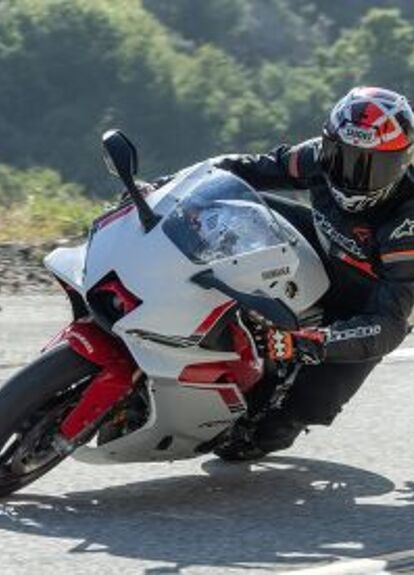
- Helmet: Shoei X-15
- Jacket: Alpinestars GP Plus R V4 Airflow
- Pants: Alpinestars Copper V3
- Gloves: Alpinestars GP Pro R4
- Boots: Alpinestars SMX-6 V3
Nic’s In Gear – Track
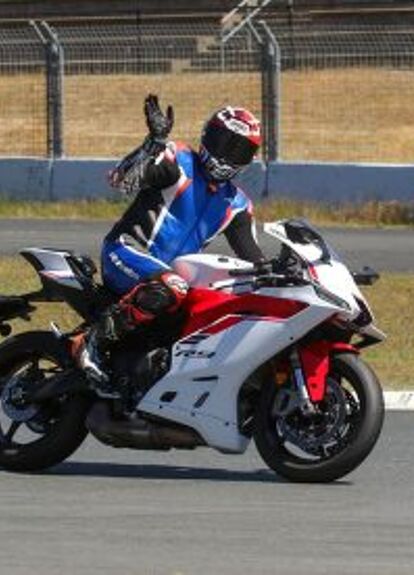
- Helmet: Shoei X-15
- Suit: Alpinestars Racing Absolute V2
- Airbag: Alpinestars Tech-Air 10 Race
- Gloves: Alpinestars GP Pro R4
- Boots: Alpinestars Supertech R
Ryan’s In Gear – Street
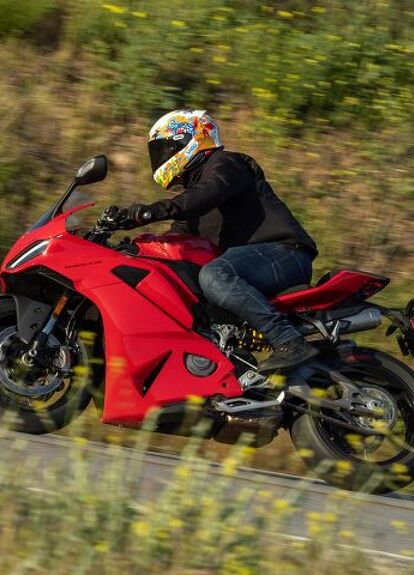
- Helmet: Shoei RF-1400
- Jacket: Alpinestars Calabasas (discontinued)
- Airbag: Alpinestars Tech-Air 3 V2 Canvas
- Pants: Alpinestars X Diesel AS-DSL Daiji (discontinued)
- Gloves: Racer Mickey
- Boots: Cortech Slayer Canvas Check
Ryan’s In Gear – Track
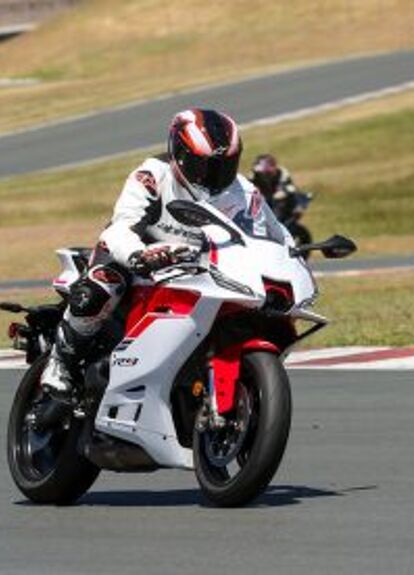
- Helmet: Alpinestars Supertech R10 Carbon
- Suit: Alpinestars GP-R7
- Gloves: Alpinestars GP Pro R4
- Boots: Alpinestars Supertech R Vented
Troy’s In Gear – Street
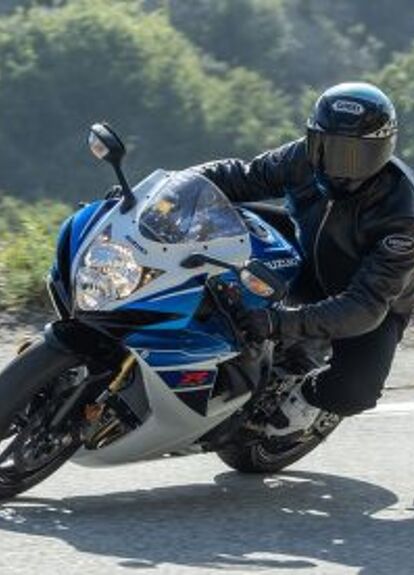
- Helmet: Shoei RF-1400
- Jacket: Vanson Full Throttle
- Airbag: Dainese Smart Air
- Pants: Alpinestars Cult-8 Riding Jeans
- Gloves: Alpinestars Phenom Leather Air
- Boots: Sidi Rex Air
Troy’s In Gear – Track
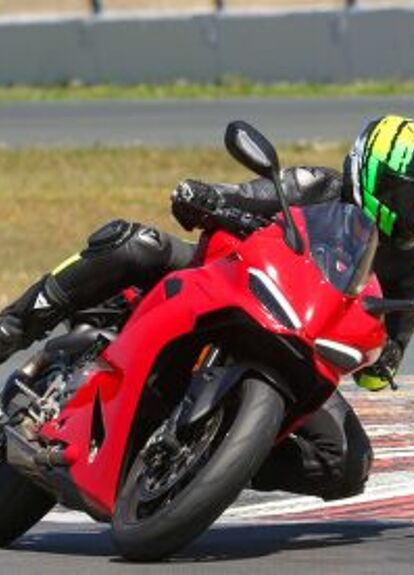
- Helmet: Arai Corsair-X
- Leathers: Dainese Misano 3 Perforated D-Air 1-Piece
- Airbag: D-Air integrated into suit
- Gloves: Alpinestars GP Pro R4
- Boots: Dainese Torque 4
Specifications | 2025 Ducati Panigale V2 | 2025 Suzuki GSX-R750 | 2025 Yamaha YZF-R9 |
|---|---|---|---|
MSRP | $15,995.00 | $13,149.00 | $12,499.00 |
Engine Type | 90° V2, 4 valves per cylinder, intake variable valves timing system, liquid cooled | Four-stroke, liquid-cooled, DOHC | Liquid Cooled, 4-Stroke, DOHC Inline-Three, 4 valves per cylinder |
Displacement | 890cc | 750cc | 890cc |
Bore x Stroke | 96.0 mm x 61.5 mm | 70.0 mm x 48.7 mm | 78.0 mm x 62.1 mm |
Compression Ratio | 13.1:1 | 12.5:1 | 11.5:1 |
Horsepower (measured) | 106.4 hp at 10,600 rpm | 121.7 hp at 11,900 rpm | 104.9 hp at 9,500 rpm |
Torque (measured) | 65.1 lb-ft. at 8,000 rpm | 55.8 lb-ft. at 10,400 rpm | 64.9 lb-ft. at 6,700 rpm |
Fuel Injection | Electronic fuel injection system. One injector per cylinder. Full ride-by-wire. | Fuel injection | Fuel injection with YCC-T |
Gearbox | 6 speed with Ducati Quick Shift (DQS) up/down 2.0 | Constant mesh 6-speed | Constant mesh 6-speed, bi-directional quickshifter |
Primary Ratio | 1.84:1 | 1.761:1 | 1.681:1 |
Final Drive | Chain 520; Front sprocket 15; Rear sprocket 42 | RRK 525ROZ5Y chain, 116 links | Chain |
Clutch | Hydraulically controlled slipper and self-servo wet multiplate clutch. | Multi-plate wet clutch | Multi-plate wet clutch |
Frame | Monocoque aluminum | Twin-spar aluminum frame | Twin-spar aluminum frame |
Front Suspension | Marzocchi 43mm fully adjustable usd fork, 4.7 inches of travel | Inverted telescopic, coil spring, oil damped, 4.7 inches of travel | Coil spring / Hydraulic damper, 4.7 inches of travel |
Rear Suspension | Fully adjustable Kayaba monoshock. Aluminum double-sided swingarm, 5.9 inches of travel | Link type, coil spring, oil damped, 5.1 inches of travel | Coil spring / Gas hydraulic damper, 4.6 inches of travel |
Front Brake | 2 x 320 mm semi-floating discs, radially mounted Brembo Monobloc M50 piston calipers with Bosch Cornering ABS. | Brembo, 4-piston, twin disc | Dual 320mm discs, Brembo Stylema radial-mount four-piston calipers |
Rear Brake | 245 mm disc, 2-piston caliper with Bosch Cornering ABS | Nissin, 1-piston, single disc | Single 220mm disc |
Front Wheel | Y-shape, 6-spokes light alloy, 3.50" x 17" | Cast 3.50" x 17" | 17M/C x MT3.50 |
Rear Wheel | Y-shape, 6-spokes light alloy, 5,50” x 17” | Cast 3.50" x 17" | 17M/C x MT5.50 |
Front Tire | Pirelli Diablo Rosso IV 120/70 ZR17 | 120/70ZR17M/C (58W), tubeless | 120/70ZR17M/C(58W) |
Rear Tire | Pirelli Diablo Rosso IV 180/55 ZR17 | 180/55ZR17M/C (73W), tubeless | 180/55ZR17M/C(73W) |
Instrumentation | Digital unit with 5" TFT color display, 800 x 480 px resolution | Analog tachometer with LCD display | 5" TFT display |
Wet Weight No Fuel | 419 pounds | 428 pounds | 431 pounds |
Seat Height | 33.0 inches | 31.9 inches | 32.7 inches |
Wheelbase | 57.7 inches | 54.7 inches | 55.9 inches |
Rake / Trail | 23.6° / 3.7 inches | 23.5° / 3.8 inches | 22°35′ / 3.7 inches |
Fuel Tank Capacity | 4 gallons | 4.5 gallons | 3.7 gallons |
Warranty | 24 months unlimited mileage | 12 months limited warranty | 12 months limited warranty |
Service Intervals | 9,000 miles / 24 months | 12,000 miles / 24 months | 12,000 miles / 24 months |
Valve Adjustments | 18,000 miles | 14,500 miles | 24,000 miles |
2025 Next Generation Supersport Shootout Gallery

We are committed to finding, researching, and recommending the best products. We earn commissions from purchases you make using the retail links in our product reviews. Learn more about how this works.
Become a Motorcycle.com insider. Get the latest motorcycle news first by subscribing to our newsletter here.
Troy's been riding motorcycles and writing about them since 2006, getting his start at Rider Magazine. From there, he moved to Sport Rider Magazine before finally landing at Motorcycle.com in 2011. A lifelong gearhead who didn't fully immerse himself in motorcycles until his teenage years, Troy's interests have always been in technology, performance, and going fast. Naturally, racing was the perfect avenue to combine all three. Troy has been racing nearly as long as he's been riding and has competed at the AMA national level. He's also won multiple club races throughout the country, culminating in a Utah Sport Bike Association championship in 2011. He has been invited as a guest instructor for the Yamaha Champions Riding School, and when he's not out riding, he's either wrenching on bikes or watching MotoGP.
More by Troy Siahaan






Comments
Join the conversation
MORE COMPAROS LIKE THIS PLEASE
Fortunately I’m at a point in life to have a modest quiver of motos in the garage and the GXR always scratches the itch the most out of all of these. Ducati lost its vibe stepping down in performance from the last gen, the Yamaha is a street bike in buck toothed clothing, which leaves the og Gixxer. It’s the perfect canvas for a canyon carving, track slaying wonder toy. And that classic blue/white livery never gets old!