


2026 Kawasaki Ninja ZX-10R and ZX-10RR – First Look

New fairing and winglets for Kawasaki’s superbike

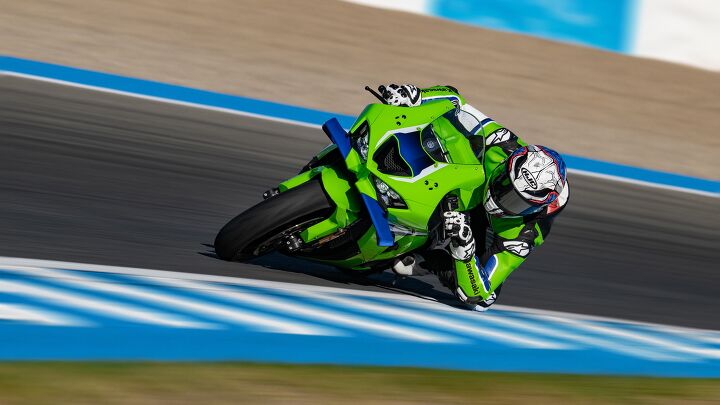
Kawasaki announced an updated Ninja ZX-10R and Ninja ZX-10RR for 2026, updating its flagship superbike with a new fairing, large aerodynamic winglets, redesigned headlights, and a larger TFT display.
Mechanically, the 2026 ZX-10R and ZX-10RR aren’t too different from the current generation versions. Apart from some chassis tweaks to compensate for the downforce generated by the new winglets, and a repositioned ram air intake, Kawasaki also added a second O2 sensor and updated the catalyst to meet Euro 5+ requirements.
Comparing the new fairing to the previous design, the 2026 ZX-10R employs much sharper-looking edges, with a bit more forward thrust to the front face. The Ram Air intake is higher, still centrally located but positioned above the headlights and just below the mounting points for the mirrors. Along the side, the single cutout from the previous design has now been separated into two smaller openings, increases the surface area of the fairing,
The acrylonitrile butadiene styrene (ABS) resin winglet is relatively flatter than some of the swoopier designs offered by the competition. Its upper edge flows directly into the ZX-10R’s signature jutting chin below the headlights. According to Kawasaki, the increased frontal area of the winglet creates a 0.3% increase in drag compared to the 2025 design, but that is a worthy trade-off to achieve a claimed 25% increase in downforce.

By moving the intake higher, Kawasaki was able to create more room to fit new hybrid projector/reflector headlights. The low beams use a mono-focus LED projector design, while the high beams and position lights use deep-set reflectors.
Under the bodywork, Kawasaki made small changes to the chassis geometry and suspension settings to complement the increased downforce from the new winglets. Kawasaki also raised the swingarm pivot point by 2mm, claiming improved traction and secondary cornering force.

Up front,the ZX-10R uses a fully adjustable 43mm Showa Balance Free front Fork. The fork spring rate is unchanged from 2025, but Kawasaki lowered the fork height by 2mm, adjusting the damping settings accordingly to match. At the rear, the ZX-10R uses a fully adjustable Showa Balance Free Rear Cushion shock with a piggyback reservoir, with the spring rate, damping settings, and linkage components optimized, which Kawasaki claims enhances rear wheel traction and mid-corner control.
The ZX-10RR uses different damping and spring preload settings for the rear, while its Balance Free Front Fork incorporates a titanium coating on the outer surface of the inner fork tubes to reduce friction.

The braking system is unchanged from before, with dual 330mm semi-floating discs and Brembo M50 monoblock radial-mount four-piston calipers up front, and a 220mm disc and single-piston caliper for the rear.
The ZX-10R comes standard with Bridgestone Battlax RS12 tires, replacing the RS11 tires from previous models. The ZX-10RR comes with Pirelli Diablo Supercorsa SP V3 tires.
The ZX-10R’s 998cc Inline-Four returns with updates aimed at improving emission output without affecting performance (that said, Kawasaki hasn’t released full specifications as of this writing.) Kawasaki added a second downstream O2 sensor while also updating the catalyst with a smaller, and lighter design. The double-R model employs lightweight titanium connecting rods from Pankl, with Kawasaki claiming a wide powerband and quicker engine response compared to the ZX-10R.
The electronics package offers three preset ride modes: Sport, Road, and Rain, plus four programmable modes. A Bosch inertial measurement unit supports the Kawasaki Cornering Management Function, overseeing lean-sensitive traction control, launch control, engine brake control, and the Kawasaki intelligent anti-lock brake system. A bidirectional quickshifter and electronic cruise control come standard.

For 2026, the ZX-10R gains a new five-inch TFT display, replacing the previous 4.3-inch screen. The screen offers two display modes: Type 1 offers an analog tachometer, core vehicle data, and turn-by-turn navigation, and Type 2 offers a bar-style tach and more track-focused data. The background color automatically switches between white and black depending on ambient light levels.
The 2026 Kawasaki Ninja ZX-10R is available in Lime Green/Blue 24 or Metallic Matte Graphenesteel Gray/Metallic Spark, while the ZX-10RR is offered in Lime Green. Expect to see them in dealerships in early 2026. U.S. pricing remains to be announced.
2026 Kawasaki Ninja ZX-10R and ZX-10RR First Look Gallery

Become a Motorcycle.com insider. Get the latest motorcycle news first by subscribing to our newsletter here.
Dennis has been a part of the Motorcycle.com team since 2008, and through his tenure, has developed a firm grasp of industry trends, and a solid sense of what's to come. A bloodhound when it comes to tracking information on new motorcycles, if there's a new model on the horizon, you'll probably hear about it from him first.
More by Dennis Chung





Comments
Join the conversation
Not a dramatically different "face" on the 10R, but it's much improved to the bottom-feeder fish face that it had, since the last time it looked great (2020).
Not a single fact about the engine output or otherwise.