


2025 Ducati Streetfighter V2 S Review – First Ride

When siblings grow apart

There’s been a lot of contempt toward Ducati downsizing its V2 from the 955cc Superquadro to the 890cc V2 mill. Toss out the desmo valves, add some springs and back the whole thing up with a double-sided swingarm, and voila, a recipe even the most discerning internet troll will be helpless from sinking its teeth into. Sure, we’ve done our fair share of proliferating the old adage of “there’s no replacement for displacement,” but we also understand there are more facets at play than just mo’ cc are mo’ better. To wit, we look to another overused expression around the ranks of moto scribes: sometimes a bike tells a more complex story than its spec sheet puts on.
2025 Ducati Streetfighter V2 S
Ducati’s latest Streetfighter V2 continues the trend Bologna has set with the other two V2-powered machines; the Panigale V2 supersport and Multistrada V2 sport-tourer. Riders will benefit from better engine performance throughout the rev-range and an overall machine that’s much quicker on its feet.
Highs
- Robust engine performance throughout the rev range
- Lighter handling
- Stout, customizable electronics
Sighs
- Quickshifter seems to have taken a step backward
- Pricing will remain a point of contention relative to the segment
- There really doesn’t need to be three
Now that we’re on our, not first, not second, but third Ducati review powered by the new V2 engine, it’s hard not to come into this one without some preconceived notions. After riding the 2025 Streetfighter V2 around some different Spanish roads from the previous tests, the overall theme continues with Ducati showcasing an emphasis on chassis performance over outright engine performance with the Streetfighter borrowing heavily from the 2025 Panigale V2 MO covered last month.

We won’t assume that you've been reading, and re-reading, and writing, and editing words about this platform for the last few months like we have, so let’s get into what makes the Streetfighter V2 a naked worth its streaming service fee.
Chassis that won’t quit

While the V2 engine makes the Streetfighter what it is, a motorcycle, we’re going to kick this one off with the Streetfighter V2’s chassis performance. Since using the engine as a stressed member of the chassis is far from revolutionary these days, and while Ducati specifically has been working with mass-produced monocoque chassis since 2012, it’s easy to overlook the engineering that has gone into making this efficient, logical idea come to fruition – and not just in theory, but in a competitive package.

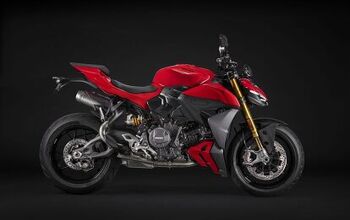
As seen above in the even more naked Streetfighter, the airbox, subframe, and swingarm essentially make up the frame which is all primarily held together by the V2 engine. Something that I hope will come as a surprise to none of our readers is that engines don’t offer much flex when it comes to chassis feedback, which makes the difficulty of precisely engineering the aforementioned components just that much more crucial. Ducati have not only saddled themselves with dialing in the appropriate ratio of stiffness to flex from both lateral and longitudinal forces, but also efficiency in packaging (e.g. making the front portion of the frame double as the airbox and steering head).

A cast aluminum subframe and swingarm round out the “frame” of the SF V2. Compared to the sport-focused Panigale V2, the Streetfighter’s wheelbase is just over an inch longer with a nod toward handling stability over outright quickness. Continuing with the theme versus its fully-faired counterpart is a slightly less steep 24.1-degree rake and longer 4 inches of trail.
Rounding out the chassis is fully-adjustable suspension for both the base Streetfighter V2 and the S model. Kayaba supplies the goods for the standard model while you get that Swedish gold from Öhlins on the S. Both machines feature a Sachs steering damper as standard.

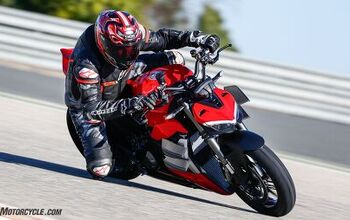
We were only able to sample the Streetfighter V2 S during our time with Ducati in Spain and while the engine is a crucial component in more ways than one to delivering the experience of the Streetfighter, it was the handling that Ducati managed to eke out of this middleweight naked that made its way to the top of mind. I was particularly thankful when I got myself too deep into a decreasing radius corner, triggered the front ABS, and managed to keep things upright without much puckering, thanks to the bike’s predictable nature. That confidence carries through not only in fast corners with the bike showcasing its stability, but equally so when dicing it up between hairpins. Unsurprisingly perhaps, the Streetfighter’s well-balanced chassis and wide lock-to-lock steering makes the machine equally adept at navigating the city. The 1.2-inch wider handlebar helps in these transitions, too.

The chassis maintains its composure under braking as well, whether you’re hard on the binders bolt upright or trailing off of them on your way to the apex. Ducati has managed to make the Brembo M50s work as good as ever, even if the feedback isn’t quite as crisp as the up-spec Brembo bling found on the V2’s big brother. The rear brake has a fairly long throw to get into the little braking force it offers. While the stock setup of the Ohlins components definitely resides at the sporty end of the spectrum, Ducati have achieved its goal of making the Streetfighter V2 the easiest dance partner to date – and there is plenty of adjustability for fine tuning.
Obviously, losing weight overall helps. Ducati says that, without fuel, the S model weighs in at 386 pounds with the standard model tipping the scales at 392 lbs. Account for 24-ish pounds from the four-gallon fuel tank and you’re looking at a ready to ride weight of 410 lbs for the S and 416 for the base (for reference, the 955cc Streetfighter weighed in at 457 pounds fully fueled on the MO scales). The weight savings on the S comes down to the lithium-ion battery, passenger accommodations, and suspension.

As a whole, the Streetfighter V2 feels much more nimble than its predecessor, putting it more in line with its middleweight rivals from Austria, Japan, and the UK. When we last got those machines together for a rip around the local roads, the Ducati felt big, heavy, and slow to steer compared to the other machines. The 955 Superquadro was the only thing pulling it up the ranks, but even then, then engine only showed its potential when being flogged in the mountains or at the track, everyday riding in the midrange revealed an engine in constant need of finessing, be it with the right wrist or clutch lever, to keep some sort of semblance of smoothness – oh, and it left the rider’s backside lightly roasted. Which leads us into…
The Ducati V2
As alluded to before, the engine is just as crucial in the overall experience of the SF V2 as the chassis that’s bolted to it. The new engine swaps adjectives like brutish, for balanced, and surging for smooth. The new V2 mill is 65cc smaller than the outgoing Superquadro with a slightly smaller 96mm bore and a 0.7mm longer stroke at 61.5mm putting its displacement at 890cc. The engine itself is also more compact and 21 pounds lighter than the previous V-Twin. As before, the 90-degree V is rotated back 20 degrees for optimal spacing and weight distribution.

As hinted at before, Ducati continues to buck tradition if only for tradition’s sake by fitting the latest V2 with 38.2mm hollow intake valves and 30.5mm exhaust valves actuated by the more commonplace finger followers and springs. This valvetrain is not only lighter, but also more compact than the desmo system – oh, and will cost you less when you go in for a valve service every 18,000 miles. Ducati’s Intake Variable Timing (IVT) helps to quell the issues we observed in the past by electronically adjusting cam timing to fill out the rev range with broad torque no matter where you find yourself in it.

This is where the V2 mill shines. Gone is the weak, surging low to mid-range performance, filled in by smooth throttle response delivering robust torque across the revs – 70% of which we’re told is available by 3,000 rpm. Ducati rates the V2 at 120 horsepower at 10,740 rpm with 68.8 lb-ft of torque at 8,250 rpm. Ducati claimed 153 hp from the crank of the 955cc V2. When we last had the Superquadro-powered Streetfighter V2 on the dyno it put down 129.9 hp to the rear wheel at 10,300 rpm – right in line with a 15% driveline loss on its way to the ground. That said, the new V2 should be producing just over 100 ponies at the rear wheel.

This is a great case in point where the numbers don’t tell the whole story. While I can agree with the sentiment that generally losing HP sauce is not the way, if the power is only accessible at full tilt, it doesn’t make for a very well-rounded experience. In the case of the Streetfighter V2, I would gladly give up some top end to smooth out and fill in the low and mid-range deficiencies of the previous gen – and that’s exactly what Ducati has done.
Torque builds smoothly from low rpm to deliver predictable performance whether you're rocketing between hairpins, or casually surfing the torque curve a gear high between them. Naturally, this experience carries over to riding around town. While we spent little time bouncing between villages, the experience is so night and day compared to the outgoing mill, I can unequivocally say a heartfelt, grazie mille to the engineers in Bologna. As much as I’ve mentioned the first two thirds of the rpm range, the V2 doesn’t fall on its face on the way to its 11,350 rpm redline either. The engine is perfectly happy to extend the thrill upwards of 11,000 with the IVT letting us have our cake and eat it too.
Riding the Matrix
As we’ve come to expect on Ducatis, a host of rider aids are at your fingertips all accessible via a redesigned switchgear and 5-inch TFT display. While navigation of the menus has gotten better over the years, there’s still such a massive amount of information and adjustability at hand that it will take some time to figure things out. What adjustments, you ask? How about IMU-based: ABS, traction control, wheelie control, and engine brake control as well as three power modes. Four ride modes deliver default settings of the aforementioned AIDS, but can all be adjusted through various parameters including off in almost every way (except front wheel ABS). The ride mode matrix below will save us some word count.
Riding Mode Matrix
Power Mode | Traction Control | Wheelie Control | Quickshift | ABS Cornering | Engine Brake Control | |
RACE | High 120hp Dynamic RbW | Level 3 (of 8) | Level 2 (of 4) | ON | Set-up 2 Max performance for amateur rider on track Cornering set-up No lift-up detection Ride slide by brake active | Level 1 (of 3) |
SPORT | High 120hp Dynamic RbW | Level 4 (of 8) | Level 2 (of 4) | ON | Set-up 3 Road Setting Cornering set-up Sporty/Safety Medium lift-up detection | Level 1 (of 3) |
ROAD | Medium 120hp Smooth RbW | Level 5 (of 8) | Level 3 (of 4) | ON | Set-up 3 Road Setting Cornering set-up Sporty/Safety Medium lift-up detection | Level 2 (of 3) |
WET | Low 95hp Smooth RbW | Level 6 (of 8) | Level 4 (of 4) | ON | Set-up 3 Road Setting Cornering set-up Sporty/Safety Medium lift-up detection | Level 3 (of 3) |
OFF | OFF | OFF | Set-up 1 Only front - no cornering Max performance for professional riders on racetrack No lift-up detection |
Other niceties like cruise control and Ducati’s Quick Shift 2.0 are standard on both models. The new quickshifter forgoes the linkage-based spring and instead works via an internally mounted sensor. My experience with the system on the Multistrada was mostly complaint free with a few instances of long cut times or missed shifts. During this ride, the complaints were coming more often. Ducati says this is to ensure the transmission is protected from aggressive shifting, though it’s not a complaint we’ve had on previous models from Ducati – or other brands that have seemingly mastered the tech. Unfortunately, during our time on the track the day prior with the Streetfighter V4 – which also uses the new system (review to come) – the issue seemed to plague the assembled bikes there almost universally. It’s not a deal breaker by any means, but it feels like a step in the wrong direction. That said, we may only be a software update away from better performance given the previous experience.

Most of our ride was was spent in Sport and Race, but we kicked off the morning in Road, which while offering all 120 horses, smooths the throttle delivery drastically, which is fine for cruising around town or on the highway, but I didn’t find the Sport mode’s throttle ramp up to be too abrupt for normal use either. Bumping it up into Race mode, power delivery remains the same as Sport, but dials back TC a bit and unlocks the ABS “2” setting which allows for a controlled rear brake slide while maintaining cornering function. For those looking for a bit more hoon and are willing to accept the responsibility of their actions, TC and wheelie control can be turned off entirely while ABS can be switched to level 1 to disable the cornering function and rear ABS entirely. As we’ve mentioned before, Ducati gives riders the maximum adjustability when it comes to these ride modes and rider aids, something we wish was more commonplace in the industry.

Super-mid, no more
Ducati tells us the shift from the 955 Superquadro-driven Streetfighter to the new V2 helps to create a better, more intentional gap between it and the Streetfighter V4. After riding the two back-to-back, there is very much a difference between the two now, but I would have likely said the same about the Superquadro. At the dealership level, to prospective customers, apparently the lines weren’t so clear. So, with the new Streetfighter V2, Bologna is hoping to usher in a new, younger generation of Ducatisti.

Separating the two models makes sense, but building an all around easier, lighter, more nimble motorcycle that a rider can exploit is the true win here. It’ll be great to get the segment back together and see how things shake out this time around.
Scorecard
Engine | 19/20 | Suspension | 15/15 | Transmission | 8/10 |
Brakes | 9/10 | Instruments | 4/5 | Ergonomics | 10/10 |
Appearance | 9/10 | Desirability | 9/10 | Value | 8/10 |
Editors Score: 91.0% | |||||
In Gear

- Helmet: Alpinestars Supertech R10 Carbon Team
- Jacket: Alpinestars Atem V4 (discontinued)
- Pants: Pando Moto Boss Dyn
- Gloves: Alpinestars GP Pro R4
- Boots: Alpinestars Supertech R Vented
Specifications | 2025 Ducati Streetfighter V2 | 2025 Ducati Streetfighter V2 S |
|---|---|---|
Engine Type | 90° V2, 4 valves per cylinder, intake variable valves timing system, liquid cooled | |
Displacement | 890cc | |
Bore x Stroke | 96.0 mm x 61.5 mm | |
Compression Ratio | 13.1:1 | |
Horsepower | 120 hp at 10,750 rpm (claimed) | |
Torque | 69 lb-ft. at 8,250 rpm (claimed) | |
Fuel Injection | Electronic fuel injection system. One injector per cylinder. Full ride-by-wire. | |
Exhaust | 2-1-2 system, with 1 catalytic converters and 3 lambda probes | |
Gearbox | 6 speed with Ducati Quick Shift (DQS) up/down 2.0 | |
Primary Drive | Straight cut gears; Ratio 1.84:1 | |
Final Drive | Chain 520; Front sprocket 15; Rear sprocket 42 | |
Clutch | Hydraulically controlled slipper and self-servo wet multiplate clutch. | |
Frame | Monocoque aluminum | |
Front Suspension | Marzocchi 43mm fully adjustable inverted fork, 4.7 inches of travel | Öhlins NIX30 43 mm with TiN treatment, fully adjustable inverted fork, 4.7 inches of travel |
Rear Suspension | Fully adjustable Kayaba monoshock. Aluminum double-sided swingarm, 6.3 inches of travel | Fully adjustable Öhlins monoshock. Aluminum double-sided swingarm, 6.3 inches of travel |
Front Brake | 2 x 320 mm semi-floating discs, radially mounted Brembo Monobloc M50 piston calipers with Bosch Cornering ABS. | |
Rear Brake | 245 mm disc, 2-piston caliper with Bosch Cornering ABS | |
Front Wheel | Y-shape, 6-spokes light alloy, 3.50" x 17" | |
Rear Wheel | Y-shape, 6-spokes light alloy, 5.50” x 17” | |
Front Tire | Pirelli Diablo Rosso IV 120/70 ZR17 | |
Rear Tire | Pirelli Diablo Rosso IV 190/55 ZR17 | |
Instrumentation | Digital unit with 5" TFT color display, 800 x 480 px resolution | |
Wet Weight No Fuel | 392 pounds (claimed, no fuel) | 386 pounds (claimed, no fuel) |
Seat Height | 33.0 inches | |
Wheelbase | 58.8 inches | |
Rake / Trail | 24.1° / 4.0 inches | |
Fuel Tank Capacity | 4 gallons | |
Number Of Seats | Dual seat | Single seat (passenger seat kit accessory available) |
Safety Equipment | Riding Modes, Power Modes, Bosch Cornering ABS, Ducati Traction Control (DTC), Ducati Wheelie Control (DWC), Engine Brake Control (EBC), Auto tire calibration, Ducati Brake Light (DBL) | |
Standard Equipment | Ducati Quick Shift (DQS) up/down 2.0, Full LED headlights with Daytime Running Light (DRL), Auto-off indicators, Coming Home, Passenger seat and footpegs, Sachs steering damper | Ducati Quick Shift (DQS) up/down 2.0, Full LED headlights with Daytime Running Light (DRL), Auto-off indicators, Lithium-ion battery, Ducati Power Launch (DPL), Pit Limiter, Coming Home, Sachs steering damper, Single seat configuration |
Warranty | 24 months unlimited mileage | |
Service Intervals | 9,000 miles / 24 months | |
Valve Adjustments | 18,000 miles | |

We are committed to finding, researching, and recommending the best products. We earn commissions from purchases you make using the retail links in our product reviews. Learn more about how this works.
Become a Motorcycle.com insider. Get the latest motorcycle news first by subscribing to our newsletter here.
Ryan’s time in the motorcycle industry has revolved around sales and marketing prior to landing a gig at Motorcycle.com. An avid motorcyclist, interested in all shapes, sizes, and colors of motorized two-wheeled vehicles, Ryan brings a young, passionate enthusiasm to the digital pages of MO.
More by Ryan Adams








Comments
Join the conversation
Magnificent article!
No desmo valves? Booooo!