


2026 Ducati Monster Review – First Ride
An Icon Refined, Not Rewritten

Back in the ’90s, as fully faired sport bikes dominated showrooms, Ducati chose rebellion over refinement. With bodywork stripped away and the engine and trellis frame proudly exposed, the Ducati Monster was born. Now, more than three decades after the first Monster hit the scene, Ducati gave us the opportunity to sample the latest fifth-generation Monster through the sinuous mountain roads of the Costa del Sol just north of Malaga, Spain — expectations were high.
2026 Ducati Monster
Although the wet conditions prevented a full evaluation of the bike, the chassis felt balanced and composed, and the engine is a gem. In this tester’s eyes, it’s still one of the best looking naked bikes out there.
Highs
- Neutral rider triangle with a low seat height
- The V2 engine is a peach
- A naked I could stare at all day
Sighs
- Tiny taillight that was especially hard to see in the rain
- Pay-to-play features
- Slippery footpegs
Video: 2026 Ducati Monster Review – A Classic Reimagined
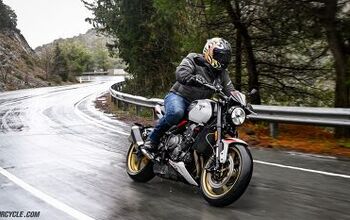
Spain delivered everything except dry pavement. We rode through cities, farmland, and twisting mountain roads under steady rain. Normally smooth and grippy, Spain’s roads turned slick and were littered with potholes, speed bumps, and debris. Despite the gray skies, the day was breathtaking, with rainbows breaking through the clouds throughout the ride — and the bike wasn't too bad either.

Before the ride, Ducati walked us through the Monster’s story. Designed by the famed Miguel Galluzzi and first shown at the Cologne Trade Fair in 1992 before entering production in 1993, the Monster broke convention when motorcycles were either fully-faired sport bikes or classic standards. While the formula has always combined a sporty engine, a Superbike-inspired chassis, and minimalist design, the Monster naturally evolved through consistent changes and upgrades. It started out air-cooled and carbureted, eventually becoming a liquid-cooled, fuel-injected beast within a decade of its inception. ABS, traction control, and Öhlins suspension eventually found their way to the Monster over the next few years, along with a plethora of engine sizes ranging from 600cc to 1200cc.
Which brings us to the current model. It now features a new V2 engine, straying away from the classic desmodromic valve actuation setup in favor of traditional valve springs.

More than 380,000 Monsters later, it remains Ducati’s most iconic model, backed by a global community of loyal riders known as the Monsteristi.
Now in its fifth generation, and Ducati’s goal is clear: take what made the fourth-generation Monster so light, fun, and approachable, and reconnect it with its roots.
A Familiar Monster, With More Attitude

Having ridden the previous-generation Monster, the 2026 bike feels instantly familiar. Ergonomics, balance, and overall approachability remain, but this version feels sharper and more alive.
Ducati offers two versions of the Monster: the standard model and the “+” model, with the latter coming with a windscreen and seat cover. We tested the standard model, though only the “+” model will be sold Stateside.

One of the first things I noticed before even rolling away was just how manageable the Monster feels. With a 32.1-inch seat height, about 0.2 inches lower than the previous generation, and a noticeably slimmer inner leg curve, it’s easy to get comfortable. At 5-foot, 6-inches, I could plant the balls of my feet on the ground. Not quite flat-footed, but secure enough to feel confident. Another rider in our group standing 5-foot, 2-inches was able to tip-toe both feet, something rare in this segment. The seat height never felt intimidating, and I could even back the bike up while seated, which speaks volumes about the Monster’s balance and low weight.
Many riders want to join the naked bike world but are often discouraged by taller seats. This Monster gives them the balance and confidence to enjoy a style of bike they might otherwise miss.

Ducati’s new V2 engine might be smaller than the previous 937cc Desmodromic engine, but delivers the same 111 horsepower as before, now with less maintenance. Oil service is now suggested at 9,000 miles or two years and the valve clearance check is recommended at 28,000 miles. A major win for customers. Like other manufacturers who have used similar technology, Ducati’s Intake Variable Timing opens up the flexibility of the engine. Now there’s smooth, low-rpm torque while keeping the engine energetic when you ask for more. The power delivery is very smooth compared to other Ducati’s I have ridden in the past. Ducati’s Quick Shift 2.0 paired well with the new motor, making up and down shifts super easy, and I really appreciated the electronics rev-matching for me to ease down shifting. Plus, it sounds phenomenal!
With four dedicated power modes (one more than the previous model), the rider truly has the ability to change how the bike feels. Initially, I spent most of the time in Road mode, and it didn’t take long to find the edge of traction. Rolling on the throttle exiting a corner, the rear tire stepped out briefly, then the traction control was quick to remind me that I was riding in the rain. I am no stranger to the rear tire wiggling a bit because of my supermoto background, but when conditions are truly wet like they were during our ride, I don’t mind having a little electronic assistance helping me out.

Switching to Wet mode transformed the bike entirely: softer throttle, more electronic intervention, and zero rear tire slides. In these conditions, Wet mode turned a treacherous, rainy mountain road into a stress-free playground.
Suspension That Just Works
Suspension setup can make or break a real-world ride, and here the Monster truly impressed me. At 135 pounds, the stock Showa 43mm inverted fork and monoshock with adjustable preload felt nearly perfect. At my weight, it's rare that I've hopped on a bike and felt comfortable with the suspension straight away.

Despite the rough city roads, potholes, speed bumps, uneven pavement, and random debris, the bike stayed composed and comfortable. It absorbed hits cleanly while still maintaining a sporty, controlled feel through corners. Ducati clearly prioritized balance over stiffness.
This Monster felt more sporty than I was expecting with its responsive and refined character. I’m a sucker for any V-configurated engine. There’s just something about their character that’s irreplaceable and this new Monster upheld that feeling. I’ve always loved naked bikes and felt teased by not getting to ride the wheels off this one because of the unfortunate weather. But I could tell it had a lot more to give.

The lightweight chassis helps too. Ducati was able to shave off nine pounds from the previous model. At just 386 pounds wet (without fuel), this is the lightest four-valve Monster ever, and you feel it immediately. The bike is easy to maneuver at low speeds and despite the wet roads on our ride, it was still confidence-inspiring when leaning into corners.
That low-speed confidence is also aided by the Monster’s steering geometry. Ducati redesigned the front air intakes not just as a styling cue, but to allow for a wider steering sweep — and it’s impressive, making tight U-turns, parking lot maneuvers, and city riding effortless. Even in tight situations, the Monster never felt like it was fighting me.
Design That Honors the Past

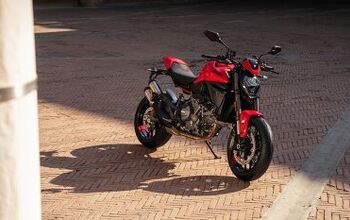
Visually, Ducati nailed the brief. The 2026 Monster connects past and present effortlessly. The iconic fuel tank remains the centerpiece, paired with a narrow seat that highlights the overall lightness of the machine
Tucked away from view is Ducati’s aluminum monocoque frame, a modern evolution of the Monster’s original philosophy. While early Monsters proudly displayed their steel trellis frames, modern day Monsters no longer have a trellis frame and instead use the engine as a stressed member to reduce weight and increase rigidity, while still retaining a trellis-style subframe for visual continuity. It’s lighter, stiffer, and a big reason why the Monster feels so balanced and approachable in real-world riding.

One of my favorite details is a subtle Easter egg: the coordinates of Borgo Panigale, the Monster’s birthplace, hidden on both side covers just below the gas tank. It’s a small thing, but it speaks volumes about Ducati’s pride in this model.
The full LED lighting system gives the bike a modern, almost robotic look, with Ducati’s signature double “C” shaped Daytime Running Lights (DRLs) up front with a matching tail light design. Ducati Red and Iceberg White both look fantastic, though I wasn’t alone in wishing Ducati would bring back the classic Monster yellow, “Giallo Fly.”
Tires For All Conditions

I’ll admit it, I was skeptical of the Pirelli Diablo Rosso IVs in the rain. They don’t have as many sipes as I typically like for wet riding, but they surprised me.
Grip was consistently better than expected, even on shiny, rain-soaked pavement. There were a few moments where the front tire felt slightly vague, almost like it wasn’t fully connected to the road, but those moments were brief and predictable. Overall, the tires performed far better than I anticipated given the conditions.

The stopping power of two 320mm discs aided by Brembo Monobloc 4-piston calipers up front and a 2-piston caliper in the rear, seems like the perfect match for this bike, but I never had a chance to truly sample their performance.
The Bottom Line

The 2026 Ducati Monster doesn’t try to reinvent itself, and that’s exactly why it works. It’s lighter, sharper, and more refined, yet still approachable and easy to ride. Ducati took what worked so well in the previous generation and added more character and electronics, while staying connected to its roots with its iconic tank design and maneuverability.
I wish I could’ve taken it to the track. I wish I could’ve wheelied it. And I wish the rain had subsided and given me a chance to really push it. I can see this improved Monster as a serious competitor in this category, and eventually becoming a competitor in the MotoAmerica Super Hooligan class. Even under gray skies, the Monster proved its point. It’s not a Streetfighter track weapon, and it’s not trying to be. Instead, it’s a bike built for real roads, real riders, and real fun.

The Monster still does what it’s always done best: it re-energizes my passion for everything about bikes. It’s funny, I sometimes forget how incredible the raw feeling of riding a naked bike is, but the Monster captures the essence of that feeling. It somehow draws a grin, almost out of disbelief at how entrancing it is. It’s a simple yet sophisticated machine that also keeps pace with modern tech and performance.
Sometimes, evolution doesn’t mean changing everything. Sometimes, it just means getting the details right.
Scorecard
Engine | 18.5/20 | Suspension | 14/15 | Transmission | 8.5/10 |
Brakes | 8/10 | Instruments | 5/5 | Ergonomics | 9/10 |
Appearance | 9.5/10 | Desirability | 9/10 | Value | 8.5/10 |
Editors Score: 90.0% | |||||
In Gear

- Helmet: AGV K6
- Jacket: Stella T-SPS V2 WP
- Jeans: Alpinestars Daisey V3
- Gloves: Stella Phenom Gloves
- Shoes: Stella Faster 4
2026 Ducati Monster+ Specifications | |
|---|---|
MSRP | $13,995 in Ducati Red $14,195 in Iceberg White |
Engine Type | 90° V2, 4 valves per cylinder, intake variable valves timing system, liquid cooled |
Displacement | 890cc |
Bore x Stroke | 96.0 mm x 61.5 mm |
Compression Ratio | 13.1:1 |
Horsepower | 110.7 hp at 9,000 rpm (claimed) |
Torque | 67 lb-ft. at 7,250 rpm (claimed) |
Fuel Injection | Electronic fuel injection system. One injector per cylinder. Full ride-by-wire. |
Exhaust | 2-1-2 system |
Gearbox | 6 speed with Ducati Quick Shift (DQS) up/down 2.0 |
Primary Drive | Straight cut gears; Ratio 1.84:1 |
Final Drive | Chain 520; Front sprocket 16; Rear sprocket 42 |
Clutch | Hydraulically controlled slipper and self-servo wet multiplate clutch, self bleeding master cylinder |
Frame | Monocoque aluminum |
Front Suspension | Showa 43mm inverted fork, 5.1 inches of travel |
Rear Suspension | Preload-adjustable Showa monoshock. Aluminum double-sided swingarm, 5.7 inches of travel |
Front Brake | 2 x 320 mm semi-floating discs, radially mounted Brembo Monobloc M4.32 four-piston calipers with radial master cylinder, and Bosch Cornering ABS |
Rear Brake | 245 mm disc, 2-piston floating caliper with Bosch Cornering ABS |
Front Wheel | Cast light alloy, 3.50" x 17" |
Rear Wheel | Cast light alloy, 5.50” x 17” |
Front Tire | Pirelli Diablo Rosso IV 120/70 ZR17 |
Rear Tire | Pirelli Diablo Rosso IV 180/55 ZR17 |
Instrumentation | Digital unit with 5" TFT color display, 800 x 480 px resolution |
Wet Weight No Fuel | 386 pounds (claimed, no fuel) |
Seat Height | 32.1 inches (standard seat) |
Wheelbase | 58.7 inches |
Rake / Trail | 23.3° / 3.6 inches |
Fuel Tank Capacity | 3.7 gallons |
Number Of Seats | Dual seat |
Safety Equipment | Riding Modes, Power Modes, Ducati Traction Control (DTC), Ducati Wheelie Control (DWC), Engine Brake Control (EBC), Bosch Cornering ABS, Auto tire calibration |
Standard Equipment | Ducati Quick Shift (DQS) up/down 2.0, Coming Home, TFT colour display, Full LED lighting system, Daytime Running Light (DRL), Self cancelling turn indicators, Lap Timer, Flyscreen, Passenger seat cover |
Warranty | 24 months unlimited mileage |
Service Intervals | 9,000 miles / 24 months |
Valve Adjustments | 28,000 miles |

We are committed to finding, researching, and recommending the best products. We earn commissions from purchases you make using the retail links in our product reviews. Learn more about how this works.
Become a Motorcycle.com insider. Get the latest motorcycle news first by subscribing to our newsletter here.

My motorcycle addiction began in 2013 after buying a 1986 Ninja 250 to save money on gas. We all know, motorcycles never truly save anyone money :). Most of my riding experience has been sport bikes on the street and the track. I recently started riding dirt bikes on trails and a little bit on MX. I am a certified MSF instructor, control rider for multiple track day organizations, and a current expert supermoto racer. I like to save money when I can so I do most of the maintenance on my motorcycles. Valve adjustments, engine rebuilds, and tire changes just to name a few.
More by Sylvia Houston









Comments
Join the conversation
How does the Monster get back to its roots without the trellis frame and desmo valves? It seems like more of a SV650 on steroids.
I'm curious how it would have felt to a normal size American rider? Would the suspension be permanently bottomed out and knees hitting the handlebars?