


2026 Triumph Tiger Sport 660 Review – First Ride

Boosted performance for an entry-level sport tourer

Lately big adventure tourers have been getting a lot of attention from manufacturers (and, presumably, from you, otherwise the OEMs wouldn’t bother making them). But I’d argue there’s something undeniably charming about a middleweight sport-tourer. Let’s face it: most of these big tourers won’t be seeing much dirt, and in the meantime you’re left with a huge, burly motorcycle to contend with. Middleweight sport-tourers are practical, comfortable, and just sporty enough to take the long way home from work. How do I know? Because I used to own a Kawasaki Versys 650 — arguably the most underrated jack-of-all-trades bikes out there.
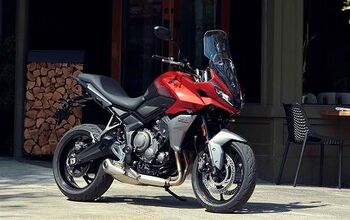
2026 Triumph Tiger Sport 660
The Tiger Sport 660 gets a refresh for 2026 that centers around a substantial horsepower bump from the 660cc Triple. It’s a lively engine that clearly is the centerpiece of the motorcycle, but it’s let down from soft suspension and aggressive ABS.
Highs
- A livelier 660cc Triple is the standout star
- Ergos are comfortable for hours in the saddle
- Arguably looks better than anything else in its (small) class
Sighs
- Really soft suspension with only shock preload adjustability
- Super intrusive ABS
- Wish the gauges were a little bigger
Granted, this category isn’t as stacked as some others, but for 2026, Triumph’s updated 2026 Tiger Sport 660 deserves to enter the chat based on a number of updates centered around a substantially revised version of Triumph’s 660cc Triple.
VIDEO: 2026 Triumph Tiger Sport 660 Review
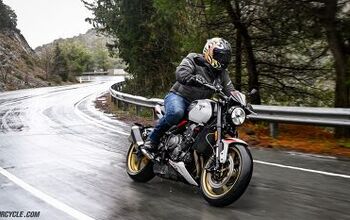
I rode the new Tiger Sport 660 around the twisty roads surrounding Alicante, Spain, and came away thinking the engine changes alone dramatically alter the bike’s personality — for the better. But there’s more to it than that. So, let’s dig in.
Triumph’s Tweaked The Triple
Let’s start with the headline change: the engine. It now has more power. The updated 660cc inline-Triple now claims 94 horsepower at 11,250 rpm — a healthy 13.8-hp bump — and 50.2 lb-ft of torque at 8,250 rpm. More importantly, 80% of that torque is available from 3,000 rpm to nearly 12,000 rpm. The redline also climbs 20% to 12,650 rpm.

Triumph achieved this by cramming more air into the engine. Gone is the single 38mm throttle body feeding three cylinders; in its place are three 44mm throttle bodies feeding each individual cylinder. That’s a significant upgrade in air volume, which requires a larger airbox. Once the air passes through the throttle bodies, it enters into a revised cylinder head with larger exhaust valves (25.5mm vs. 24.2mm previously), higher-lift exhaust cams (8.2mm lift vs. 7.0mm), and a new engine tune to adjust the power delivery to the back tire. Intake valves and camshaft remain unchanged. There’s also a revised 3-into-1 exhaust to handle the added air and power, updated gearbox internals with new ratios, recalibrated Triumph Shift Assist, and a slip/assist clutch to not only make downshifts smoother, but also to keep pressure on the clutch plates when getting on the gas.
Fourteen more horses isn’t something you miss, and the Tiger Sport 660 really is transformed with the extra power and torque. Roll the throttle open exiting a corner and the Triple now spins up with genuine enthusiasm. If you let the revs climb, it rewards you with a healthy amount of power before gently trickling off a few hundred revs shy of redline. Best of all, that Triumph Triple at such high revs sounds so, so good. However, being the sport-touring bike that it is, let’s talk about real world riding. With 80% of the torque available at 3,000rpm, I’d purposely be a gear or two too high and the Tiger Sport 660 lugged its way along without much of a hiccup. Like the Trident 660 the Tiger shares much of its platform with, the updated engine is the star of this show.

An Agile, But Handicapped, Chassis
The Tiger Sport 660 has the task of being sporty and comfortable, and to achieve the sporty end of the deal is a chassis also largely shared with the Trident 660. The chassis remains a tubular steel perimeter frame, but to make room for the three throttle bodies, a notch needed to be cleared from the frame. A different forging was used to make the frame thinner without losing stiffness, which meant Triumph could keep the same chassis dynamics while also keeping from making the frame wider between the rider's legs.
Triumph uses different subframes between the Tiger Sport 660 and Trident 660. While the latter is a roadster, the versatile nature of the Tiger Sport 660 means it needs to be able to handle a passenger, or luggage, or sometimes both. Because of this, the Tiger’s subframe is longer, stronger, and also incorporates mounting points for the accessory panniers that’ll set you back $805. A top box is also available for $385, but you’ll need the $185 rack to mount it correctly.

Suspension is taken up by Showa, with its 41mm SFF-BP fork in front and monoshock in the back. You get no adjustments in the fork, and only preload adjustment in the back via a remote dial-type adjuster. Suspension travel is 5.9 inches at both ends. The rest of the cast consists of 17-inch cast wheels wrapped in Michelin Road 5 tires. A wet weight of 465 pounds is reasonable for the class, and the upright ergonomics make the bike instantly approachable.
Seating position is very neutral, with wide bars and pegs mounted fairly low, at least in relation to the Trident 660. The knee bend is very relaxed and touching the ground wasn’t a problem for me, though it was just the balls of the feet for my 30-inch inseam. In many ways, sitting on the Tiger Sport 660 reminded me of the aforementioned Kawasaki Versys 650.

On the tight Spanish mountain roads surrounding Alicante, the Tiger Sport felt light on its feet. Its steering geometry is fairly sharp, with a 23.1º rake and 3.8 inches of trail, giving that lightness when changing direction. Of course, wide bars give you leverage to move the bike around, too. Offsetting the aggressive geometry is a long wheelbase of 55.8 inches, keeping the Tiger stable mid-corner. The Tiger Sport certainly feels athletic while also being comfortable thanks to its upright riding position giving you a commanding view of the road ahead.
If your riding consists of commuting during the week and spirited (but not crazy) weekend rides, the Tiger Sport’s overall chassis balance is appealing.

But there’s a catch.
Soft Suspension And Touchy ABS
The Tiger Sport 660’s biggest limiting factor — especially when the pace picks up — is its suspension. In a word, it’s soft. Really soft. At 168 pounds, it’s not like I’m a heavy guy, but the Showa components are damped for cruising comfort over all else — and only if you’re riding alone.

Should the pace pick up and you want to explore the “Sport” in sport-touring, tread carefully. During the canyon-heavy press ride in Alicante, the soft suspension quickly made itself known. Hard braking resulted in considerable fork dive, and the front initially felt vague mid-corner, as if there wasn’t much weight over the front Michelin.
Without much adjustability, the only “solution” at our disposal was dialing in more preload. On my particular test bike, it ended up being six more turns of preload to raise the rear of the bike enough just to get a decent amount of weight over the front tire.

That helped, but the limitations remained. All you can do at that point is ride the bike you’re given. As such, I’d utilize the fork dive to help enter corners, use the rear brake to stabilize the chassis, then wait for the suspension to rebound, using that upward momentum to fling the bike to the other side. For experienced riders, the Tiger Sport is actually a good (albeit unintended) training tool for using chassis pitch and brake control to your advantage. Of course, I’d still prefer to have a motorcycle that’s damped correctly in the first place.
Extrapolating further, if the suspension already feels soft with just the rider aboard, it’s not hard to imagine it becoming overloaded with a passenger and/or fully loaded luggage — two scenarios this bike is clearly designed to handle. If you’re eyeballing a Tiger Sport 660 and have plans for two-up touring, head to the suspension shop straight from the dealership. In fact, that’s good advice even if you’re riding alone.

In all this talk about playing with the brakes in order to get the bike to behave, we haven’t talked about the binders themselves. Braking duties are handled by twin 310mm discs with two-piston Nissin sliding calipers up front. You get stainless lines throughout, and fluid is fed through an axial master cylinder. A six-axis IMU gives you Cornering ABS, too.
Actual stopping power is decent, but the axial master cylinder gives the lever a spongy feel, even with braided brake lines. Honestly, I could live with that. More frustrating is the ABS calibration. During spirited riding, the system tended to engage earlier and more frequently than I’d prefer, especially under aggressive braking. Riding conditions were perfect for our ride, so gauging traction wasn’t too tricky. Had we been riding in the rain, I’d be thankful for the ABS. As it were, the sensitive ABS intervention added another element to the delicate dance we were doing to ride quickly, slow down promptly, control the chassis pitch via the brakes when turning left and right, all while getting the ABS to intervene as little as possible.

For everyday commuting or touring (especially in slick conditions), that conservative setup might be reassuring. For canyon riding on a nice day, it added an otherwise unnecessary challenge.
Touring-Friendly Details
By now we’ve explored the Tiger Sport 660’s sporting side, but what about the touring aspect? For starters, Triumph’s increased the fuel tank capacity to 4.9 gallons (from 4.5 gallons), coinciding with the triple throttle bodies and the extra air they suck in. After our spirited romp through the Spanish countryside (which should also be in no way indicative of normal riding scenarios), our test bike returned 32 miles per gallon, if our calculations and conversions from the metric system on the side of a Repsol station are correct.

Other niceties include an adjustable windscreen that can be changed with one hand. For my 5-foot, 8-inch frame, the wind blew right over my chest, up and around my helmet with the screen at its lowest setting. The seat height is slightly on the tall side at 32.9 inches.
Like its Trident sibling, the Tiger Sport 660 comes with a healthy dose of rider aids, much of them made possible thanks to the ride-by-wire throttle. These include three ride modes: Sport, Road, Rain, the aforementioned Cornering ABS, as well as Cornering traction control, Triumph Shift Assist quickshifter (which worked smoothly in both directions), one-button cruise control, a TFT/LCD instrument display (albeit a rather small one), and MyTriumph connectivity for navigation, calls, music, etc. It wasn’t long ago that these features were commanding top dollar and only seen on premium models. To see them on a $10,295 Tiger Sport 660 is a sign of progress.

The Competition
Unlike its Trident sibling, the Tiger Sport 660 isn’t wading in a pool filled with serious threats. In this case, we’re looking at Honda’s Transalp or NC750X, possibly BMW’s F 900 XR or the CFMOTO Ibex 800, and of course, the Kawasaki Versys 650. None of these neatly fits into a category of being direct competitors to the Tiger Sport 660, though the Versys likely comes closest. As a former Versys owner myself, I can attest to its versatility. But the Tiger Sport has a clear advantage: that Triple engine. Which one would I choose overall? Tough to say.
Final Thoughts
The 2026 Triumph Tiger Sport 660 is a better motorcycle than before — and the new engine is the reason why. The extra horsepower, improved throttle response, and higher rev ceiling give the bike an obvious level-up of excitement. It’s matched with a chassis that’s eager to play, or simply commute, making it an excellent everyday machine. But in case it wasn’t already clear above, the soft suspension, without much in the way of adjustment, and intrusive ABS hold it back when the riding gets truly spirited. If it were mine, I’d take the bike straight to a suspension shop. But there’s not much that can be done about the ABS…

Unlike the Trident 660 and 800, which are only separated by $1000 (as of press time), at $10,295, the Tiger Sport 660 undercuts its bigger sibling, the Tiger Sport 800, by about $2,200. That’s enough separation that the two bikes likely won’t step on each other’s toes.
In Gear

- Helmet: Arai Corsair-X Blade
- Jacket: Vanson Full Throttle
- Airbag: Alpinestars Tech-Air 5 Plasma
- Pants: Alpinestars Cult-8 Jeans
- Gloves: Alpinestars Phenom Air
- Boots: Alpinestars Superfaster Shoes
Scorecard
Engine | 18.5/20 | Suspension | 10.5/15 | Transmission | 8/10 |
Brakes | 7/10 | Instruments | 3.5/5 | Ergonomics | 8/10 |
Appearance | 8.5/10 | Desirability | 7/10 | Value | 7/10 |
Editors Score: 78.0% | |||||
2026 Triumph Tiger Sport 660 Specifications | |
|---|---|
MSRP | Starting at $10,445 |
Engine Type | Liquid cooled, inline 3-cylinder,12 valve, DOHC, 240° Firing order |
Capacity | 660cc |
Bore | 74.0mm x 51.1mm |
Compression | 12:01 |
Horsepower | 95hp at 11,250 rpm (claimed) |
Torque | 50 lb-ft. at 8,250 rpm (claimed) |
System | Multipoint sequential electronic fuel injection with electronic throttle control. 3 rider modes (Rain, Road, Sport) |
Exhaust | Stainless steel 3 into 1 header system with low single sided stainless steel silencer |
Final Drive | X-ring chain |
Clutch | Wet, multi-plate, slip & assist |
Gearbox | 6 speed |
Frame | Tubular perimeter frame, steel |
Swingarm | Twin-sided, fabricated, steel |
Front Wheel | Cast, aluminum alloy, 5 spoke, 17 x 3.5 in |
Rear Wheel | Cast, aluminum alloy, 5 spoke, 17 x 5.5 in |
Front Tire | 120/70 R 17 |
Rear Tire | 180/55 R 17 |
Front Suspension | Showa 41mm upside down separate function cartridge forks, 5.9 inches of wheel travel |
Rear Suspension | Showa monoshock RSU, with remote hydraulic preload adjustment, 5.9 inches of wheel travel |
Front Brakes | Twin Ø310mm fixed discs, 2 piston sliding calipers, OCABS |
Rear Brakes | Single Ø255mm fixed disc, single piston sliding caliper, OCABS |
Instrument Display and Functions | LCD Multifunction Instruments with integrated colour TFT screen |
Length | 81.5 inches |
Width Handlebars | 32.6 inches |
Height Without Mirror | 51.7/54.9 inches (low/high windscreen) |
Seat Height | 32.9 inches |
Wheelbase | 55.8 inches |
Rake / Trail | 23.1° / 3.8 inches |
Wet Weight | 465 pounds (claimed) |
Tank Capacity | 4.9 gallons |
Service Interval | 10,000 miles (16,000km) / 12 months (whichever comes first) |

We are committed to finding, researching, and recommending the best products. We earn commissions from purchases you make using the retail links in our product reviews. Learn more about how this works.
Become a Motorcycle.com insider. Get the latest motorcycle news first by subscribing to our newsletter here.
Troy's been riding motorcycles and writing about them since 2006, getting his start at Rider Magazine. From there, he moved to Sport Rider Magazine before finally landing at Motorcycle.com in 2011. A lifelong gearhead who didn't fully immerse himself in motorcycles until his teenage years, Troy's interests have always been in technology, performance, and going fast. Naturally, racing was the perfect avenue to combine all three. Troy has been racing nearly as long as he's been riding and has competed at the AMA national level. He's also won multiple club races throughout the country, culminating in a Utah Sport Bike Association championship in 2011. He has been invited as a guest instructor for the Yamaha Champions Riding School, and when he's not out riding, he's either wrenching on bikes or watching MotoGP.
More by Troy Siahaan





Comments
Join the conversation
Is it calm or buzzy at 80?
The photos/videos still show a 15 tooth front sprocket, but the article references altered gear ratios? Is first gear taller now or what? So many riders of this bike suggest going to a 16 tooth front because they feel first is too low. Can anyone shed any light on this?