


Alpinestars Supertech R7 Helmet Review

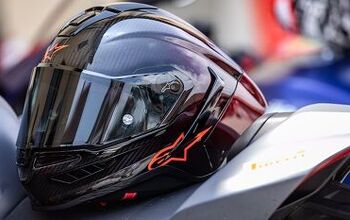
Alpinestars’ racetrack-derived helmet for the street
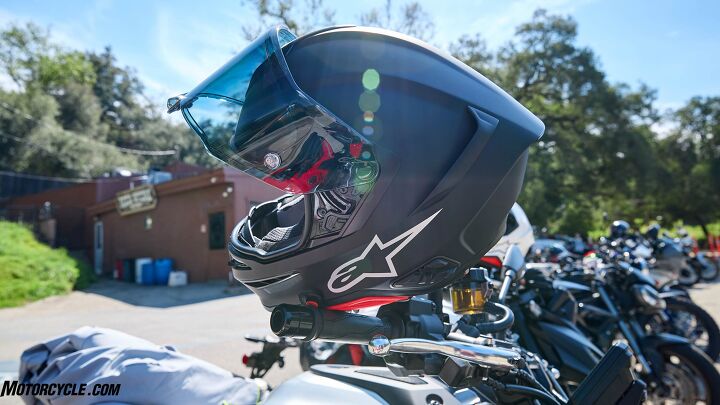
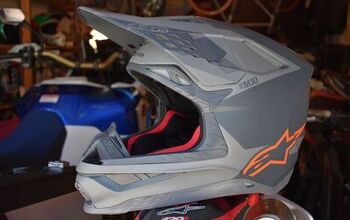
For the longest time, Alpinestars had complete motorcycle protection — for everything except your head. For the dirt crowd, that changed in 2018 when the Supertech M10 was introduced. Street riders, and track riders in particular, had to wait five more years for the introduction of the flagship Supertech R10. It was clear the SR10 was a racing helmet first and foremost, developed with input from MotoGP riders and subjected to years of wind-tunnel and track testing. It’s a great helmet, but one with a clear bent towards racing. And it’s also over $1000. Nonetheless, for Alpinestars’ first real foray into street helmets (it produced a scooter helmet years ago, but we don’t really count that one), it makes sense to enter the scene with a halo product. In that regard, the SR10 delivers.
Video: Alpinestars Supertech R7 Review
But not everyone needs — or wants — to drop top-tier race helmet money. That’s where the Supertech R7 comes in. Positioned as the more attainable sibling to the $1,150 R10, the R7 borrows heavily from the same development philosophy while trimming the price well below the four-digit mark to $679.95 (for solid colors). The result is a helmet much better suited for street duty, but with plenty of SR10 attributes baked into it. Oh, and it’s still plenty good for a trackday, too. How do I know? Because Alpinestars invited Motorcycle.com to the Streets of Willow racetrack to put this helmet through its paces.
Let’s break it down.
Construction
To understand a helmet, it’s best to start on the inside and work our way out. Under the shiny exterior, the Supertech R7’s shell is made from a multi-layer composite construction combining fiberglass, carbon composite, and carbon/aramid interwoven fibers. That outer shell works with a multi-density EPS liner made up of seven pieces across six different densities to manage impacts. Unlike cheaper helmets that may use one or two shell sizes and stuff different padding inside to make up the size range, the SR7 is available in six different consumer sizes, comprising three different outer shell sizes and four EPS liner sizes.

Like the SR10 and Alpinestars’ own motocross helmet, the SM10, the SR7 also includes a collarbone relief shape at the bottom of the shell designed to reduce the risk of clavicle injury during a crash. Nucleon Plasma inserts dissipate impact energy, minimizing the blow to your bones if/when the helmet were to make contact. The helmet is ECE 22.06 and DOT certified — but not Snell certified. Take that into consideration if a Snell seal of approval is important to you. Speaking of which, in Alpinestars own impact testing, the SR7 registered 50% below the threshold for linear impacts and 80% below for oblique impacts compared to the ECE standard.
Weight for my size Medium came in around 1500 grams (3.3 pounds), which feels pretty typical for a high-performance composite helmet. In fact, if you live somewhere not beholden to DOT regulations like the US of A, then the ECE-only Medium SR7 will come in 100g lighter. That weight savings only gets bigger the larger the sizing goes.

Fit and the A-Head Adjustment System
Fit is subjective, but the SR7 fits my intermediate-oval head very well, which should fit a lot of North American riders nicely. The helmet felt snug but not overly tight — exactly how I prefer it, though others weren’t so happy with that much snugness. So, try one on before committing. That said, there is a wide array of cheekpads available, and all are interchangeable between sizes, to help tailor the fit to your liking.

A feature first used on the SM10 helmet is Alpinestars’ A-Head fit system, which allows you to micro-adjust both the height and angle at which the helmet sits on your head. It’s a clever idea. A small adjustable pad inside the EPS lets you fine-tune whether the helmet sits slightly higher or lower, or more forward/backward on your head. Riders who frequently switch between aggressive track body position and upright street riding will probably appreciate the extra adjustability. And it’s all adjustable via four snaps underneath the crown padding. In practice, however, I’ve found that I tend to set the A-Head system where I like it and leave it alone.
Aerodynamics
I didn’t appreciate the importance of helmet aerodynamics until I wore the SR10. Having been a faithful wearer of a certain Japanese helmet that starts with an A, I’d become accustomed to head buffeting — I thought my head bouncing around was simply the cost of not being fully enclosed like in a car. The SR10 opened my eyes as to how much more stable and aerodynamic a helmet could be, ultimately leading to less fatigue and a clearer mind to focus on the task at hand. The SR7 continues with those aerodynamic elements.
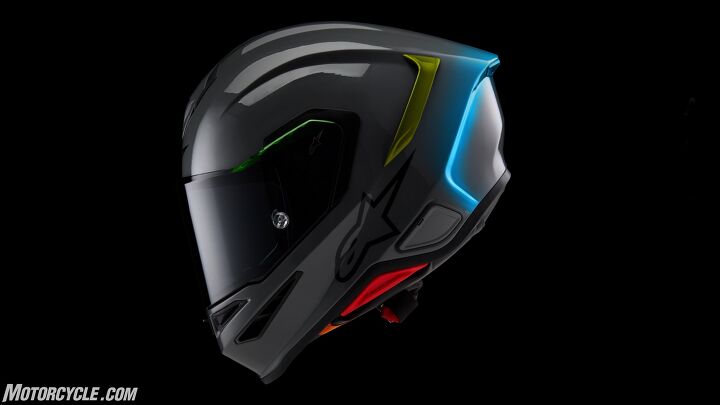
Alpinestars used computational fluid dynamics and wind-tunnel testing to fine-tune the shape and design elements of the SR7. Those winglets on the side? They provide lateral stability and reduce the drag profile of the air, which then moves to the rear spoiler that reduces drag even more and stabilizes the helmet at speed. In comparison to the SR10 and its huge, elongated spoiler, the SR7’s is much more modest in comparison. In fact, according to Alpinestars’ own wind tunnel testing, the SR7 and its short spoiler are only about 5% less aero efficient than the SR10 with its Road (read: shorter) spoiler.
Another interesting tidbit: Alpinestars wind tunnel tested the SR7 both with and without the winglets. What it found was that the wingless helmet was less efficient, applying nearly 71% more lateral force to the helmet, and thus, the rider’s head, compared to the helmet with wings.

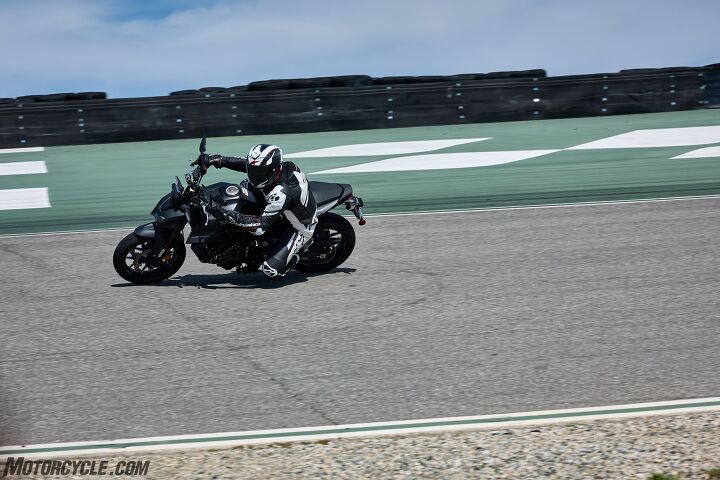
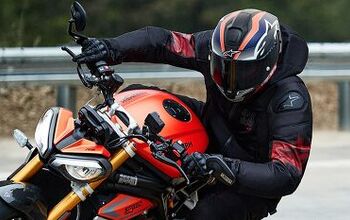
All the numbers might sound impressive, but the real test comes when you’re actually wearing it. I spent some laps around Streets of Willow deliberately cruising along at normal speeds (not exceeding 80 mph), sitting completely upright on naked bikes before I decided to move along at track pace, and the SR7’s aerodynamics impressed me just as much as the SR10’s. It sliced through the air cleanly, putting minimal stress on my neck. And since the air wasn’t so turbulent, my vision wasn’t rattled either. I could turn my head left and right without any tugging or pulling. Even in a straight line, the SR7 also exhibited far less buffeting, which my neck was grateful for. It’s almost as if the wind didn’t exist.
Ventilation
You can’t talk about the shell and liner without talking about ventilation. Here, the R7 impressed me yet again. The helmet uses six intake vents and four exhaust vents, including three chin vents and a large adjustable top vent that reveals three internal airflow channels. Hot air then escapes through vents on the sides and back of the helmet. And while the faceshield is Pinlock compatible, if you forget to install the Pinlock the chin vents also channel airflow toward the visor to help clear out fogging.

Of course, nearly every helmet company will say its helmet has great ventilation. And, to be fair, many of them do. Now we can add the SR7 to that list. With all the vents open, I could feel the rush of cool air coming in at speeds as low as 30 mph. Then, obviously, you get more air the faster you go — but it doesn’t feel like the air is coming up from under the chin area. It’s the vents doing their thing. Considering the fact that this is a street helmet primarily, being able to feel the airflow at low speeds is an impressive accomplishment.
Eyeport
One of the first things you notice when you put the SR7 on is the generous eye port. Alpinestars claims 220 degrees of lateral vision and 57 degrees vertically. What that means in practical terms is being able to move your eyes more before the top of the eyeport starts obstructing your view. It’s not super critical on the street, where you’re not cranked over at elbow-down lean angles, but it’s definitely helpful on the track, say, in a tuck with your neck cranked all the way up or leaned all the way over trying to find the apex. The big eyeport is the start to being able to see what’s ahead, but dialing in the fit with the A-head system will get you much of the way to proper helmet fitment, and thus, proper vision. Personally, I wear my helmets with some real estate between my eyebrows and the top of the eyeport.
The shield itself is a 1.6mm Optical Class 1 visor with tear-off posts and compatibility with a Pinlock 120XLT insert. That’s all well and good, except the visor mechanism is… finicky.
The visor swap system is technically tool-less, and once it’s installed properly everything works great. Like the SR10, there’s a metal clasp to keep the visor shut and reduce the odds of it opening in a crash. But actually installing it requires aligning a small guide pin with the mechanism inside the side pod.

If you don’t — and the mechanism shifts slightly — it’s really hard to get the visor seated. Then you remove it and start the process again. If the hole is misaligned, you need to use a pen or some other small object to move the hole in the mechanism up and back into its proper position — it’s very tedious. The SR7 supposedly uses a spring to keep the mechanism in the proper, upright position, but I still found a way to move the mechanism just enough to cause fits. It’s not a deal-breaker, but it’s definitely annoying. That said, I’ve learned to be fairly efficient with Arai faceshield swaps, so maybe my barometer is different than most.
A-Connect Communication Integration
The R7 is also designed to integrate with the A-Connect Bluetooth communication system, which uses Harman Kardon speakers and supports both mesh and cellular-based intercom via a Sena 60S communicator (sold separately). While you can use a standard 60S, the A-connect system from Alpinestars is loaded with additional, Alpinestars-proprietary software. Installation is straightforward thanks to built-in channels and recesses for wiring and speakers. More importantly, the speaker pockets are deep and correctly positioned.

In my experience, many helmets place the speakers too close to my ears, which eventually creates pressure points and discomfort. With the R7, the recesses are deep enough that the speakers sit exactly where they should without pressing against my ears.
While riding around the track with former Motorcycle.com staffer Tom Roderick, he paired the system on both our helmets with two quick presses and we were chatting almost immediately. With earplugs in and the volume turned up to max, I could still hear him clearly even at track speeds.
Closing Thoughts
Granted, for some, the SR7’s $700 price tag is still steep. But I’d argue that if the Supertech R10 is the all-out race weapon, the R7 is the practical performance version. You still get race-derived aerodynamics, excellent stability at speed, a wide field of view, effective ventilation, the option to tweak the fit to your liking (to a point), and the option to add a communicator easily. Aside from the slightly frustrating visor mechanism, there’s very little to complain about here.

For riders who want a helmet capable of handling both aggressive street riding and trackdays — without jumping to full MotoGP-level pricing — the Alpinestars Supertech R7 hits a sweet spot. It delivers much of the R10’s performance in a package that’s easier to justify for everyday riders.
It used to be that Alpinestars had you covered from neck to toe. With the SR7, Alpinestars truly offers complete protection from top to bottom, especially for those with no intention of crossing a checkered flag.
- Price: Starting at $679.95
- Sizes: XS-2XL
- Helmet shape: Intermediate oval
- Safety standards: ECE 22.06 and DOT
We are committed to finding, researching, and recommending the best products. We earn commissions from purchases you make using the retail links in our product reviews. Learn more about how this works.
Become a Motorcycle.com insider. Get the latest motorcycle news first by subscribing to our newsletter here.
Troy's been riding motorcycles and writing about them since 2006, getting his start at Rider Magazine. From there, he moved to Sport Rider Magazine before finally landing at Motorcycle.com in 2011. A lifelong gearhead who didn't fully immerse himself in motorcycles until his teenage years, Troy's interests have always been in technology, performance, and going fast. Naturally, racing was the perfect avenue to combine all three. Troy has been racing nearly as long as he's been riding and has competed at the AMA national level. He's also won multiple club races throughout the country, culminating in a Utah Sport Bike Association championship in 2011. He has been invited as a guest instructor for the Yamaha Champions Riding School, and when he's not out riding, he's either wrenching on bikes or watching MotoGP.
More by Troy Siahaan







Comments
Join the conversation
I might need to go give this a try on if they have them anywhere local.
Last year went cheap and bought a Bell Qualifier DLX helmet to replace my old Shoei RF1200.
That helmet is cheaply made and I learned my lesson. Time to get something quality.
Protection, vision and ventilation. Good enough for me.