


Dirt Riding Fundamentals: Common Mistakes & New Rider Tips

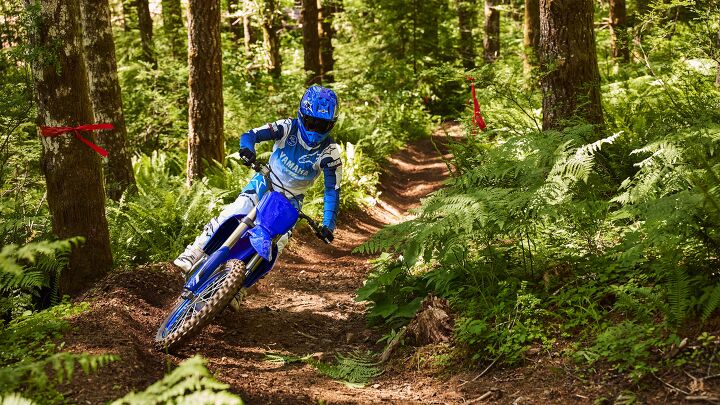
If you’re reading this then you can agree that riding a motorcycle is one of the most freeing feelings there is. You buy a dual-sport or ADV bike because you want to disappear into the wilderness with nothing but a bike, maybe some camping gear, and just enough cell signal to call for help if you need it (and even that is questionable). But before you can get to that point, you need to remember: just like any other skill in life, you need to learn how to do it properly. And if there is a parallel to road riding, it’s that mistakes can be costly, painful, or even worse. Off-road riding is humbling. Let’s leave the ego at the door and learn to do it the right way.
Video: Dirt Riding Fundamentals: Common Mistakes & New Rider Tips
Motorcycle.com thanks Yamaha for sponsoring this new rider series.
In this piece, we’re going to cover some common mistakes new dirt riders make, how you can avoid them, and offer our own tips for new riders.
Looking Down Instead of Ahead

Whether you ride on-road or off, you’ll hear the phrase “don’t target fixate.” It means don’t lock your gaze in one spot, especially if that spot is right in front of you. The bike will go where your eyes are looking, and if you’re looking down – guess where you’re going? In the dirt your eyes should always be scanning — for ruts, rocks, roots, and what’s just over that crest. You’re trying to anticipate the right line to take for the best odds of getting past whatever’s in front of you.
While it may not immediately make sense on the street since the pavement is smooth and you think you can put the bike anywhere, the practice of scanning ahead means you start noticing camber, gravel patches, oil slicks, and other hazards earlier. You don’t get target-fixated because you trained yourself not to. You scan, take note, and put the bike where it should be to avoid potential danger.
Holding On Too Tight
Dirt or street, a common mistake new riders make is holding on to the bars with a death grip. Your hands are clasped so tight you could crush a diamond with your bare hands. From a physiological perspective, this makes sense. Learning something new can be scary, especially when that “something new” is a dangerous sport like riding a motorcycle. And when we’re scared, nervous, and otherwise lack confidence, we tend to tense up.

The problem with the death grip is it doesn’t let the bike move underneath you, which is important for proper handling. Riding off-road teaches you that the bike has to move underneath you, and you need to stay loose to make that happen. If you pay attention, you’ll notice dirt riders tend to keep their elbows very bent. Along with a relaxed grip, the deep bend in the elbows effectively makes your arms a secondary suspension. Tighten up and the bike can’t move as much. You need to let the bars dance a little. Unlike in a car, where you just sit there, on a bike the rider is very much an active participant.
On the street, staying relaxed on the controls means bike movements won’t scare you. Sudden wind gust? Pavement ripple? Mid-corner bump? You don’t flinch. Your hands are relaxed. You let the bike do its job and ride through it instead of overcorrecting and making things worse.
Giving the Bike Too Much Room Between Your Legs
You know that bit up above about staying loose on the bike and relaxing? That applies to your upper body. Your lower body is what you use to control the bike, so it needs to stay tight to it. If your legs are flapping in the wind and your upper body is equally as loose, what are you using to make the bike go where you want it to?

You need lower body control. Squeeze with your knees. Use your legs to grip the bike and stabilize. Your body and arms stay loose and provide steering inputs. Weighting the pegs with your feet will help guide the bike the rest of the way. Especially when standing. What’s more, when it comes time to slow down, especially if you need to stop fast, using your legs and knees to squeeze the bike will give you something to brace onto while your hands and upper body are working the brake lever right up to the limit.
All of this directly translates into street riding. Even though you might not be standing up, squeezing the tank with your knees gives the same bracing while braking hard. Using your feet to weight the pegs when turning has a similar effect. Granted, if you’re cruising for miles and miles on the interstate with nothing ahead in sight, you can relax a little. Motorcycling becomes a full body exercise when it’s time to apply the laws of physics.
Sitting Too Far Back on the Seat
This is another bad habit street riders bring to the dirt. We’re used to sitting a little further back from the bars on a street bike because most street bikes are just designed that way. The fuel tank is the size that it is, and it’s right in the middle of the bike. Where else are you supposed to go?

In the dirt, sitting too far back can cause all kinds of problems, especially if you need to feel what the front end is doing. Body position is everything. On climbs, descents, or corners, where you sit changes traction and steering response. You learn to stay centered — or forward — to keep weight on the front tire and keep it planted. The one possible exception where moving back makes sense is if you’re trying to accelerate hard. Weighting the back of the bike puts weight over the rear tire and helps it find traction. Again, the lesson here is all about weight transfer and placing it over the tire that needs it most.
The same rules apply on the street. When you need sharp inputs – fast transitions, hard braking, trail braking into a corner – being forward gives you better feel and control. The front end communicates more. The bike turns quicker. Effectively, the bike is talking to you and you’re understanding what it’s saying. In turn, your confidence goes up.
Letting the Bike Control Them

When you’re riding off-road, the bike is going to move – a lot. The mistake some people make is letting the bike decide where it’s going because the rider freezes. It’s okay if the bike moves around – it’s supposed to do that – but if there’s one takeaway from everything we’ve written so far, it’s that you need to be the one in charge. Riding at your own pace, with confidence in your ability to control the throttle and brakes, and your knowledge of body position and foot pressure. If you can master – or at least get comfortable with – manipulating the motorcycle, you can anticipate the next move instead of just responding to it.
You may not be dealing with the same terrain or obstacles on the road, but being in command of your street bike will be easy once you learn how to do it in the dirt. Dealing with pot holes, debris in the road, or even riding in the rain – none of it will scare you (or at least it’ll scare you less) – because you have an understanding of how your body inputs affect the motorcycle.
Cross-training Brings Invaluable Experience
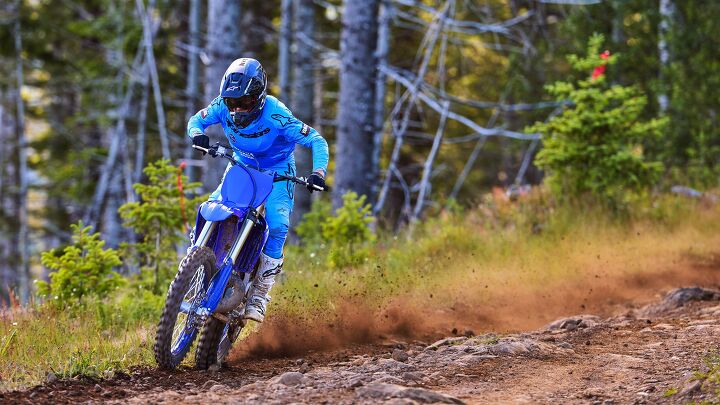
Off-road riding is brutally honest. It exposes every flaw in your technique – and then teaches you how to fix it. It’s just you, the bike, and terrain that’s unforgiving.
Build the confidence and the skills, and when you get back on the street? Everything clicks. Your inputs are cleaner. Your reactions are faster. Your confidence is higher – and your fear? Way lower (it never fully goes away).
So if you really want to be a better rider, which ultimately amounts to a faster one, spend some time in the dirt. It’s uncomfortable. It’s humbling. And it’s the best training you’ll get.
Final Thoughts

Off-road riding isn’t about perfection — it’s about progression. You will stall. You will tip over. You will get stuck in something you thought was just a puddle. That’s part of the fun. Every mistake is a lesson.
Get good gear. Start small. And stay humble. Because there’s never enough practice when it comes to riding.
Become a Motorcycle.com insider. Get the latest motorcycle news first by subscribing to our newsletter here.
Troy's been riding motorcycles and writing about them since 2006, getting his start at Rider Magazine. From there, he moved to Sport Rider Magazine before finally landing at Motorcycle.com in 2011. A lifelong gearhead who didn't fully immerse himself in motorcycles until his teenage years, Troy's interests have always been in technology, performance, and going fast. Naturally, racing was the perfect avenue to combine all three. Troy has been racing nearly as long as he's been riding and has competed at the AMA national level. He's also won multiple club races throughout the country, culminating in a Utah Sport Bike Association championship in 2011. He has been invited as a guest instructor for the Yamaha Champions Riding School, and when he's not out riding, he's either wrenching on bikes or watching MotoGP.
More by Troy Siahaan





Comments
Join the conversation
Nice piece, Troy! I help train street riders coming over to adventure riding, and two of the major issues for all are leaning with the bike, and thinking that the back brake is better for stopping or slowing.
I'll be using this article for some pre-work ahead of training.
Good piece. Beside technique and skill building I discovered how physical off road riding can be, especially on an ADV bike, so some weight training and cardio go a long way for enjoying the ride.