


How Off-road Skills Make You a Better and Safer Rider on the Street


If you’ve been following along in the latest of our New Rider’s Hub journey, you understand what riding in the dirt is all about. You know the types of bikes, the types of gear, and even some pitfalls riders make when learning off-road skills. In this, the fourth and final installment of the series, we tie it all together and help you understand how all these lessons in the dirt will help you when you come back to the street.
Video: How Off-road Skills Make You a Better and Safer Rider on the Street
Motorcycle.com thanks Yamaha for sponsoring this new rider series.
To set the stage, think of it this way: off-road riding is like finishing school for motorcyclists. Compared to street riding, the margin for error is gone (or dramatically reduced) because it takes away traction and drops you into a world where the bike moves constantly, the surface is never consistent, and the only thing saving you is your own skill. It’s where all the inputs matter — and all the bad habits come out. Once you figure it out, or at least get a better handle on things, you’ll come back to the street a totally different rider. Calmer. Quicker. Safer. You’ll be ready to react when things get weird. Better still, you’ll put yourself in a position to avoid things getting weird in the first place. How? Read on to find out.
You’ll Learn to Ride When There’s No Grip

When you’re riding on the street, traction is usually predictable. Asphalt is consistent, and you’re rarely, if ever, riding at the limit of grip. It’s the opposite in the dirt. Traction is a suggestion. When you’re riding over sand, mud, gravel, loose rocks, and other slippery surfaces, both ends will get loose. Often at the same time. The skills you need to stay upright in those conditions will make you a more confident street rider.
Here’s what you can expect when you’re riding in the dirt. You’ll learn how the bike behaves when it’s not glued to the ground — how it slides, how to correct it, and (most importantly) how to stay calm when it happens. Now when your street bike wiggles mid-corner on cold pavement it won’t bother you (or at least bother you less).
You’ll Master Body Position and Balance

In many ways, body position between on-road riding and off-road riding couldn’t be more opposite. On the street you’re leaning into the corner, weighting the inside peg, knee out (maybe). In the dirt you’re putting weight on the outside peg, leaning your body away from the turn, elbows up and foot out.
How are these two positions related? In the dirt, if your body position is wrong, the trail will let you know. The motorcycle will feel awkward and hard to handle – assuming you’re able to stay upright in the first place. Whether you’re climbing a hill or riding in the sand, you’re constantly shifting weight forward, back, and side to side to keep the bike balanced.

The concept of weight transfer translates directly on the street, even if the movements you do on the bike are different. You’ll feel more in tune with your bike’s balance in corners, under braking, and when you have to suddenly change direction – like when you’re dodging a branch on the road.
Riding in the dirt teaches you that you are the gyroscope. You start riding with your whole body, not just your wrists and knees. And that makes you smoother and safer everywhere.
You’ll Develop Throttle and Clutch Control
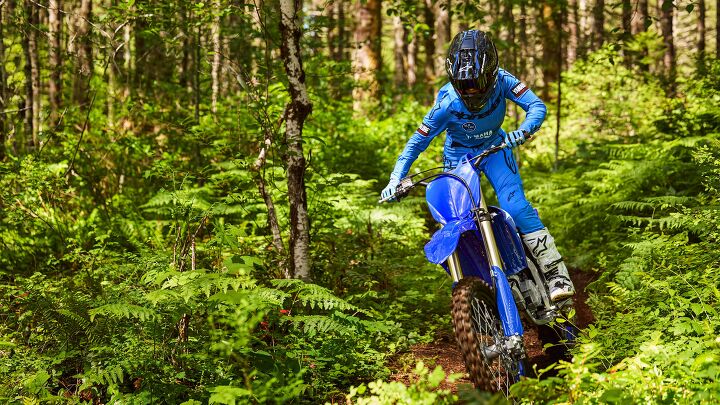
Riding off road involves dancing and balancing between the controls frequently. Too much throttle in soft terrain and the rear spins. Too little and you stall halfway up a hill. And if you need to keep the revs up but the speeds down, feathering the clutch becomes a mandatory skill to learn. This tango of clutch feathering, throttle application, and brake balancing – all while standing on the pegs – develops muscle memory to stay on two wheels.
On the street, those fine motor skills make you smoother at low speeds, better in wet weather, and more confident in emergency situations. Ever try splitting lanes in traffic at really slow speeds? That kind of finesse with the controls is something you can learn in the dirt without the pressure of having cars all around you.
You’ll Understand Motorcycle Feedback

Riding in the dirt means you’re constantly reacting to tiny inputs — the way the front wheel tucks, the rear steps out, the suspension loads and unloads. All of those moments are the bike talking to you. And just like learning a language, full immersion will get you fluent much faster than just practicing in school.
That feel for the bike is more subtle on the street, but that same instinct helps you anticipate when the rear is getting light in a panic stop, or when it’s going sideways — literally or metaphorically. It’s the same for the front. Your understanding of weight transfer and how much load you’re putting on the front helps you get a better sense of when you’re reaching the limits of front traction. Your reactions get faster, but also calmer. You don’t panic (as much). You adjust.
You’ll Learn a Finer Understanding of the Brakes

You’ll cross the limits of traction all the time when you brake in the dirt. Hard braking from either end will lock the wheel, but if you tip-toe to those points, you’ll get an understanding of how the bike – and the tires – react at the limit and beyond. On a slippery downhill, the front brake is a scalpel and the rear paints with broad strokes. You learn to drag it mid-corner, modulate it in the sketchy stuff, and trail brake with purpose.
Often, dirt riders who transition to street riding are very timid when using the brakes because of how easy it is to lose traction in the dirt. However, if you come from a street background, you’re aware of how much more traction the tires have. Trail braking in corners or emergency stopping drills won’t scare you. You’ve trained your body to feel what’s happening.
You’ll Understand Line Selection

In the dirt your eyes are always scanning — for ruts, rocks, roots, and what’s just over that crest. You’re trying to anticipate the right line to take for the best odds of getting past whatever’s in front of you.
While it may not immediately make sense on the street since the pavement is smooth and you think you can put the bike anywhere, the practice of scanning ahead means you start noticing camber, gravel patches, oil slicks, and other hazards earlier. You don’t get target-fixated because you trained yourself not to. You scan, take note, and put the bike where it should be to avoid potential danger.
Cross-training Brings Invaluable Experience

Going off-road resets your skill meter. It humbles you. It teaches you things your years of street riding never could. It does so by allowing you to reach and exceed the limits in a safer environment. Then you can take those lessons back to the street. The result? A version of you that’s a more adaptable, more confident, and, yes, safer street rider.
Become a Motorcycle.com insider. Get the latest motorcycle news first by subscribing to our newsletter here.
Troy's been riding motorcycles and writing about them since 2006, getting his start at Rider Magazine. From there, he moved to Sport Rider Magazine before finally landing at Motorcycle.com in 2011. A lifelong gearhead who didn't fully immerse himself in motorcycles until his teenage years, Troy's interests have always been in technology, performance, and going fast. Naturally, racing was the perfect avenue to combine all three. Troy has been racing nearly as long as he's been riding and has competed at the AMA national level. He's also won multiple club races throughout the country, culminating in a Utah Sport Bike Association championship in 2011. He has been invited as a guest instructor for the Yamaha Champions Riding School, and when he's not out riding, he's either wrenching on bikes or watching MotoGP.
More by Troy Siahaan






Comments
Join the conversation
Woohoo, TW 200!
Being a Dirt Bike Rider from Youth, my MSC Instructor didn't like that I didn't lean into turns like a MotoGP rider when we were doing our Turn Drills..."Sorry Charlie, this is the way I ride and it works"...I've always exaggerated Weight on the Outside Peg...