


2026 Yamaha YZF-R7 – First Look

New electronics, chassis and fairings for middleweight sportbike
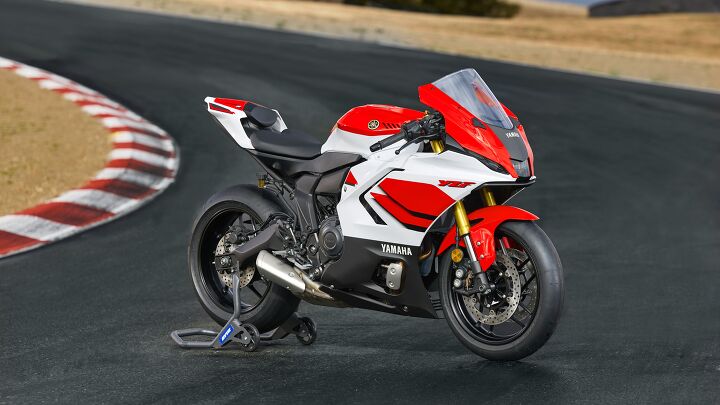
Yamaha updated its middleweight R7 sportbike for 2026, adding an electronic throttle, selectable ride modes, a six-axis inertial measurement unit, a refined chassis and new fairings. Most of the changes were expected, as they were bestowed upon the MT-07 last year, but the updates to the R7 come just in time for it to compete in the inaugural FIM World Sportbike Championship in 2026.
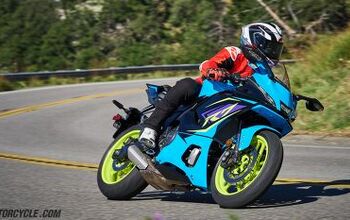
The 2026 R7’s new styling brings it in line with the current aesthetic of Yamaha’s R-series sportbikes, including the M-shaped opening in the front face. Yamaha says it put special emphasis on reducing the frontal area by using a slimmer, smoother fairing. The headlight is still housed inside the M opening, but it has a new, more aerodynamically efficient shape. Combined with the chin spoiler under the headlight, the front face now directs more air towards the radiator. Like the R9 and the R1, Yamaha also replaced the turn signal stalks with indicator lights integrated into the mirrors, further slimming the R7.
Yamaha reshaped the fuel tank and repositioned the handlebars to make it easier for a rider to shift their bodyweight when changing directions. The footpeg position is the same, but the R7 now uses the same peg as the R1, with Yamaha claiming it makes it easier to plant your weight onto the pegs when cornering. Yamaha also lowered the seat to 32.7 inches (0.2 inches lower than the previous height) to make the R7 a little more accessible.

The R7 remains powered by Yamaha’s 689cc CP2 Inline-Twin engine, but it now joins the MT-07 in using a Yamaha Chip controlled Throttle (Y-CCT). This ride-by-wire system allows the R7 to make use of electronic systems. The R7 comes with three preset ride modes (Sport, Street, and Rain) to go with two custom modes. With the help of a six-axis IMU, the R7 is equipped with a lean-sensitive traction control system, slide control, lift control, engine brake management, brake control, and a back slip regulator. For track use, the R7 also makes use of launch control and the ability to turn off the anti-lock braking system to the rear wheel.
For smoother gear changes, Yamaha increased the number of engagement teeth for the male and female dog gears for first through third gear, while modifying the dog gear angles for fourth through sixth gear. The R7 also gains Yamaha’s third generation Quick Shift System. The system offers two settings: setting 1 allows for clutchless upshifts while accelerating and downshifts when slowing, while setting 2 offers downshifts while accelerating and upshifts while decelerating. On paper, that sounds needlessly complicated, but we’ll have to see how it works in practice.
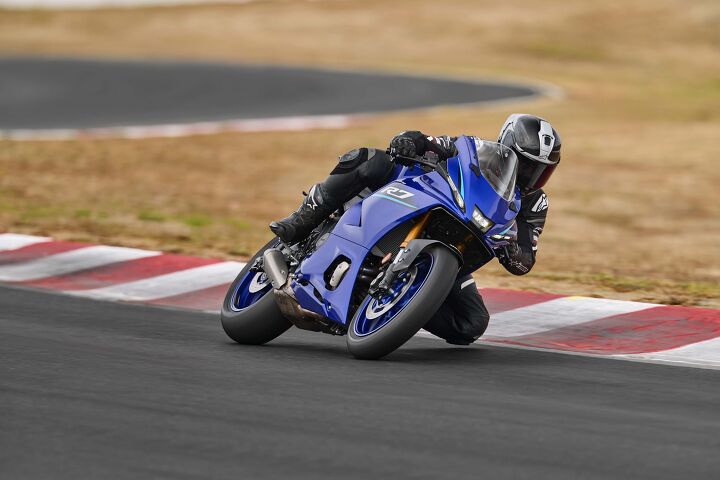
Like the MT-07, the R7 receives a brand new frame with increased torsional, longitudinal, and lateral rigidity. The swingarm has also been tweaked to provide better feedback. Yamaha also designed a new triple clamp to optimize feeling and strength, while also providing a visual similarity to the R1 and R9’s clamps.
The fully adjustable 41mm inverted fork now uses aluminum piston rods instead of steel, saving 0.8 pounds. The fully adjustable rear suspension is unchanged from 2025. The braking system is also unchanged, with dual four-piston radial-mount calipers and 298mm discs up front, and a single-piston caliper with a 245mm disc at the rear.

Other highlights include a five-inch TFT, new switchgear, cruise control, and smartphone integration through Yamaha’s MyRide app. The R7 is also compatible with the Y-TRAC Rev app Yamaha introduced with the R9. The track-focused app offers data tracking including lap and sector times, lean angles, engine speed, gear position, throttle position, and electronic settings, allowing riders and their pit crews to analyze their data.
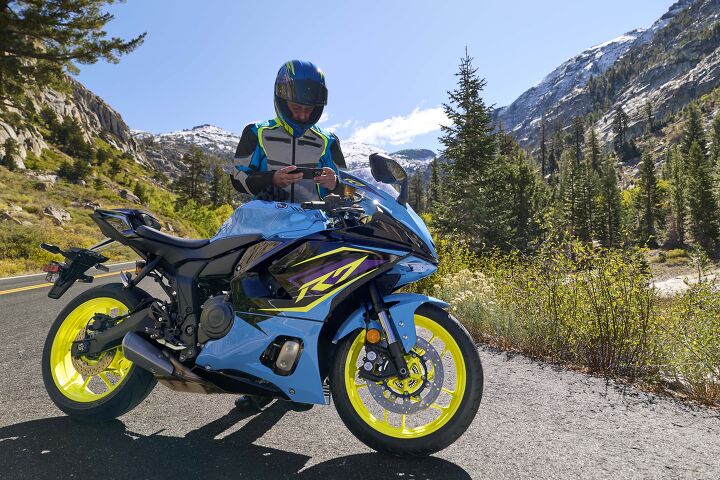
In Europe, the 2026 Yamaha R7 will be available in three color options: Icon Blue, Midnight Black, and Anniversary White. The U.S. gains a fourth, flashier Breaker Cyan/Raven color with purple and yellow highlights. Expect the 2026 R7 to arrive in U.S. dealerships in February 2026 with a starting price of $9,399.
2026 Yamaha R7 Specifications | |
|---|---|
MSRP | $9,399 ($9,699 for 70th Anniversary Edition) |
Engine Type | 689cc liquid-cooled, 4-stroke, DOHC inline twin-cylinder; 4-valves per cylinder |
Bore x Stroke | 80.0mm x 68.6mm |
Compression Ratio | 11.5:1 |
Fuel Delivery | Fuel injection with YCC-T |
Ignition | TCI: Transistor Controlled Ignition |
Transmission | 6-speed; multiplate wet clutch; with Assist & Slipper clutch |
Final Drive | Chain |
Fuel Capacity | 3.7 gallons |
Front Suspension | Telescopic fork; 4.7-inches travel, adjustable for preload, rebound and compression |
Rear Suspension | Linked-type Monocross shock, adjustable preload and rebound; 4.8-inches travel |
Brakes/Front | Dual 298mm hydraulic disc; Brake Control System and ABS |
Brakes/Rear | 245mm hydraulic disc; Brake Control System and ABS |
Tires/Front | 120/70ZR17 Bridgestone BATTLAX HYPERSPORT S23F |
Tires/Rear | 180/55ZR17 Bridgestone BATTLAX HYPERSPORT S23R |
Length | 81.5 inches |
Width | 28.5 inches |
Height | 45.7 inches |
Seat Height | 32.7 inches |
Wheelbase | 54.9 inches |
Rake/Trail | 24.0°/3.6 inches |
Ground Clearance | 5.3 inches |
Fuel Capacity | 3.7 gallons |
Wet Weight | 417 pounds (claimed) |

Become a Motorcycle.com insider. Get the latest motorcycle news first by subscribing to our newsletter here.
Dennis has been a part of the Motorcycle.com team since 2008, and through his tenure, has developed a firm grasp of industry trends, and a solid sense of what's to come. A bloodhound when it comes to tracking information on new motorcycles, if there's a new model on the horizon, you'll probably hear about it from him first.
More by Dennis Chung







Comments
Join the conversation
If you put this R7 on a time machine and brought it back to 2005 or so when the SV650S was popular, just think of the atom bomb that would have been.
Tremendous improvements, both functionally and visually.