


2026 Honda CB1000F Announced For Europe

Retro roadster breaks cover
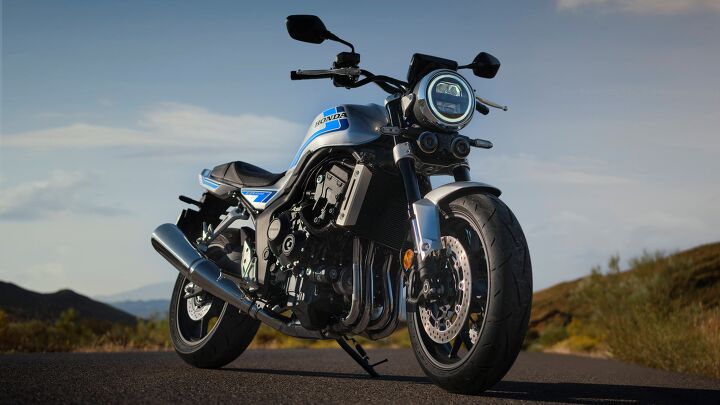
After several months of showcasing it as a concept model, Honda officially launched the CB1000F for the European market. The production CB1000F is based on the CB1000 Hornet, but with a retuned engine and retro styling inspired by the CB750F that Freddie Spencer raced in the 1980s.
Read More:
There’s no word on U.S. availability, but the fact Honda cites Fast Freddie’s AMA championship winning CB750F as inspiration is a positive sign. We do notice American Honda hasn’t confirmed the CB1000 Hornet for 2026 yet. If Honda does decide to offer the CB1000F here, it’ll likely bundle the announcement with the returning Hornet.

While the Hornet is positioned as a modern streetfighter, Honda says the CB1000F was developed to be the “best balanced roadster,” combining the handling of a middleweight with a big bike feel.
Juxtaposing the CB1000F with the Hornet, we can see how stark the difference is between the two bikes despite sharing similar underpinnings. While the Hornet is all sharp edges with a pointy stinger-like tail, the CB1000F emphasizes smooth surfaces with rounded corners. The flat fuel tank flows into the side covers and back to the seat cowl, whereas the CB1000 Hornet’s lines rise upward from front to rear.
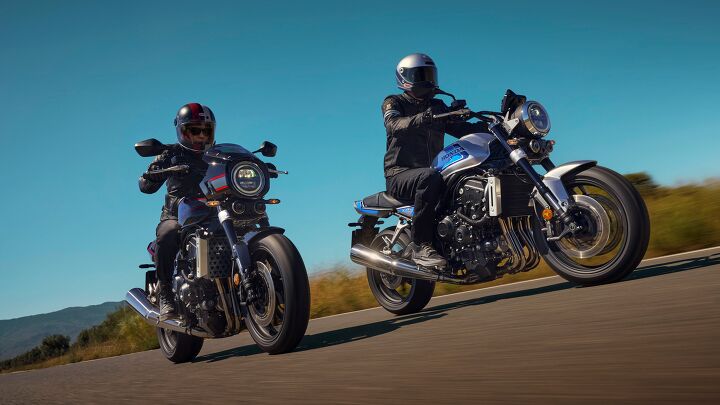
The handlebars are higher and closer to the rider while the footpegs are slightly ahead compared to the CB1000 Hornet, making for a more upright seating position. The well cushioned rider seat sits 31.3 inches from the ground, compared to the Hornet’s 31.9 inches. The pillion accommodations are also lower, with more relaxed footpeg positioning.
Like the CB models from the ’80s, the CB1000F sports a single round headlamp over twin horns with separate frequencies. Honda is also offering a color-matched headlight cowl either as a standalone accessory or as part of a Sports Pack.

The 1,000cc engine is derived from the 2017 CBR1000RR’s Inline-Four, just like the CB1000 Hornet. While the Hornet’s engine is tuned towards high-rpm performance, the CB1000F is tuned to favor low- and mid-range torque. This was achieved through revised intake and exhaust valves, and larger intake funnels. Compared to the CB1000 Hornet’s intake, the CB1000F’s intake funnels were extended 50mm to 140mm, and a smaller minimum diameter (now 36mm from 42mm). The two left funnel inlets are 50mm in diameter, while the two on the right are 40mm, resulting in a pulsating intake sound. Honda also designed a new airbox to fit the CB1000F’s more squared off fuel tank.
To match the new intake notes and the ’80s styling, Honda added a 4-2-1 exhaust system with a period-correct three-chamber megaphone-style muffler. Altogether, Honda claims the CB1000F produces 122 horsepower at 9,000 rpm and 76.0 lb-ft. at 8,000 rpm compared to the Hornet’s 149.7 hp at 11,000 rpm and 76.7 lb-ft. at 9,000 rpm.

Honda also revised the gearbox to suit the CB1000F’s more gentlemanly character. First and second gear use lower ratios than the CB1000 Hornet, increasing low-speed response and acceleration. Gears three through six, however, have higher ratios for more relaxed cruising. An assist/slipper clutch helps to reduce fatigue and manage rear wheel hop during hard, rapid downshifts and braking. Like the headlight cowl, a bidirectional quickshifter is available either on its own or as part of the sports package.
Despite the retro look, the CB1000F is fitted with modern electronics, including a throttle-by-wire system and a six-axis inertial measurement unit (IMU), which we must point out, the more modern looking Hornet lacks. The CB1000F comes preset with Standard, Sport, and Rain modes, plus slots for two custom modes. Each mode offers a combination of engine power, engine brake, and the Honda Selectable Torque Control (i.e. traction control). Settings are managed via a five-inch TFT color screen and backlit switches on the left handlebar.

Smartphone connectivity is available through the Honda RoadSync app, enabling on-screen turn-by-turn navigation as well as audio through a Bluetooth headset. A wireless key fob adds another modern touch, though a regular key is still required to unlock the seat or open the gas cap.
The one-pieced steel diamond-style twin-spar frame is unchanged from the Hornet, but the CB1000F does employ a different subframe to go with the flatter tail.

Up front, the CB1000F uses a Showa inverted 41mm Separate Function Fork Big Piston (SFF-BP) fork, with adjustable spring preload, rebound and compression damping. Showa also supplies the separate pressurized single-tube rear shock, with adjustable preload and rebound damping.
The braking system consists of dual radial-mount Nissin four-piston calipers with 310mm discs up front, and a single-piston Nissin caliper with a 240mm disc at the rear. Cornering ABS comes standard.

The 2026 Honda CB1000F will be offered in three color options: Wolf Silver Metallic with Blue Stripe, Wolf Silver Metallic with Grey Stripe, and Graphite Black. Honda has prepared a number of accessories, as well as a choice of three curated packs.
The Sports pack includes a color-matched headlight cowl, tank side decals, a radiator grill, engine guards, a red oil filler cap, and a bidirectional quickshifter. The Comfort Pack adds a high windscreen, upper and lower deflectors, fog lights, and more comfortable seating. The Travel Pack combines a tank bag and soft saddlebags.

2026 Honda CB1000F Specifications | |
|---|---|
Engine Type | Liquid-cooled, inline 4-cylinder, DOHC |
Engine Capacity | 1,000 cc |
Bore x Stroke | 76.0 x 55.1 mm |
Compression | 11.7:1 |
Fuel System | EFI |
Horsepower | 122 hp at 9,000 rpm (claimed) |
Torque | 76.0 lb-ft. at 8,000 rpm (claimed) |
Transmission | 6 speed |
Clutch | Wet, multiplate slip/assist |
Final Drive | Chain |
Frame | Steel, twin-spar |
Front Suspension | 41mm inverted Showa SFF-BP telescopic fork with adjustable preload, compression, and rebound damping; 5.1-inches of travel |
Rear Suspension | Separate pressurized single-tube type cushion unit Pro Link 140mm travel; 5.5-inches of travel |
Front Brakes | Radial mounted Nissin four-piston brake caliper, 310 mm floating double disc; cornering ABS |
Rear Brakes | Nissin mono-piston caliper, 240 mm single disc |
Front Tire | 120/70ZR17M/C (58W) |
Rear Tire | 180/55ZR17M/C (73W) |
Seat Height | 31.3 inches |
Wheelbase | 57.3 inches |
Ground Clearance | 5.3 inches |
Rake/Trail | 25.0° / 3.9 inches |
Curb Weight | 472 pounds (claimed) |
Fuel Capacity | 4.2 gallons |
Electronics | Full-color 5-inch TFT display, ride modes, six-axis IMU, Honda Selectable Torque Control, adjustable engine braking, Cornering ABS, Honda RoadSync |
Colors | Wolf Silver Metallic with Blue Stripe, Wolf Silver Metallic with Grey Stripe, or Graphite Black |
Become a Motorcycle.com insider. Get the latest motorcycle news first by subscribing to our newsletter here.
Dennis has been a part of the Motorcycle.com team since 2008, and through his tenure, has developed a firm grasp of industry trends, and a solid sense of what's to come. A bloodhound when it comes to tracking information on new motorcycles, if there's a new model on the horizon, you'll probably hear about it from him first.
More by Dennis Chung


Comments
Join the conversation
Please bring to USA. I want one.
This new Honda CB1000F is nice, but the new 2026 Kawasaki Z900RS looks better and is the better bike overall. On top of all that, we know the Kawasaki is coming out in the U.S. soon unlike the Honda, which hasn’t even been announced for the U.S. market yet.