


2025 Harley-Davidson CVO Road Glide RR – First Ride

Getting a rip on the most powerful – and most expensive – production Harley to date

At $110,000, Harley-Davidson’s most expensive production motorcycle isn’t what you think it is. It won’t blind you with endless amounts of chrome, nor is the front wheel raked out so much you’ll see it minutes ahead of the rest of the bike. There are no tassels, glowing lights, or ape hangers either. What you have with the 2025 Harley-Davidson CVO Road Glide RR is a Harley more committed to performance than ever before. And in case you couldn’t guess, we have the wildly successful Bagger racing phenomenon to thank for it.
2025 Harley-Davidson CVO Road Glide RR
The CVO Road Glide RR is what happens when you dump everything and the kitchen sink at a standard Road Glide. Built off the lessons learned from the Bagger racing program, this is the closest Harley has come to a street-legal track bike (yes, that’s a wild thing to say), all while maintaining a two-year, unlimited mileage warranty.
Highs
- The engine stuns with its power and delivery
- An exhaust note that can wake the dead
- Rear suspension!
Sighs
- Speed governor ruins the fun
- No protectors for the precious (and expensive) pegs and exhaust
- US availability only
I admit it. When I first heard of the idea to modify baggers and send them hurling around a racetrack, I thought it was dumb. It was a gimmick. Dare I say… it was sacrilege? Racetracks were the domain of sportbikes – precisely engineered machines built with the primary purpose of lapping as quickly as possible. These motorcycles were on the cutting edge of technology with a singular focus in mind, and that focus most definitely was not burning miles with the saddlebags loaded up en route to Sturgis.

That was then. This is now. I’ve since changed my tune. I’ve come to broaden my horizons and realize that racing improves the breed, and the appreciation for modification and engineering to lap as quickly as possible is perhaps even greater for baggers like the Harley-Davidson Road Glide than it was for sportbikes. Taking a huge touring bike, lopping off nearly two hundred pounds, modifying the huge V-Twin to nearly tap 180 mph at Daytona – reliably – and achieving lap times that would comfortably qualify in the Supersport class is nothing short of impressive.
It’s not fair to have performance like this and not share it with others, hence the RR is here to celebrate that success among 131 devoted (and wealthy) fans who can get one. That’s right, the number of cubic inches the big Twin displaces is the same number of RR’s Harley will make, and the entire run will be limited to the U.S. market (although if you have the expendable cash for one of these and you don’t live in the U.S., you’ll probably figure out a way to get one anyway).
When Racing Meets The Road
Most recently, my time aboard a Street Glide as Ryan and I toured northern Ontario gave me an even deeper appreciation for how enjoyable Harley’s are to ride when I switched my brain from racer to tourer. The V-Twin rumble, sound, and character aren’t things you can quantify on a spec sheet. But I’ve always complained about a lack of rear suspension travel.

Conversely, I’ve also been lucky enough to get up close and personal with different generations of Harley-Davidson’s bagger racebike, and even had the opportunity to ride Kyle Wyman’s championship-winning bike a few years ago. Believe me when I say it’s essentially a superbike riding around in carbon/kevlar clothes. The Screamin’ Eagle 131 race engine is pissed off, and not only is the seat bolstered higher than a yoga block, but the Öhlins suspension front and rear raises the bike even higher still. You notice the performance immediately, but it’s so raw and unfiltered (not to mention insanely buzzy at high rpm), that there’s no way it makes sense as a street bike.
The CVO Road Glide RR meets somewhere in the middle. Visually, you can’t help but notice the striking factory orange livery that directly resembles the race bikes, but you have to look closer to realize that paint is sitting atop carbon/kevlar bodywork front to back – just like the race bikes. From the front fender to the saddlebags and all the trim pieces in between, you’ll find carbon/kevlar everywhere. Even the seat pan is carbon.

But the business end of the RR is the engine. The Screamin’ Eagle 131 in the RR is beefed up with a host of Screamin’ Eagle parts to make it the most powerful Harley engine offered in a production bike, pumping out 153 hp at 5750 rpm and 150 lb-ft at 4750 rpm. Those engine speeds are laughably low if you’re used to traditional sportbike engines revving nearly three times that high, but those low engine speeds are also easier to access, so riders not accustomed to revving that high can appreciate the performance. As an aside, when you imagine each of these pistons are over four inches wide, the mechanical symphony is hard not to appreciate.
Obviously, getting to these numbers takes a bit of work. Starting with the CNC ported cylinder heads, which then house 42mm intake valves and 34mm exhaust valves – both 2mm bigger than what’s found on the standard Road Glide. Airflow is smoothed out even more as the multi-angle valve seats are fully blended to the ports and combustion chamber. You’ll notice the cylinders have their distinctive fins to help with air-cooling, but the cylinder heads are liquid-cooled, with the rear (hotter) cylinder head receiving the initial flow of coolant before being circulated to the front.

A high performance camshaft with 0.550-inch valve lift not only provides a boost in power, but moves the power profile towards the upper rev range, where a performance engine tends to spend more of its time. To accommodate the higher valve lift, other internal components needed to be bulked up. This includes the Screamin’ Eagle high-capacity valve lifters, valve springs, and inner camshaft bearing. A high-flow oil pump ensures proper lubrication and upgraded fuel injectors provide the additional juice needed at higher rpm.
Sucking the air in is a 68mm throttle body (same as race bike) and matching aluminum intake manifold that’s CNC machined to match the intake ports for smoothest possible airflow. It’s also shaped to minimize weight and offer extra leg clearance for the rider. Of course the engine breathes through the hi-flow Screamin Eagle air filter.

A 30-tooth output sprocket is two teeth smaller than the standard Road Glide for better acceleration, while a new billet clutch basket was designed specifically by the Factory Race team after Kyle Wyman lost at Daytona because his bike couldn’t stay in gear. This new piece is machined from 7075 aluminum with a MIL-spec anodized finish. Its higher tolerances not only reduce clutch wear but also help keep the bike in gear. That same clutch basket was successfully used in Wyman’s race bikes and is now the same piece that’s in the RR.
As for the transmission itself, a new Screamin’ Eagle King 6 transmission with back cut angles on the shift dogs improves gear engagement and keeps the bike in the selected gear. The gears and shafts themselves have been shot peened for added strength.

We got to join the Factory Harley-Davidson race team at The Podium Club in Arizona, during their pre-season testing. Seeing as how I’d never been to the track before, Kyle Wyman guided us around on stock CVO Road Glides to get a lay of the land. Set to the Sport riding mode, it delivered plenty of punch off the bottom and signed off not long after that – as you’d expect.
The RR turns that formula on its head. Set to the Track Plus riding mode (more on the modes later), power delivery off the bottom is actually noticeably softer than the standard Road Glide in Sport mode. However, the 131 absolutely comes alive after 4,000 rpm and doesn’t quit until redline about 2,000 revs later. Where the standard bike has checked out, the RR is just hitting its stride. Let’s not forget that this is a street-legal tourer afterall, and unlike the race bikes that vibrate like crazy when revved that high (at least the early version I rode years ago), the RR is downright smooth at those revs with hardly a buzz felt through the bars. You certainly feel the rush of power, but there’s also a double whammy to your senses as the intake and exhaust roar turns angry. You can’t quantify character on a spec sheet, but this is exactly the kind of character that builds legions of fans because it makes you feel alive. Akrapovič is the technical partner for exhausts on the race bike, and it applied its expertise on the RR to provide a full titanium system that not only meets Euro5+ regulations, but also lobs more than 10 lbs. off the weight of the standard Road Glide exhaust.

This throttle mapping is exactly the same as the one Wyman uses on his race bike. The reason for the softer punch off the bottom is because of the high lean angles the race bikes reach. When Wyman’s that far over on the side of the tire, he needs a delicate delivery of power to not overwhelm the little strip of rubber he has at his disposal. By the time the surge of power hits, the bike’s already on the fat part of the tire and can put that power to the ground.
Speaking of power surges, Podium Club’s front straight is long enough to reach the RR’s top speed – 125 mph. Well, the engine and gearing are enough to go faster, but the speed governor is set to 125 mph for a reason: the tires are only rated to 130 mph. While the RR is light for a Road Glide, it’s still a 785-pound motorcycle, ready to ride. The kind of hard braking that comes with track riding is punishing for any tire, especially one holding up that much weight.

Getting back to ride modes, Track Plus mode disables linked braking, giving the rider full control of both brakes. Cornering ABS is set to its least intrusive setting, allowing the rear to slip more under downshifts and/or hard braking. Lastly, Cornering traction control also is reduced to its lowest setting.
Moving backwards through the ride modes, there’s Track mode. Track and Track Plus both keep Wyman’s throttle mapping. The front brake is still linked to the rear, but not the other way around. C-ABS and C-TCS are slightly more intrusive than Track Plus but are still pretty liberal compared to the other modes.
Like mentioned before, Sport mode actually delivers the most aggressive throttle mapping, with a punch of torque off the bottom that is noticeably more potent than what you get in Track or Track Plus mode. Sport mode also gets its own Cornering traction control and ABS setting.
By now you probably get the idea of the hierarchy of modes, but nonetheless, Road mode offers a softer throttle map and less mid-range power compared to Sport mode. C-ABS and C-TCS are also more conservative compared to Sport.
Lastly there’s Rain mode, which tames the party considerably to help keep you upright when the grip is low. Throttle response and power output are neutered, engine braking is limited, and both C-ABS and C-TCS are ramped up to their highest levels.
Because ‘Murica is all about having options, if you don’t like any of the above modes, you can also set four custom modes where you can choose your own throttle map, torque delivery, C-ABS, and C-TCS.

When it’s time to change gears, not only are the mid-mount controls all billet machined, but the linkages themselves are more direct with very little slop (compared to the standard Road Glide). Clicking up or down through the gears is done the old fashioned way (no quickshifters here), but each change is met with positive engagement. Again, this was one of the first criticisms Wyman wanted changed after riding the first Bagger racebike prototype back in 2020. There are pegs instead of floorboards, and while they’re not placed as high or rearward as the racebikes, this combined with the two extra inches of ride height from the Öhlins suspension do give the bike a little extra ground clearance and 3º more lean angle on each side.
More Race Parts Ahead
The engine is definitely the star of the show with the CVO Road Glide RR, but its supporting cast definitely deserves recognition. First and foremost is the Öhlins suspension. The 43mm FGR 253 fork is the same thing the race bikes used, just with different valving and spring rates. But the internal machining and TTX25 cartridge? Identical. The fork legs are held in place with billet machined triple clamps top and bottom for a combination of strength, lightness, and proper geometry. The two Öhlins shocks with remote reservoirs are also the same as the race bikes, again with different valving and springs. It goes without saying that front and rear are adjustable for rebound, compression, and preload, while the rear ride height can also be altered via the rear eye (but you’ll need to remove the saddlebag to do it). The result is having 36° of lean angle on the left and 35° on the right.

Without a doubt, the single most eye-catching component of the Harley race bikes is the swingarm. Now the RR gets the same one. Machined from a solid piece of billet aluminum, topology optimization software examines how the most amount of material can be cut while creating a swingarm with the strength and flex targets Harley were looking for. What starts as a 220-pound block of aluminum then is machined for 12.5 hours, resulting in a swingarm weighing only 18 lbs. That’s a 10% reduction in weight with a 10% increase in stiffness compared to the stock steel Road Glide swingarm.
Per MotoAmerica rules, frames in the Bagger class must remain stock. This is an obvious weak point in handling, but it's also fascinating to see how the various teams and manufacturers (and riders!) deal with it. Because the frames were never meant to be hustled around a track, they twist and oscillate and otherwise get out of shape rather easily when compared to your typical sportbike frame.

When riding the standard CVO Road Glide around Podium Club to get the lay of the land, there’s a particularly tricky section of S bends, culminating in a tight right leading to a blind left that opens. However, in the middle of this transition is a series of small bumps that wouldn’t otherwise faze your average sportbike and its beefed-up, perimeter-style frames. On the standard Road Glide, this quick direction change over bumpy pavement sent the entire bike into an oscillation that moved like slow-motion from the front tire, up the bars, and through the frame. Because the bike is so heavy and long, there’s no man handling it back into shape. You just have to ride the wave and be gentle on the controls until things settle again.
With the RR, the bike still waves and wiggles through the same section, but the upgraded swingarm and suspension mean the bike not only oscillates less, but it recovers faster. Considering the extra 3º of lean on offer, the ability of the bike to get back into shape when you inevitably do scrape hard parts on the ground is nice.

In addition to the Öhlins suspenders, Brembo components bring the bike to a stop. GP4-RX calipers bite on dual 320mm x 5.5mm T-drive rotors – Brembo’s latest design in full-floating rotors. In the rear is a four-piston Brembo caliper mated to a 300mm rotor, and because there’s a lot of weight over the back of the bike, the rear brake gets used judiciously when trying to slow the RR, though there’s not much feel getting transmitted to your right foot when using it. As mentioned before, there’s Cornering-ABS, linked braking, and Cornering Traction Control in addition to the Cornering Drag Torque Slip Control, and Vehicle Hold Control.
We’ve touched on this already, but shedding weight where possible was another goal with the RR. Machining billet aluminum parts in place of standard steel pieces on the stock Road Glide was one way of losing weight, but the RR also uses carbon/kevlar bodywork extensively – just as on the race bikes. The front fender, fairing, saddlebags, various covers, and even the seat base are all carbon/kevlar.

Speaking of the seat, at 28.9 inches, it sits 2.3 inches higher than the stock Road Glide, and the rear bolster reaches high to envelop more of the rider and keep them from moving back under acceleration. Typically, a 29-inch seat height wouldn’t be considered too bad. But factor in how wide the Road Glide is and suddenly the height feels a little daunting. My 5-foot, 8-inch frame and 30-inch inseam could reach the ground, but just on the balls of the foot.
Borrowing again from the race bikes is the addition of the tank pommel in front of the seat, on the rear of the fuel tank, to give the rider’s legs something to latch onto during cornering. While it might seem absurd to some, it actually does come in handy since the unique riding position (I’ve heard it likened to “sitting at a desk while going 100 mph”) would otherwise place the rider’s knees in an awkward spot with nothing to brace against.

Seeing as how the RR is meant to borrow heavily from the race bikes, there are two areas where it deviates from its track focus. First is the bar position. Racing motorcycles, including the Bagger race bikes, tend to have the bars low so the rider can tuck behind the bubble. The RR has gone the other way. The 6-inch riser is 2.2 inches taller than the standard Road Glide and places the handlebar as high up as Harley is legally allowed to on a production motorcycle. The bar itself is much flatter than the standard Road Glide bar, however.
The second area is the audio system. Yes, despite being such a performance-oriented machine, the CVO Road Glide RR is still a Road Glide at heart and is still able to churn up a party while layin’ down the miles. While listening to the exhaust rumble would be music to many people’s ears, the RR retains the Rockford Fosgate Stage III audio system so you can blast actual music into your (and other people’s) ears. The system includes 6.5-inch speakers rated for 250 watts each and is powered by a Rockford Fosgate 4-channel, 500 watt amp. Exclusivity comes from the orange trim rings and grille inserts, which is saved just for the RR.
Is A $110,000 Harley All It’s Cracked Up To Be?
Well, for a price like that, it better be! And it is. You can’t help but feel like you’re riding something exclusive when you throw a leg over it. Everywhere you look, all you see is carbon fiber on every body panel – and if you don’t see carbon you’re staring at billet aluminum. Crank the engine over and that signature Harley sound isn’t overly loud at idle, but astute ears will be able to tell there’s something different going on inside.

Then there’s the ride. While our time with the bike was exclusive to the race track, it was also the perfect venue to experience just how much of a difference the RR engine makes over the standard CVO Road Glide. The rush of power in the upper rev ranges is one thing, but combine that with the intake and exhaust roar and it’s enough to make even the most demure person feel alive. The throttle mapping is clean, the shifts engage without a hitch, and maybe most surprising, the brakes are able to handle the punishment.
If you’ve seen anything I’ve reviewed from Harley in the past, you’ll see that my constant complaint is about the rear suspension travel – or lack thereof. The RR’s Öhlins shocks adds all the length and travel I’ve always wanted, and the effect transforms the bike. The taller rear ride height helps the RR change directions easier, which is expected, but the extra suspension travel and improved valving actually absorbs bumps and gives a compliant ride in the rear instead of bottoming at the mere sight of road imperfection.

Still, that doesn’t mean the bike is without its faults.
While it’s great the RR has added ground clearance and lean angle, spirited riders are still going to touch hard parts on the ground. It just comes later than before. While the added ground clearance and lean angle are nice, if it were my $110,000, I might be a little peeved to see chamfering on my pegs and scrape marks all along my exhaust.
Next is a more philosophical complaint because instituting the fix would likely exacerbate the problem above. The RR rolls on a 19-inch front wheel and an 18-inch rear. To truly exploit the performance capabilities, 17-inch wheels would open up several tire options that go above and beyond the 130 mph speed rating of the standard Dunlop rubber.

And lastly, the brakes. Granted, the Brembo components actually performed well considering the job they were tasked with. However, for a bike capable of mid triple-digit speeds weighing nearly 800 lbs, it seems logical to use the latest 330mm rotors instead of 320mm, and/or something thicker.
Ultimately I’m nitpicking. The CVO Road Glide RR clearly is not a true sportbike. But it does an admirable job pretending to be one. Sometimes manufacturers of sport-touring bikes brag about making motorcycles you can ride to a track, do a trackday, then ride back home on. You can usually do that to varying degrees of success with those models. The hilarious thing with the RR is it’s still a Harley touring bike afterall. You can most definitely fill up the saddlebags and ride across the country to your next trackday!

At least you can if you’re one of the lucky ones. There’s the obvious $110,000 price tag, but also only 131 will be made, each with their own serialized number plate on the top triple clamp. They will be hand built on a temporary production line in Milwaukee that, at full capacity, can build no more than 12 per week. Availability is limited to US Harley dealers, and priority will go to dealers that sell high volumes of ST models. Delivery will be in early summer 2025.
Scorecard
Engine | 19/20 | Suspension | 13.5/15 | Transmission | 9/10 |
Brakes | 9/10 | Instruments | 5/5 | Ergonomics | 9/10 |
Appearance | 9.5/10 | Desirability | 8/10 | Value | 5/10 |
Editors Score: 87.0% | |||||
In Gear
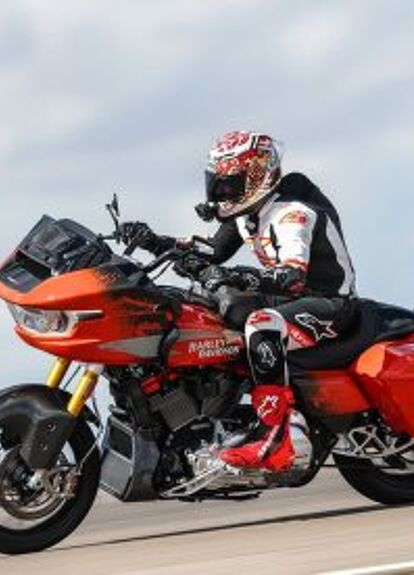
- Helmet: Arai Corsair-X Nakagami
- Leathers: Alpinestars Missile V2 Ward
- Airbag: Alpinestars Tech-Air 7X
- Gloves: Alpinestars GP Pro R4
- Boots: Alpinestars Supertech R
2025 Harley-Davidson FLTRXRRSE CVO Road Glide RR Specifications | |
|---|---|
MSRP | $110,000 |
Engine Type | Screamin' Eagle 131 |
Valve System | Pushrod-operated, overhead valves with hydraulic, self-adjusting lifters; four valves per cylinder |
Capacity | 131ci (2,153cc) |
Bore x stroke | 109.5 mm x 114.3 mm |
Compression Ratio | 11.0:1 |
Horsepower | 153 hp at 5,750 rpm (claimed) |
Torque | 150 lb-ft. at 4,750 rpm (claimed) |
Engine control | Electronic Sequential Port Fuel Injection (ESPFI) |
Clutch | Mechanically actuated 10 plate, wet Assist & Slip with Harley-Davidson Factory Racing premium billet clutch basket |
Transmission | Screamin' Eagle Racing King 6 Transmission |
Primary Drive | Chain, 34/46 ratio |
Final Drive | Belt, 30/68 ratio |
Lighting | All LED |
Frame | Mild steel; tubular frame, two-piece stamped and welded backbone; cast and forged junctions; twin down tubes; bolt-on rear frame with forged fender supports; MIG welded |
Swingarm | One piece billet aluminum performance swingarm from Harley-Davidson Factory Racing |
Front Suspension | Screamin' Eagle by Öhlins FGR 253 inverted front fork, fully adjustable for preload, compression, and rebound damping |
Front Travel | 5.1 inches |
Rear Suspension | 14 in. (357 mm) Screamin' Eagle by Öhlins Remote Reservoir Rear Shocks, fully adjustable for preload, compression, and rebound damping |
Rear Travel | 3.5 inches |
Front Brake | Dual radially mounted four-piston Brembo GP4-RX CNC calipers, 320 mm Brembo T-Drive disc |
Rear Brake | Single axially mounted four-piston Brembo caliper, 300 mm disc |
Electronic Aids | Cornering Electronically Linked Brakes (C-ELB) Cornering ABS (C-ABS) Cornering Traction Control (C-TCS) with modes Cornering Drag Torque Slip Control (C-DSCS) Vehicle Hold Control (VHC) Tire Pressure Monitoring (TPMS) |
Front Wheel | 3.5" x 19" black, 7-spoke cast aluminum with CVO RR branding |
Rear Wheel | 5.0" x 18" black 7-spoke cast aluminum |
Front Tire | Dunlop Harley-Davidson Series D408F, bias blackwall tires |
Front Tire Size | 130/60B19 M/C 61H |
Rear Tire | Dunlop Harley-Davidson Series D407T, bias blackwall tires |
Rear Tire Size | 180/55B18 M/C 80H |
Rake / Trail | 30° / 6.7 inches |
Wheelbase | 64.4 inches |
Length | 96.3 inches |
Width | 36.6 inches |
Max. Lean Angle | 36° left, 35° right (claimed) |
Seat Height | 28.9 inches |
Curb Weight | 785 pounds (claimed) |
Fuel Capacity | 6.0 gallons |
Infotainment | Full-color 12.3-inch TFT display with Skyline OS, imbedded navigation with real-time traffic and weather via Wi-Fi Hotspot |
Luggage | Lockable hard-shell saddlebags, 2.42 cubic feet capacity |
Warranty | 24 months (unlimited mileage) |
Service Interval | First 1,000 miles, every 5,000 miles thereafter |
2025 Harley-Davidson CVO Road Glide RR First Look Gallery

We are committed to finding, researching, and recommending the best products. We earn commissions from purchases you make using the retail links in our product reviews. Learn more about how this works.
Become a Motorcycle.com insider. Get the latest motorcycle news first by subscribing to our newsletter here.
Troy's been riding motorcycles and writing about them since 2006, getting his start at Rider Magazine. From there, he moved to Sport Rider Magazine before finally landing at Motorcycle.com in 2011. A lifelong gearhead who didn't fully immerse himself in motorcycles until his teenage years, Troy's interests have always been in technology, performance, and going fast. Naturally, racing was the perfect avenue to combine all three. Troy has been racing nearly as long as he's been riding and has competed at the AMA national level. He's also won multiple club races throughout the country, culminating in a Utah Sport Bike Association championship in 2011. He has been invited as a guest instructor for the Yamaha Champions Riding School, and when he's not out riding, he's either wrenching on bikes or watching MotoGP.
More by Troy Siahaan















Comments
Join the conversation
My Ducati has more power, except torque, is more original and looks so much better for 1/4 the cost of that land yacht.
Glad to see youre back at it Troy!
V4 Superleggera: $100k. CVO RR: $110k. I own 2 Harleys currently along with several other bikes, I'm not a HD hater by any stretch, but I cant fathom how they think this bike is worth anywhere near that price. I could turn my Road Glide into a much better track bike than this is for less than half the cost.