


2026 Royal Enfield Classic 650 Review
A question that sets the stage

Being the oldest continuously operating motorcycle company in the world, Royal Enfield’s been chugging along since 1901. When choosing where to hold the press introduction for its newest model to North America, the Classic 650, Enfield had a novel idea: going to one of the oldest cities in the United States: St. Augustine, Florida — which dates back to the 1500s.

2026 Royal Enfield Classic 650
Royal Enfield takes their beloved 650 motor and nestles it into their Classic frame and trim. This simple and stylish motorcycle, featuring both an analog and digital dash, should appeal to those who don't want or need the modern tech found on today's motorcycles.
Highs
- Unlimited mile warranty and roadside assistance for three years at no extra cost
- Affordable
- Smooth transmission
Sighs
- Shorter riders will have a hard time with the wide seat and height.
- Steering sweep is shallow
- Vallam Red does not have any hand painted pinstripes
St. Augustine and a Familiar Silhouette
The Spanish-style buildings, old brick-laid roads, and the old masonry fort, helped set the stage for Royal Enfield’s new Classic. If you’re expecting a dramatic reveal filled with horsepower claims and spec-sheet bragging, that’s not what happens here. The name itself describes what Royal Enfield wanted to achieve: a classically styled motorcycle that doesn’t pretend to be anything it isn’t.
Royal Enfield doesn’t need to prove it can build something modern. They already did that with the 650 Twin platform. Last year’s record breaking sales were fueled by the demand for 350cc variants (Classic, Bullet, Hunter, Meteor) and increasing international exports to over 100,000 units. With this achievement, Royal Enfield felt the need for their very successful 650 engine to be placed inside their classic motorcycle chassis, and thus the Classic 650 was born.

The 2026 Classic 650 derives from more than a century of craftsmanship, simplicity, and an unmistakable shape. With the upright riding position, the teardrop tank, and the metal accessories you'll notice the homage to previous generations. But, looking closer, you can see how the design is more refined, with rounded features and updated controls, it is the spiritual successor to the Bullet and the Classic 350/500.

The Spec Sheet Doesn’t Tell the Story
When one reviews the spec sheet of the Classic 650, it doesn’t come close to telling the complete story of this motorcycle. This is a classic example of not judging a book by its cover. The spec sheet may not be impressive compared to contemporary bikes, but the designs are gorgeous, and its simplicity reminded me that a motorcycle does not have to be engineered with high-performance capabilities to be impressive. I’ll admit I wasn’t well versed in Royal Enfield’s past, but after learning about its history and how the Classic 650 carries that history forward, I was excited to go for a cruise.

The lack of modern technologies like traction control, wheelie control, and cruise control, not to mention suspension adjustability, opened my eyes to the true roots of motorcycling. I didn’t need all that high-performance technology to have fun and enjoy the game. I do like that it features a modern LCD screen for the gear position, fuel gauge, clock, and odometer, along with a standard USB-C port and Tripper navigation pod along with the retro analog speedometer. But, even with those modern touches, it still keeps that cool, classy, vintage-esque cluster. So, if you’re looking for a spaceship, this isn’t it.
Engine Character Over Peak Numbers
At the heart of the Classic 650 is a 648cc air- and oil-cooled Parallel-Twin that Royal Enfield says churns out 46.4 horsepower at 7,250 rpm and 39 lb-ft of torque at 5,650 rpm. Just like the running theme of the Classic 650, these figures won’t knock your socks off. It's the delivery of these figures that paints a clearer image than the numbers themselves.

The power delivery is focused low in the rev-range. Torque delivery comes on smooth and early, making the bike feel responsive and peppy. It doesn’t push you to rev it out. It would be an exemplary city bike, if it could cut a little weight. The acceleration is fun but there’s no dramatic top-end rush. Instead, what you get is a smooth and predictable delivery of power that feels like it’s built as a daily around-towner.
The last thing I expected to like about this bike was the shifting, because it doesn’t have a quick shifter or a hydraulic clutch. I managed clutchless shifts with ease, and felt the transmission from the lever to the cogs within, worked smoothly and in harmony. That said, the cable-actuated clutch was stiff and the lever sat far from my smaller-than-average hands, so clutchless shifting became a useful technique.
Suspension and a Nod to History
The suspension setup is straightforward, with a 43mm Showa conventional fork up front and twin rear shocks, delivering 4.7 inches of travel in the front and 3.5 inches in the rear.

Royal Enfield claims to be the first manufacturer to introduce a modern, oil-damped swingarm rear suspension on a full production motorcycle with the 1948 Bullet (350cc and 500cc models). While earlier rear suspension systems existed, the Bullet’s 1948 design pioneered the twin-shock, pivoted-fork configuration that would become the industry standard. Before the swingarm system, rear suspension designs were often plunger-style or rigid. The new Classic 650’s suspension felt basic but it worked well for the smooth streets and low speeds we encountered around the coastal city. Unfortunately, my ride time was limited to city streets, which tempted me to run off the road just to test the bike on some rough terrain. Alas, I did not let my intrusive thoughts win. It may not outperform more premium middleweights, but, generally, those machines also command a much higher price.
Royal Enfield was also a pioneer in another important drivetrain innovation: the cush drive. In 1912, the company developed and patented the first cush drive hub, creating a rubber-cushioned drive system that reduced driveline lash and protected the chain. This led to the transition from belt drives to more durable chain drives.
Brakes

The brakes consist of Bybre calipers paired with a single floating 320mm front rotor and a single floating 300mm rear rotor. My only noteworthy complaint about the 650 is the front brake because it isn’t terribly strong, but it will still get the job done – eventually. The extra weight doesn’t help either. At a claimed 536 pounds (with 90% full tank) it makes the brakes feel duller. However, the rear brake felt firmer and stronger than expected – likely due to the riding position. The rear ABS engaged earlier than on many other bikes I’ve ridden, but it interacted smoothly and wasn’t overly intrusive. The pedal was sensitive to my normal pressure, so I had to lighten my input.
Weight, Balance, and Real-World Feel

You feel the weight while maneuvering in a parking lot or holding it upright at a stoplight. But once the wheels are rolling, it sheds that heaviness impressively well. The mass feels carried low in the chassis, giving it a planted and stable ride without being awkward in motion.
The Classic 650’s approachable 31.5-inch seat height makes it more manageable, which in turn makes it accessible to a wider range of riders. That figure can be a little misleading, though, because the seat is fairly wide, costing you some footing. At 5-foot, 6 inches with a 28-inch inseam, I was tiptoeing most of the time.

One thing that really caught my attention was the steering sweep – or lack thereof. I was expecting a bit more handlebar movement at lower speeds. The sweep felt tighter than I would have liked, with slow U-turns requiring more planning and momentum than anticipated. A broader steering sweep would have improved low-speed maneuverability, which this bike, as a heavier standard-style machine, could benefit from. But, really, I’m picking nits at this point.
I appreciate that it offers a neutral riding position which delivers comfort without fatigue. I didn’t feel stretched out or like I was overreaching for the bars like on some larger cruisers. I was able to stay in, what I like to call, “the pocket.” My arms are bent and relaxed, my knees aren’t locked out or excessively bent, almost like how I’m sitting when driving a car.
Colors With a Story

In the United States, the Classic 650 comes in three different color options: Vallam Red, Teal Green, and Black Chrome. The legendary teal color of Royal Enfield has a unique origin story. It began with a book written by Gordon May which featured a grey-colored bike that appeared teal due to a publishing error. The unexpected shade gained popularity, and the “error” evolved into a signature Royal Enfield color, later featured on the 2008 Classic 500, the new 2025 Classic 650, and the Goan Classic 350.
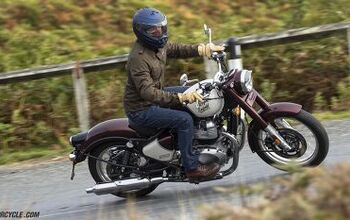
Royal Enfield has its master painters add pin stripes to the Black Chrome and Teal Green colorways by hand. I chose to ride the Vallam Red Classic 650 because it matched my REV’IT jacket, but if I'm being honest Teal Green gets my vote for best dressed.
Price and a great warranty

The Classic 650 will be available in American dealerships by early April 2026. At $7,499, it’s hard to beat. When talking with Ross Clifford, Royal Enfield’s Business Head, he mentioned something that shocked me. Royal Enfield feels they have created such a bulletproof (pun intended) motorcycle that they offer a three year, unlimited-mile warranty and roadside assistance — not for an extra cost, but included automatically when you buy a new Royal Enfield globally. They want customers, especially new riders, to feel safe in their decision to purchase a bike. A great thing to hear.
A Tribute to Simplicity
As I mentioned earlier, the design and overall aesthetic of the Classic 650 are simply put, awesome. It’s not just retro-styled — it’s genuinely classic. It doesn’t just look classic; it feels classic – but not in a bad way. With Royal Enfield celebrating 125 years since its founding in 1901, the Classic 650 feels like a proper tribute, and personally, I think the Vallam Red and Teal Green are stunning.

Cruisers and standards usually sit at the bottom of my preference list. I typically gravitate toward performance-focused machines loaded with technology and top-level components – as I’m sure many of our readers do. Yet there’s something deeply nostalgic about the Classic 650’s absence of flashy electronics and high-performance extras. It took me back to when I first started riding, when the joy came from the ride itself, not the numbers attached to it.
Scorecard
Engine | 18.5/20 | Suspension | 13/15 | Transmission | 9.5/10 |
Brakes | 7.5/10 | Instruments | 4/5 | Ergonomics | 9/10 |
Appearance | 9.5/10 | Desirability | 9/10 | Value | 9.5/10 |
Editors Score: 90.0% | |||||
In Gear

- Helmet: Airoh Connor
- Jacket: REV'IT! London Ladies
- Airbag: Alpinestars Tech-Air 5 Plasma
- Shoes: REV'IT! Arrow 2 H2O Women's Shoes
- Jeans: REV'IT! Victoria 2 Ladies SF
- Gloves: REV'IT! Cassani H2O
2026 Royal Enfield Classic 650 Specifications | |
|---|---|
MSRP | $7,499 |
Engine Type | Air-cooled Parallel-Twin cylinder, 4 stroke, SOHC |
Bore x Stroke | 78 mm x 67.8 mm |
Displacement | 647.95cc |
Compression Ratio | 9.5:1 |
Horsepower | 47 hp at 7,150 rpm (claimed) |
Torque | 38 lb-ft. at 5,250 rpm (claimed) |
Starter | Electric start |
Lubrication | Forced lubrication, Wetsump with pump driven oil delivery |
Clutch | Wet multi plate |
Transmission | 6-Speed constant mesh |
Fueling | Fuel Injection |
Frame | Steel Tubular Spine Frame |
Front Suspension | Telescopic Fork 43 mm; 4.7 inches of travel |
Rear Suspension | Twin shocks; 3.5 inches of travel |
Front Tire | 100/90-19" |
Rear Tire | 140/70 R18 |
Front Brake | Hydraulic disc brake, single 320 mm disc, twin piston floating caliper |
Rear Brake | Hydraulic Disc Brake, single 300 mm disc, twin piston floating caliper |
ABS | Dual Channel |
Wheelbase | 58.1 inches |
Ground Clearance | 6.1 inches |
Length | 91.3 inches |
Width | 35.1 inches |
Height | 44.8 inches |
Seat Height | 31.5 inches |
Fuel Capacity | 3.9 gallons |
Curb Weight | 535 pounds (claimed) |
2026 Royal Enfield Classic 650 Review Gallery

We are committed to finding, researching, and recommending the best products. We earn commissions from purchases you make using the retail links in our product reviews. Learn more about how this works.
Become a Motorcycle.com insider. Get the latest motorcycle news first by subscribing to our newsletter here.

My motorcycle addiction began in 2013 after buying a 1986 Ninja 250 to save money on gas. We all know, motorcycles never truly save anyone money :). Most of my riding experience has been sport bikes on the street and the track. I recently started riding dirt bikes on trails and a little bit on MX. I am a certified MSF instructor, control rider for multiple track day organizations, and a current expert supermoto racer. I like to save money when I can so I do most of the maintenance on my motorcycles. Valve adjustments, engine rebuilds, and tire changes just to name a few.
More by Sylvia Houston







Comments
Join the conversation
Does one grow to like the look of this model? For some reason, my brain goes to this when I see it.
I spent some time riding the Classic 350 and found it far more fun than I expected. I've been waiting for the larger classic to reach the US. I admit that I'm partial to the black/chrome model and love the way they painted the frame teal to match the rest of that model. For the red one, I just find the paint scheme and tank script to now match the overall theme of the bike as well, but again, different strokes.
This was a nice write-up and I do appreciate having RE bringing so many interesting affordable bikes to the US market.