


2025 Honda CB750 Hornet Review – First Ride

Midimalism in motion

I rode the 2025 Honda CB750 Hornet on the second day of a two-day press event. The first day was spent aboard Big Red’s other new mechanized insect, the CB1000 Hornet SP. Both days, Honda’s Ryan Dudek led us on varied routes into the western slopes of the Sierra Nevadas, where ribbons of asphalt unfurl haphazardly through forests of Ponderosa and Lodgepole pines, and past small mountain towns with names such as Cool and Volcano.
Dudek’s pace aboard the 750 Hornet was, in politically correct parlance, spirited. Even the horde of power-hungry journalists riding liter-bike Hornets wouldn’t complain of being held up. It wasn’t long after swinging a leg over the Hornet 750 the next day that I understood his choice to lead aboard the 750.
2025 Honda CB750 Hornet
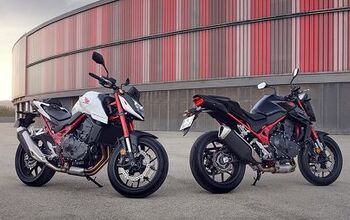
The 2025 CB750 Hornet is an excellent example of the 'less is more' premise. Less power, fewer cylinders, and lighter weight result in impressive performance, better affordability, and a whole lot of good fun!
Highs
- Accessible power
- Agile handling
- Excellent value
Sighs
- USB Port Location
- Not for taller riders
- No cruise control
VIDEO: 2025 Honda CB750 Hornet Review
Thanks to Cardo for making this video possible. Use discount code Motorcycle10 for 10% off at www.cardosystems.com.
The lesser Hornet’s 755cc SOHC eight-valve, Parallel-Twin engine produces substantially less horsepower and torque than the Hornet SP’s 1000cc Inline-Four, but it delivers that power in a delightfully usable manner. Coupled with the 750 Hornet’s 43-pound weight advantage (422 lbs vs 465 lbs), the CB750 will dissect a set of tight switchbacks more efficiently than the SP. It’s only on longer straights and sweepers where the Hornet 1000 leaves the 750 in its wake.

Another advantage of the 750’s Parallel-Twin is the absence of a flat spot in the low-to-mid-rev range. To achieve a good drive exiting some slower corners, the 1000 SP forced me into first gear when I would have preferred second gear; the 750 Hornet made no such demands. While the Honda engine spins quickly and builds its stride right up to its 10,000 rpm redline, the Twin doesn’t have as much punch off the bottom as some of its mid-size competitors ( MT-07, GSX-8S). When I first rode the new Parallel-Twin in the Transalp 750 two years ago, I commented that “I kept short-shifting the Suzuki V-Strom 800DE’s Twin to stay in the thick of its powerband compared to me constantly discovering the rev limiter of the Honda.”
The source of the Honda’s revvy nature is found in its oversquare bore and stroke dimensions of 87.0 mm x 63.5 mm. However, the Hornet’s midrange didn’t seem as deficient as on the Transalp, and with the same final drive gearing (16T/45T) between them, the better mid-range punch may come down to the Hornet’s lesser cub weight, shorter wheelbase, and its 17-inch wheels compared to the Transalp’s 18-inch rear. One thing’s for sure: the Hornet 750 sure sounds good. Accompanying the rev-building climb to redline is a pleasing growl from the uneven firing order of the 270-degree crankshaft emanating from the stock exhaust pipe.
Midimalism

According to somewhere on the internet, midimalism is a design concept aiming to find balance between the extremes of minimalism and maximalism. With the 2025 Hornet 750, Honda hit the midimalism bullseye. Unlike its SP stablemate, the 750 comes outfitted with a variety of more affordable components. At one end of the spectrum are the non-adjustable Showa SFF-BP fork and the preload-adjustable-only Showa shock, as well as dual front Nissin radial-mount calipers. At the other end, the 750 shares with the SP a five-inch full-color TFT display and the same suite of rider aids.

While chasing Dudek on our guided tour of the Sierra Nevada mountains, I found myself being bucked out of the seat of the Hornet 750 more often when striking the upheaval of errant tree roots than I did on the Hornet SP. That comment is more about praising the Öhlins TTX36 shock on the SP than it is disparaging the Showa shock on the 750. Both the front and rear suspension components on the Hornet 750 felt well-balanced from the factory, providing good absorption for aggressive sport riding as well as comfort during long trips. A midimalism in suspension performance and price, if you will.
The same can be said about the Hornet 750’s braking components. Where the Hornet SP is outfitted with Brembo Stylema calipers and a Brembo master cylinder, the 750 comes equipped with dual Nissin radial-mount calipers. Front braking performance was exceptional on the 750, just without the intricate feel and feedback you get from the Brembos. It’s worth noting, though, that the 750 is outfitted with pedal-style discs whereas the upgraded SP is not. Both models are equipped with non-defeatable anti-lock braking systems (ABS).

The rider aids the two bikes share feature five ride modes and three levels each for engine braking, power, and Honda Selectable Torque Control (HSTC) — Honda's traction control system.
The preset modes include:
- Sport: Delivers the most power with minimal engine braking and HSTC.
- Standard: Offers a balanced middle ground for power, engine braking, and HSTC. Power is softened in the first two gears, and torque is reduced at partial throttle.
- Rain: Provides the lowest power, medium engine braking, and high HSTC, with reduced power and torque primarily in the first three gears.
Additionally, two User modes let you customize power, engine braking, and even disable traction control. A significant drawback is that these User modes reset to their defaults every time you turn off the motorcycle. This can be frustrating, as custom settings like disabled traction control aren't saved. I also found the lowest engine braking setting to be a bit too strong, wishing for more "freewheeling" when off the throttle.

The TFT display is positioned above the dual LED projector headlights. Its sealed-resin design enhances visibility, even in direct sunlight. You can choose from three screen layouts, though I used the standard one. The display shows essential information, such as gear position, speed, RPM, ride mode, fuel level, and time, in a clear and easy-to-read format. It also connects to your smartphone via the Honda RoadSync app for turn-by-turn navigation, calls, and music. All display functions are controlled using a four-way toggle switch on the left handlebar. An unwelcome carryover from the Hornet SP is the absence of an IMU, meaning there’s no lean-sensitive traction control or lean-sensitive ABS. Cruise control is also missing on the 750 as well as the 1000.

The CB750 Hornet is built around Honda’s steel diamond-shaped frame, which features an integrated subframe. At 36.6 pounds, the Hornet’s frame is 4.2 pounds less than the CBR650’s, which factors into the Hornet’s light 422-pound claimed curb weight. Considering the 750’s rake and trail figures are the same as the Hornet SP (25.0° x 3.9”), but with a wheelbase that’s 1.4 inches less (55.9” vs 57.3”), and sporting a 160-series rear tire, it’s easy to see on paper just how much more nimble the 750 is compared to its liter-size brother.
When it comes to the bi-directional quick-shifter, though, the 750’s unit performs more inline with what you’d expect from a quick-shifter with notchier selections at slower speeds and when not under full load. I've been told that quick-shifters perform better with the smooth power delivery of an Inline-Four versus a Parallel-Twin, and this was evident when riding the two bikes back-to-back.

With 31.3 inches between the pavement and the top of the seat, the Hornet 750’s seat height is certainly attainable for shorter folk. At 5'11” with a 32-inch inseam, I certainly noticed the low seat height, but I didn’t feel pretzeled into the bike after a full day of riding. Once you reach over six feet, there may be a comfort issue. Still, for everyone else, the seating position of the Hornet 750 is inviting in typical streetfighter posture: upright, but with a slight lean forward to the one-piece handlebar. In fact, due to the Hornet 750 not having a weird ridge around the bottom of its fuel tank, and with a thicker-padded seat that’s narrow at the tank juncture but wide under your butt, the 750 is also a much better all-day mount than the SP — another reason why Dudek probably chose this bike. Underneath the seat, Honda placed the USB port, which isn’t the most convenient location, but it's better than having no port at all.

The Honda CB750 Hornet, a strong seller in Europe for several years, is making its debut in the US market. According to my local Honda dealer, the Hornet 750 hasn’t yet taken flight. This is likely to change as more people become aware of this impressive mid-displacement naked bike, a sentiment echoed not just by me, but by many journalists who attended the launch.
In Gear
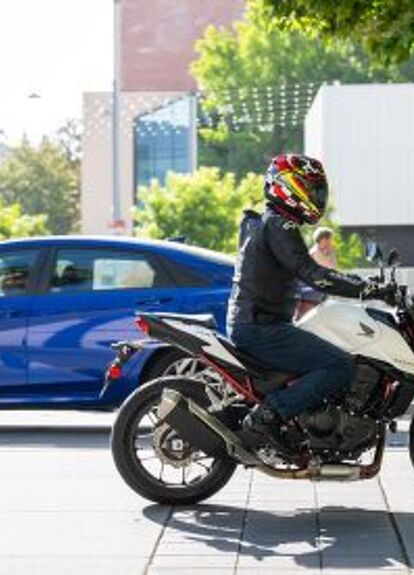
- Helmet: Arai IOM TT 2023
- Jacket: Alpinestars Missile V2 Ignition
- Gloves: Alpinestars GP Pro
- Pants: Scorpion Covert
- Boots: Alpinestars SP-2
Scorecard
Engine | 18.75/20 | Suspension | 12.25/15 | Transmission | 8.5/10 |
Brakes | 7.75/10 | Instruments | 4.25/5 | Ergonomics | 8.75/10 |
Appearance | 8.5/10 | Desirability | 8.25/10 | Value | 9.5/10 |
Editors Score: 86.5% | |||||
2025 Honda CB750 Hornet | |
|---|---|
MSRP | $7,999 |
Horsepower | 83 bhp @ 8,500 rpm |
Torque | 55.3 lb-ft @ 7,250 rpm |
Engine Capacity | 755 cc |
Engine Type | Liquid-cooled 30º Parallel-Twin-cylinder four-stroke w/ 270º crank |
Bore x Stroke | 87.0 x 63.5 mm |
Compression | 11.0:1 |
Fuel System | PGM-FI; 46mm throttle bodies |
Transmission | 6 speed |
Clutch | Wet, multiplate slip/assist |
Final Drive | #520 Chain; 16T/45T |
Frame | Steel diamond |
Front Suspension | 41mm Showa Separate Function Front Fork Big Piston (SFF-BP) telescopic inverted fork; 5.1 in. travel |
Rear Suspension | Pro-Link system w/ single Showa remote-reservoir shock w/ 7-stage preload adjustability; 5.1 in. travel |
Front Brakes | Dual Nissin hydraulic radial-mount, four-piston calipers w/ 296mm petal-style discs; ABS |
Rear Brakes | Single hydraulic one-piston caliper w/ 240mm disc; ABS |
Front Tire | 120/70 17 |
Rear Tire | 160/60 17 |
Seat Height | 31.3” |
Wheelbase | 55.9” |
Rake/Trail | 25.0° x 3.9” |
Curb Weight | 422 lbs |
Fuel Capacity | 4.0 gal |
Electronics | Full-color 5-inch TFT display, ride modes, TC modes, adjustable engine braking, ABS, bi-directional quick-shifter, Honda RoadSync |
Colors | Matte Black Metallic; Matte Pearl White |
Warranty | Transferable, one year included, unlimited mileage |

We are committed to finding, researching, and recommending the best products. We earn commissions from purchases you make using the retail links in our product reviews. Learn more about how this works.
Become a Motorcycle.com insider. Get the latest motorcycle news first by subscribing to our newsletter here.
A former Motorcycle.com staffer who has gone on to greener pastures, Tom Roderick still can't get the motorcycle bug out of his system. And honestly, we still miss having him around. Tom is now a regular freelance writer and tester for Motorcycle.com when his schedule allows, and his experience, riding ability, writing talent, and quick wit are still a joy to have – even if we don't get to experience it as much as we used to.
More by Tom Roderick




Comments
Join the conversation
Not into parallel twins. I’ll stick with my bug eyed Street Triple.
Meh. KTM 790 has more of everything except Honda reliability.