


2026 KTM 990 Duke R Review – First Ride

A leaner, meaner 990 Duke is rewriting what it means to be a "Middleweight"

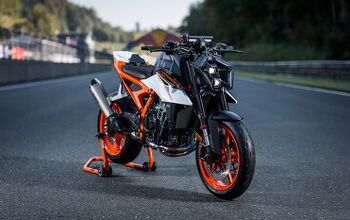
There’s a familiar playbook KTM likes to run: build a sharp standard model, then turn the dial to 11 with an R. The 2026 KTM 990 Duke R is exactly that — the high-spec, sharpened, and unapologetically aggressive evolution of the 990 Duke. KTM calls the base 990 Duke a Sniper. For the R, Team Orange is turning to comic book lore and naming this one: The Punisher. I’m not sure who or what The Punisher is seeking revenge against, but its message is clear to all the other contenders in the category: look out.
2026 KTM 990 Duke R
KTM means business when it launches an R model, and the 990 Duke R is no different. With more power, a better chassis, and upgraded electronics compared to the standard 990 Duke — much of it shared with the 990 RC R, the 990 Duke R thrives when the pace gets hot.
Highs
- Killer engine and chassis
- Extremely impressive electronics package
- At a base price that undercuts the competition
Sighs
- Transmission is a little crunchy at street speeds
- Slippery footpegs
- Cockpit’s a little tight when getting into a tuck
Coming on the heels of the introduction of the 990 RC R, the bones of the 990 Duke R shouldn’t be too surprising, as it shares a surprising amount of DNA with its fully-faired cousin. Same frame. Same swingarm. Same shock linkage. Same suspension hardware (though internals are slightly different).
VIDEO: 2026 KTM 990 Duke R Review — First Ride
R DNA, Turned Up
Let’s start with the chassis. The Duke R uses KTM’s steel tubular frame with the engine as a stressed member, paired with a gravity die-cast aluminum swingarm and linkage system that’s shared with the 990 RC R. Also, it’s orange — the telltale sign you’re dealing with an R model.
Suspension is WP Apex front and rear, fully adjustable, but unlike the standard 990 Duke, with its 43mm fork, the R model gets a 48mm open-cartridge fork with 5.6 in of travel and a total of 30 clicks of compression and rebound adjustment, each. Out back is a linkage shock with 5.5 in of travel, adjustable for high- and low-speed compression, rebound, and preload. And thanks to the shock linkage, the spring is now linear instead of the progressive piece on the standard, linkage-less 990 Duke. This difference in suspension is the reason the center of gravity is raised 0.59 inches over the standard Duke. Additionally, the wheelbase is stretched slightly to 58.3 in. from 58.1 in. Combined, these changes amount to a little more lean angle and a little more stability.

Further differences between the Duke R and the non-R are sprinkled throughout. Braking is handled by radially mounted Brembo Stylema monoblock calipers up front with 320mm semi-floating discs, plus a Brembo MCS master cylinder, adjustable in ratio between 19mm and 21mm. The standard gets a KTM-badged J.Juan caliper and master, along with 300mm discs. The Stylemas, while no longer the top dog in Brembo’s production calipers (the Hypure calipers took that spot) are still excellent on the Duke R and offer that premium, race-bred bite and feel most testers, including myself, have praised over the years.
While both the standard Duke and the Duke R share the same 947cc LC8c Parallel-Twin, the R version makes more power — 128 hp vs. 121 hp. This is primarily thanks to a higher rev ceiling. And if you didn’t know, for a given displacement, the more revs an engine can spin up to, the more power it’ll make. KTM says the engine weighs in at 125.6 lbs., a handful of pounds more than the 120-lb 890cc V-Twin from Ducati. At least according to each manufacturer’s claims.

The Duke R gets its own aluminum die-cast subframe with integrated airbox and intake. It’s not a steel trellis design, but it mimics one as a sort of homage to the company’s history (and success) with the trellis frame. Switching over to the 990 Duke R versus the standard 990, you see the peg placement is revised — 1.3 in. farther back and 0.5 in. higher on the R than the standard Duke, resulting in a more aggressive stance. The handlebar is flatter, lower, and slightly farther forward, though you can move the bars forward or backward and rotate it even further to customize it to your liking.
Titillating Tech
Then there’s the tech. The 2026 Duke R’s massive 8.8-inch TFT touchscreen display is as impressive as it is big. It’s bright, wide, and works even with gloves on (to varying degrees of success, depending on the glove). Coatings on the surface help cut the glare and resist leaving fingerprints should you use the screen gloveless. KTM has gone all-in on UI and functionality here, with split-screen layouts, favorites, and full offline map navigation via Mapbox built into the bike — no need to connect your phone to get directions (though you can still connect your phone with the KTMconnect app via Bluetooth to get live traffic updates).

You get four standard ride modes (Rain, Street, Sport, Custom), plus an optional Track Mode and extra Custom modes via KTM Tech Packs. Like other KTMs, the Duke R has a Demo Mode, allowing the user to try everything before deciding whether to buy it. Should you want to go all-in and get the complete Tech Pack and unlock all features, that will set you back $899.99. Each mode now bundles all the electronic settings — ABS, traction, anti-wheelie, throttle response, quickshifter, and display interface — so you’re not toggling ten menus just to get the bike to feel right. However, you still can if you want to, as each mode lets you customize to varying degrees, and it saves the settings when the bike is turned off.
For full adjustability, however, this is where the additional Track Mode and three Custom Modes come in. Track Mode’s pre-defined, and adjustable, settings give the most liberty to the rider, sharpening throttle response and backing off much of the aids, while the Custom Modes truly let you decide every parameter of the bike. Multiple Custom Modes means you can have one for a dry day and another for a wet one. And if you’ve made a million changes and can’t find your way back to stock, there’s always the Factory Reset button.

For several years, I’ve championed a certain Italian brand from Borgo Panigale as the leaders when it came to tech, UI, and UX. But sitting behind the Duke R’s big screen and being able to flip through it with my gloves on (the joystick and buttons on the bars also toggle through the screens if your gloved hands don’t work) was really impressive. I generally don’t bother uploading navigation from my phone to the bike’s dash, so having maps and nav already native to the KTM was the impetus I needed to actually try it. And it works really well, as I discovered when I lost our group and needed to find a gas station. With a tap of a few buttons, I successfully refueled and rendezvoused with the rest of the group at the hotel. It’s super simple.
Of course, the accolades for the UI and UX go beyond the navigation. Since the screen’s so big, all the information you need is easy to spot, and flipping through different screens, changing settings, and adjusting the bike’s behavior is all really easy. And you can do nearly all of it while riding. Once you key the bike off, it remembers your settings and picks up where you left off when you key the bike back on again. I don’t usually dedicate an entire section of a review for a bike’s tech, dash, and user interface — and when I have it’s usually been for Ducatis — but KTM have really impressed me this time around.

Riding It
So where does the 990 Duke R land? The clues were already out there as early as 2024. These days Chris Fillmore is KTM’s Media Relations Manager, but in a past life he was a KTM factory superbike rider, AMA Supermoto champ, and Pikes Peak winner. When he saw the 990 Duke R prototype in Austria the year prior, he came up with the idea to race it as part of a marketing pitch. KTM is the “Ready to Race” brand, after all. The series? MotoAmerica’s Super Hooligan class. To everyone’s surprise, especially Chris’s, KTM said yes.
Fast forward to Mid-Ohio 2024 and there Chris was, sitting on the grid for the first time in years. Because the bike wasn’t for sale to the public yet — the 990 Duke R wasn’t even public knowledge at this point — it was technically illegal for the class. MotoAmerica allowed it anyway, but scratched its results from the official record. Whatever. This was a marketing exercise anyway and being on the grid, getting TV time, was a win. What happened next was even more legendary. Onboard a prototype 990 Duke R with plenty of prototype KTM Powerparts go-fast bits added, Chris not only showed the bike’s potential, he led a handful of laps against the factory Indian and Harley teams, including the last lap before losing the lead in the draft, ultimately finishing third. You won’t see his results on the official record because of his “Exhibition” status, but everybody watching knew. The 990 Duke R was the real deal.

It’s also street legal. Which is why the assembled motojournalists gathered in Palm Springs, California at the base of the Palms to Pines scenic byway, to see how the race-first mentality of the bike translates on the roads. A 62-mile ribbon of asphalt, P-to-P slices and dices through the Santa Rosa and San Jacinto mountains and features twists and turns that are made for the 990 Duke R. But first, we endured a little bit of freeway slog to get there.
While normally these boring stretches are something we get through to ride the fun stuff, this time around the calmer pace of city streets and freeway gave me a chance to familiarize myself with the KTM’s dash display. As I’ve already explained above, it’s impressive. But toggling through menus while stationary in a parking lot is different than scrolling through menus while rolling. First and foremost, all the necessary information I needed — road speed, engine speed, gear position, fuel level, etc. — was in plain sight, even with the navigation displayed in a split screen beside it. And in case I needed one display to be bigger (like the navigation, for example), I could simply take my gloved finger and move the slider on the screen to make that display bigger. Granted, this may not work as well with thick winter gloves.

Changing a setting is a matter of swiping up, down, left, or right — perfect for today’s swiping generation. If you prefer to keep your hands on the bars, the motions are just as simple with the toggles and buttons on the left switchgear.
There’s obviously no wind protection on the Duke, but while humming along at 80 mph, I didn’t find that to be particularly concerning. The slightly forward lean of the rider triangle helps combat the rider feeling like a sail, and the slight buzz coming from the engine wasn’t at all off-putting. Should you really need a break to unwind and shake out the extremities, cruise control is just a click of a toggle away. Unfortunately, the Duke R doesn’t have adaptive cruise control, but we’re willing to let that one go. This isn’t a touring bike…

Once the roads started to wind up, I was reminded of my impressions of the standard 990 Duke over the 890 Duke R before it. The 890’s had noticeably more chassis flex, which I interpreted as feedback, and feedback is obviously a good thing the quicker you go. The 990’s chassis is stiffer, more focused, more demanding of your attention. The 990 Duke R moves that needle up yet another notch.
A lot of it comes down to the 48mm fork. The combination of its wider diameter and accompanying triple clamp brings with it more stiffness, which translates to a more direct connection to the road. The feedback is still there, but the rider has to try harder to find it, typically through suspension adjustments. It initially caught me off-guard, as every bump was coming through the bars and back to me. Thankfully, both compression and rebound adjustment of the fork can be dialed with clickers atop the tubes, and dialing out a couple clicks (without any tools) of both gave me a much more compliant ride.

From there, the Duke R wanted to attack any corner in front of it. Some bikes prefer finesse and smoothness to get the best out of it through a set of corners. In typical KTM style, the 990 Duke R likes to be manhandled. The leverage from the bars makes it easy to toss the bike into corners, and the added stability from the longer wheelbase adds a touch of confidence that everything’s going to be alright.
In the rear, the shock linkage provides more precise articulation of the rear suspension. This along with the change to a linear spring, provided tons of compliance from the back of the bike. Granted, a well-tuned linkage-less shock/swingarm setup (like that of the standard 990 Duke) can be made to work, but it’ll inherently have drawbacks compared to having a linkage.

Astute readers may have noticed it’s taken me this long to talk about the engine. Really, it’s because the electronics and chassis impressed more than I thought they would, while I knew the engine would be a treat. And I wasn’t wrong. The 947cc Parallel-Twin moves with serious gusto. There’s ample torque to drive out of corners, with a healthy bit of power on top. All 130 horses the Duke has are ready to leap at the twist of the wrist.
Which is where the Ride Modes come into play. While starting the ride in Street Mode, I found the throttle response to be… fine, if a tiny bit too sedate for my tastes. Switching to Sport Mode delivered a seemingly 1:1 relation between my wrist and the back tire. Which was perfect. It wasn’t long ago I’d immediately put whatever bike I was testing in Track Mode and never look at the other modes again. This time around, however, Track Mode proved too aggressive for our ride, requiring utmost care while twisting the grip. Hitting a bump in the road, and the resulting jolt from my wrist, would deliver a commensurate spike in power. As it turned out, Sport Mode was the perfect place to be for the canyons.

If there is a gripe, though, it’s the transmission. Changing through the gears with the quickshifter feels mechanical, like I could almost feel the gear move from one to another through my boot, especially on upshifts. There was never an instance of a missed gear or a false neutral, and naturally, shifting with the clutch is as smooth as you like, but if a bike has an up/down quickshifter, then I’m going to use it. This one, at least on the street, doesn’t feel refined unless the revs are high.
Of course, what goes must slow, and the Stylema calipers and 320mm discs, paired with Brembo’s 19/21 MCS master cylinder, are a magical combination of stopping power and feel. Often, a single finger was all that was needed to scrub whatever amount of speed I needed so much so that I didn’t bother moving from the 19mm piston to the 21mm available with the twist of a knob on the brake lever.

Among the many adjustments you can make, different levels of ABS are also at your fingertips, including Supermoto and Supermoto+. The former lets you hang the rear end loose pretty far, but rear ABS will eventually kick in if the slide angle is too much. Switch to Supermoto+ and you’re entirely in control of the back tire, while the front ABS is set pretty liberal. While I like a good slide once in a while, I wasn’t brave enough to test the limits of either setting, choosing to keep my rear tire only slightly out of line with the front.
Track Bros
The origin story of Fillmore riding the prototype Duke R in a MotoAmerica race wouldn’t be complete if we didn’t end up taking the bike to the track. Not only did we venture to Chuckwalla Valley Raceway to do just that, but the standard Michelin Power Cup 2 tires (which are already a fine trackday tire, in my opinion) were swapped for Dunlop Slicks in the R7 compound in front and R8 compound in the rear. Both are hard compounds, meant to last the day at the track, not set a personal best. Of note were the tire sizes: a 120/75-17 front and 180/65-17 rear. Both offer a taller sidewall than the standard 120/70 and 180/60 Michelins that come stock.

For the track environment, KTM stiffened the suspension at both ends, increasing compression while slowing rebound, but left the shock preload the same. This would become an important detail.
With its moment to shine, and the bike set to Track Mode, the Parallel-Twin wasted no time barking its distinct growl. The aggressive throttle map I experienced on the street was perfect for this environment, and the Duke launched itself away from pit exit towards Turn 2. In fact, it launched itself out of all the corners with accuracy from the throttle, before going WFO down any straight delivered a decent spurt of power up top. But I found the bike hard to turn and even harder to finish a corner, relying on the front brake for longer than I should to steepen the rake angle and get the bike to point in the right direction. It quickly became an issue nearly everyone was struggling with.

Dialing in at least two turns more rear preload (some others in attendance added three) to raise the rear and put more weight over the front tire was the best fix considering the limited options. While we were at it, some compression damping was taken out of the fork, allowing it to dive easier on the brakes and help it turn. It also helped soak up the cracks in the track surface better.
These changes made a big difference. Now the Duke R could turn with confidence, hold a line, and finish a corner much better. More fine tuning would have been nice, but we ran out of time. Nonetheless, the impressions were clear: the 990 Duke R is at home when it’s ripping laps at a track. The engine is a gem with a broad spectrum of fun, usable power. Better still, at least at the track, the quickshifter was smooth as you like. At least shifting up. Downshifts were mostly smooth as well, but the bike would hesitate occasionally when changing down from high revs, presumably to save a piston from smacking a valve.

With the suspension mostly working how I wanted it, the confidence from the bike while leaned over is superb. I’ve been a fan of the 890 Duke R’s softer chassis as being able to communicate better with the rider at lean, but the rigidity of the 990 communicated that it could handle the additional horsepower to carry more speed — whether that was entry speed or mid-corner. So I gave it my best shot.
On the electronics front, I deliberately kept traction control at a fairly high setting (level 5 of 10) because the harder compound of the Dunlop slicks made the back step out at times, even under what I thought was gentle throttle. Not wanting to launch myself into orbit in my fresh new RST leathers, it was nice to know the bike would have my back if I couldn’t manage the tire with my right hand first. And even though Chuckwalla doesn’t have much in the way of hard braking zones, the Brembos thrived at the track with the same excellent power, feel, and modulation I felt on the street. The additional speed was nothing these binders couldn’t handle.

My one gripe with the Duke R on track was the tight seat front to back. If I wanted to get into a proper tuck and lay as flat as possible, I’d almost immediately be sitting on top of the passenger seat cowl the moment I moved back. Stopping at the edge of the seat and simply laying my chin down would put me face-to-face with the dash. Between those two options, I preferred being atop the seat cowl, but neither are great. Since I don’t generally get into a tuck on the street, I didn’t notice it there.
Final Thoughts
On paper, the 2026 KTM 990 Duke R looks like exactly what an R should be: not just faster, but more focused. The Parallel-Twin is a ton of fun thanks to its broad spectrum of power, and the chassis (once sorted) can make you feel like a hero. Add in the impressive brakes and electronics, and this is a package that will be hard to beat. A lot of us are getting hung up on the fact this is now a “middleweight” naked bike, even though it’s only 53cc shy of being a liter-class machine! I don’t know what to call it either, but I do know that for my own tastes, I’d pick one of these over a 1390 Super Duke. While the 1390s are fun, they also require every single bit of your attention (and talent). Nevermind the fact they’re also physically bigger, heavier, and chew through tires faster.

To me, and I’m sure many others, the 990 Duke R lands in that sweet spot of power, handling, and physical size that the demographic of “middleweight” naked bike buyers will love. It’s almost as if KTM remembered that it already had a hit on its hands back in 2011 with the original 990 Super Duke.
Best of all, at $13,399 (without the Tech Package), it’s cheaper than the $14,495 Triumph Street Triple 765 RX and $15,995 Ducati Streetfighter V2 — both excellent machines in their own right, but with smaller engines than the KTM. Even adding in the $900 to get an as-tested bike, it still undercuts the competition.

It appears as though KTM has forced its way to the top of this class — at least on paper. While the competition is making a pitch towards smaller, easier to ride engines, KTM’s out to prove that bigger is better, if integrated correctly with a matching chassis and electronics package. Naturally, this means we need to put these contenders, and any others, together to see which reigns supreme. Historically, KTM’s R models have been hard to beat. The 990 Duke R looks poised to continue that trend.
Scorecard
Engine | 19.5/20 | Suspension | 14/15 | Transmission | 8.5/10 |
Brakes | 9.5/10 | Instruments | 5/5 | Ergonomics | 9/10 |
Appearance | 9/10 | Desirability | 9/10 | Value | 9/10 |
Editors Score: 92.5% | |||||
In Gear: Street

- Helmet: Scorpion EXO Covert FX
- Jacket: Vanson Full Throttle
- Airbag: Alpinestars Tech-Air 5 Plasma
- Pants: Alpinestars Cult-8 Jeans
- Gloves: Alpinestars Phenom Air
- Boots: Sidi Rex Air
In Gear: Track

- Helmet: Arai Corsair-X
- Suit: Race Dept V4.2 D3O Airbag Leather Suit (Custom)
- Gloves: RST Moto Tractech Evo 4 (Custom)
- Boots: Alpinestars Supertech R
2025 KTM 990 Duke R Specifications | |
|---|---|
MSRP | $13,399 |
Engine Type | Liquid-cooled, four-valve, DOHC Parallel-Twin, 4-stroke |
Displacement | 947 cc |
Bore x Stroke | 92.5 mm / 70.4 mm |
Compression Ratio | 13.5:1 |
Transmission | 6 gears |
Fuel System | Electronic Fuel Injection |
Clutch | Cable-operated PASC Slipper clutch |
Ignition / Engine Management | Bosch EMS with RBW |
Traction Control | MTC (lean angle sensitive, 3-Mode disengageable + Track mode optional) |
Frame | Chromium-Molybdenum-Steel frame using the engine as stressed element, powder coated |
Subframe | Aluminum, powder coated |
Handlebar | Aluminum, tapered, Ø 28/22 mm |
Front Suspension | WP APEX 48 Open Cartridge, Compression and rebound (30 click), Preload (±3 Clicks), 5.6-inch travel |
Rear Suspension | WP APEX Compression High Speed (3 turns) Low Speed (30 Clicks), Rebound (30 Clicks), Preload (10 turns, 5.5 inches of travel |
Front Brake | 2x radially mounted Brembo Stylema 4 piston caliper, brake disc Ø 320 mm |
Rear Brake | Single piston BREMBO caliper, brake disc Ø 240 mm |
ABS | Bosch 9.3 MP Two Channel (Supermoto ABS) |
Front Wheel | Cast aluminum, 3.50 x 17” |
Rear Wheel | Cast aluminum, 5.50 x 17” |
Front Tire | 120/70 x 17, Michelin Power Cup 2 |
Rear Tire | 180/55 x 17, Michelin Power Cup 2 |
Wheelbase | 58.3 ± 0.59 inches |
Ground Clearance | 8.3 inches |
Seat Height | 33.1 inches |
Fuel Capacity | 3.8 gallons |
Curb Weight | 418.8 pounds (claimed) |

We are committed to finding, researching, and recommending the best products. We earn commissions from purchases you make using the retail links in our product reviews. Learn more about how this works.
Become a Motorcycle.com insider. Get the latest motorcycle news first by subscribing to our newsletter here.
Troy's been riding motorcycles and writing about them since 2006, getting his start at Rider Magazine. From there, he moved to Sport Rider Magazine before finally landing at Motorcycle.com in 2011. A lifelong gearhead who didn't fully immerse himself in motorcycles until his teenage years, Troy's interests have always been in technology, performance, and going fast. Naturally, racing was the perfect avenue to combine all three. Troy has been racing nearly as long as he's been riding and has competed at the AMA national level. He's also won multiple club races throughout the country, culminating in a Utah Sport Bike Association championship in 2011. He has been invited as a guest instructor for the Yamaha Champions Riding School, and when he's not out riding, he's either wrenching on bikes or watching MotoGP.
More by Troy Siahaan








Comments
Join the conversation
Current KTM Duke owner, still loving my Duke, no issues with it. KTM makes excellent Nakeds, each Duke model excels at the top of their respective class!
The 990 is certainly a great machine. Kudos to KTM for bringing this to the masses. I question is a 990 truly a middle weight bike ??