


2025 Kawasaki Ninja 1100SX SE Review

Give a little, get a little

Want vs. need is something that every rider faces when choosing their next motorcycle: we might want the uncompromising thoroughbred performance of a superbike, yet what we need is the comfort and practicality of a conventional touring machine. A classic case of the rational mind thrashing against the emotional in their eternal struggle, one that is calmed by wise compromise, or rather, the sport-tourer. Sometimes, we give a little to get a little, but in the case of the 2025 Kawasaki Ninja 1100SX SE, we get a lot.
2025 Kawasaki Ninja 1100SX SE
The 2025 Kawasaki Ninja 1100SX SE returns with a stroked-out engine and subtle refinements that build on an already strong foundation. After spending a few months rolling around Southern California with it, we’re still smitten with the big Ninja.
Highs
- That midrange slaps, son!
- A mighty fine chassis
- Simple, direct, sport-touring machine
Sighs
- Luggage is an accessory
- Brakes have improved, but not as much as we’d like
- Confounding User Interface

Kawasaki established its current sport-touring Ninja formula back in 2011, quickly cementing itself as a staple within the brand's lineup by carefully balancing its sporting scales against utility and value. Those core tenets still ring true in the age of inflation, seeing as the base-model Ninja 1100SX ($13,699) undercuts fellow liter-class competitors such as the Suzuki GSX-S1000GT+ ($14,299) and BMW R 1300 RS ($23,190). The MSRP ordering does shuffle a bit when factoring in the snazzy new up-spec Ninja 1100SX SE ($15,399) variant we've tested here, which boasts upgraded Brembo M4.32 calipers hooked up to steel-braided lines, a fully adjustable Öhlins S46 shock, heated grips, and an exclusive colorway. Adjusting for the $1,128.96 key-and-color-matched 28-liter hard bags, and you're still in a decent place.
But enough financial navel-gazing, it's time to talk about fun stuff. This year's headlines are short but no less sweet: we've got a refined up/down quickshifter, the Rideology app supports voice commands, and a USB-C port slapped on the left handlebar. Good, great, we'll take it — moving on.

Above all else, we've got a larger DOHC Inline-Four engine that's gone under the knife to meet Euro5+ emissions standards. Engineers are sticking with the 77mm bore while lengthening the stroke by 3.3mm to 59mm, bumping the displacement from 1,043cc to 1,099cc. Leaning into the longer stroke, the Ninja 1100 platform is chasing improved low-to-midrange performance with several other tweaks, namely lower-lift cams, valve springs, a new 38mm throttle body, and narrower intake ports to increase air velocity — all bolstering the bottom end and midrange. In fact, Kawasaki is quite open that this iteration of its mill sacrifices a few peak horsepower, but what's gained can't be ignored. If all that sounds vaguely familiar, it’s probably because this is exactly what’s found in the 2025 Kawasaki Versys 1100 SE LT.
On the Motorcycle.com dyno, the big Ninja produced 124.6 horsepower at 9,200 rpm and 77.4 lb-ft of torque at 7,600 rpm. Deliciously smooth and replete with a compelling induction howl, its sheer ferocity is kept in check with a 3% heavier flywheel — it isn't nearly as cutthroat as a high-revving ZX model, nor should it be, though there's a whiff of those steely-eyed Ninjas in there yet. Giving up a few ponies at the bitter end only makes it more potent in the areas that matter because when it's galloping anywhere between 4,200 and 7,600 rpm — boy howdy, it pulls — delivering excellent roll-on power when exiting apexes or executing zesty passes.
It stacks up to be a well-rounded riding experience.

Settling into a groove in the canyons is easy enough, where riders can simply work the well-attenuated ride-by-wire throttle and not have to mess with the refreshed quickshifter, as slick as it might be. Riding around town isn't a bear, either. Aside from the added torque, the four-pot mill is a little more user-friendly thanks to revised gearing — longer primary gear ratios, along with taller fifth and sixth gears, specifically. Cruising along at freeway speed will have this engine barely breaking a sweat around 4,200 rpm, and achieving 40+ mpg figures seems realistic during long hauls. With a sportier-minded individual behind its bars and fun roads ahead, those mpg figures will dip into the high 30s, but you'll still see 170+ miles out of the 5.0-gallon tank.
In the age of electronic wizardry all too common in the halo-priced sport-touring and ADV-sport-touring segments, it's almost refreshing to see a handful of established rider aids relegated to the easy-to-read 4.3-inch full-color TFT display. As with prior iterations, we see preset Sport, Road, and Rain riding modes on deck, with the customizable Rider setting that offers Full or Low power engine maps, as well as manual adjustment of lean-angle-sensitive traction control (three levels and off). Conventional cruise control is standard, as is non-adjustable cornering ABS.

Within that praise, there is a critique: Kawasaki's instrument panel has a deceptively confusing UI, and that's an observation that stands concerning all Team Green machines using this dash. Notably, switching ride modes elicits raised-eyebrow jabs at the switchgear, and I still seem to stumble through the process every time. Luckily, this is more of a "set it and forget it" situation, and once you luck into selecting the mode you want, you're unlikely to change it again. Personally, Rider mode in Full power and TC 1 worked for me, regardless of the situation.
Tipping the in-house scales at 527 lbs (with bags mounted and a full tank of gas), the Ninja 1100SX SE does know how to cut a rug with its returning twin-spar aluminum frame and conventional suspenders. The fully adjustable Showa fork is, as we remember it, controlled, balanced, and always happy to communicate its front-end feel nicely. Meanwhile, the SX SE's updated Öhlins S46 shock has improved ride quality and support over the prior-gen and current base model. With a few quick turns of the handy-dandy remote preload adjuster, riders can get the Ninja carving through corners quite skillfully and do so without compromising comfort too much.

On the handling front, we should note that the Kawasaki has some decidedly unsport-touring geometry figures, citing a comparatively short wheelbase (56.7 inches) and steepish rake (24º), imbuing it with respectable agility. For reference, a ZX-10R is nearly an inch longer when measured from axle to axle. There are limits to anything in its weight class, where mid-corner g-outs stand as some of the few obstacles that will faze the big Ninja's sure-footed nature. Still, the Ninja 1100SX platform certainly hangs its hat on the sportier side of sport-touring, which is underscored yet again by the grippy Bridgestone Battlax Hypersport S23 tire choice. If we're being objective, that's probably a lot of tire for the use case, and opting for a more mileage-conscious option down the road would be prudent. Then again, grip falls under the "better to have it and not need it" umbrella in my book.
Of course, riding quickly works a lot better when you can stop quickly. To do that, the SX SE enjoys an upgrade over the base model's Nissin units with its tried-and-true Brembo M4.32 calipers in the front, clamping onto 300mm rotors. They haul things to a halt nicely with more than enough power on tap, though the Nissin master cylinder doesn't offer quite the feel we'd like, despite also enjoying upgraded steel-braided lines. We see a change for either the Ninja 1100 in this area, featuring a larger 260mm rear rotor. That 10mm larger unit helps handle slow-speed maneuvers or simply calm the beast through bumpier sections of road.

Nothing has changed with respect to the rider triangle, as we see the casual riser handlebars, 32.3-inch-tall seat, and well-positioned rearsets return for another bite at the cherry. With my 5-foot 10-inch frame stuffed behind the adjustable windscreen, the SX SE is ready for thrashing all day, regardless of where you happen to get after it. The knee bend isn't too extreme, though leggier folk could disagree. Again, the Kawasaki leans toward the sportier side, putting riders in a comfortable, though slightly more aggressive, stance than a more subdued ST machine might display. The multi-position windscreen doesn't create helmet buffeting while offering a good amount of wind deflection at pace.
In truth, ergonomics is where the Ninja 1100 and its cohorts come into focus: a pure sportbike has more performance potential, there's no debate there. However, put this steed and a clip-on-handlebar-boasting baddie onto the same canyon road and we're exerting half the effort while getting nearly the same sporty experience. Plus, you can enjoy the ride to the twisty routes and back, especially if the temperature drops, because you'll have heated grips. It is a bit of a no-brainer for those who need more out of their machines, despite my heart fluttering at the sight of any shrieking race replica.

Running on that theme is the integrated luggage. Sure, a finger wag should be aimed at Kawasaki for making the 28-liter hard cases an accessory and a pricey one at that, because there is no reason not to have them. That's a significant component of a sport-tourer being a sport-tourer. Thankfully, the GIVI-built panniers are darn good and can fit a full-sized standard road helmet inside of them neatly. Removing or mounting them is done without battling annoying brackets, deftly completed in seconds.
After many winding roads, highway miles, and city sprints, the Ninja 1100SX SE stands as a refinement on what was already a compelling proposition for many road riders. The big I4 engine spins up freely, delivering the kind of midrange that can't be ignored within this space, while an already capable chassis continues to deliver the goods. Within all that is a bike that makes its argument every time you ride, providing a mix of thrills and functionality that feeds wants vs. need in equal measure.

In Gear
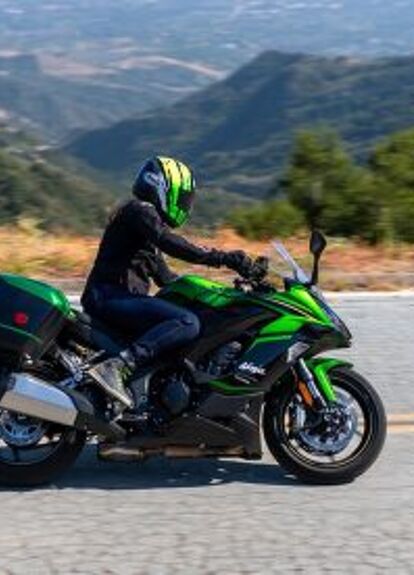
- Helmet: Arai Corsair-X
- Jacket: Alpinestars Stella T-GP Plus R V4
- Gloves: Racer Guide 2
- Pants: Bolid'Ster Jeny'Ster (discontinued)
- Boots: Stylmartin Kansas WP (discontinued)
Scorcard
Engine | 19/20 | Suspension | 14/15 | Transmission | 10/10 |
Brakes | 9/10 | Instruments | 4/5 | Ergonomics | 8.5/10 |
Appearance | 8.5/10 | Desirability | 9/10 | Value | 8/10 |
Editors Score: 90.0% | |||||
2025 Kawasaki Ninja 1100SX SE Specifications | |
|---|---|
MSRP | $15,399 |
Engine Type | 4-Stroke, Liquid-Cooled, DOHC,4 Valve Cylinder Head, Transverse In-Line 4-Cylinder |
Displacement | 1,099cc |
Bore & Stroke | 77.0 x 59.0mm |
Torque | 83.2 lb-ft @ 7,600 rpm (claimed) |
Compression Ratio | 11.8:1 |
Fuel Injection | DFI with 38mm ETV Throttle Bodies (4) |
Ignition | TCBI with Digital Advance |
Transmission | 6-Speed |
Final Drive | Sealed chain |
Rake/Trail | 24.0°/3.9 inches |
Front Tire | 120/70 ZR17 |
Rear Tire | 190/50 ZR17 |
Wheelbase | 56.7 inches |
Front Suspension | 41mm inverted cartridge fork with spring preload adjuster, stepless adjustable compression and rebound damping; 4.7 inches of travel |
Rear Suspension | Öhlins S46 Shock with Adjustable Rebound Damping and Remote Preload Adjuster (SE); 5.4 inches of travel |
Front Brake | Brembo M4.32 Calipers and Brembo Discs (SE) |
Rear Brake | Single 250mm Petal Disc, ABS |
Fuel Capacity | 5.0 gallons |
Seat Height | 32.3 inches |
Curb Weight | 516.0 pounds (claimed) |
Curb Weight W/ Panniers | 527.0 pounds (measured) |
Warranty | 12 months (Kawasaki Protection Plus 12, 24, 36 or 48 months) |

We are committed to finding, researching, and recommending the best products. We earn commissions from purchases you make using the retail links in our product reviews. Learn more about how this works.
Become a Motorcycle.com insider. Get the latest motorcycle news first by subscribing to our newsletter here.
A lifelong interest in anything with two wheels, Nic combined his passion for motorcycling with a rare and mysterious skill known as typing to join the motojournalism ranks. Motorcycle.com's Senior Editor and sometimes club racer displays an unrivaled desire to sample baked goods across the globe and partake in post-track day celebratory pizza.
More by Nic de Sena






Comments
Join the conversation
Auto-lubers have existed for a long time. Bikes still used to have centerstands. Chain oilers make a mess, and are not a good substitute for chain maintenance. I lube the chain with gear oil every other day on a trip. The dirt wipes off with a rag. The whole process takes about 5 minutes. When you don’t use gummy canned lubes no scrubbing is necessary. Touring bikes with chains should have centerstands. As far as I know this is the only bike intended for touring with no factory centerstand option. Is Kawasaki wiser than everyone else or dumber? I vote dumber. Not only should the have one, they are missing out on selling people a $100 stand for $350.
If only there were better colour choices. If only the dash didn't look so awful.