


2027 Ducati Superleggera V4 Centenario – First Look

A carbon fork, carbon brakes, and a new 247 hp engine

Ducati praises itself for pushing the envelope with every generation of superbike. We saw that again in the current generation Panigale V4, and the racing homologation special Panigale V4 R, both boasting advanced MotoGP-derived technology never before seen on production motorcycles.
Read More:
But there are practical limits to what can be done on large production bikes, including the risk of pricing your product beyond the reach of your audience (or in the case of the Panigale V4 R, beyond the price cap for World Superbike eligibility). Those concerns are less important when it comes to limited edition models, which are designed for those who seek the utmost in performance, and have the means to afford it.

That’s the path Ducati has taken since 2014, when it introduced the 1199 Superleggara, followed by the 1299 Superleggera in 2017, and Superleggera V4 in 2020. Each iteration pushed Ducati’s superbike platform to new, more exotic levels. As part of the company’s 100th anniversary celebrations, Ducati is once again setting benchmarks with the new Superleggera V4 Centenario.
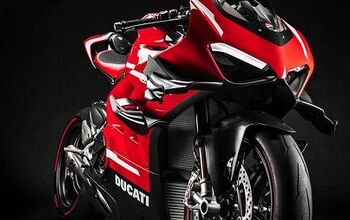
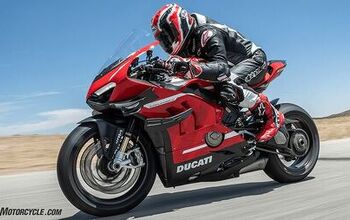
As with previous Superleggeras, the Centenario makes good use of carbon fiber to reduce weight, employing the lightweight material for its frame, swingarm, bodywork, and wheels. For the first time on a street legal production bike, the Superleggera V4 Centenario adds carbon-ceramic brake discs and carbon fork sleeves, while also debuting a new version of its V4 engine.

The Desmodsedici Stradale R 1100 engine combines the cylinder head of the 998cc Panigale V4 R’s engine with the regular Panigale V4’s longer stroke, bringing the displacement back up to 1,103cc. As with the V4 R, the Centenario’s engine uses 34mm titanium intake valves and 27.5mm steel exhaust valves, all driven by a Desmodromic timing system.
Ducati replaced the regular V4 crankshaft’s steel counterweights with denser tungsten inserts, allowing the weight to be concentrated further from the axis of rotation. According to Ducati, this allows the engine to rev faster for more immediate response, while also reducing the load on the bearings and other mechanical components.

According to Ducati, the Centenario reaches a peak output of 228 hp at 14,500 rpm, and 86.7 lb-ft. at 10,500 rpm using the underslung Akrapovič silencer, but with the dual undertail Akrapovič racing exhaust and Ducati Corse Performance oil, Ducati claims the engine can reach up to 247 hp at 14,750 rpm, and 93.2 lb-ft. at 10,500 rpm.
The engine is matched with a dry clutch employing titanium fasteners, contributing to a claimed eight-pound weight reduction. The Centenario also uses the Ducati Racing Gearbox first introduced on the Panigale V4 R, employing a racing configuration with neutral located below first gear, and a Ducati Neutral Lock system to prevent accidentally engaging neutral.
The electronics package is inherited from the V4 R, but with updated calibrations. The package includes lean-sensitive traction control, wheelie control, slide control, power launch, cornering ABS, and engine brake control with dynamic engine brake functions.

The Superleggera V4 Centenario is the first road motorcycle equipped with Öhlins’ pressurized NPX 25/30 Carbon fork, which uses carbon fiber sleeves. According to Ducati, the carbon fork is 10% lighter than the Panigale V4’s fork, and 8% lighter than the V4 R’s fork, while offering improved front-end sensitivity. For the rear, the Centenario uses an Öhlins TTX36 GP LW shock with a steel spring and MotoGP-derived valves, connected to the carbon swingarm via a titanium linkage system.
The braking system pairs new Brembo GP4-HY monoblock calipers with integrated cooling fins machined from solid aluminum and carbon fiber-reinforced ceramic discs. The silicon carbide discs are designed to maintain performance efficiency even at high temperatures, while weighing a pound lighter and exhibiting 40% less momentum of inertia compared to a traditional steel disc. The technology has been used with hypercars before, but this is the first application for a production motorcycle.

The carbon fiber bodywork includes aerodynamic winglets and cornering sidepods derived from the Panigale V4 R, combining to generate downforce on straightaways and when leaned over.
The GP26 Rosso Centenario livery uses a dark red based on the color of past models such as the 1949 Ducati 60 and the company’s first racebike, the 1955 Gran Sport “Marianna”, offset by white stripes. Ducati will produce 500 units, each with a plate signed by the technician that hand-set the Desmodromic camshaft timing.
Ducati is also producing a limited run of 100 units in a Tricolore livery inspired by the 1986 Ducati 750 F1 BOT, the final racing motorcycle designed by Fabio Taglioni. The red, white, and green colors are matched with Ducati’s double-stripe ’80s-era logo, a gold-colored stripe on the tank recalling transparent sections on historic racing bikes to view fuel levels, and the 618 racing number of Daytona Battle of the Twins winner Marco Lucchinelli.

U.S. pricing remains to be announced, but if past Superleggera models are any indication, we can expect something well into six digits.
2027 Ducati Superleggera V4 Centenario Specifications | |
|---|---|
MSRP | TBA (but if you have to ask...) |
Engine Type | Desmosedici Stradale R 1100, 90° V4, counter-rotating crankshaft, Desmodromic timing, 4 valves per cylinder, liquid-cooled |
Displacement | 1,103cc |
Bore x Stroke | 81 x 53.5 mm |
Compression Ratio | 14.0:1 |
Horsepower | 228 hp at 14,500 rpm / 247 hp at 14,750 rpm with krapovič racing exhaust and Ducati Corse Performance oil (claimed) |
Torque | 86.7 lb-ft. at 10,500 rpm / 93.2 lb-ft. at 10,500 rpm with krapovič racing exhaust and Ducati Corse Performance oil (claimed) |
Fuel Injection | Electronic fuel injection system. Twin injectors per cylinder. Full ride-by-wire elliptical throttle bodies. |
Exhaust | 4-2-1-2 system, with 2 catalytic converters and 4 lambda probes |
Gearbox | 6 speed (N123456 with Ducati Neutral Lock) |
Primary Drive | Straight cut gears; Ratio 1.80:1 |
Ratio | 1=36/15 2=34/17 3=33/19 4=32/21 5=30/22 6=27/22 |
Final Drive | DID ERV7 chain; Front sprocket 16; Rear sprocket 40 |
Clutch | Dry clutch with titanium screws |
Frame | Carbon fibre "Front Frame" with optimized stiffnesses. |
Front Suspension | Fully adjustable 43 mm Öhlins NPX 25/30 Carbon pressurized fork with TiN treatment and carbon fibre outer tube. 4.9 inches of travel. |
Rear Suspension | Double-sided swingarm in carbon fibre. Fully adjustable Öhlins TTX36 GP LW shock absorber, with GP valves and optimized lightweigth steel spring. 5.1 inches of travel. |
Front Wheel | 5-split spokes carbon fibre 3.50" x 17" with titanium bolts. |
Rear Wheel | 5-split spokes carbon fibre 6.00" x 17" with titanium bolts. |
Front Tire | Pirelli Diablo Supercorsa SP-V4 120/70 ZR17 |
Rear Tire | Pirelli Diablo Supercorsa SP-V4 200/60 ZR17 |
Front Brake | 2 x 340 x 8 mm carbon-ceramic Brembo discs, Brembo Monobloc GP4-HY with Race eCBS. Brembo MCS 19.21 master cylinder with remote adjuster. Self bleeding master cylinder. |
Rear Brake | 223 mm floating disc, 2-piston caliper with Race eCBS |
Instrumentation | Digital unit with 6,9" TFT display and Optical Bonding - 1,280 x 480 px resolution |
Weight | 381 pounds (claimed, wet with no fuel) |
Seat Height | 33.7 inches |
Wheelbase | 58.3 inches |
Rake/Trail | 24°/3.9 inches |
Fuel Capacity | 4.5 gallons |
Seats | Single seat |
Electronics | Riding Modes, Power Modes, Ducati Slide Control (DSC), Bosch Cornering ABS, Ducati Vehicle Observer (DVO), Ducati Traction Control (DTC) DVO, Ducati Wheelie Control (DWC) DVO, Dynamic Engine Brake (DEB), Race Brake Control, Tire Calibration, Ducati Quick Shift (DQS) up/down 2.0, Type-approved Akrapovič muffler, Lithium-ion battery, Quick adjustment buttons, Öhlins steering damper, Carbon fiber wheels, Coming Home, Single seat configuration, Ducati Power Launch (DPL) DVO, TFT colour display, Full LED lighting system, Self cancelling turn indicators, Lap Timer, Pit Limiter |
Ready For | Anti-Theft, Tyre Pressure Monitoring System (TPMS), Cruise control, Ducati Multimedia System (DMS), Lap Timer Pro, Heated grips, Turn-by-Turn navigation system, USB port, Ducati Remote Telltale (DRT) |
Warranty | 24 months, unlimited mileage |
Maintenance Intervals | 7,500 miles (12,000 km) / 12 months |
Valve Adjustment Intervals | 15,000 miles (24,000 km) |
2027 Ducati Superleggera V4 Centenario First Look Gallery

Become a Motorcycle.com insider. Get the latest motorcycle news first by subscribing to our newsletter here.
Dennis has been a part of the Motorcycle.com team since 2008, and through his tenure, has developed a firm grasp of industry trends, and a solid sense of what's to come. A bloodhound when it comes to tracking information on new motorcycles, if there's a new model on the horizon, you'll probably hear about it from him first.
More by Dennis Chung




Comments
Join the conversation
This bike is too much of everything and I absolutely love it!
Already sold out!