


How to Clean a Motorcycle Helmet Visor
Cleaning your motorcycle helmet visor is essential to ensure safety

Summer is here: The birds are chirping, the snow has melted, and our bikes are getting much-needed time on the road. Do you know who else has decided to join in on the festivities? Bugs and lots of them! That's not the only thing that ends up there because your visor collects all kinds of road grime, too. Cleaning your visor is a simple, albeit disgusting, part of motorcycling safety because we all need to maintain optimal vision when riding. Still, at least you're not riding around the Smoky Mountains picking mosquitoes out of your teeth! Here, we will discuss how to clean a motorcycle helmet visor and the best ways to do it.
Promoted Product: RUROC EOX Helmet X Iron Maiden

Ruroc EOX Iron Maiden is now live and on tour. The RUROC EOX helmet now comes in two exclusive Iron Maiden designs, ‘Piece of mind’ and ‘Writing on the Wall’, combining legendary artwork with top-tier protection and performance.
The EOX is RUROC’s most advanced helmet yet, engineered for serious riders who demand both safety and style. It’s built with a Quad-Matrix composite shell, Ruroc’s signature blend of T300 carbon fiber, Kevlar, Nylon, and Fiberglass, all designed to deliver high impact protection while keeping weight low.
Inside, a six-part EPS and EPP liner system uses four different foam densities to absorb low, medium, and high-energy impacts, giving you smarter, layered protection where it counts. It is also lined with RHEON protection technology, a smart material that reacts instantly on impact, stiffening when hit, which helps to absorb both straight-on and rotational forces.
Designed for seamless integration with the Shockwave Mesh communication system by Cardo, the EOX lets you connect to music and access comms to up to 15 other riders.
Key features include DOT and ECE certification, a 215° wide-angle visor that swaps out tool-free, six vents plus internal channeling for fully adjustable airflow, and three shell sizes with two cheek pad options for a perfect fit.
Get yourself ready to ride for the hills!
They say that the best maintenance is preventative maintenance, and things aren't getting any cheaper – not in this economy, partner! Sheesh. When talking about helmets manufactured by reputable brands, the visor will be far more than mere pieces of plastic. More often than not, your helmet's visor is an advanced, optically correct piece of equipment with years of research baked into it, designed to withstand impacts, penetration, and improve aerodynamics. Routinely cleaning your visor properly ensures that no contaminants will be left to damage your visor in any capacity while allowing you to have the best view possible.
You don't need fancy chemicals or tools to clean your visor properly. You only need a microfiber cloth, a paper towel, and water. That's it, and you can even get there with just water and a cloth.

In fact, many helmet manufacturers advise owners to only use water and light dish soap for stubborn gunk, but there's a good reason. Certain chemical-based cleaners, like various window or motorcycle cleaners, might seem like a good idea. However, they can include harsh acids, solvents, and other chemicals that will compromise the integrity of your visor. Remember, your visor's first and most important job is to protect you from debris, and we'd never want to weaken it unknowingly. Now that we've covered that let's talk about how to clean your visor.
If you have a favorite cleaning solution, ensure it is water-based and doesn't include anything that will react negatively with plastics, rubber, or paint.
Cleaning Your Helmet's Visor

One question we wish we got asked at Motorcycle.com is, "How do the MOrons stay looking so fresh, so clean, and knee-achingly attractive while riding with supreme skill during photo/video shoots?" Unfortunately, we don't have that question thrown at us, but we know how to clean a helmet quickly and effectively, even out in the boonies.
We clean our helmets far more often than the average rider and always rely on a fresh microfiber cloth, some water, and a little bit of elbow grease. If you follow these steps, you'll be on the road in no time and have perfect vision to keep those reaction times optimal.
Cleaning your visor properly should only take a few minutes at most. Here's what you gotta do: Take a soaking wet paper towel, rag, or microfiber cloth and lay it across your visor's exterior. This is essential in loosening dried bugs, grime, and containments. In addition, water acts as a lubricant, which helps prevent debris from scratching your visor – always try to avoid wiping your visor with abrasive materials.

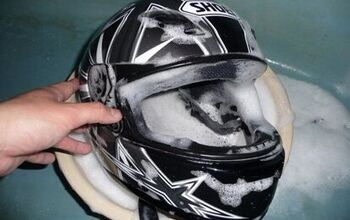
Once you've thoroughly soaked the visor, it's time to wipe away all the debris stuck to it, which will come off relatively quickly. If you're struggling with stubborn spots, add additional water to the rag or towel and let it sit longer. Repeat this process for the interior of the visor because road grime will also collect on the inside surface. Off-road riders who routinely encounter dusty conditions will undoubtedly be familiar with this, as dust can get into every nook and cranny. Now that you've cleaned the visor, thoroughly wipe it down with a dry microfiber cloth to ensure it's as clean as possible. There's not much more to it than that! If things are extra filthy, or you're dealing with grease/oils, you can opt for some warm water and dish soap, which will take it all off.
Doing this after a long ride is always a good idea because you can inspect your helmet for damage and perform additional TLC. Lubricating your helmet's visor seal with silicone grease will ensure that your visor creates an airtight seal, reducing noise, further controlling airflow, and preventing fogging.
What About Pinlock-Equipped Visors?

If you run a Pinlock on your visor, you'll need to take a few extra steps. Carefully remove the Pinlock insert and repeat the process we've already covered. Wet a clean paper towel, rag, or microfiber cloth to clean the Pinlock insert and visor, then wipe down thoroughly with a dry microfiber cloth. Once complete, let the visor and Pinlock air dry completely before reinstalling the insert.
That's it, folks. Clean microfiber cloths, water, and a little dish soap are all you need to get the job done. Cleaning your helmet's visor is a dirty job, but it is crucial because we must see whatever is coming at us. So, always pack a spare cloth on your bike or luggage so you can get things handled on the road.
Become a Motorcycle.com insider. Get the latest motorcycle news first by subscribing to our newsletter here.

More by Edward Narraca






Comments
Join the conversation
For fogging in the winter, after cleaning the visor I add a drop of dish soap and work it into the inner surface with my finger until it's disappeared. Works.
A great product that I always use now (since working in the aircraft detailing field) is called Novus Plastic Polish.
Novus comes in three levels (1, 2 & 3), where #3 is for heavy scratches, #2 is for light scratches and #1 is for the final polish. I keep a small spray bottle on the bike.
Works well and I’ve never had any issues with deteriorating the shield plastic.
Another product I often use in conjunction with the Novus is Rymple Cloth. It’s an extremely soft mesh cotton cloth that we used on aircraft shields. On the down side, though, it’s fairly expensive, harder to find and designed to be a one-use product. So, I use it sparingly with a clean microfiber cloth in between.
I also agree with other posters on here about initially using a soaking wet cloth (paper towel, terry towel, microfiber, etc.) to soak the shield first. Definitely a good practice.
Another aviation tip is to always wipe you shield up and down rather than side to side. No matter what product or cloth you use, you’re still creating micro scratches. When you wipe side to side, those micro scratches tend to reflect the sun’s rays up into your eyes, creating an annoying (possibly dangerous) glare. Wiping up and down, on the other hand, lets those rays just travel right through your face shield or windscreen. Honestly, I don’t know how much that affects our shields, since we replace much more often that an aircraft shield, but it certainly can’t hurt, right?
Anyway, that’s my two cents. Err…maybe that’s six cents as this post is kinda lengthy…