


Comparison: 2025 Honda CB750 Hornet vs Suzuki GSX-8S vs Yamaha MT-07

Three parallel twins, three different personalities. Which one do we like the best?

The middleweight naked class has always been one of motorcycling’s best playgrounds. Affordable, approachable, and endlessly fun, these bikes are the gateway drug for many riders and a permanent fixture in the garage for plenty of veterans. This year we’ve lined up three contenders that all share a common thread: parallel-twin engines with 270-degree cranks. On paper, they should be similar. But if that were the case, we wouldn’t be here testing them.
Video: 2025 Middleweight Naked Comparison
Yamaha has found big success with what was first called the FZ-07. The rest of the world has always known it as the MT-07, and eventually the Tuning Fork company wised up and solidified the MT-07 name everywhere. For 2025, the bike sees a host of updates, including a stiffer frame and revised electronics. The 689cc CP2 engine? It’s basically unchanged.

Suzuki also found a hit with its GSX-8S. Capitalizing on the popularity of the class, Suzuki’s entry introduced the first new engine platform for the company in a long time. Not only that, but for many, myself included, it represents the spiritual successor to the venerable, and much loved, SV650 (spiritual because Suzuki still sells the SV to this day — for the same price as the 8S, too). We’re big fans of the 776cc Twin, and apparently you are too, because Suzuki sells a bunch of them.
Not wanting to miss out on the middleweight fun, Honda has revived an old name in its lineup and built a new bike around it. The 2025 CB750 Hornet is the new player on the scene Honda hopes will steal some of the thunder from its Japanese rivals (not to mention the European players, too). Housed in its frame rails is a 755cc Twin, with a supporting cast that includes Showa suspension, Nissin brakes, and geometry similar to the other bikes here. Which is a nice reminder that while the specs on paper might look close, the reality of how these three bikes perform is very different.

That’s where we come in to test them out and tell you about it. Joining me for this one are my partners in crime, Nic de Sena and Ryan Adams. Our testing spanned the gamut of street riding, from boring freeway droning, city riding runabouts, and of course, some good hooning in the canyons.
What do we think? Grab a cup of your favorite beverage and get comfortable. We’re going on a ride.
Engines: Same Crank, Different Stories
Let’s get this out of the way right off the bat and present you with the dyno chart:

It’s not surprising to see the Yamaha bring up the rear of the power and torque graphs with its smallest engine, but it’s interesting to see the MT-07 edge ahead of the Honda early on in the rev range. On the opposite end of the spectrum, the Honda makes the most power here — but only at the pointy end of the rev range. That was a little bit of a surprise considering its engine is smaller than the Suzuki’s, but there’s no denying the Honda engine likes to rev. Then there’s the Suzuki. It makes the most torque thanks to its biggest displacement, and even though the peak horsepower number isn’t the best of the bunch, everything under the peak skews in the GSX-8’s favor. What that amounts to in the real world is excellent usability in all conditions.
Nic points out that “three Parallel-Twin engines all sharing the same in-vogue 270-degree crank orientation can have such disparate personalities and strengths, underscoring how spec-sheet gazing will only get you so far.” And he’s right. Each bike makes its case differently.

In the case of the Yamaha MT-07, we have a bike that, a decade ago, Yamaha surprised us with. The 689cc CP2’s punchy, MotoGP-inspired crossplane crank character was a ton of fun and it’s still a riot today. Nic noted it had “an entertaining and boisterous” 65 horses with loads of midrange that’s perfect for riders climbing the ladder from an MT-03. Ryan added that it “never had a hard time keeping up with the other two bikes in this test on the mountain roads north of Los Angeles.” The downside might be hard to believe. Yes, the engine is fun and packs a punch, but it’s still the smallest of the bunch. As such, it’s lacking the horsepower of its rivals and doesn’t have the quickshifters they bring (although Yamaha will sell you one as an accessory if you want).
Each time I hopped on the MT-07, its bottom-end rush belied the fact it’s “displacemently challenged.” It leaps with purpose and is like that bullish puppy dog, eager to nip at the heels of the Honda and Suzuki, though it doesn’t have the same kind of bite. It revs freely and has a ton of attitude and character. It’s easy to see why Yamaha sells so many models with this engine in it. We had to use the clutch lever often since the MT was the only bike here without a quickshifter, but it really wasn’t an issue. Clutch pull is so light our left hands hardly felt tired.

At some point, however, horsepower takes over, and when the Honda and Suzuki decide it’s time to move, the Yamaha understandably struggles to keep up. That old adage about displacement having no replacement still rings true, and it’s ultimately the Yamaha’s downfall in this group.
With that, it shouldn’t come as much of a surprise the Yamaha MT-07 brought up the rear of the field on the trusty MO scorecard. Still, it deserves its flowers for doing more with less.
The Honda’s mill is the high-strung one of the group. With 76.6 hp and a rev-happy bore/stroke design, Nic calls it “a whipper snapper that builds momentum up to its peak and doesn’t give up the ghost as early as many parallel-twin engines.” Ryan backed that up, saying “the CB750 also takes the cake for delivering the most horsepower at 8,200 rpm – and it sounds sweet the whole time it’s working its way up there.” The tradeoff? Softer low-end torque than its peers, making it feel a little sleepy around town until the tach climbs past 4,600 rpm. The answer, obviously, was to keep the revs in the sweet spot as much as possible.

We all agreed the Honda’s engine evokes some of Honda’s CBR spirit. For me, that personality trait made it my favorite engine of the group. Despite the relative sluggishness down low, it’s a ton of fun once you get it spinning. Being the more pragmatic types, Ryan and Nic didn’t quite feel as enthusiastic about the Hornet’s mill as I did.

Also cool is the Honda’s quickshifter/autoblipper. Let the engine rev and upshifts are clean and crisp, with a racy “pop” from the exhaust. Shift at mid-rpm range and the CB will exhibit a lag before reapplying power, especially in the first two gears. Downshifts are also fairly smooth, especially considering the pricepoint the CB sits at: $7,999 — the cheapest one here. Neither the Honda or Suzuki have world-class quickshifters/autoblippers, but in this group, the Honda’s is the better of the two.
If the Honda is the screamer and the Yamaha is the hooligan, then the Suzuki is the adult in the room. Nic calls it “the most mature engine among the three,” and Ryan tagged it as the “goldilocks mill of the bunch.” Its 776cc displacement delivers the most torque — 53.4 lb-ft at just 5,400 rpm — and makes the GSX-8S the easiest to ride lazily. The only knock? A finicky quickshifter and a heavier clutch pull.

Take another look at the dyno chart and pay attention to the Suzuki’s graph. It trounces the Yamaha from top to bottom (not surprising), but also shows the Honda who’s boss below 7,500 rpm — you know, the actual rev range most people will find themselves in most of the time. This sort of user friendliness is what has endeared the GSX-8S — and all the other bikes this engine is in — to the masses. It’s also why we’re such fans of it, too. In fact, both Nic and Ryan ranked it their favorite engine of the three.
I can certainly see why my esteemed colleagues voted the way they did, but to me, the GSX-8 revs slowly, a byproduct of its long-stroke engine design. It’s useful to have all that torque, but it doesn’t inspire the same thrill as the Honda’s engine. Some might think it's silly to rank thrill over useability, but hey, motorcycles are emotive, not necessarily pragmatic.

What the three of us universally found puzzling was the Suzuki’s quickshifter. Nic called it “the quirkiest of the bunch” because, as he puts it, “the upshift function isn’t bad, but the downshift takes a curiously high amount of pressure to activate. The solution for anyone riding at a spirited pace is to ignore the newfangled gadgetry and blip the throttle the old-fashioned way; however, the biggest bike also has the heaviest clutch pull.” And therein lies the rub.
Is it a dealbreaker? Not really. We’re still big fans of the GSX-8S engine. But a proper quickshifter would be the cherry on top.
Chassis and Handling
Yamaha’s big update this year centers around the chassis. It’s stiffer than before and now is paired with a 41mm inverted fork. The difference is a big one, as previous versions of the bike would exhibit some flex once you started to push it. Not anymore. The MT-07 is all grown up, although Nic says it’s still “the softest, with the most street-focused damping and spring rates,” while Ryan added that its short wheelbase and steep rake made it “a willing dance partner” in the canyons. The tradeoff is vagueness at the front end — Ryan again: “the upright riding position leads to not getting much weight over the front wheel and the torquey engine exacerbates the vague front end feel.”

My experience, however, is a little different. At least in terms of chassis compliance. Where Nic and Ryan thought the MT-07 was damped on the soft side, I disagreed. Whenever I hopped off the Yamaha, I’d tell the guys that I felt like the 07 was transmitting every single bump in the road right back to me, it was that stiff. Both of them met me back with blank stares.
Our best guess comes down to the difference in body weight between us. I’m at least 20 pounds lighter than the other guys, and while I never thought that was enough to make a huge difference on a street bike, apparently it is. The spring rates feel better suited to those heavier than me, and when you combine that with the already stiffer chassis, it was enough for me to experience different things than Nic and Ryan. Though I will agree with Ryan on the vagueness from the front end. On a positive note, the MT-07 was the only bike here with adjustable rebound in the shock. It’s not much, but it was welcomed.

The Honda, meanwhile, feels like the engineers really wanted to add an R to its name. Its sporty engine is matched with a chassis equally as eager. Nic noted it “flies through canyons with agility and confidence,” thanks to its narrow 160-section rear tire (the other two bikes wear 180/55 rears) helping it turn on a dime. But that agility comes at the cost of composure — “it doesn’t absorb rough patches on the freeway quite as well, nor does it stay as controlled as the Suzuki,” Nic observed. Ryan agreed, saying the Hornet felt like “a nice middle ground in terms of support and comfort,” but still on the taut side.
You sit with the most sporty bend of the three while on the Honda, another nod towards its CBR aspirations, which helps put some weight over the front, in turn giving the rider all important feedback. The bars aren’t particularly wide, but are wide enough to put some ample leverage and dictate which way you want to go. In its element, the Honda engine and chassis are a fun combination to exploit. Its ergonomics, however, are what let it down. We’ll cover that in a minute.

By now you could likely guess that the Suzuki, predictably, lands in between. Stable, composed, and planted, it’s the bike that can carve a canyon if you want it to, or it can cruise in relative comfort. Nic said it “stood up to most heavy hits” that rattled the Honda, while Ryan summed it up: “the GSX-8S earns my greenbacks thanks to its well-rounded package.” The flip side is steering — while the Honda flicks like a sportbike, the Suzuki wants more rider input and feels a little sluggish by comparison, but makes up for it with the sturdiest front-end feel here.
Things get confusing when it comes to the shock. I thought it felt soft, which was great for normal riding, but not when the pace picked up. What’s weird is Ryan and Nic didn’t feel the same, both noting how the shock was damped well for their tastes. Unfortunately, without any adjustability other than preload in the shock, riders who don’t like how it feels can’t do much about it. Still, as all of these bikes will spend the majority of their time at normal speeds, the Suzuki’s overall compliance gives it the nod in the chassis department.
Brakes
Braking is an area where all three bikes still show their budget roots. To be fair, all three have radially mounted calipers with four pistons inside, but all three also use axial master cylinders and rubber brake lines. Despite how similar this sounds on paper, the reality of how all three actually operate isn’t similar at all.

Excuse us if you’ve heard this before, but, in Ryan’s words, the Yamaha’s brakes have, “plenty of power, zero feel. Just Yamaha things.” It’s the same Yamaha story we’ve heard (and experienced) over and over before. As far as outright braking power is concerned, there’s a good argument for the MT-07 to be the strongest of the three. Trying to modulate that power is tricky.

The Hornet has the opposite problem: Nic found it “communicates quite a lot of feedback via the front lever, but doesn’t offer nearly the same kind of power or attack.” Nic wasn’t the only one who felt this way, as I also noted how the Honda’s brakes offer a complete 180° compared to the Yamaha. You have to squeeze the lever(s) quite a bit to slow down with any sort of gusto, but at the same time, it feels as though each incremental pull on the lever amounts to an equal amount of braking force. You just need a lot of pull.

Once again we find the Suzuki being a nice compromise. Its brakes aren’t the strongest, nor does it offer the best feedback. But they’re strong enough, and it’s not like they’re wooden. The GSX-8S still offers predictable stopping power, just in a manner that goes about its business without any fanfare. Because of this, once again, the Suzuki finds itself winning another category on the MO scorecard.
Ergonomics and Comfort
Ryan’s take on the Honda was clear: “Ergonomically, you also feel very much like you’re sitting in the bike rather than on it,” which works for shorter riders but cramps taller ones. Nic agreed, saying it’s “the most compact rider triangle” of the group. I third the opinions of Nic and Ryan. The Honda feels the tightest of the three, which may work out fine if you’re short. The pegs also feel slightly higher than the rest. So, if you’re tall or long-legged, prepare yourself for some achy knees. Also, you don’t have much room to move around or get into a tuck before running into the passenger seat. Save for a few minor movements, you’re effectively locked into position on the CB750. This isn’t so bad for short rides, but the longer you ride, the more you’re going to want to shift your position, even if it’s to tuck on the freeway to find some reprieve from the wind. There simply isn’t much room to move.

The Yamaha is the upright outlier. Ryan called it “a sit up and beg riding position” that’s comfy around town but “turns you into a sail at freeway speeds.” Nic says the MT-07 has a “supermoto-esque feel to it, propping riders up in a commanding position with handlebars that come back further to meet the rider while also offering ample legroom.” He also noted the Euro-influenced accessories on our tester — heated grips, comfort seat, and topcase — only added to its commuter versatility. We didn’t have the standard seat to try alongside the comfort one fitted to our test bike, but we found this accessory seat didn’t particularly feel any more or less comfortable than any other seat we’ve been on. We expected more. Unless, by comfort, Yamaha’s talking about the seat raising the rider up, and thus relaxing the knee bend.

Guess what? We find ourselves with the Suzuki, again, as the middle ground. Ryan praised it as “the goldilocks of the bunch… you’re able to scoot back on the seat and generally move around in the cockpit easier than the Honda or Yamaha.” Nic echoed that it feels like “the most mature motorcycle here, offering the most cohesive package between its riding position, engine, and chassis.” He continues, “Suzuki’s sensibility is another green flag. It does have the tallest seat height at 31.9 inches, though we should note that none of these saddles are stacked particularly high to begin with. Factor in the slim Parallel-Twin engine dimensions, and riders of varying sizes shouldn’t have too much trouble reaching terra firma.”

Once again, I agree with my colleagues. Despite being the heaviest bike here and having the tallest seat, the GSX-8S wins the comfort category. The soft shock I talked about earlier compresses enough once you’re sat on it that it’s nearly possible for my 5-foot, 8-inch frame and 30-inch inseam to flat-foot the ground with both feet. Once you’re down the road, there’s plenty of space to move about the cockpit since the transition from rider’s seat to passenger seat is less acute. There’s also a faint forward tilt to the bars, which is just enough to resist feeling like a sail the faster you go.
Electronics
We live in an age now where even sub $10,000 motorcycles like these three come with electronics. ABS? Yep. Traction control? Of course. Power modes? That’s a no-brainer. Two of the three come from the factory with bi-directional quickshifters, and the third has an upshift-only quickshifter in the parts catalog. In fact, the Honda even allows you to adjust the firmness of the quickshifter up and down in three increments.

Over the course of our testing, which happens in the motorcycling mecca of Southern California, we never truly got to put the safety nets to use. We never found ourselves in slippery situations to test the traction control. We also never found ourselves braking hard enough (at least with the front) in an emergency situation to engage ABS. But previous experience has convinced us that the level of competency of the systems is wholly adequate for normal riding situations. None of the bikes here have an IMU, so don’t expect cutting-edge performance, but there’s plenty of tech waiting in the background to step in if you need it.

Instead of rating the actual tech on each bike, it’s worth comparing the UI and UX between these three. All three bikes have TFT screens that are bright, colorful, and easy to read. The Yamaha and Suzuki menus are also fairly easy to navigate. The MT relies primarily on a joystick to move between screens, while the GSX-8S has more traditional directional buttons.

What annoyed the three of us was the Honda’s UI/UX. A small multi-directional button on the left switchgear is the primary method to move between screens and make selections, but Honda chose to use symbols instead of actual words in some areas, making it very confusing to know which menu we were selecting. Equally confusing was knowing when to press the button versus tapping it a certain direction. We’re sure owners of the bike will figure it out and get used to it over time, but it shouldn’t be this hard to figure out.

Verdict
Here we have three bikes with three distinct personalities. The Yamaha MT-07 has grown up — the stiffer chassis has turned it from a forgiving play bike to one that requires more of your attention, but rewards those who are able to rise to the challenge (and those who are the right weight for the suspension). We still enjoy the MT-07 as much as we always have because it’s tons of fun, ultra-friendly, and just plain practical. It also scored the best fuel mileage of our test by a long shot, averaging 47 mpg while the Honda and Suzuki barely got over 40.
Right from the onset, however, we knew the Yamaha was going to be outgunned. The engine makes good, usable power — just not enough of it. We weren’t thrilled with its ergos, especially on the freeway, and worst still, its $8,599 price tag puts it in the middle of this group. So there isn’t much of a value proposition to talk about.

Despite these setbacks, Nic rated the Yamaha as his second favorite bike while Ryan had it tied for second. I was the only one of us that ranked it last. However, when factoring objective metrics like price and power-to-weight ratio on the MO scorecard, the MT-07 sits in third place in this test — by less than one percentage point.
The Honda CB750 Hornet is sharp, agile, and the horsepower king, but its softer bottom end make it less universal, and its cramped ergos earned it huge demerit points amongst us. We also scowled and huffed a sigh of despair anytime we had to mess with the menu screen. On the Scorecard, Nic really didn’t gel with the CB750, ranking it last in his personal scores. Meanwhile, Ryan had the Honda tied with the Yamaha for second place in his overall rankings.

I was the complete outlier in the group, ranking the Honda as tied for first place in my personal scorecard, primarily because of its engine. I simply loved it. It got me excited, it’s more playful than the other engines here, and the tinkerer in me is most intrigued with its hidden potential from very simple mods. And the best part? It’s the least expensive motorcycle here, by far, at only $7,999.
Alas, when you combine the subjective scoring with the objective scores, the Honda scores a runner-up finish.
Which then leaves the Suzuki GSX-8S. While it’s not the best in any one category, it’s pretty darn good in all of them. It is the all-rounder — stable, torquey, and confidence-inspiring, if a little less exciting. Though, as we’ve mentioned before, if you ride any of these in a vacuum, “less exciting” won’t be what comes to mind.

The GSX-8S just makes a lot of sense as an overall package. Both Ryan and Nic gave it emphatic first place finishes on their scorecards, while as much as I loved the Honda’s engine, I couldn’t deny the Suzuki’s strengths, which is why I have it tied for first with the Hornet. Factor in the objective scoring with our subjective scores and the Suzuki still comes out on top. At $9,209, the 8S is the most expensive bike in this test, but it also delivers on that price tag, making it a smart buy if it’s on your radar.
Ultimately, where you land depends on what you value most. Fun, flash, or balance. There’s something here for everyone.
Scorecard
Category | Honda CB750 Hornet | Suzuki GSX-8S | Yamaha MT-07 |
|---|---|---|---|
MSRP | 100% | 86.9% | 93.0% |
Weight | 98.3% | 93.7% | 100% |
Pounds/HP | 100% | 91.7% | 87.3% |
Pounds/Torque | 100% | 100% | 93.3% |
Total Objective Scores | 99.4% | 92.1% | 94.4% |
Engine | 92.5% | 94.2% | 85.8% |
Transmission | 90.0% | 85.0% | 80.0% |
Handling | 90.0% | 93.3% | 90.0% |
Brakes | 75.0% | 80.0% | 73.3% |
Suspension | 85.0% | 85.0% | 81.7% |
Technologies | 90.0% | 90.0% | 80.0% |
Instruments/Controls | 76.7% | 85.0% | 85.0% |
Ergonomics | 66.7% | 88.3% | 85.0% |
Quality | 80.0% | 90.0% | 90.0% |
Cool Factor | 81.7% | 83.3% | 83.3% |
Grin Factor | 83.3% | 86.7% | 85.0% |
Overall Score | 86.8% | 88.8% | 85.9% |
Nic’s In Gear
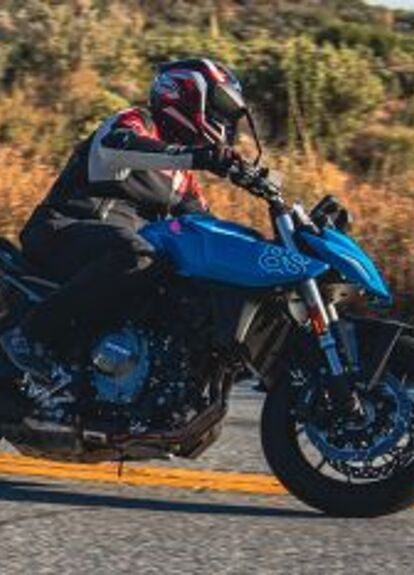
- Helmet: Arai Contour-X
- Jacket: Spidi DP Progressive Hybrid Leather
- Pants: Spidi Supercharged Tex
- Gloves: Spidi Power Carbon
- Boots: XPD Moto Fast H2Out
Ryan’s In Gear
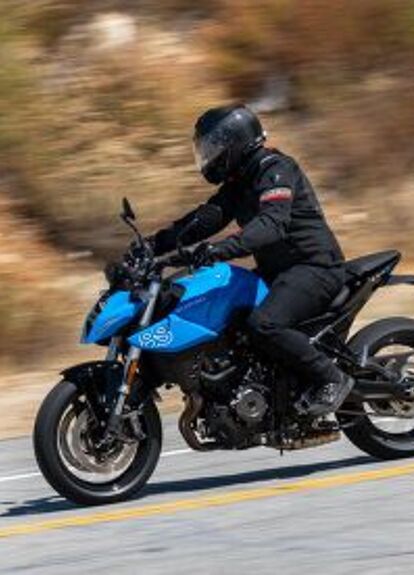
- Helmet: Schuberth C5 Carbon
- Jacket: REV'IT! Tornado 4 H2O
- Pants: Pando Moto Boss DYN 01
- Gloves: Cortech Mirror Breaker
- Boots: Cortech Slayer Checkered
Troy’s In Gear
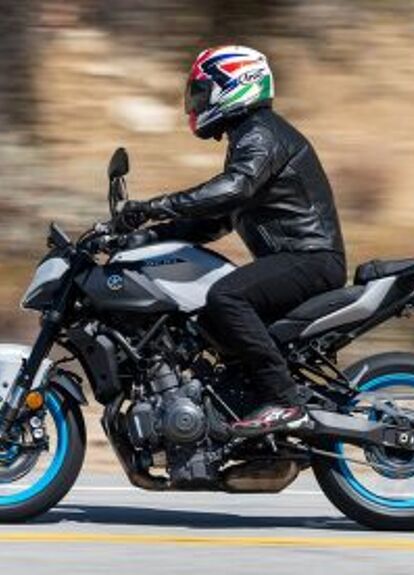
- Helmet: Arai Corsair-X Cadalora
- Jacket: Vanson Full Throttle
- Airbag: Alpinestars Tech-Air 5 Plasma
- Pants: Alpinestars Cult-8 Riding Jeans
- Gloves: Alpinestars Phenom Leather Air
- Boots: Alpinestars SuperFaster
Specifications | Honda CB750 Hornet | Suzuki GSX-8S | Yamaha MT-07 |
|---|---|---|---|
MSRP | $7,999 | $9,209 | $8,599 |
Engine Type | Liquid-cooled 30° Parallel-Twin-cylinder four-stroke w/ 270° crank | Four-stroke, liquid-cooled, DOHC Parallel-Twin | Four-stroke, liquid-cooled, DOHC Parallel-Twin |
Displacement | 755cc | 776cc | 689cc |
Bore x Stroke | 87.0 mm x 63.5 mm | 84.0 mm x 70 mm | 80.0 mm x 68.6 mm |
Compression Ratio | 11.0:1 | 12.8:1 | 11.5:1 |
Horsepower | 76.6 hp @ 8200 rpm | 73.5 hp @ 7900 rpm | 65.1 hp @ 8500 rpm |
Torque | 50.9 lb-ft. @ 7200 rpm | 53.4 lb-ft. @ 5400 rpm | 46.3 lb-ft. @ 6300 rpm |
Fuel System | PGM-FI; 46mm throttle bodies | Fuel injection | Fuel injection with YCC-T |
Ignition | Full transistorized | Electronic ignition (transistorized) | TCI: Transistor Controlled Ignition |
Clutch | Wet, multi-plate type | Wet, multi-plate type | Wet, multi-plate Assist & Slipper clutch |
Transmission | Manual 6-speed | Manual 6-speed constant mesh | Manual 6-speed |
Final Drive | #520 Chain; 16T/45T | O-ring style chain, 525 x 118L | Chain |
Front Suspension | 41mm Showa Separate Function Front Fork Big Piston (SFF-BP) telescopic inverted fork; 5.1 inches of travel | Inverted telescopic, coil spring, oil damped; 5.1 inches of travel | 41mm KYB inverted fork; 5.1 inches of travel |
Rear Suspension | Pro-Link system w/ single Showa remote-reservoir shock w/ 7-stage preload adjustability; 5.1 inches of travel | Link type, single shock, coil spring, oil damped, 5.1 inches of travel | KYB single shock, adjustable preload and rebound damping, 5.1 inches of travel |
Front Brakes | Dual Nissin hydraulic radial-mount, four-piston calipers w/ 296mm petal-style discs; ABS | Dual Nissin radial-mount 4-piston calipers; ABS | Dual four-piston radial-mount calipers, 298mm disc; ABS |
Rear Brakes | Single hydraulic one-piston caliper w/ 240mm disc; ABS | Nissin 1-piston, single disc, ABS | Single one-piston caliper; ABS |
Front Tire | 120/70-17 | 120/70ZR17M/C (58W), tubeless | 120/70ZR17 Dunlop Sportmax Q5A |
Rear Tire | 160/60-17 | 180/55ZR17M/C (73W), tubeless | 180/55ZR17 Dunlop Sportmax Q5A |
Length | 82.4 inches | 83.3 inches | 81.3 inches |
Width | 30.8 inches | 30.5 inches | 30.7 inches |
Height | 42.7 inches | 43.5 inches | 43.7 inches |
Rake / Trail | 25° / 3.9 inches | 25° / 4.1 inches | 24.3° / 3.7 inches |
Wheelbase | 55.9 inches | 57.7 inches | 54.9 inches |
Ground Clearance | 5.6 inches | 5.7 inches | 5.9 inches |
Seat Height | 31.3 inches | 31.9 inches | 31.7 inches |
Curb Weight | 420 pounds (measured) | 441 pounds (measured) | 413 pounds (measured w/ rack, acc seats, and heated grips) |
Fuel Capacity | 4.0 gallons | 3.7 gallons | 3.7 gallons |
Fuel Mileage (average) | 40.3 mpg | 40.8 mpg | 47.7 mpg |
Color | Matte Black Metallic; Matte Pearl White | Candy Daring Red/Metallic Matte Black No. 2; Metallic Matte Black No. 2/Glass Sparkle Black | Team Yamaha Blue; Ice Storm; Matte Charcoal Black |
Service Intervals | 8,000 miles (16,000 miles for valve adjustments) | 7,500 miles (15,000 miles for valve adjustments) | 4,000 miles (26,600 miles for valve adjustments) |
We are committed to finding, researching, and recommending the best products. We earn commissions from purchases you make using the retail links in our product reviews. Learn more about how this works.
Become a Motorcycle.com insider. Get the latest motorcycle news first by subscribing to our newsletter here.
Troy's been riding motorcycles and writing about them since 2006, getting his start at Rider Magazine. From there, he moved to Sport Rider Magazine before finally landing at Motorcycle.com in 2011. A lifelong gearhead who didn't fully immerse himself in motorcycles until his teenage years, Troy's interests have always been in technology, performance, and going fast. Naturally, racing was the perfect avenue to combine all three. Troy has been racing nearly as long as he's been riding and has competed at the AMA national level. He's also won multiple club races throughout the country, culminating in a Utah Sport Bike Association championship in 2011. He has been invited as a guest instructor for the Yamaha Champions Riding School, and when he's not out riding, he's either wrenching on bikes or watching MotoGP.
More by Troy Siahaan


Comments
Join the conversation
i only wish that passenger accommodation wasnt such an afterthought on middleweights.
Im in my 70s and dont go out with a lot of pole dancers.
The same with real fenders (it rains in the BC lower mainland)
And as noted, most of them were styled by people who couldnt make in mecha anime, but still want to (i expect them to turn into human sized robots under the right conditions).
Nothing looks organic or aerodynamic (the GSX8TT is better, but the passenger seat is still designed for a 12 year old).
So im stuck looking at 300+kg touring bikes with engines bigger than most of the cars I've owned, cruisers with 6cm of rear suspension travel and ergonomics that put all my weight on my tailbone or adventure bikes i need a step ladder to get on.
i put almost a quarter million km on my Moto Guzzi 1000SP, a lot of them two up (and even on it, i stretched the wheelbase 3cm to open up passenger space and improve weight distribution) and another quarter million on 4 other Guzzis, plus probably another quarter million on assorted Hondas, Yamahas, Nortons and Enfields, but nothing under 250kg was really good for two up without extensive modifications.
This is at least the third time they have run this article. I think it is time for something new.
I was deciding between the GSX8S and CB750, then came across deal on a slightly-used, BMW F900R with all the options
Think GSX8S, but with more hp & torque...plus IMU, cruise control, heated grips, TPMS, ESA, better handling, center stand, etc.
GSX8S and CB750 are really good, but the F900R is just better & feels much more premium. Sure used vs new...but I chose the better motorcycle.