


Best Motorcycle Airbag Jackets

The latest in motorcycle safety gear is not just a bunch of hot air.
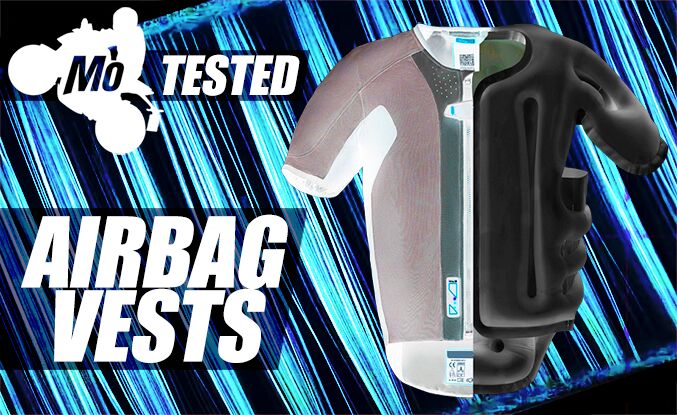
Motorcycling airbags systems have now been in development for upward of 30 years. Companies like Alpinestars and Dainese have brought products to market, revised them, updated them, and developed new airbag systems to cover a broad range of motorcycling such as track riding, commuting, and off-road riding. We’ve seen these systems go from being integrated into specific garments, to standalone units that can be worn universally (with proper fitment). Now, we even have subscription-based systems that offer a lower barrier to entry price-wise than initially available.
Here at MO, we’ve done our best to cover the cutting edge of this technology as new products and airbags emerge. Heck, our own Troy Siahaan has proven himself time and time again to be a most excellent crash test dummy and because of this, he won’t be caught on two wheels without an airbag between him and impending doom. Do yourself a favor and read through Troy’s copious crash tested articles for first hand experience of airbag deployments. Due to his experience, I couldn’t think of a better person to lend a few keystrokes to this article.
Before we get into the five airbag systems we were able to test, we want to address the lack of a major player in the biz. We contacted Helite, which initially showed interest in being involved, but was then later unresponsive. Helite makes a range of airbag products from vests and jackets, to airbag backpacks, and now, airbag riding pants. All of the company’s current product line relies on mechanical tethers to the motorcycle which, when pulled, opens a CO2 cartridge which then deploys the airbag. There are other interesting features to Helite products and we are disappointed to have not been able to include them in this buyer’s guide.
While we know there are other companies out there, these were the latest products we were able to have on hand to review.
With all that said, let’s take a look at how airbags from the other major players stack up.
Why Trust Motorcycle.com?
At Motorcycle.com, our reputation as a trusted authority in the motorcycle world since 1994 is built on our deep expertise and commitment to quality. Our team, composed of seasoned riders and industry experts, brings a wealth of knowledge and experience to every review and product recommendation we offer. We understand that when it comes to motorcycles, parts, and accessories, the right choice can enhance both performance and safety.
Our extensive range of in-depth reviews and performance tests are more than just evaluations; they are insights born from years of hands-on experience and a thorough understanding of what riders truly need. We cover every aspect of motorcycling, from sport bikes and cruisers to adventure bikes and beyond, ensuring that our recommendations cater to every type of rider.
The trust placed in us by over 2 million enthusiasts monthly is a testament to the reliability and accuracy of our advice. Whether it's selecting a new bike, finding the best accessories, or choosing the right gear for your ride, Motorcycle.com is dedicated to providing advice you can trust, backed by decades of expertise in the motorcycling field.
1. Alpinestars Tech-Air 10
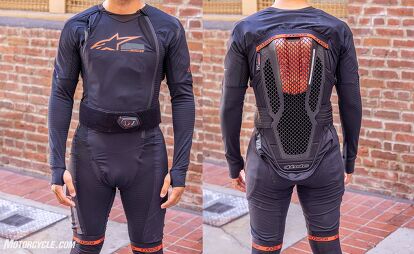
The Tech-Air 10 offers what no other smart airbag system currently on the market offers: airbag protection for the hips and thighs – a very common area prone to impact and injury during a street or track crash. Otherwise, the inner workings of the Tech-Air 10 are very similar to the rest of the Tech-Air family. There are accelerometers and gyroscopes throughout the upper body and back area, but unlike other Tech-Air systems, the TA10 acts as your base layer. There are other differences between it and the other Tech-Airs, too. Apart from the base layer thing, the integrated passive back protector extends lower down the back than the TA5, for example. A Velcro waist strap activates the system, and a removable LED status panel can be placed in dedicated pockets, on the bike, or removed altogether.
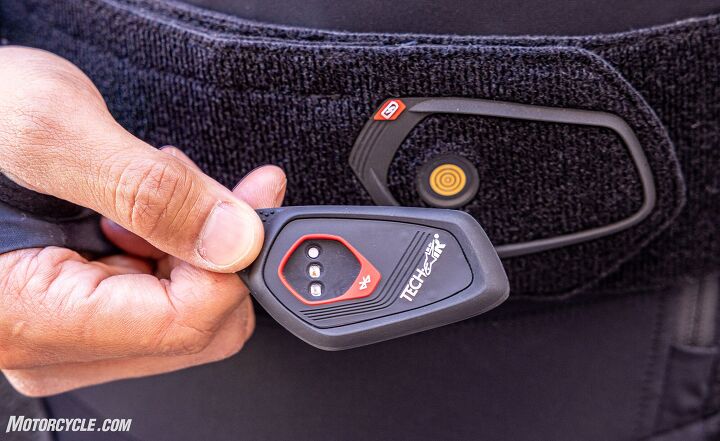
Practically speaking, the Tech-Air 10 looks like it would restrict air flow, and while there’s definitely a noticeable difference compared to not wearing anything at all, when paired with a vented jacket (or suit) there’s a nice amount of airflow you can feel flowing up the sleeves and to the chest area. One gripe is the LED panel having a separate battery life compared to the airbag, so if you don’t use the airbag in a while and the LED panel is detached, the LED might display red to indicate the panel itself is low on battery, not the airbag. A good rule of thumb is to keep the LED attached whenever possible, charge both units the night before you plan on using it, and only detach the LED (if you choose) when the TA10 is actively in use.
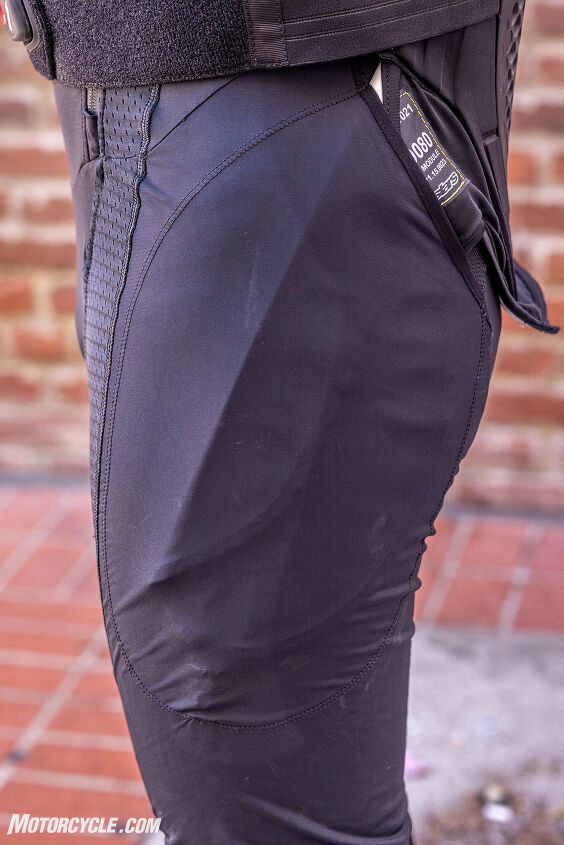
Thankfully, we haven’t had the need to crash test its abilities, but the coverage it provides gives the rider peace of mind knowing they have the most complete amount of airbag protection available. On the downside, sizing can be finicky, as people with broad shoulders may need to move a size up to accommodate. This has a ripple effect of making the leather suit difficult to put on, too. In our opinion, the TA10 is well suited for racing, but can be a bit cumbersome for the street rider.
2. Alpinestars Tech-Air 5 Plasma

The Alpinestars Tech-Air 5 Plasma is the brand’s latest evolution in wearable motorcycle airbags, picking up where the original Tech-Air 5 left off. Building on that vest’s success, the Plasma is offering improved functionality, better comfort, and owner-friendly servicing features. Above all else, the Plasma boasts improved comfort. Built as a slim, lightweight vest that slips under most jackets, the Plasma provides full upper-body protection, covering the chest, ribs, back, and shoulders.
It features three selectable riding modes —Street, Off-Road, and Race — making it adaptable to a wide range of disciplines. The system deploys via a sophisticated array of sensors and algorithms, monitoring the rider’s movements and detecting impacts or crashes in milliseconds. With this design, the Plasma serves as a versatile, all-in-one modular airbag solution, whether a rider is commuting, trail riding, or at the racetrack. We should note that the Tech-Air 5 cannot be mounted via zipper to compatible jackets and suits like the Tech-Air 7X or Tech-Air 10. However, that does mean it can be word with any riding gear that has room to accommodate it.

Technically, the Plasma improves on its predecessor with a complete redesign that makes it about 25% lighter and significantly slimmer. Of course, that will depend on the size of your unit. Troy Siahaan’s medium Tech-Air 5 Plasma weighs in at 3 pounds 9 ounces. Its integrated Nucleon Plasma back protector houses all electronics and sensors in a removable chassis, allowing the vest itself to be hand-washed — something riders will appreciate for long-term use. Construction emphasizes airflow and flexibility, using stretch mesh panels in key areas like the collar, arms, and torso, along with elasticized hems to ensure a snug fit under outerwear and has proven to be far more breathable than its predecessor. The vest uses one replaceable gas canister instead of two, reducing bulk and simplifying post-deployment servicing. Combined, these updates make the system less intrusive, easier to wear across climates, and more practical for everyday motorcyclists.

From a usability standpoint, the Plasma also refines charging and connectivity. It employs a USB-C port for faster, more reliable charging, with battery life offering up to 30 hours of riding time on a full charge and a recharge from empty in about 4 hours. Bluetooth connectivity allows pairing with the Tech-Air app, giving riders access to system status, firmware updates, and mode selection. Physical buttons on the unit are large enough to toggle modes even while wearing gloves. Altogether, the Plasma balances cutting-edge protection with rider-friendly design, delivering lighter weight, improved breathability, customizable functionality, and a level of convenience that makes airbag protection easier to adopt for all types of riders. If you’re looking for a versatile airbag solution fit for riding in any environment, then the Tech-Air 5 Plasma is a wise choice.
3. Dainese Smart Jacket
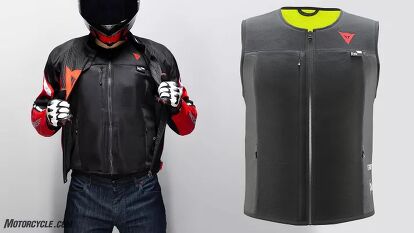
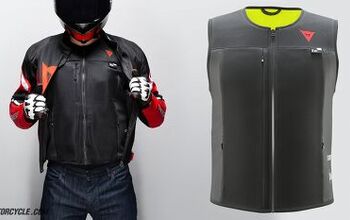
The Dainese Smart Jacket was the first of its kind – a foldable, lightweight airbag vest that can be worn over or under a riding jacket. Previously, Dainese only offered systems built into race suits and various styles of jackets. While it still does offer these options, the Smart Jacket has now been added to its catalog.
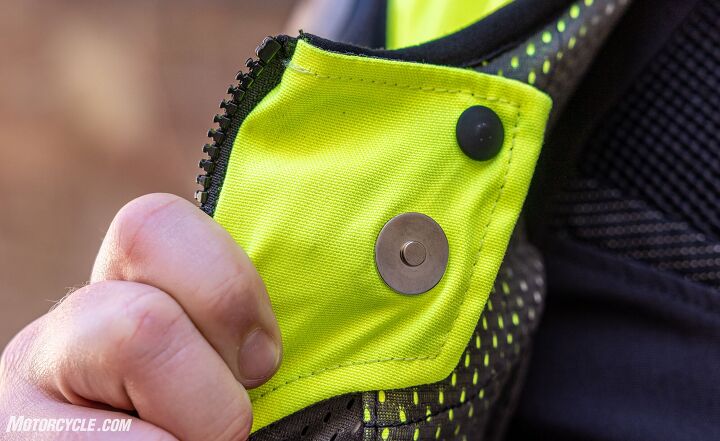
The Smart Jacket’s airbag – which deploys in approximately 45 milliseconds (the average blink of an eye is 100 milliseconds) – covers the back, collar bones, and upper chest and uses microfilament technology. Dainese claims the microfilaments connecting the layers of the airbag help the airbag keep its shape when inflated. The electronics and gas canister are found at either side of the lower back and are contoured to fit around the body comfortably. This design – without a passive back protector – allows the Smart Jacket to be folded although the Hi Viz version seen here uses a thicker, more robust fabric than the black version, which makes it slightly more difficult to fold.
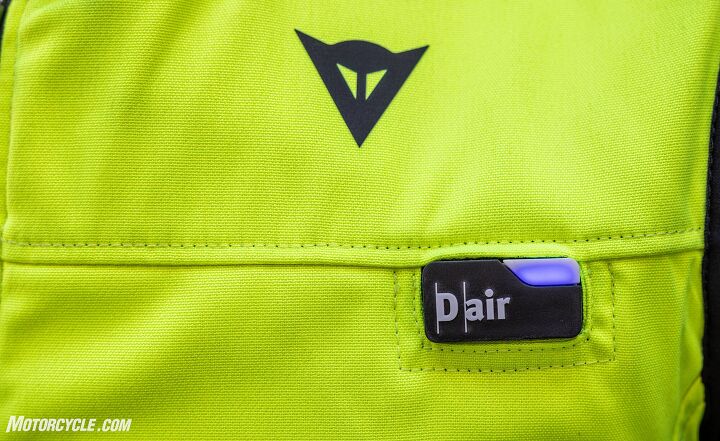
The Smart Jacket seems to run on the small size compared to other systems in this buyer’s guide. A medium is fairly snug and can be worn under most of my jackets comfortably, but is too tight to wear over anything but lighter textile jackets for me. The medium Alpinestars Tech-Air 3 feels just slightly oversized and offers a lot of stretch, which allows it to work well over or under a larger range of jackets. The adjustable elastic waistband in the Smart Jacket helps achieve a comfortable fit, but the lack of any sort of stretch panels in the rest of the vest hampers its versatility. Because of the Hi Viz version’s more durable fabric and tight fit, it doesn’t allow for much airflow. I would say, out of the airbags included here, I’ve found the Smart Jacket to feel the most bulky. Also, the airbag is only good for one deployment, so if you ever find yourself in that unfortunate situation, you’ll need to send the vest back to Dainese USA in Costa Mesa, CA for servicing with an approximate cost of $300.
During normal use the Smart Jacket requires the vibration from a motorcycle’s engine or speeds of 6 mph to arm the system. During my time riding the Livewire One, lack of vibration caused the system to disarm itself when stopped at traffic lights. Evans mentions in his review that he also had a very smooth running ICE motorcycle cause the same issue. Dainese is aware of this and says it’s developing a way to fix this issue currently.
Are motorcycle airbags worth it?
Cost is a somewhat relative thing, isn’t it? For the über wealthy, price is merely a number. For a struggling college student, every penny counts. Save for one jacket on this list, each option below range from $500 and can go beyond $1100. If your financial situation makes you balk at these prices, consider for a moment the cost of an ambulance ride – or worse, a helicopter trip should you crash and hurt yourself in an area an airbag would protect. Either one is an order of magnitude higher than any of the options seen below – and we haven’t even begun to talk about the hospital bill after they fix you. When viewed under that light, these prices are much more amenable.
What is the best motorcycle airbag jacket?
The one you’re wearing. Like virtually any other piece of protective equipment, they don’t do a thing if you’re not wearing them. Different riders will have different qualities they’re looking for. Whether it’s cost, technology, integration with their existing gear, or any number of other criteria, simply calling one airbag jacket or vest “the best” doesn’t cover the nuance of the question. Choose one that fits your needs – then hope you never have to actually use it.
What motorcycles have airbags?
As you can probably imagine, it’s much harder to integrate airbags into motorcycles than it is to integrate them into a car. This is why airbags are something we wear. However, a few different manufacturers have tested airbags on their motorcycles. Most notably, airbags were a feature on certain Honda Gold Wings.
Additional Resources
Recent Updates
- October, 2025: Updated with currently available images. Replaced original Alpinestars Tech-Air 5 with current-generation Tech-Air 5 Plasma.
- March 6, 2024: After additional evaluation and discussion amongst our editors, we have decided to reduce the number of recommendations to three for a better shopping experience. In addition, we have new rankings for our top three recommendations.
- September 2022: Article text and images revised
We are committed to finding, researching, and recommending the best products. We earn commissions from purchases you make using the retail links in our product reviews. Learn more about how this works.
Become a Motorcycle.com insider. Get the latest motorcycle news first by subscribing to our newsletter here.
Ryan’s time in the motorcycle industry has revolved around sales and marketing prior to landing a gig at Motorcycle.com. An avid motorcyclist, interested in all shapes, sizes, and colors of motorized two-wheeled vehicles, Ryan brings a young, passionate enthusiasm to the digital pages of MO.
More by Ryan Adams






Comments
Join the conversation
What about Klim?
For long trips, I would never use an electronic air bag. You better remember to charge it. For some years now, use a Helite Turtle 2 tethered. $25 cartridge to rearm. You can do it on the road. I do have an electronic Helite also that I used to test ride the bikes at are dealership. No worries about tethering or discharge time.