


2025 KTM 450 SMR – First Ride

Supermoto: Your favorite new hobby

There is a single recurring thought when a supermoto of any caliber graces my midst, and it's a simple one: "I should buy a supermoto." After the dust has settled and the thumping single-cylinder din has come to rest, it's easy to take in the audaciously simple design with a grin. After all, we're talking about lightweight motocross or dual-sport motorcycles prepped with road-focused wheels, which always makes for a good time. The class is synonymous with motorcycling's greatest anti-social behaviors, embracing wheelies, stoppies, and backing-it-in as if it were second nature. Within this niche category is an upper echelon of supermoto, which is designed for competition use only. That's precisely where we'll find the generously updated 2025 KTM 450 SMR.
2025 KTM 450 SMR
Looking for a good time? The 2025 450 SMR is a turn-key racing and training solution that can do it all at the kart track. Getcha a bike that can do both, ladies and gentlemen.
Highs
- Incredible Handling
- Punchy single-cylinder engine
- Top-tier chassis feedback
Sighs
- Limited tire options due to wheel size
- It's not street-legal
- The Aggressive map lives up to its name
Thanks to Rokform for making this video possible. Use discount code Moto25 for 25% off at www.rokform.com.
We know the Austrian firm's "Ready To Race" marketing slogan. When viewing its off-road offerings, plenty of models can be plucked directly from the dealership floor and planted on a starting line without a second thought. That reality isn't quite as accurate when peeking at the roadracing side of things. For those of the road-going persuasion, we have the limited edition KTM RC 8C for those lucky enough to get their hands on one. Of course, we're also patiently awaiting the delayed 990 RC R and its anticipated race-ready cousin, the 990 RC R Track edition. Until then, we can greedily rub our hands together at the prospect of a factory-prepped supermoto designed to rip kart tracks a new one.

The 450 SMR's design brief is one that any gearhead can appreciate, especially those who prostrate themselves before the power-to-weight ratio altar. We start with a thoroughbred MX machine, which in this case is none other than the recently refreshed 2025 KTM 450 SX-F ($11,299.00), meaning that it enjoys the same updated tubular-steel frame featuring feedback-improving reliefs for additional flex while cranked over and the same reworked 449cc SOHC single-cylinder engine producing a claimed 63 horsepower. Couple that with its estimated 250-pound running weight, and the party is already pumpin' — KTM claims 239 lbs. without fuel.
Supermoto or MX: What's the Difference?

Converting that package into a supermoto is straightforward on paper: Lower it slightly, enjoy the lower center of gravity, and toss on smaller diameter wheels that'll accept slicks. In this case, Metzeler Racetec K1 slicks. Seems easy, right? There's more to it than that, but that's the gist. Admittedly, the chassis receives a lot of engineering love this time around. Still, the brand took the time to install slimmer footpegs for improved ground clearance at lean while also calibrating the ride modes (Mellow and Aggressive), traction control (on/off), and launch control specifically for the SMR. Stick with the Mellow throttle map because Aggressive is too sharp.
Starting at the front, the SMR features a model-specific triple-clamp with a 16mm offset (the MX bike has a 22mm offset). Those clamps hold onto the updated WP XACT fork with 11.1 inches of travel and damping adjustment. The big news is that the prior generation's WP XACT AER air fork internals have been ditched, and a conventional spring-actuated and oil-damped closed cartridge system is installed. That might seem a little counterintuitive to those familiar with the advantages of an air fork since it is lighter (about three pounds), offers a broader range of adjustment, and has excellent bottoming resistance.

According to brand reps, the SMR didn't necessarily realize the benefits of the AER fork because a supermoto can utilize a little more weight in the front while attacking the tarmac, and bottoming isn't as much of a concern — the jumps simply aren't nearly as big as what an MXer would hit. Owners also commented that the air fork was finicky to set up, bringing us to the closed cartridge's consistency, feedback, and feel benefits.
As for the rear, the fully adjustable WP XACT shock boasts updated damping rates, but its model-specific linkage also goes the same route as the frame, utilizing smaller diameter bolts to increase flex. We've got an ample 10.5 inches of travel, too, and while the swingarm it interacts with is unique to the SMR, the main difference is that it can accept larger tires. The prevailing theme with everything mentioned so far is improved feedback and edge grip, which you'd want from a race-ready steed.

The more obvious changes are with the tubeless wire-spoke Alpina 16.5-inch front and 17-inch rear wheels, while the brakes are beefed up via a Brembo M50 caliper and 310mm rotor. Less obvious is the up-only quickshifter (2nd – 5th gears) and the lusty Suter Racing Products slipper clutch stuffed inside the five-speed gearbox. Taken together, the shorter suspension and smaller wheels also drop the seat height to 35.3 inches – that seems tall, but between the suspension squish and ultra-slim chassis, you'll probably reach the deck.
If you're anything like me, you may think you can finesse your buying strategy, "Why don't I just buy the SX-F and convert it? Then I'd have two bikes in one!" Theoretically, it'd be possible, but it's impractical due to the 450 SMR being $850 more than the MX bike. The slipper clutch alone exceeds that price difference. Then consider suspension, wheels, brakes – you get the idea. Basically, pick a lane.
Riding The Darn Thing

Apex Racing Center fully embraces the two-wheeled contingent and, more specifically, supermoto. The 9/10th-mile kart track features a revamped dirt section that yours truly floundered around for a few minutes, then quickly scampered back to the safety of asphalt.
Hopping aboard the 450 SMR, it becomes painfully apparent this is a purpose-built machine – no keyed ignition, no dash, push the starter button, and off you go. It's remarkably slim compared to any road bike, accentuating the sense of lightness not only there visually but physically.

Let's start with the perky thumper, which has plenty of bark and bite. Cracking the whip and the short-throw throttle delivers a torquey wallop great for pulling out of tight corners, commonly found in the close-quarters environment at a kart track. From there, the smooth yet decidedly zesty powerband latches onto its ample midrange, carrying us through faster sections of track without forgetting all that grunt. As sharp-edged as it suggests, having that inviting low-end adds a bit of forgiveness into the mix, allowing riders to carry a gear too tall and get away with it for the most part. At the other end of the spectrum, there's plenty of overrun to play with if needed. It's a fierce little thing and wickedly entertaining. Again, the Mellow throttle map is my favorite, and fueling is sweet.
Slotting into gears is done with the aid of the up-only quickshifter, which those coming from road bikes will probably find a touch slow to react when compared to what’s found on road-going KTM models. It plays out as needing to be a little more deliberate with your shifts, this is by design because you don't necessarily want a shifter that'll activate from any light tap while bouncing around in a dirt section. Backing down through the gearbox is slicker than snot, thanks to the Suter slipper clutch. That excellent unit helps keep things tidy while downshifting aggressively into those hard braking zones and can take whatever abuse you throw at it.

The star of the show is the lightweight chassis, giving riders all the leverage they need to toss around its 250-pound running weight with near reckless abandon. What comes through that recently reworked frame is arguably some of the clearest communication you'll feel from any motorcycle on the market, save for race-spec machines like the Krämer EVO2-690 platform, that still don't match it. Every slip, shimmy, or jitter that might spell disaster when hard on the brakes or grabbing a fistful of throttle comes through the SMR like a megaphone. And that's why these are excellent training tools for roadracers, let alone a wise solution for anyone wanting to compete in supermoto events.
It'd be tough to say that the new frame is better than the previous iteration without making a direct back-to-back comparison, but whatever KTM has done is working, full stop. Running the bike without TC shouldn't make anyone wince, as the mechanical grip is plentiful, along with the help of the sticky German rubber. It flicks through chicanes with lightning quickness, and that 16.5-inch front wheel helps it steer with scalpel-like precision. The wheel sizing is unorthodox in street bike terms. However, its reasons are justified: a smaller diameter wheel encourages cornering via less gyroscopic penalties. More importantly, KTM staffers also cite a tall tire profile, putting a bigger contact patch on the ground. It does mean your tire options narrow, though everything is a compromise, right?

There is a bit of an acclimation period for those coming directly from conventional road bikes. Suspension on our street-aimed machines usually isn't this lengthy, creating much more pitch and squatting than expected. It's all part of the game here, with the suspension striking an excellent balance between holding up under the rigors of kart track abuse while remaining composed as it works through the stroke. It just rips, folks. And while we are on the suspenders subject, I did take it for a jaunt in the dirt section. Any minor launch I achieved was met with quite the cushy landing. It's not my forte and something I'll want another crack at simply because it was fun.
The same can be said of the riding position. The SMR is slim between the knees, meaning you'll want to drive through your legs and support yourself, as it's easy to death-grip the wide motocross bars otherwise. That raises the question of knee-down or leg-out riding styles, which is the beauty of supermoto. The answer is: the choice is yours. Do whatever you're most comfortable with and what applies to your training.

Brembo provides the stopping power, and the SMR bolts on a radial master cylinder for its speeder purposes; the rear brake is essential during off-tarmac excursions or when trying to slide into corners. Feel at the front lever is good and stopping power is plentiful, although I'd probably swap to more aggressive pads if it were my name on the pink slip.
Few motorcycles are this focused straight from the factory; then again, few bikes are this exciting. Yes, it's a niche product for a niche audience. It's a purpose-built supermoto racebike with racebike maintenance schedules listed not in miles, but in hours. That's fine; that's what it's supposed to do, and it has the performance to back it up — engine, chassis, suspension, you name it. But what keeps coming back to me is how insanely fun this thing is; in the end, that's what motorcycles are all about, anyway. So, here I am, telling myself again, "I should buy a supermoto.”

Scorecard
Engine | 19/20 | Suspension | 14.5/15 | Transmission | 8.5/10 |
Brakes | 9/10 | Instruments | 4/5 | Ergonomics | 9/10 |
Appearance | 10/10 | Desirability | 10/10 | Value | 9/10 |
Editors Score: 93.0% | |||||
In Gear
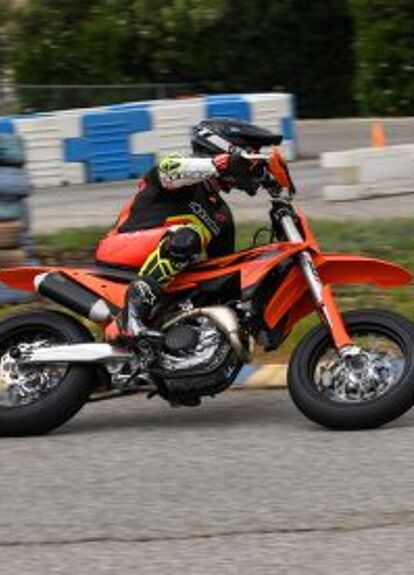
- Helmet: Shoei VFX-Evo
- Suit: Alpinestars GP Tech V4
- Airbag: Alpinestars Tech-Air 7X
- Gloves: Alpinestars GP Tech V2
- Boots: Alpinestars SuperTech R
2025 KTM 450 SMR Specifications | |
|---|---|
Engine Type | Single Cylinder, liquid-cooled 4-stroke, SOHC, four valves controlled by rocker arm |
Displacement | 449.9 cc |
Bore x Stroke | 95 x 63.4 mm |
Compression Ratio | 13.6:1 |
Starter/Battery | Electric Starter / 12.8V, 2 Ah |
Fuel System | Keihin EFI, 44 mm Throttle Body |
Lubrication | Pressure lubrication with 2 oil pumps |
Silencer | Aluminum |
Clutch | Wet multi-disc SUTER clutch, Brembo hydraulics |
Transmission | 5 speed, claw shifted |
Primary Ratio | 29:72 |
Final Drive | 14:46 |
Chain | 520, Non-sealed |
Ignition | Keihin EMS |
Frame | Central Double-Cradle Type 25CrMo4 Steel |
Sub Frame | Aluminum reinforced Polyamide |
Handlebar | Neken, Aluminum Ø 28/22 mm |
Front Suspension | WP XACT USD Closed Cartridge, Ø 48 mm, 11.1 inches of travel |
Rear Suspension | WP XACT Monoshock with linkage, 10.4 inches of travel |
Front Brakes | Single radial-mount four-piston fixed caliper with a 310 mm floating disc brake |
Rear Brakes | Single single-piston floating caliper with a 220 mm fixed disc brake |
Front Rims | 3.5 x 16.5"; 5 x 17" ALPINA |
Rear Rims | 3.5 x 16.5"; 5 x 17" ALPINA |
Front Tire | 125/75 R16.5 |
Rear Tire | 165/55 R17 |
Steering Head Angle | 26.1° |
Triple Clamp Offset | 0.6 inches |
Wheelbase | 57.9 ± 0.4 inches |
Ground Clearance | 11 inches |
Seat Height | 35.3 inches |
Fuel Capacity | 1.9 gallons |
Weight | 239.8 pounds (without fuel, claimed) |

We are committed to finding, researching, and recommending the best products. We earn commissions from purchases you make using the retail links in our product reviews. Learn more about how this works.
Become a Motorcycle.com insider. Get the latest motorcycle news first by subscribing to our newsletter here.
A lifelong interest in anything with two wheels, Nic combined his passion for motorcycling with a rare and mysterious skill known as typing to join the motojournalism ranks. Motorcycle.com's Senior Editor and sometimes club racer displays an unrivaled desire to sample baked goods across the globe and partake in post-track day celebratory pizza.
More by Nic de Sena





Comments
Join the conversation
Ready for a go-kart track near you! Personally, a DRZ 400 SM is probably perfectly adequate for most people. 250 pounds and 63 hp would be a hoot, but it could easily get you into trouble if you know what I mean.
Can't refer to KTM as a Swiss company any more. Part Swiss perhaps. This bike is only for folks with lots of toys like toy haulers and cash to burn and not for the everyday Joe or Jane. There are better choices noted here in the comments.