


In Gear: Alpinestars Tech-Air 5 Plasma Review

A complete redesign of the Tech-Air 5 is slimmer, lighter – and has an off switch!

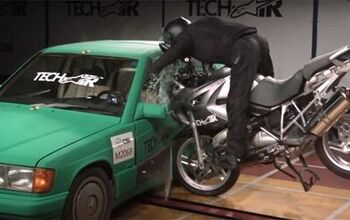
If you’ve followed the MO pages for a while, you’ll know our collective stance on airbags. However, for those new to these parts, let’s get you up to speed. In late 2022 I was hit by a car. I flew over the bars, somersaulted in the air, landed on my upper shoulders/lower neck area, and did another somersault or two before coming to a stop. I was able to walk away with nothing more than some soreness and bruising, and I credit much of that to the airbag I was wearing. That airbag? The Alpinestars Tech-Air 5. Since then airbags have become mandatory whenever I ride.
Video: Alpinestars Tech-Air 5 Plasma
The Tech-Air 5 has proven itself to be a convenient do-it-all airbag for a lot of riders, but it wasn’t without its faults. Many complained about a lack of airflow through the vest, while others also bemoaned the bulkiness of the overall system. Others hated the single-use nature of the airbag and the need to send it back to Alpinestars to re-pack. Universally (or at least it seems), everyone scratched their heads as to why there wasn’t an off switch when not using the airbag or when storing the airbag away.

With the new Tech-Air 5 Plasma, Alpinestars has heard your complaints and addressed virtually all of them. This complete redesign of the Tech-Air 5 platform aims to make it not only more comfortable to wear but also more user-friendly. Maybe best of all is the overall ownership experience versus the previous Tech-Air 5 will end up costing you less in the long run. But more on that later.
Before we get started, let’s first mention that this review won’t get into the details of how the Tech-Air system works. That topic has been covered numerous times. Our review of the Tech-Air 5 covers the logic and the hardware behind the system, and of course you can also read about how it works in a real crash scenario – mine. The sensors and algorithms that power the Tech-Air 5 Plasma are all the same as before, except for one major difference: all the sensors and electronics are housed within the removable back protector. Previously, sensors were placed in the shoulders as well as the back protector. None of which were removable.
A New Experience

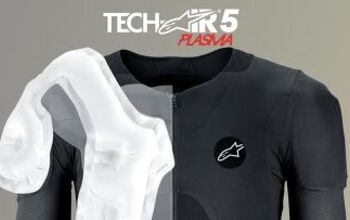
It’s commonplace to say version 2.0 of something improves upon the weak points of its predecessor, but it’s more than just marketing with the Tech-Air 5 Plasma. Not only is it 25% lighter than the old TA5 at just over 3.0 lbs (making it the lightest Tech-Air in the entire range), but it’s also much slimmer.
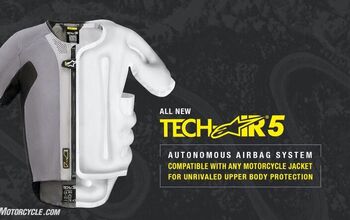
Before getting into both of those aspects, however, let’s talk comfort. As part of the redesign of the system, the airbag itself was re-thought. You still get coverage in the same areas you did before – collarbones, sternum, ribs, and back – but the overall chassis is made with a stretchable, more breathable material. Also, the fine-tuning of the airbag’s shape leaves more room for a thinner, more stretchable, and breathable mesh material in the collar, lower stomach, underarms, and biceps. Elastic fitment at the ends of the sleeves and bottom of the vest allow it to hug tighter to the body, move around less, or bunch up under a suit or jacket.

Like before, a magnetic activation system turns on once you zip the vest closed, while haptic feedback from the LED panel also tells you it’s on.
A major contributor to the slimmer profile compared to the old Tech-Air 5 is the integrated Nucleon Plasma back protector. Not only is the Plasma protector physically thinner than the previous back protector, it’s more flexible and malleable while still meeting CE level 1 standards. It’s also super easy to remove, and doing so means you’re left with a bare vest with no electronics in it, in the event you want to wash the vest. That said, Alpinestars recommends hand washing and letting it air dry. Don’t toss it in the washing machine.
User-Friendly Features

The big news with the Tech-Air 5 Plasma is the ability to change your own canisters, like the Tech-Air 7X and Tech-Air Off-Road systems before it. But this is also an area where Alpinestars saved weight. Previously, the Tech-Air 5 used two canisters to inflate the airbag. The Plasma reduces that number down to one canister (and no, the canisters are not interchangeable between systems due to the volume of each respective airbag and the speed they need to inflate). Nonetheless, accessing the canister is easy, as it sits inside the back protector underneath a cover held in place with Velcro. Replacing a canister takes 30 seconds, and as long as you remember “lefty-loosey, righty-tighty,” you’ll be back on your way in no time (see the embedded video for a demonstration). Alpinestars says the airbag itself is good for six(!) deployments before they recommend sending it back for inspection and possible replacement. No other Tech-Air system is rated for so many deployments before inspection. Should you want to test the system at any point, an included pressure test valve is also included, allowing you to remove the canister, install the valve, and inflate the system with a bicycle pump to test for leakage.
Ever since the original Tech-Air Race system was introduced in the late 20-teens, riders have wondered why successive airbags didn’t have an off switch. Well, finally, the simple switch has returned! Located next to the canister in the Tech-Air 5 Plasma you’ll find an On/Off switch for those times you won’t use the airbag for extended periods. Otherwise, it’ll switch off when the magnets stop making contact when it’s unzipped. Alternatively, a long press of the button on the control panel will turn the system off and haptic feedback (vibrations) will indicate the system is powering down. Alternatively, if you're wearing the TA5 under off-road gear and can't access it, a long period of inactivity *should* power down the system (say, for a trailside snack break), but this is all the more reason to reach for the button on the front and give it a long press.

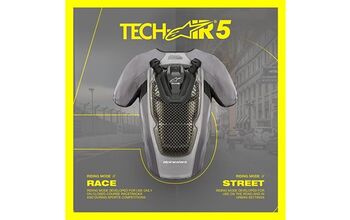
There are other noteworthy features of the Plasma, of course. The next being the ability to switch between not two, but three different modes: Street, Track, and now Off-Road. Being able to hop back and forth between Street and Track is nothing new, but the addition of the Off-Road mode brings another element for riders who do a little bit of everything and are looking for one airbag system to handle it all. To be clear, Off-Road mode is meant for trail riding and Adventure bikes, not extreme off-road riding like Motocross (there’s a separate system on the horizon for that).
Unlike in past Tech-Air iterations, switching between modes is no longer done via a phone app, but instead through a control panel on the front of the vest. Here you’ll find three LEDs that indicate which riding mode you’re in, as well as a fourth LED to indicate battery status. Modes are switched by simply pressing the button in the middle for two seconds. Once you release the button, the panel will vibrate indicating a change is happening, and the indicator light will switch modes. You keep pressing the button like this until you land on the ride mode you want. The Tech-Air app remains though, so you can check the system status in greater detail, get software updates, and/or track your ride.

At the front of the control panel is the charge port that uses a USB-C cord. No longer do you have to finagle a charger to the back of the vest. Now it’s easily accessible on the front. A full charge from a completely dead battery takes about four hours and nets you 30 hours of actual riding time.
Alpinestars has developed the Tech-Air 5 Plasma while keeping the cost the same as the previous Tech-Air 5 – $789.95 (Editors note: the Tech-Air 5 Plasma MSRP has increased to $829.95, as of August, 2025). Replacement canisters will cost $119.95. However, unlike before, where you had to send the airbag back to Alpinestars after each deployment, the fact you can do it yourself will save you money and get you back on the road faster.
Riding With It

The key to any piece of safety gear is comfort. No matter how advanced or protective a piece of gear may be, if it’s too uncomfortable to wear, then what’s the point? It’s not like I had many complaints about the previous Tech-Air 5, but I did note how it was a little bulky, especially the sleeves. Then, of course, there’s the overall width of the old TA5. This wasn’t such a big deal inside of a loose riding jacket, but it was annoying when worn under a suit or sport-oriented jacket.
I learned to accept both, but for a time I reverted to wearing the REV’IT! Avertum airbag, which is essentially a rebadged TA5 licensed to REV’IT! but with some small changes. The Avertum had a slightly slimmer profile, but my main attraction to it was the form-fitting sleeves with elastic at the end. This proved more comfortable, but the cut was a little tight and restrictive in the armpit area. This wasn’t a big deal for short rides or track sessions, but you felt it at the end of a touring ride.

With the Tech-Air 5 Plasma, once I put it on I forgot it was there. The reason is comfort. The revised fitment and added stretch throughout the vest makes it more form-fitting. It sounds weird to point this out, but the Tech-Air 5 Plasma’s new stretch panel size and placement, give the arms lots more freedom to move and don’t feel tight in the armpits. That’s a big deal when you’re moving from side to side on a bike or even when you’re burning hundreds of miles in a day.
Alpinestars wanted to give us a taste of the different riding environments the TA5 Plasma was built for, so we went on a quick jaunt on the street, in the dirt, and on the track to experience the flexibility the new system offers.

Aside from the comfort aspect mentioned earlier, a simple button press to change the ride modes is a big improvement over having to do it through the app. Armed with an adventure jacket for the street and dirt portions, the slim nature of the vest reduced the bulk underneath the jacket and gave room to pile on additional warmth layers. Speaking of which, it was a little chilly on the morning of our ride, so I kept the (limited) vents closed on my jacket. A true test of the airbag’s breathability will have to come later in the year when the weather warms up.
As far as track riding goes, the big annoyance when putting on an airbag with leathers is the dreaded “ride up” when hurling the suit over your shoulders. With the airbag on, the moment you try to put the suit on over your shoulders, the whole vest and built-in back protector will “ride up” with your suit and block the suit from settling into place. This is the point where you either squirm around trying to push the back protector portion of the airbag down into place, or yell for help from a friend (or pit neighbor) to push it down for you.

The form-fitting nature of the Tech-Air 5 Plasma, as well as the elastic ends to the sleeves and chassis, help it stay put when putting on a suit, but the problem still remains. It’ll still ride up, just not as much. I was able to squirm around and tilt my head backwards to push it back into place, but others weren’t so lucky. It seems as though the winning formula is still to place the airbag inside your suit first and then put the whole thing on together. Both the Tech-Air 7x and Tech-Air 10 can be mounted inside certain suits, making them more convenient.
Otherwise, once the suit was on and I was out on track, the same comfort sentiments from before apply. Extreme body positions that are common when track riding were no problem, and the slimmer profile made it easier for me to wedge an external chest protector between the suit and the vest. You don’t have coverage over the tail bone like you do with the Tech-Air 7x, but that’s a small price to pay, methinks.
An Airbag For All

The majority of riders who have accepted airbags into their gear profile don’t want to have several different kinds to suit the type of riding they do. For them, the Tech-Air 5 Plasma is hard to overlook. Unless you live for the next gate drop and hammering the whoops, the new TA5 can handle it all. From commuting during the week, to weekend trackdays, and even the odd jaunt off-road, the combination of comfort, protection, and value is all there. It’s hard to fault it, but if there was one area to knock it, you could ding it for not being wearable over your jacket like the Tech-Air 3, but talk about splitting hairs. Overall, I’d say we have a winner.
The Tech-Air 5 Plasma is available in sizes XS to 4XL, and Alpinestars says it’s designed to be a unisex fitment, so no Stella version is needed for female riders.
- Price: $829.95
- Colors: Black
- Battery life: Up to 30 hours
- Sizes: XS to 4XL
- Certification: Category II Certified PPE (Full Vest), EN1621-2:2014 Level 1 (back protector), EN 1621-4:2013 Level 1 (inflatable protector)
We are committed to finding, researching, and recommending the best products. We earn commissions from purchases you make using the retail links in our product reviews. Learn more about how this works.
Become a Motorcycle.com insider. Get the latest motorcycle news first by subscribing to our newsletter here.
Troy's been riding motorcycles and writing about them since 2006, getting his start at Rider Magazine. From there, he moved to Sport Rider Magazine before finally landing at Motorcycle.com in 2011. A lifelong gearhead who didn't fully immerse himself in motorcycles until his teenage years, Troy's interests have always been in technology, performance, and going fast. Naturally, racing was the perfect avenue to combine all three. Troy has been racing nearly as long as he's been riding and has competed at the AMA national level. He's also won multiple club races throughout the country, culminating in a Utah Sport Bike Association championship in 2011. He has been invited as a guest instructor for the Yamaha Champions Riding School, and when he's not out riding, he's either wrenching on bikes or watching MotoGP.
More by Troy Siahaan






Comments
Join the conversation
Good article, looks like I'm going to have to sell my Tech Air 5 1.0 and grab this one!
Hmmm, so this provides more comfort, but less protection than the previous tech air 5?
I don't wear an airbag for comfort.. Protection is way more important to me 🤔